
What is Cybersecurity?
Cybersecurity is the practice of protecting computer systems, devices, networks, and data from unauthorized access, disruption, manipulation, or theft. At its core, this discipline exists to ensure that digital systems behave as expected: doing what they're supposed to do, only when they're supposed to, and never anything they're not. NIST and ISO/IEC 27032 both frame it as a combination of technologies, processes, and people. In other words, it is not a static shield, but an ongoing practice applied across everything from personal devices to national infrastructure.
The meaning of cybersecurity itself traces back to cybernetics, the 1940s science of control and communication systems. As computers became globally networked, “cyberspace” entered the vocabulary, with the term “cybersecurity” following it.
There are three related terms that often get confused. Information security is the broadest one and it refers to protecting information in any form, be it digital or physical. Cybersecurity definition places it as a subset focused on digital ecosystems, such as systems, networks, apps, the data that is within them. IT security is narrower still, typically describing the operational protection of an organization's technology infrastructure.
Underlying all three is the CIA Triad, shorthand for Confidentiality, Integrity, and Availability, which has served as the foundational model of the field since the 1980s. Every security decision ultimately comes back to preserving these three properties and balancing the tradeoffs between them.
Why Is Cybersecurity Important?
A cybersecurity failure rarely stays contained for long. Someone loses access to a bank account. A hospital system goes offline. A company stops shipping orders because internal systems can no longer be trusted. What begins as a technical incident quickly becomes a business problem, a financial problem, or, in some cases, a public safety problem.
Between 2015 and 2020, most organizations were thinking in terms of office networks and company-owned devices, but that boundary is much thinner now. Today, data is in constant movement between cloud services, remote employees, contractors, personal phones, third-party vendors, and even external platforms that the organizations themselves are not in full control of. The attack surface expanded quietly, mostly in the name of convenience and speed.
What didn't change is how serious the consequences are, greatly surpassing purely technical aspects. For example, a serious incident can have a multitude of grave repercussions. It can halt operations, it can also expose years of customer data, and, even worse, it could trigger GDPR or HIPAA penalties. Maybe the most feared one is the loss of trust from customers, something that is difficult to repair even years after the incident. Even when systems are restored relatively quickly, an organization might still spend years dealing with the reputational and legal fallout.
The importance of cybersecurity is usually associated to private companies, but power grids, transportation networks, hospitals, financial systems, and public services also rely on digital infrastructure operating continuously and reliably, with catastrophic consequences when their security fails. That is why cybersecurity awareness, practical cybersecurity tips, and long-term cybersecurity solutions have become part of operational resilience rather than purely technical administration.
The Cost of Cybercrime
Cybercrime impact can be measured in several ways: breach costs, reported victim losses, economic damage projections at a broader level, etc. Although these tell different stories, the direction they usually point to is the same.
According to IBM’s Cost of a Data Breach Report 2025, the global average cost of a data breach reached USD 4.44 million per incident. In the United States, the average rose to USD 10.22 million. IBM also reported an average breach lifecycle of 241 days to identify and contain an incident. An organization can remain compromised for the better part of a year without realizing it.
There are certain sectors that traditionally absorb heavier losses: an average 2025 breach cost USD 7.42 million in healthcare and USD 5.56 million in financial services. What differs in these sectors is that downtime, regulatory exposure, data protection obligations, and other factors can create overlapping costs because of frameworks such as HIPAA, GDPR, PCI DSS, among others.
The FBI Internet Crime Complaint Center (IC3) recorded USD 20.9 billion in reported cybercrime losses in the United States during 2025, and this was the first time the figure exceeded USD 20 billion.
Types of Cybersecurity
When looking at the broader architecture of digital defense, there is no single, fixed canonical list of categories. Search queries often ask about five or seven specific pillars, but practitioners view the field through a fluid matrix of major commonly recognized categories. Because modern data travels across complex paths, breaking down the primary types of cybersecurity helps organizations deploy targeted cybersecurity solutions rather than relying on a single defensive line.
Below are some core specializations that provide a look at how modern security functions across different environments.
|
Domain |
Focus & Scope |
Real-World Example |
|
Network Security |
Secures the digital perimeter and transit pathways connecting internal systems. It uses traffic analysis, architecture segregation, and boundary controls to block unauthorized entry. |
A major retailer preventing a remote intruder from pivoting out of a guest Wi-Fi network into corporate checkout lanes. |
|
Protects data, applications, and virtual infrastructure hosted in off-premise environments. It manages shared responsibility models between companies and vendors to fix structural misconfigurations. |
A banking application running on public infrastructure configuring real-time posture assessments to stop open, public database access. |
|
|
Application Security |
Focuses on hardening software code throughout development and deployment to minimize vulnerabilities. It embeds safety protocols directly into development pipelines to ensure the application cannot be manipulated. |
A streaming platform auditing its source code to prevent an exploit from leaking premium subscriber session cookies. |
|
Defends individual user-facing machines that connect directly to an enterprise network. It monitors laptops, workstations, and corporate servers to detect and isolate local anomalous behaviors. |
A field technician's laptop that is used on multiple client sites gets flagged and quarantined automatically before a suspicious process reaches shared corporate drives. |
|
|
Determines which users, devices, and services can reach a certain system; it also enforces those boundaries continuously (not just at login). |
An insurance firm revoking a departing contractor's access credentials across all internal databases the moment their contract expires. |
|
|
Security Operations & Incident Response |
Watches for anything unusual across systems, investigates when something looks wrong, and responds before it becomes a bigger problem. |
A dedicated security operations center actively cutting off a live, unauthorized lateral network movement at 2:00 AM. |
|
Data Security |
Focuses on the information more than on the infrastructure that holds it, so that wherever that data travels, encryption, access controls, and monitoring for unusual data movement apply to it directly. |
An enterprise classification engine discovering and automatically locking down unencrypted files containing raw corporate payment records. |
|
Disaster Recovery & Business Continuity |
Defines the processes and technical workflows required to maintain operations during an active crisis. It details exactly how an organization recovers functionality and spins up clean environments after infrastructure failure. |
A regional utility company running simulated network restores to guarantee its customer database can recover within two hours. |
|
Addresses the unique vulnerabilities associated with handheld consumer form factors. It separates corporate environments from personal applications on employee devices to prevent data leakage. |
An employee that uses a personal phone to access corporate email might not be aware that the devices is now part of the organization's security environment, whether formally managed or not. |
|
|
IoT & Smart Device Security |
Most Internet of Things devices (sensors, cameras, hospital equipment, factory controllers, etc.) were designed to work often weakly secured. Default credentials, unpatched firmware, and no update path are still the norm rather than the exception. |
A hospital isolating connected heart-rate monitors on a separate subnet to prevent tampering with patient vitals. |
Common Cybersecurity Threats
Analyzing how modern adversaries exploit network vulnerabilities requires a fundamental shift in perspective. Today, types of cyber attacks are heavily characterized by stealth rather than overt disruption. Data from Cybersecurity Assessment Report highlights a tactical pivot, as 84% of major attacks involved Living Off the Land (LOTL) techniques. Rather than deploying easily flaggable malicious code, attackers increasingly clear a path by “logging in instead of breaking in,” abusing trusted, native administrative utilities like PowerShell, WMI, and RDP to blend seamlessly into standard operational traffic.
The line between normal activity and an active attack becomes increasingly blurred and traditional threat categories today often overlap with these techniques:
- Malware and Ransomware: Malicious software built to infiltrate, spy on, or take control of systems, including viruses, worms, spyware, and trojan horses. Modern ransomware has grown well beyond file encryption: attackers now steal data, destroy backups, and use LOTL techniques throughout, making recovery harder regardless of whether a ransom is paid. Ransomware is ranked among the top three incidents experienced by organizations across every surveyed country, affecting 39% of U.S. respondents and 36% in Germany.
- Phishing and Social Engineering: Deceptive messages are the main way that people are tricked into revealing their credentials or giving access to threat actors. In fact, in the Verizon 2025 DBIR, the human element was in roughly 60% of breaches, making cybersecurity awareness as important as technical controls.
- Business Email Compromise (BEC): A highly targeted fraud in which executive or trusted vendor impersonation is used in order to hijack financial transfers. According to the FBI Internet Crime Complaint Center (IC3), BEC remains one of the costliest financial vectors, with $2.77 billion in reported losses in 2024 alone.
- Supply Chain Attacks: Instead of directly targeting the company, a vendor, software provider, or an open-source dependency is compromised in order to reach the real target through a back door. According to the Verizon 2025 DBIR, third-party involvement in breaches doubled in a single year, rising from 15% to 30%.
- Zero-Day Exploits: Target vulnerabilities the vendor doesn't know about yet or knows, but hasn't patched properly. There's no signature to detect, no fix to apply, and no warning before the damage is done.
- Denial-of-Service (DoS) and DDoS: A target is flooded with more traffic than it can handle until it goes offline. Can reach astounding power, like the AISURU botnet (assembled from compromised home routers) that launched a record-breaking 22.2 Tbps attack.
- Man-in-the-Middle (MitM) Attacks: A third party sits between two communicating endpoints and reads or alters the exchange without being noticed, the most common example being the harvesting of credentials passed through an unencrypted public Wi-Fi.
- SQL Injection: Web applications sometimes don't properly validate user input and this is used by attackers to trick the server into running malicious database commands, like in the 2023 MOVEit Transfer breach that exposed data at hundreds of organizations before the vulnerability was discovered.
- Insider Threats: Security incidents sometimes start from an insider such as an employee, a contractor or a partner who misuses their access or exposes data through poor habits, mistakes or even deliberately.
- Advanced Persistent Threats (APTs): These are long-running intrusion campaigns characterized by the fact that they prioritize staying hidden. Typically performed by nation-state actors or well-funded criminal groups with the goal of intelligence gathering or data theft done over months or years in most cases.
- AI-Related Cyberthreats: AI tools are increasingly used to accelerate and scale attacks and the growth in prevalence is striking: 67% of security professionals report witnessing an increase in AI-powered attacks through automated malware development and deepfake impersonations.
For many of the categories above, technical sophistication is important, but less than people assume, considering that phishing exploits trust and BEC exploits routine. That's probably why, according to the Bitdefender Cybersecurity Assessment Report 2025, 68% of security leaders now say reducing the active attack surface is their priority, as the greatest threats often look like normal activity.
How Cybersecurity Works
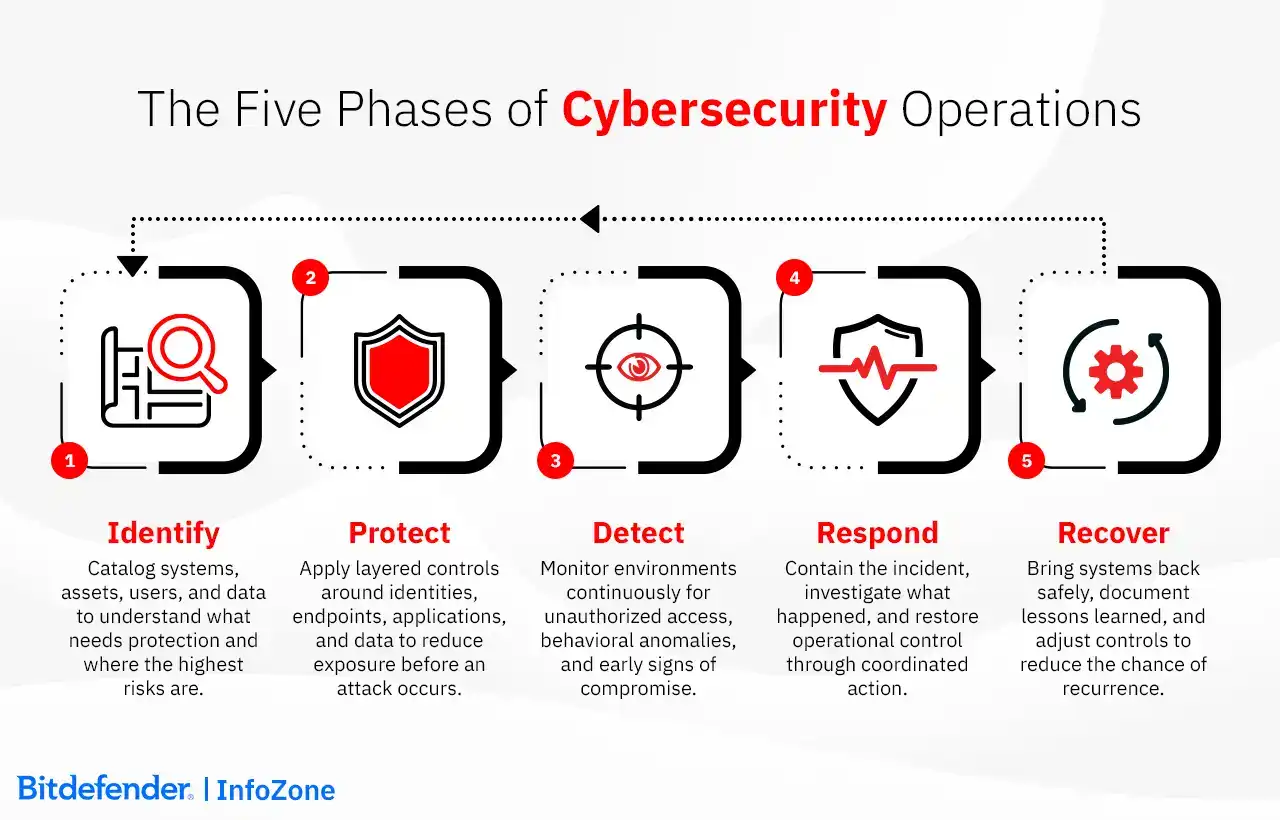
No single control stops every attack. Credentials get stolen, software contains undiscovered vulnerabilities, and trusted systems get compromised. This is why cybersecurity works through layers. This approach is called defense-in-depth, the idea that the failure of one control doesn't mean the failure of everything behind it. Most mature programs, including the NIST Cybersecurity Framework, organize this into five operational phases.
- Identify - understand what systems, assets, data, users, and external connections exist, then assess which areas carry the highest risk.
- Prevent - reduce exposure through layered safeguards around systems, identities, applications, and data.
- Detect - monitor environments for signs of unauthorized access, abnormal behavior, or suspicious activity.
- Respond - contain incidents, investigate what happened, coordinate communication, and restore operational control.
- Recover - restore systems and services safely while learning from the incident to reduce the chance of recurrence.
Zero trust architecture applies this layered logic at the identity level. It treats every access request as unverified regardless of where it originates. Cybersecurity software and cybersecurity services support different phases of this cycle, but the cycle itself is what defines how resilient security actually works.
Top 10 Cybersecurity Best Practices
Most security incidents can be traced back to gaps that were known and fixable and below are cybersecurity tips that address the most common ones.
- Enforce strong password and passphrase policies. Weak and reused credentials are some of the most consistently exploited entry points. By requiring long, unique passphrases per account (length protects better than complexity) and the use of a password manager makes compliance much more practical.
- Introduce multi-factor authentication (MFA). When a password is stolen and that allows foreign access to important accounts, the consequences can be devastating. MFA can prevent the vast majority of automated credential attacks. Also, when possible, prioritize phishing-resistant methods for high-risk accounts.
- Apply patches and updates as fast as possible. Mandiant's M-Trends 2025 Report found that vulnerability exploitation was the most common initial access method for the fifth consecutive year and most of those vulnerabilities were already patched. Prioritize internet-facing and high-criticality systems.
- Maintain data backups and make sure that they are tested. Use the 3-2-1 principle which states “three copies, two storage types, one offline”. Recovery needs to be tested regularly because a backup that's never been restored is a backup that might be unreliable.
- Segment networks & critical systems. When infrastructure is divided into zones, one compromise in a certain area can't spread freely. Especially sensitive data, operational systems, and guest access should be kept on separate segments.
- Make sure the Principle of Least Privilege (PoLP) is applied. In other words, users, accounts, and apps only need access that they genuinely require. This involves auditing permissions regularly, and revoking access when roles change, in line with zero trust architecture.
- Develop & test an incident response plan. Before an actual incident makes visible the gaps inside your organization take the steps necessary for a functional response plan: roles are defined across technical, legal, and communications functions, containment and escalation paths are documented. Also, rehearse through tabletop exercises.
- Encrypt data in transit and at rest. Whether it is data that moves across networks, is stored on devices and databases, or held in backups, it needs encryption, especially on portable devices where physical loss is a genuine risk.
- Manage third-party and supply chain risks. This can be done through assessing vendor security before onboarding, limiting external access, and clarifying responsibilities in cloud environments.
- Train users to recognize phishing and social engineering. Human error is a key factor in such a significant number of incidents that no technical controls can truly compensate lack of knowledge inside the workforce.
Cybersecurity Compliance and Regulatory Requirements
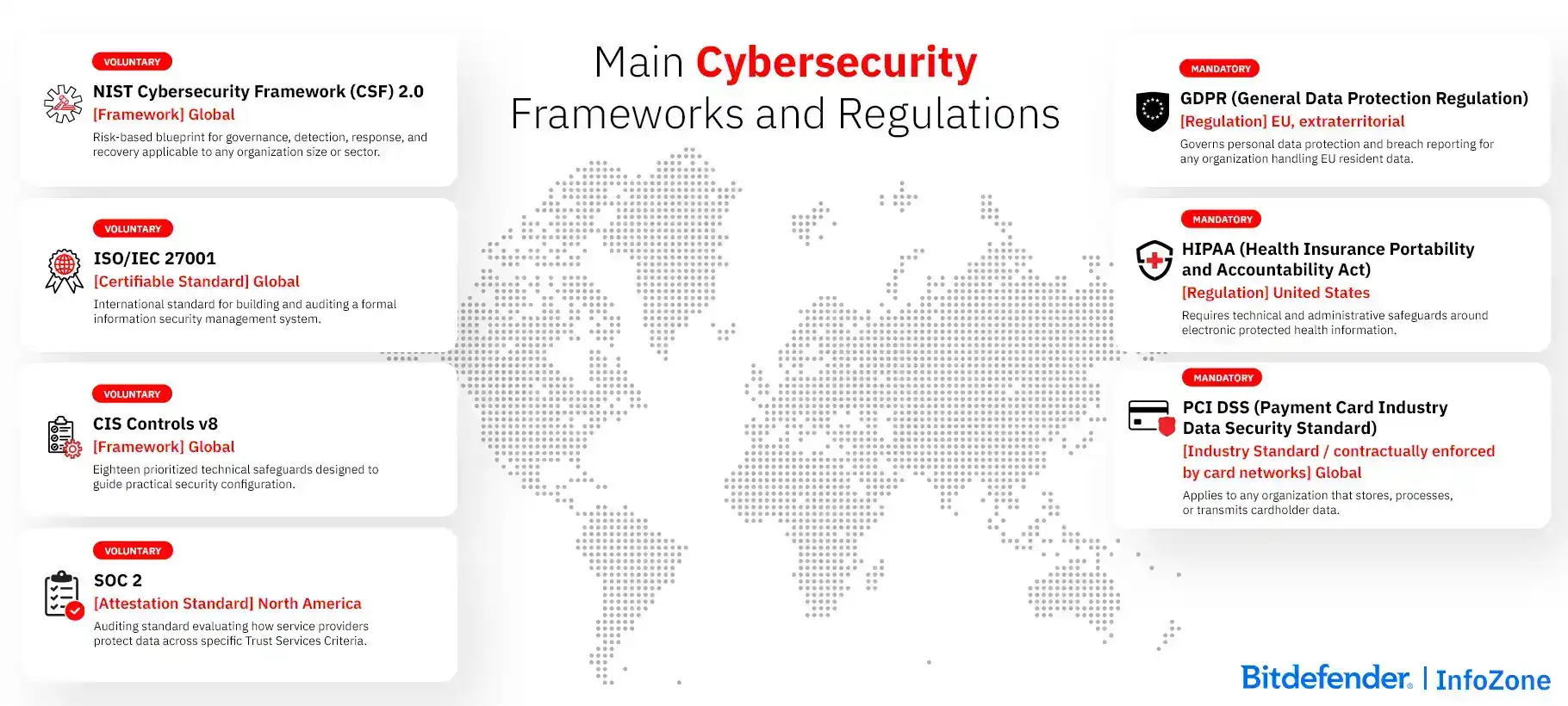
Cybersecurity compliance refers to the fact that organizations must follow certain legal, regulatory, as well as industry obligations when handling data, in most cases, sensitive data such as financial, healthcare, or related to payment systems. The exact requirements depend on the type of data involved, but also the industry sector and its geography. Some of the most widely recognized include:
- GDPR is the EU regulation that governs personal data protection and breach reporting obligations. It refers to organizations that handle data that belongs to EU residents.
- HIPAA is a U.S. healthcare regulation requiring safeguards around electronic protected health information (ePHI).
- PCI DSS is the payment card industry standard applying to organizations that store, process, or transmit cardholder data.
- SOX is a U.S. law requiring public companies to maintain reliable internal controls around financial reporting and digital records.
- CCPA (California Consumer Privacy Act) is a privacy law giving consumers greater control over how businesses collect and use personal information.
Compliance and security are closely related, but they are not the same thing. A compliant organization may still be vulnerable if controls exist mainly for audit purposes and are not maintained effectively under real conditions. Compliance establishes a minimum legal baseline; cybersecurity focuses on reducing actual operational risk.
This distinction is behind the fact that many modern organizations rely on security leadership, but also make sure there is compliance oversight. While the CISO (Chief Information Security Officer) is usually the one who oversees the cybersecurity program and risk posture, there are often compliance officers who coordinate audits, reporting obligations, regulatory alignment. In many cases, external cybersecurity services, auditors, and cybersecurity companies also support these functions.
Cybersecurity Frameworks and Standards
Frameworks are used by organizations to structure their security programs and communicate risk, as well as to demonstrate to auditors and partners that controls are not handled ad hoc. Although they generally do not create legal obligations like regulations do, they do provide the operational blueprints that cybersecurity companies use to translate abstract security methodologies into repeatable, auditable operations.
Four primary frameworks define modern operational governance:
- NIST CSF 2.0: A highly flexible, risk-based blueprint structured around six core functions: Govern, Identify, Protect, Detect, Respond, and Recover. It is universally applicable across all organization sizes and industrial sectors.
- ISO/IEC 27001:2022: An international standard for Information Security Management System (ISMS) establishment and operation, as well as for auditing. Mature enterprises are the main adopters when there is a need for a formal, third-party certification that demonstrates strong data governance to global business partners.
- CIS Controls v8: A prescriptive roadmap consisting of 18 prioritized, highly actionable technical safeguards designed to guide the practical configuration of enterprise cybersecurity software and hardware configurations.
- SOC 2: An auditing standard developed by the AICPA (American Institute of Certified Public Accountants) evaluating a service provider's internal data controls against specific Trust Services Criteria. This type of compliance is practically mandatory for cloud platforms and organizations that provision managed cybersecurity services across North America.
At a Glance
|
Framework |
Type |
Governing Body |
Primary Use Case |
Geographic Applicability |
|
Framework |
NIST |
Baseline risk management & posture assessment |
Global (U.S. origin) |
|
|
Framework |
ISO/IEC |
ISMS establishment and certification |
Global |
|
|
Framework |
CIS |
Prioritized technical defenses & system hardening |
Global |
|
|
SOC 2 |
Framework |
AICPA |
Auditing B2B service providers on data trust |
North America (Global reach) |
With these frameworks effectively mapped on activity, organizations can embed structural principles such as zero trust architecture and security-by-design within their daily technological deployment.
Cybersecurity Awareness Training - Why It Matters
Because human error is a primary factor driving the total number of enterprise breaches, as cited by the Verizon 2025 Data Breach Investigations Report (DBIR), building human-centric defenses is a high-yield investment. Even advanced technical solutions are ultimately dependent on the daily actions of the workforce. Moving past legacy, annual compliance-based modules (which typically result in low knowledge retention), organizations must pivot to ongoing, behavior-change-focused programs that treat employees as operational security sensors rather than simple liability vectors.
Information is almost never enough for changing daily habits. Therefore, cybersecurity awareness programs need to combine regular cybersecurity tips with hands-on practice with people placed in realistic situations. The core curriculum should cover:
- Simulated phishing attacks, with feedback delivered right after someone falls for one.
- Strong password hygiene and recognition of sophisticated social engineering tactics.
- Safe browsing practices across mixed professional and personal digital environments.
- Clear, easy reporting procedures so the security team can flag live threats early.
Security culture doesn't come from a training module. It comes from making these cybersecurity best practices part of how work actually gets done, ensuring that data protection keeps pace with the threats employees face every day.
What Is the Role of AI in Cybersecurity?
Both attackers and defenders now draw from the same pool of models and techniques enabled by AI. The difference is in how those tools are directed, not in the tools themselves. That's what makes the current situation genuinely hard to navigate.
The core value of machine learning in cybersecurity when we look at the defensive side is its processing scale. Security environments generate so much event data that most human teams cannot meaningfully review it. IBM's 2025 research reports that organizations that use security AI and automation extensively had lower breach costs by around $1.9 million, while incidents were resolved faster by roughly 80 days. The reason for this is that these systems establish the approximate normal parameters for a user, device, network segment, and this makes it possible to correctly identify deviations like when a service account starts pulling from databases it never touched before, something that is done without a known signature to match against. SIEM (Security Information and Event Management), UEBA (User and Entity Behavior Analytics), EDR (Endpoint Detection and Response) and XDR (Extended Detection and Response) all work on this principle, just applied to different layers of the environment.
On the offensive side, generative AI has improved social engineering far more than it has improved technical exploits. Phishing content no longer carries the grammatical errors that once made it easier to spot. Deepfakes are increasingly used for impersonation, like when attackers used AI-generated video of executives to convince finance staff to authorize $25 million in wire transfers. Reconnaissance, traditionally the slow and noisy phase of an attack, has also become nearly invisible with automation.
There's also a distinction worth making between cybersecurity software that includes AI as a feature and platforms built primarily around machine learning and automation. In the latter, behavioral telemetry is the core input and the system adapts continuously rather than waiting for rule updates. It's a difference worth considering when evaluating cybersecurity solutions and cybersecurity services.
Cybersecurity Solutions and Services
For deploying effective cybersecurity solutions, matching technical capabilities to operational capacity is mandatory. For individuals, securing personal data is done through foundational cybersecurity software such as consumer antivirus and endpoint protection, a personal VPN, basic device encryption. That is not the case for corporate environments, which require automated, multi-layered architectures in order to successfully disrupt sophisticated attacks.
The corporate technology landscape comprises specialized controls. Perimeter defense tools like a network firewall and intrusion detection system (IDS) work alongside internal safeguards, including identity and access management (IAM) and data loss prevention (DLP). To combat rapid lateral threat movement, businesses upgrade traditional antivirus to EDR or XDR platforms, which correlate live system telemetry alongside a SIEM for centralized log aggregation. For dynamic infrastructure, cloud security posture management (CSPM) and DevSecOps pipelines embed continuous validation directly into software development workflows.
Procuring technology is only half the equation; organizations must also choose an operational model:
- In-House Teams: Large enterprises often build a dedicated Security Operations Center (SOC) to maintain total configuration control, though this requires substantial internal engineering overhead.
- Outsourced MSSPs: There is a way for organizations to offload 24/7 monitoring to external security experts through partnering with specialized cybersecurity companies that act as Managed Security Service Providers (MSSPs) or by subscribing to SOC-as-a-Service and Managed Detection and Response (MDR) overlays.
- Hybrid Models: A blended approach where an internal IT team manages daily configurations and basic cybersecurity tips, while outsourcing complex threat hunting to a third party.
Scale dictates this operational strategy. Small and medium-sized businesses (SMBs) usually lack the resources for a standalone SOC, meaning they derive the highest ROI from consolidated, managed cybersecurity services that enforce cybersecurity best practices out of the box. Conversely, enterprise environments demand high-scale customization, deep API interoperability, and dedicated teams to manage massive infrastructure complexity.
How Bitdefender Can Help
Bitdefender GravityZone consolidates endpoint protection, risk management, and incident response into a single platform, closing the gaps that appear when there is tool sprawl.
Attack surface can also be reduced proactively, something that GravityZone PHASR (Proactive Hardening and Attack Surface Reduction) does by identifying and disabling unnecessary tools, permissions, and applications before attackers can abuse them. The platform's EDR and XDR capabilities connect activity across endpoints, identities, and cloud workloads, giving security teams the visibility needed to detect threats that individual point solutions would miss.
For teams that need more in-house analyst capacity, their coverage can be easily extended through Bitdefender MDR, which adds 24/7 expert monitoring and guided response without additional internal headcount.
Frequently Asked Questions
What is the difference between cybersecurity and information security?
Information security protects information in any form it comes, such as digital files, paper records, intellectual property, verbal disclosures, but it is also in charge of access to physical spaces where sensitive information is. Cybersecurity focuses on protecting digital systems, networks, accounts, applications, and data in connected environments. The two overlap substantially but are not identical. A locked server room is an information security control. A firewall is a cybersecurity control.
What are the three pillars of cybersecurity?
The foundational model that is mostly referenced is the so-called CIA Triad, abbreviation for Confidentiality, Integrity, and Availability. Cybersecurity is also sometimes described operationally through people, processes, and technology.
Confidentiality refers to information reaching only entities that are authorized to access it. Integrity is about data and systems staying accurate and altered only if there is a valid authorization. Availability means systems and data are accessible when legitimate users need them - because disrupting access is itself a form of attack even when nothing is stolen.
How can individuals protect themselves online?
For an individual, the main protection comes from ensuring safe access to own information and this is most efficiently done through long, unique passwords for every account, stored in a password manager. Multi-factor authentication on email, financial accounts, and any service that supports it adds a critical second layer. What is often overlooked is keeping your devices and apps updated, considering how many successful attacks are done through vulnerabilities that have available patches. Another important protection comes from being skeptical of messages that create urgency or ask you to click, log in, or pay, regardless of who appears to have sent them. And last, but not least, your important files should be kept in a safe backup. Also worth mentioning is that limiting how much personal information you share publicly online can also be an important protection.
How can businesses protect themselves online?
Effective programs combine modern, vetted technical controls with operational disciplines such as incident response planning, vendor risk management, and employee awareness training. The human element is involved in roughly 60% of breaches according to research, therefore, it can be a costly mistake to assume that technical controls alone are sufficient. Another thing to consider is that the right mix depends on the organization. The best example is that a small business does not need the same operational model as a multinational enterprise.
How much does a data breach cost on average?
Estimated at USD 4.44 million per incident in 2025, the global average is surpassed by U.S.-based organizations that have an average of USD 10.22 million, mostly driven by disclosure obligations, litigation, and regulatory consequences. Actual costs vary, influenced by data type, detection speed, industry, recovery capacity and so on. Healthcare traditionally holds the highest average breach cost by industry.
What are the main cybersecurity certifications and how do I start a career in cybersecurity?
Starting out requires advancing along a realistic technical continuum where your daily responsibilities naturally shift as your experience grows.
Entry Level roles are typically Security Analyst or IT Security Specialist, with work that centers on human-scale triage like monitoring alert queues, handling credential resets, sorting true security events from background network noise.
Mid Level roles, like Senior Incident Responder or Enterprise Penetration Tester, have a focus shift to engineering, as these actively building security infrastructure, configuring technical boundaries, isolate live intrusions, etc.
Senior / Specialist Level roles like Security Architect, CISO, or Red Team Lead is a tier that focuses on strategy, enterprise governance, managing holistic corporate risk, directing adversary simulations among others.
The certification map includes:
- Google Cybersecurity Certificate (Google/Coursera) is a way for absolute beginners with no prior experience to start, as it introduces core security concepts, asset visibility, and basic command-line navigation.
- CompTIA Security+ (CompTIA) provides a broader, foundational coverage of risk management and network security, being widely regarded as a good certification for passing the initial hiring filters.
- CEH (Certified Ethical Hacker by EC-Council) is for mid-level professionals, covering offensive security mechanics, scanning tools, and actual attacker techniques so you can design better preventive defenses.
- AWS Certified Security - Specialty (AWS) is a bit more advanced and it validates specific, hands-on architectural competence in deploying encryption, access boundaries, and visibility controls natively inside AWS cloud infrastructure.
- CISA (Certified Information Systems Auditor by ISACA) is considered by many to be the industry standard for specialists auditing IT infrastructure, as well as those that manage formal risk logs or validate organizational governance.
- CISM (Certified Information Security Manager by ISACA) is also for advanced and it is geared strictly toward security management, with a focus on incident response strategy, compliance, security posture and business goals alignment.
- CISSP (Certified Information Systems Security Professional by ISC2) is a senior-level standard for experienced professionals, as it formally requires years of verified field experience. It is testing competence across eight distinct security domains.
What should I do if my personal data has been breached?
This depends on what was actually exposed and for most breaches this involves login credentials. The damage comes less from the breached account itself and more from credential reuse (the same password could be used elsewhere), therefore, change the password on the affected account, but also everywhere it was reused. Enable multi-factor authentication on anything sensitive. If financial data or identity documents were involved, a credit freeze at the major bureaus is free and prevents new accounts being opened in your name. Monitor your statements in the following months and treat any message referencing the breach with extra suspicion, since attackers use breach data to make follow-up scams more convincing.
Who are the main cyberthreat actors?
Not every cyberattack comes from the same type of actor or for the same reason. Some groups are financially motivated, others are politically driven, and some operate on behalf of governments. Their methods often overlap, but their objectives usually do not.
Nation-state groups typically perform well-funded, patient campaigns tied to intelligence gathering, geopolitical influence, strategic disruption and are focused more on long-term access than immediate results. A recent example is Volt Typhoon, a Chinese state-linked operation that maintained covert access inside U.S. critical infrastructure environments for extended periods.
Organized cybercrime groups for years already have been using structures that are copied from legitimate businesses, with affiliates, customer support channels, as well as revenue-sharing models. Before international law enforcement disrupted parts of its infrastructure in 2024, LockBit was one such enterprise, running one of the most active ransomware operations globally.
Hacktivists promote various political or ideological causes with operations that aim to increase visibility and public attention. The most famous example is Anonymous, groups related to it managing to frequently enter the news cycle through repeated targeting of government institutions and corporations using website disruptions and data leaks tied to geopolitical events.
Insider threats refer to people who already have legitimate access to systems and these can be employees, but not limited to them, as contractors, vendors, or former staff can also represent such a threat. Incidents can be malicious, but they can also stem from negligence or misuse of privileges. In 2023, Tesla disclosed that former employees leaked personal information belonging to more than 75,000 individuals.