

What is Adversarial Training in Machine Learning?
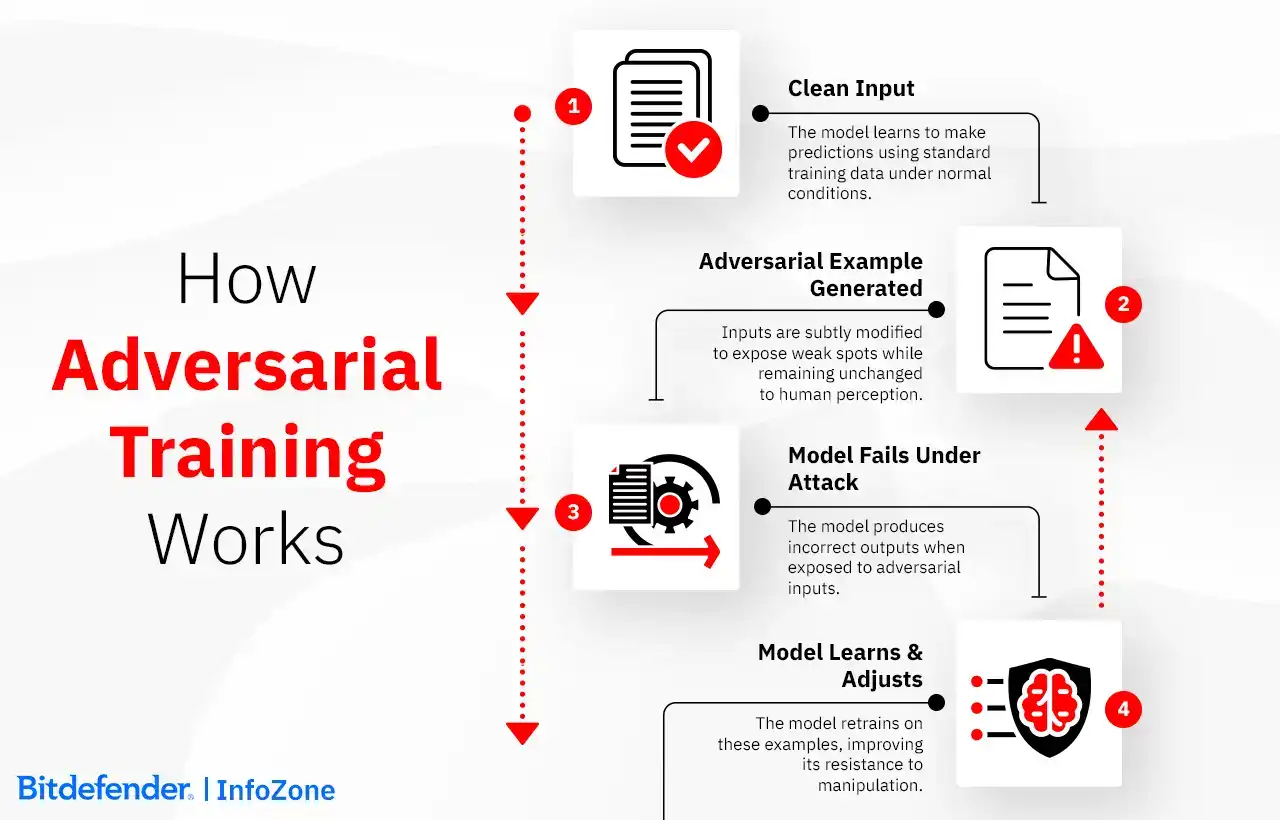
Adversarial training is a machine learning technique that improves a model's ability to resist attacks by using deceptive inputs during training. These examples are subtly altered to provoke mistakes, helping the model learn patterns that are less fragile and more reliable under manipulation.
In simpler terms, it teaches models to stay reliable even when the inputs are slightly manipulated in ways meant to confuse them. These manipulations are often invisible to humans but can cause a model to make confident mistakes. By learning to handle such inputs, the model becomes less fragile and more dependable in real-world conditions. This is done in ways designed to confuse it, so that adjustments can be made in the learning process until the model learns to handle them. These tampered inputs, called adversarial examples, might look normal to a human but can trick a model into making confident mistakes. A recent research study found that something as simple as a single autumn leaf stuck to a traffic sign could cause an AI vision system to misread the sign with near-total confidence. By including these mistakes during training, developers push the model to rely on more stable, less fragile features that won't break the moment an input is nudged. The result is a model that is accurate in ideal conditions, as well as better prepared for the kinds of distortions it may face in the real world.
The model’s fragility is related to how decision boundaries form. In high-dimensional spaces, models often create narrow or irregular boundaries between classes. A small nudge in the input can move a sample across the boundary. That’s all it takes to produce an error, even if the input still looks the same to a human. These boundaries are not intentionally designed this way; they are a byproduct of optimization focused solely on performance under normal conditions.
Robustness of the system becomes especially important in settings where errors are costly. That includes autonomous systems, medical diagnostics, financial risk models, and any system exposed to public inputs. In these environments, the risk isn't hypothetical – perturbations, whether accidental or adversarial, can affect outcomes in material ways.
Adversarial training treats vulnerability not as a deployment risk, but as a training-time property. It shifts the problem upstream by acknowledging that models will be exposed to challenging inputs and should be prepared for them from the start. This is not an approach that can eliminate all forms of sensitivity to perturbations, but what it can do is change how robustness is factored into model development.
Technical Foundations and Core Adversarial-Training Methods
Adversarial training reframes how machine learning models are taught to make decisions. The process doesn't assume that future inputs will look like clean training examples, but it actively anticipates worst-case manipulations. This is formalized as a min-max optimization problem. In other words, the model minimizes loss, while a simulated attacker maximizes it by generating the most damaging inputs within allowed limits. At a conceptual level, the training process is built upon an arms race embedded into it.
Unlike traditional loss minimization, which assumes the world is benign, adversarial training starts from the premise that it’s adversarial by default.
How Adversarial Examples Are Built
To simulate attacks during training, what is commonly used are gradient-based perturbation methods, which modify inputs slightly – often imperceptibly – to expose weak spots in the model's decision-making.
The Fast Gradient Sign Method (FGSM) is one such approach. It takes a single, calculated step to push the input in the direction that increases the model’s error. FGSM is computationally efficient, but it often leads to catastrophic overfitting. That is, models become resilient to FGSM attacks specifically, but still break under stronger ones.
Projected Gradient Descent (PGD) avoids this by taking multiple, smaller steps and projecting the perturbed input back into a valid range after each one. It’s stronger and harder to overfit, and is widely considered the standard for empirical robustness. The trade-off is cost – training time can increase five- to tenfold compared to standard approaches.
Each perturbation is constrained by an ε (epsilon) budget, which defines how much an input can be changed. This budget is not arbitrary; it sets the boundaries of the assumed threat model. This ε, or perturbation budget, is a critical dial to understand: a minor ε might introduce subtle noise or blurring, whereas a larger one allows for more visible changes, pushing the boundaries of what an adversary can achieve before the model breaks. Crucially, the very definition of a model's robustness is entirely relative to the specific ε-budget applied during its training.
Strategies for Learning Robustness
Adversarial training isn't just about modifying inputs – it also extends to how models are taught to learn. Some methods go beyond feeding the model with difficult examples and instead adjust the loss function itself to promote more stable decision-making.
TRADES is a good example of this approach. The idea behind TRADES is that there's often a trade-off between a model's accuracy and its robustness – but the two aren't necessarily at odds. TRADES tackles this by tweaking the loss function: it penalizes the model when its predictions on slightly altered inputs are too different from what it would say on clean ones. The goal is to nudge the model toward making stable decisions, even when the input is a bit messy or manipulated.
This technique represents a shift toward robust optimization. Rather than just measuring how well a model performs under attack, it tries to build that resilience directly into the learning objective. TRADES breaks down classification error into two things that really matter:
- Natural Error: Misclassifications on clean, unaltered inputs.
- Boundary Error: A measure of how close these clean inputs sit to the model's decision boundaries, which can signal how vulnerable they are to slight perturbations.
TRADES doesn't just acknowledge this trade-off – it builds it into the loss function. The function contains two main components, controlled by a hyperparameter $\beta$:
- Cross-Entropy on Clean Data: Ensures the model doesn't lose touch with its primary goal – getting clean inputs right.
- KL Divergence Penalty: This is where the robustness comes in. The model is penalized if its predictions on adversarial versions of the same input diverge too much from the original ones. That nudges it toward making decisions that are stable even in hostile conditions.
How the β (beta) value is set shapes the trade-off between robustness and clean accuracy. In adversarial training, this value decides how much focus is put on resisting adversarial examples versus doing well on normal inputs. A higher setting boosts robustness but can lower clean accuracy, while a lower setting does the opposite. This tunability lets practitioners match the model’s behavior to real-world needs, from protecting critical infrastructure to keeping a smooth user experience in less sensitive cases.
Another technique in this category is MART (Misclassification Aware Robust Training). Unlike TRADES, MART gives more attention to the examples the model is already misclassifying. The goal is to reinforce the model's weakest spots and reduce the risk of failure under pressure.
Techniques like TRADES and MART give engineers a way to tune how much the model focuses on accuracy versus how well it handles tampered inputs. This kind of flexibility matters in high-stakes environments where mistakes, even rare ones, can't be tolerated.
Implementing Robustness in the MLOps Lifecycle
Robustness can’t be retrofitted. It must be designed into the development process and continuously enforced. In practice, this means shifting left – treating adversarial resilience as a build-time requirement rather than a late-stage fix. Continuous integration and deployment (CI/CD) pipelines are where this becomes operational.
Practical Steps for CI/CD Integration
Adversarial training starts during model build. Perturbed inputs are generated on the fly using methods like PGD (Projected Gradient Descent), then folded into training batches. This helps produce models that are less sensitive to small manipulations.
After training, models face a dedicated robustness gate. This automated validation step tests performance against adversarial inputs and blocks promotion if robust accuracy falls below a set threshold. It turns robustness into a release criterion, not a post-hoc metric.
Experiment tracking must go beyond models and code. Tools like MLflow or SageMaker Pipelines which track machine learning experiments, should also keep a log of adversarial datasets used and the exact training settings. Full traceability supports reproducibility and allows teams to explain and audit how robust a model truly is.
In high-risk or regulated environments, it’s worth cryptographically signing artifacts that pass robustness checks. This ensures the deployed model is exactly the one that was vetted – unaltered and provable.
Governance and Team Responsibilities
Governance frameworks help structure these controls. The NIST AI Risk Management Framework (AI RMF) identifies robustness as a key property of trustworthy AI. Its “Measure” and “Manage” functions are directly supported by traceable versioning and automated robustness gates, which quantify and enforce resilience thresholds.
MITRE ATLAS provides a structured adversarial threat taxonomy. Teams can translate tactics like AML.T0005 (input manipulation) into concrete test cases. Incorporating these into AI implementation strategy ensures coverage against known threats and enables communication with security and compliance stakeholders.
Cross-functional collaboration underpins all of this. ML engineers implement adversarial training logic and interpret trade-offs, while MLOps teams manage orchestration and artifact lifecycle. At the same time, security engineers define realistic threat models and adversarial constraints following established guidelines like the OWASP AI Security and Privacy Guide, while compliance leads ensure governance frameworks. These roles operationalize robustness as both a technical and organizational asset.
Evaluating and Testing Model Robustness
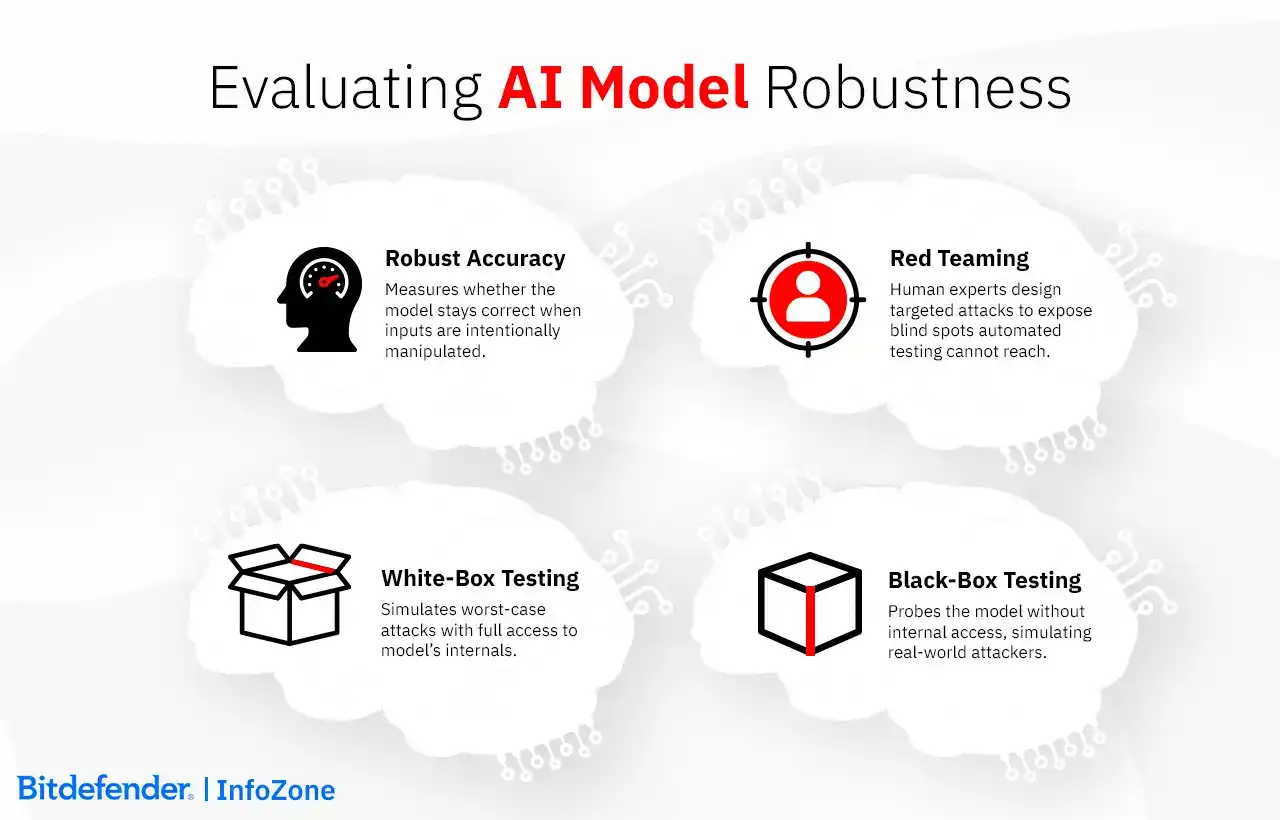
A model might ace standard accuracy tests but still be dangerously fragile. That's because clean datasets don't tell the whole story – what matters is how the model behaves when things go wrong. Robust evaluation pushes models into edge cases and adversarial conditions to see if they still hold up. One common benchmark is robust accuracy, which measures whether the model can stay correct even when the input has been intentionally manipulated. We can think of it as stress-testing the model's reasoning.
There's also a category of methods that aim to go beyond testing and actually prove robustness. These approaches try to guarantee that, within specific limits, no small manipulation can cause a wrong prediction. Tools like randomized smoothing or bound propagation fall into this camp. They're powerful, but the trade-off is cost – they often demand a lot of compute, so they're mostly practical in environments where that level of certainty is worth it.
To evaluate robust accuracy in practice, two testing strategies dominate. White-box testing assumes full access to model internals – gradients, architecture, parameters – and uses techniques like Projected Gradient Descent (PGD) to simulate worst-case attacks. Black-box testing, by contrast, approximates real-world threats: adversaries use transferability from surrogate models or iterative queries without knowing the target model’s structure.
For systematic, repeatable testing, several tools have become industry standards. IBM’s Adversarial Robustness Toolbox (ART) offers a wide range of attacks and defenses. Foolbox excels in gradient-based attacks, while RobustBench and AutoAttack provide standardized benchmarks. AutoAttack in particular – a combination of four parameter-free attacks – has become the gold standard for reliable robustness measurement.
Yet automated evaluation alone isn’t enough. Manual red teaming, where human experts design targeted, often semantic attacks, remains crucial for exposing model blind spots. A robust system is one that can survive both automated fuzzing and human ingenuity.
Critically, threat model alignment must guide all evaluation. If your training assumed bounded L∞ (L-infinity) perturbations (each input feature can only be changed by a small fixed amount), your tests must reflect that. Testing with mismatched assumptions leads to misleading results and false confidence.
Finally, robustness evaluation is not a one-time task. It must be baked into the ML lifecycle – ideally as part of CI pipelines – because models degrade as data distributions drift and attack techniques evolve. As with security more broadly, robustness demands continuous vigilance.
Why Robustness Is Hard to Achieve
Robust training can inflate compute budgets by five to ten times and still degrade clean accuracy, forcing teams to ask: where is robustness worth the performance tax?
Another risk is robust overfitting – models that appear secure during training but collapse when facing novel attacks. Instead of learning generalizable robustness, they memorize patterns tied to specific perturbation strategies, leaving dangerous blind spots.
These limitations intensify in complex AI systems. Traditional adversarial defenses assume small, norm-bounded input tweaks. But multi-modal models face threats that blur across modalities, like adversarial text degrading visual outputs. LLM agents, meanwhile, operate in open-ended environments, where the attack surface includes prompts, context shifts, and long-horizon manipulation. Here, bounded noise assumptions break down entirely. The threats become semantic, behavioral, and structural, and far harder to detect.
Future directions aim to bridge this gap. Techniques like certified robustness and formal verification offer mathematical guarantees, but remain expensive, narrow, or difficult to scale. Even synthetic data generation, once a promising solution, introduces its own risks, sometimes serving attacker and defender alike.
Adversarial training, then, isn’t a silver bullet; it’s a layer. Mature teams don’t treat robustness as a milestone – they treat it as an operational discipline. That means robustness gates in CI pipelines, red teaming beyond known threats, and continuous adaptation. In this arms race, resilience is never static – it’s earned, defended, and rebuilt.
How Bitdefender Can Help
Bitdefender GravityZone is a unified cybersecurity platform designed with adversarial resilience at its core. By embedding hardened machine learning models across the stack – from endpoints to cloud workloads – it helps organizations build and defend AI-powered systems against manipulation and evasion.
At the model level, Bitdefender applies adversarial training internally, using custom-built deep learning algorithms and even GAN-style sparring between AI systems to simulate and neutralize emerging attack techniques. This research feeds directly into GravityZone capabilities like HyperDetect, which uses tunable decision boundaries to detect threats designed to slip past static defenses.
Bitdefender also uses machine learning models that are trained individually for each endpoint. These models learn what normal activity looks like on that specific system, so they can spot unusual behavior more accurately, without overwhelming analysts with false alarms. That's especially useful when detecting early signs of adversarial behavior, which often hide in small, easy-to-miss changes. Advanced Threat Control and Fileless Attack Defense further strengthen runtime protection by analyzing process behavior and command-line execution paths in real time.
To connect these insights across environments, GravityZone Extended Detection and Response (XDR) correlates signals from endpoints, identities, and cloud platforms, surfacing threats that would otherwise go unnoticed. For teams needing extra coverage, Managed Detection and Response (MDR) provides around-the-clock monitoring and expert intervention.
To explore Bitdefender's broader work in AI security – including its defenses against adversarial AI attacks – visit our dedicated AI security solutions page.
Frequently Asked Questions
What is adversarial testing in AI?
Adversarial testing is a way to evaluate AI models under hostile conditions, not just clean benchmarks. It blends automated testing (like fuzzing and white-box attacks using tools such as IBM's Adversarial Robustness Toolbox or AutoAttack) with human-driven red teaming. Algorithms can churn out thousands of adversarial inputs in seconds, but they often miss the kind of subtle, real-world tricks that trip up models in practice. Think small visual shifts or harmless-sounding language tweaks – things a machine might ignore but that can throw its predictions off entirely. That's where human red teamers come in. Their job isn't just to break models – it's to spot the gaps that pure math can't always reveal.
What is game theory for adversarial machine learning?
Adversarial training isn't just a technique – it's a fight. You build a model, and then you throw everything at it to try and break it. Each time it learns, you push harder. That back-and-forth – model versus attacker – isn't random; it follows a kind of logic that game theory helps make sense of. You're not aiming for perfection, just a model that can stand its ground when things get ugly. Researchers have used game theory concepts like Nash or Stackelberg equilibria used to simulate more realistic scenarios, where the attacker might strike first or keep part of their strategy hidden. Of course, real-world threats don't always follow clean mathematical rules, but this kind of modeling gives defenders a useful way to think ahead – not just to patch holes, but to shape systems that are harder to exploit in the first place.
What is an adversarial model?
The phrase “adversarial model” can mean different things, but at its core, it highlights that vulnerability in AI isn’t a bug – it's a side effect of how most models learn. In defensive contexts, an "adversarial model" often means one that's been hardened – trained specifically to focus on robust, human-interpretable features so it doesn't break under slight manipulations. But from an attacker's perspective, it might be a surrogate: a model built to mimic a target system when direct access isn't available. These stand-ins are used to craft adversarial inputs that, thanks to transferability, often work just as well on the real thing. This dual meaning reflects the constant push and pull between offense and defense in adversarial machine learning.