

What Is an Insider Threat?
An insider threat is an individual or an identity with authorized access to the internal systems, data, or facilities of an organization, with the potential to misuse that access (intentionally or unintentionally) and cause harm to the organization. Access may belong to employees, contractors, partners, or other third parties, but in modern environments can also include non-human identities: service accounts, automation, application credentials, etc. Any vulnerability or weak process can enable insider incidents; however, the insider threat is defined not by the weakness itself, but by the presence and misuse of internal access.
People often try to understand what is an insider threat by comparing it to an external cyberattack, and the contrast is usually quite telling. Most external attacks come from outside the organization and revolve around getting in. An insider threat does not start that way at all. It comes from someone who is already part of the environment. In cybersecurity, what best describes an insider threat is the risk created by people operating internally, with valid credentials or approved access, and with some degree of familiarity with systems and data.
This obviously makes insider threats extremely dangerous: there is no need for bypassing defenses in the traditional sense. Because they understand business processes, where data is located, and the context of the organization, insiders can take apparently legitimate actions that, in the long run, can cause devastating harm.
Insider threats are not limited to clearly malicious behavior, as access can be abused deliberately, although often the damage comes from routine lapses - a rushed decision, a missed detail, or a shortcut taken without thinking through the consequences. Employees are usually the first group that comes to mind, yet insider risk does not stop there. Contractors, temporary staff, and even trusted vendors or partners can introduce the same exposure once they are granted internal access. These can be seen as types of insider threats based on who holds access, but as we will explain further in the article, insider threats can also be categorized based on how that access is misused in the end.
Why Insider Threats Matter (Context & Impact)
Insider threats have always mattered, but lately their importance has grown, as we can see them appearing in real environments at sometimes astoundingly destructive scales. For most organizations that track insider threats, the apparent pattern is more frequent and more expensive incidents, harder to sort out, and, on average, they surface later than before. Recent reports estimate an average annual cost at around $17.4M in 2025 (up from roughly $16.2M in 2023).
This pattern shows up often in healthcare, being also common in financial services and the public sector. In these environments, access tends to be broadly distributed, and work has to continue even when controls are strict and oversight is heavy. As a result, insider activity often blends into day-to-day operations and does not immediately stand out as risky.
The drivers behind insider incidents are rarely mysterious. Financial pressure is one factor. Personal grievances, espionage, and simple mistakes also play a role. What makes them harder to deal with today is the way work actually happens. With hybrid and remote work, internal activity no longer lives in one place. It is spread across home networks, personal laptops, and cloud services shared by entire teams. The access itself is still valid, but the surrounding signals are weaker, and early warning signs do not always register as problems.
In practice, most insider incidents do not stand out right away. Activity can look normal for a long time, even when it is slowly drifting out of bounds, and that makes it easy to overlook. By the time the behavior is clearly problematic, the impact has often already built up.
The same dynamic shows up with automation and AI. These tools make it easier to move faster and work across more systems, which is usually the point. When something does go wrong, that speed becomes a liability. Activity can spread across systems where it was not intended to enter. Early mistakes are harder to contain once they start in these cases, which, in practice, allows issues to persist unnoticed until the point of no return or no way of undoing. Therefore, insider risk today is tied to how broad is access, but also to understanding that "normal" has become harder to pin down due to rapid technological changes.
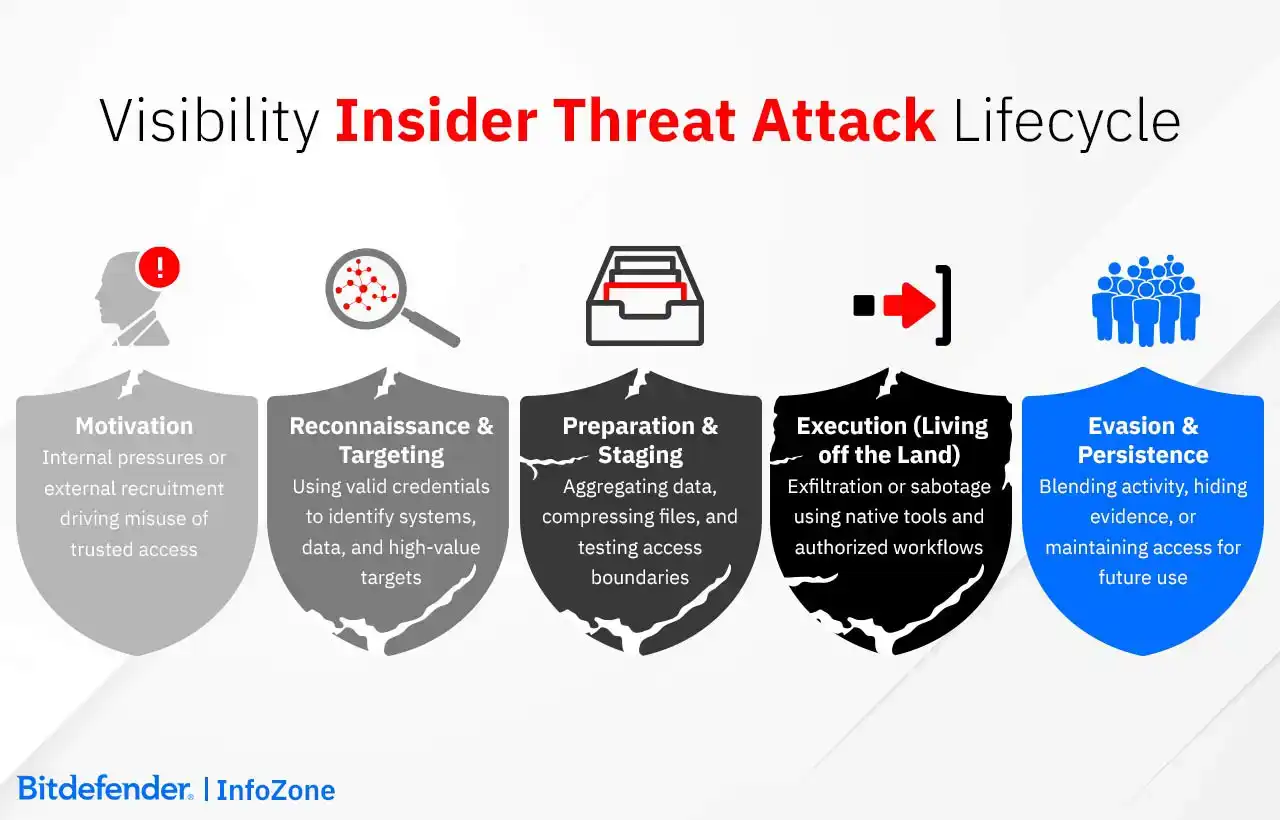
Insider Threat Attack Lifecycle
After the decision to act settles in, the insider begins to look around, which is the reconnaissance phase. This does not resemble external probing, because the insider already knows the environment. They use normal systems and ordinary access to see what matters, what is reachable, and what might be useful. From the outside, it still looks like routine activity.
Next comes preparation. The insider tests what their access allows and starts getting ready to act. Information is gathered. At this stage, data might be pulled together into a single place or compressed to make it easier to exfiltrate later. Speed is important later on, so preparation needs to ensure the action can be carried out without friction once a specific moment pushes things forward.
The exploitation itself is often straightforward. Authorized access is used to take data, change records, or disrupt systems. The individual actions are often carried out using the same tools the insider normally relies on, effectively living off the land. What makes this an attack is judged less by the method it uses and more by its reasons and the result it produces.
Insiders commonly disengage after the action and try to reduce attention or responsibility, maybe relying on the fact that their access was legitimate, which means that their actions can be explained as part of their role, as a mistake, or as normal work that looks wrong only when taken out of context.
Types of Insider Threats
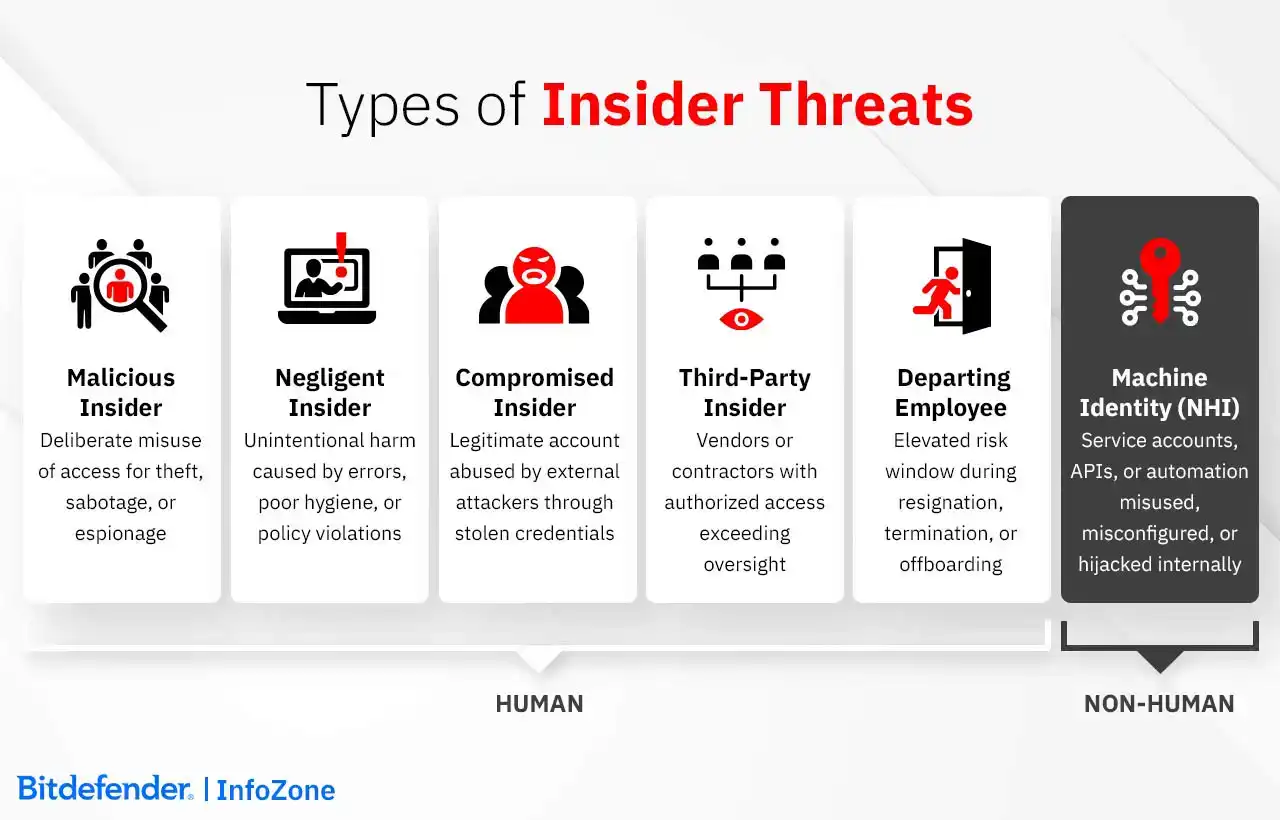
Insider threats change as technology and society change. Below are the most commonly discussed types in cybersecurity.
- Malicious insiders: Sometimes the reason an insider becomes a threat is money, sometimes it is a grievance, and sometimes it is pressure from outside. It does not take sophisticated techniques for this to work when someone already knows where sensitive data sits or which systems matter.
- Negligent insiders: Contrary to common assumptions, the majority of insider incidents fall into this group, as passwords are reused, links are clicked, and settings are modified without malicious intent. There are astounding risks that can come from small, seemingly harmless actions repeated across users and systems.
- Compromised insiders: In cases involving compromised insiders, the account remains internal, but control no longer does. Credentials are stolen, or users are manipulated into acting on behalf of an external actor. From the organization's perspective, the activity still appears legitimate, which is precisely why this type of threat is difficult to detect.
- Third-party and contractor threats: Contractors and vendors are often given internal access so work can move forward. In practice, that access does not always get reviewed as closely as it should. Some of that access simply stays in place, and problems show up later inside systems that were already trusted.
- Departing employee threats: Changes in roles or employment create awkward moments for access control. Accounts may remain active even as responsibilities shift or attention moves on. During that period, data can be taken or kept simply because nothing has been updated yet to prevent it.
- Non-human insider threats (emerging): As AI agents, automation, and service accounts become more common, access is no longer tied only to people. These identities can read data, move it, or trigger actions on their own. When something goes wrong, there may be no human decision behind it, but the impact looks the same from the inside.
Common Insider Threat Indicators
Behavioral indicators are usually noticed first, and they can take idle forms, like the form of someone starting at working hours that do not match their past routine. Financial stress can become visible, just like frustration or disengagement, or policies that are bent more often than before. There may also be a growing curiosity about information or systems that sit well outside the person's role. None of these indicators is unusual by itself, and the signal to pay attention to is the change in behavior, not the trait itself.
Most technical signs appear inside normal access. Data may be opened more often than before, copied in bulk, or moved to places that are not typically used. Files show up where they usually don't. New devices or tools appear without much explanation. Taken alone, none of this is unusual enough to stand out.
Other signals are easier to notice but harder to interpret. Things like badge use that does not quite match a schedule, following someone through a secured door, or handling sensitive material too casually are usually easy to dismiss. On their own, they rarely lead anywhere. They start to matter only when they appear alongside other changes.
Some of the activity that draws attention looks technical at first. Some patterns can also reflect legitimate work, and that is why context is so important when something like large data transfers or activity falls outside normal working hours. This is especially true when it involves unfamiliar destinations such as personal cloud storage or unmanaged SaaS platforms.
Around the same time, access can shift for completely mundane reasons, as roles change. Departures also often leave accounts and permissions slightly out of step with reality. During these periods, copying or downloads can increase simply because access has not caught up yet. It does not look unusual on its own. Internally, activity like this is often recorded under broad labels and left there, especially when nothing clearly demands follow-up. Some of it sits for a while without much attention.
Simple checklists do not handle that kind of drift very well. Individual signals come and go, and most never amount to anything on their own. What eventually stands out is repetition and overlap over time. Noticing these patterns is not about assigning fault. It is about shortening the stretch of time in which exposure can exist without being seen.
Insider Threat Detection Strategies
Detecting insider threats is not difficult because data is missing. In fact, most organizations already collect plenty of information about user activity. The problem is that insiders usually do things that look legitimate. Basically, accounts, tools, and systems are used as intended, but not quite in the way they used to be.
That is why detection ends up focusing on drift rather than events. What matters is how access changes over time: who touches what, when, and whether those patterns still make sense in context. Before anything can stand out, there has to be a sense of what ordinary access looks like for a given user or system.
Different tools surface different pieces of activity. UEBA focuses on changes from prior behavior. SIEM and XDR collect events that would otherwise stay separate. DLP and identity-focused analysis add visibility into data use and account activity. None of these views is complete on its own.
Insider activity does not show up in a single place. Relevant signals may come from endpoints, cloud services, identity systems, email, file storage, or physical access records. When those sources are reviewed independently, most of what appears looks routine.
What tends to draw attention is order rather than volume. File access followed by compression. Data movement that does not resemble earlier patterns. Removable media use that appears only after hours. These details are easy to miss when they are treated as isolated events.
Prevention & Protection Measures
When you strip it down, most organizations are dealing with two related problems: limiting the chances for misuse, and limiting the fallout when it happens anyway. Those problems don't line up neatly with individual controls, and trying to solve one doesn't automatically solve the other. The approaches that hold up tend to be layered and grounded in how work actually happens.
Security awareness training helps people recognize risky situations like phishing attempts, data handling mistakes, social engineering, and other commonly encountered dangers, but it has real difficulty eliminating error or intent once an insider is involved.
Access control is often granted for a specific reason and then left in place, but over time, roles change, projects end, and permissions remain usable long after the original need disappears. From a cybersecurity standpoint, this is where identity and access management (IAM), privileged access controls, and Zero Trust principles come into play, treating access as conditional, time-bound, and continuously reassessed rather than implicitly trusted once granted.
Timing plays a role here as well. Access is usually reviewed before it is granted, but it is not always revisited with the same urgency when someone leaves. When accounts or permissions linger after a role ends, they create openings that are easy to miss.
Data security controls focus on containment. Focus on a clear visibility into existing systems, datasets, and unapproved tools such as personal cloud storage or unmanaged SaaS. Pay special attention to hardening and patching efforts, usually associated with external threats. These remain essential because insiders can use the same configuration weaknesses and outdated software as an external attacker. Measures like data classification, encryption, tokenization, watermarking, or content-aware DLP are not designed to prevent misuse outright. Instead, they limit how freely data can travel and how easily it can be repurposed once accessed.
Monitoring and automated responses serve a different purpose. They are often used to buy time, for example, by narrowing access or isolating sessions while someone looks more closely at what is happening. The Zero Trust idea assumes breach and continuous verification, so it naturally fits here, but only as long as it does not turn the entire inside of the organization into a surveillance space. Trust still matters. It needs to be handled carefully, not spent casually in the name of security. Proportionality, transparency, and governance should remain part of how insider risk is addressed.
Insider Threat Protection Program
To build an insider threat program, organizations first need to define how internal risk is identified and addressed across teams. That usually means clarifying ownership, setting review thresholds, and deciding how escalation should work before incidents occur. Departments such as security, IT, HR, and legal are usually all involved, but the goal is not constant involvement, but clarity around who reviews what and when.
At a basic level, a program should follow a repeatable flow: signals are reported or detected, reviewed, and triaged. When defined thresholds are met, and only then, there is escalation. How consistently this flow works when signals are ambiguous or high in volume - this is what best defines the effectiveness of the program. Clear criteria for review, escalation, and closure matter more than detailed procedures, which can be considered the most fragile part of an insider threat program.
Consistency is another important point. The rule should be that similar situations are handled in similar ways, no matter who reviews them. This can create internal friction and second-guessing, so use documented decision paths and shared thresholds.
Insider threat measurement is tricky, but also important for establishing KPIs and ROI, so make it as practical as possible. Look at recommended common indicators: time to review alerts, escalation rates, false positives, and reduction in Mean Time to Contain (MTTC). There are tools that can surface activity and context, but in the end, it's up to human interpretation and decision to make it work.
Such programs should not be designed from scratch and should build upon existing HR and security capabilities. Use well-established frameworks from CISA and the National Insider Threat Task Force (NITTF), which can help your organization toensure governance, privacy safeguards, and multidisciplinary coordination. The NIST Cybersecurity Framework and NIST SP 800-53 (specifically Control PM-12) serve as supporting references for risk management and identity governance.
Legal & Ethical Considerations
Employee monitoring raises the greatest legal and ethical questions, as simple as it may sound on paper. Insider threats are real, but so are employee privacy rights, and ignoring them can create significant internal and external tension.
Transparency. The team members should know that monitoring exists, as well as what and why it is used for. Attention: this should not be buried in policy language, but stated as directly and openly as possible. When monitoring comes to light only after an incident, it becomes hard to justify it, as clear as it is that it was done for protection. This expectation is not just moral; it is also clearly stated in privacy frameworks like the General Data Protection Regulation (GDPR), which focuses on notice and purpose when employee data is involved.
Proportionality. Collecting everything “just in case” is difficult to defend using security as a reason. Access to monitoring data should be 1.) limited, 2.) role-based, and 3.) logged. Also, it should exist for a reason. In practice, it is considered that when information is kept longer than needed (or without a clear purpose), exposure tends to increase without improving outcomes.
Context. Legal and labor constraints vary by region. In the EU, GDPR and, in many countries, worker councils influence how employee monitoring can be introduced. In North America, limits often come from union agreements and privacy laws such as the California Consumer Privacy Act (CCPA/CPRA). Data sovereignty adds a global layer to the insider threat containment, as can be seen in regulations such as China’s PIPL, which can restrict where monitoring logs are stored and who can access them.
Ethics. This aspect is related to how signals are handled, because seeing a risk is not equal to proof of wrongdoing. Monitoring, investigation, and any legal or disciplinary response should be separated for practical reasons – programs that respect separation are easier to defend and also easier to trust.
Real-World Insider Threat Examples and Case Studies
Not all insider threat cases come under public scrutiny due to the scale of their impact. Many are revealed due to their social impact or as use cases of ordinary situations that evolve into surprising breaches of trust.
Edward Snowden’s disclosures (2013) and Chelsea Manning’s 2010 leaks have structural similarities in how they involved long-term access to sensitive systems, gradual data collection, being detected only after the information leak. Their impact had far-reaching consequences for diplomacy and state authorities' credibility.
Corporate cases tend to unfold under less scrutiny, but there are plenty of examples that made headlines, like Yahoo's 2013–2014 breaches, the 2016 Waymo trade secret theft involving Anthony Levandowski, and General Electric's 2020 IP theft. Capital One's 2019 breach related to a former cloud engineer is another case that followed a similar pattern of using legitimate credentials and familiar infrastructure, with a delayed realization of scope.
More recent cases show that the surface keeps shifting, like in the case of the KnowBe4 fake IT worker incident in 2024 that raised questions about trust during hiring and remote onboarding. Access can still be exploited without raising immediate alarms, like in the Rippling "employee spy" case in early 2025 or in the Salesforce-hosted breach that affected Google. Human elements of applying pressure, offering incentives, and exploiting prolonged access continue to be preferred to technical break-ins in cases like the public disclosures related to Coinbase bribery allegations and the Tesla data leaks (2023–2025). Government environments are still not immune despite all the famous cases from the 2010s, as can be seen in the document deletions involving U.S. agencies in 2025. Authorized systems and processes led to the loss of records later identified during oversight and audit activity.
It is difficult to pinpoint a specific tactic or motive across all these cases. But what does stick out is timing: by the time the activity visibly crossed a line, the access had already been effectively used.
How to Evaluate Insider Threat Detection Solutions
When insider threat solutions are evaluated, the first mindset shift that an organization needs to make is to pay less attention to checking boxes and more to considering the ways a tool treats uncertain situations. Insider activity rarely looks dangerous at the start, so a system needs to be able to make sense of subtle changes without creating unnecessary noise or crossing boundaries.
Telemetry coverage is a good place to start from, and what useful solutions do is pull signals from endpoints, cloud services, identities, and file access, capturing events like USB insertions, unusual command-line or PowerShell execution, impossible-travel logins, or sudden spikes in file downloads or API activity. More than volume, how signals are seen together is more important, and that refers not just to employees, but also to service accounts, bots, and API keys.
UEBA quality becomes obvious very quickly. Strong systems build baselines that resemble how work actually happens and can explain why something stands out. False positives matter here. Tools that flag normal behavior all day are usually ignored. Insider incidents unfold slowly and without a clear starting point in many cases, which means that these tools need to make it possible to revisit earlier activity.
Detection solutions support basic containment actions, such as temporarily limiting access or pausing a transfer while a situation is reviewed. This can reduce impact while the intent is still unclear. Unfortunately, solutions based on detection alone are not very efficient for insider threats.
Privacy and governance are important in how insider threats are identified, and that brings another important aspect to consider in the evaluation process: can monitoring remain proportionate and defensible over time? Role-based access, audit trails, and limits on who can view sensitive details influence this, so take these capabilities into careful consideration.
Besides the total cost of ownership, which is something to evaluate regardless of the solution needed, evaluate Requests for proposal (RFPs) and proofs-of-concept using real conditions, testing with representative data, or realistic insider scenarios. This can expose gaps that polished demos rarely show. It also shows how well a solution fits day-to-day collaboration between security, IT, HR, legal, and compliance departments.
Frequently Asked Questions
What is the difference between an insider risk and an insider threat?
The moment access is granted to an employee/contractor or service account that can reach sensitive systems or data, technically, an insider risk already exists. The risk is simply the possibility of loss created by access itself, and it remains present even when everyone is acting in good faith and following the rules.
Access creates a baseline level of exposure, and an insider threat becomes relevant when activity begins to change, no matter if the change involves intent, negligence, or loss of control over an account. The category is less important than the shift from normal use toward risky behavior.
How does Zero Trust reduce insider threats?
By treating “inside the network” as irrelevant: access isn’t a one-time decision, it’s continuously re-checked, scoped, constrained. That is how Zero Trust can significantly reduce insider threats, and this becomes more evident when we take into consideration that most insider damage happens after someone already has legitimate access. Zero Trust limits lateral movement and shrinks the blast radius using security principles and techniques, such as least privilege, segmentation, and tighter controls around privileged actions. Maybe these can’t fix bad intent or totally eliminate human error, but they sure make concealed misuse a lot harder to scale.
Can AI predict an insider threat before it happens?
To reliably predict who will “turn” or what someone intends to do is most likely science fiction, although it is impossible to predict if, someday, it will become reality. What AI can do is spot early signals of user drift through unusual access patterns, data hoarding or staging, strange timing, and the appearance of workflows that stop matching a user baseline. This ability is valuable to security teams as it allows quicker investigation, before intent becomes clear or before an irreversible incident.