

What is Adversarial AI?
Adversarial AI (or Adversarial Machine Learning) is a deliberately engineered cyber threat that uses intentional manipulation of machine learning systems to distort their intended outputs or behaviors.
AI systems are not infallible, with errors occurring due to factors such as imperfect training data or unpredictable real-world inputs. However, routine errors and statistical noise are not considered Adversarial AI, which refers only to targeted attacks. Although the modifications are often imperceptible to the human eye, they can lead to widespread failures with alarming consequences in critical AI-driven applications.
Machine learning jargon doesn’t always map cleanly to security contexts, and this is possibly what led to confusion about the term. Generative Adversarial Networks (GANs), for instance, use the word “adversarial” in a completely benign sense: two models sparring to improve image synthesis or data realism. Similarly, “adversarial training” refers to hardening a model by exposing it to simulated attacks during development. And red teaming, borrowed from military doctrine, is a security audit, not a breach. These are just a few common examples showing that not all adversarial methods involve malicious intent.
The idea of using inputs intentionally designed to trick AI models, not just as a research curiosity but as a real attack method, began to take shape around 2014. Research showed deep neural networks could be misled by minute changes invisible to humans, something that wasn’t taken seriously at first. It resembled a mathematical quirk more than a real vulnerability. That changed quickly.
From an organizational perspective, the risk is no longer speculative. Shadow AI (the use of AI tools without formal oversight or security controls) has become a serious risk factor. Incidents involving shadow AI increased breach costs by approximately $670,000 per incident. The operational drag of things such as corrupted analytics, manipulated automation, and trust issues is harder to quantify exactly, but considering that AI takes on more high-stakes decisions, these failures are starting to be considered less technical hiccups and more strategic liabilities.
Adversarial AI in Cybersecurity: Dual Nature of AI in Cyber Warfare
Adversarial AI has changed how cyberattacks and defenses work. This was not visible through one big breakthrough, but rather through many small changes over time. Today, both attackers and defenders use many of the same AI techniques. The difference is in how they are used, not in the tools themselves. AI technology enables attackers and defenders to operate at speeds and scales that were impractical just a few years ago. But the same core models now underpin both intrusion and detection, making it harder to distinguish between the tools of offense and the tools of defense.
On the attacker’s side, generative AI tools are widely accessible, both free and paid, and available as cloud services or for local deployment. This has improved social engineering far more than coding exploits. Language models are now used to impersonate executives with convincing detail. Malware generation is evolving, but not always with precision; what matters is the speed of iteration. Meanwhile, reconnaissance, traditionally the slow and noisy stage of most attacks, has become nearly invisible. AI and machine learning now automate the collection of public and leaked data sources, allowing attackers to map out target organizations with speed and minimal traceability. This includes scanning exposed APIs, misconfigured cloud buckets, leaked credentials, and vendor metadata, activities that once required significant manual effort.
Defensive teams are adapting, though the pace varies widely. In some environments, static rules have been replaced by systems that learn baseline behavior and alert on what falls outside it, models that don’t rely on known indicators, but look for deviations, sometimes very subtle ones, that wouldn’t trip traditional alarms. The idea of systems that can detect unknown threats by learning normal behavior patterns sounds ideal, at least in theory. But tuning these systems to avoid constant noise remains a work in progress. Threat hunting is getting support too: AI now helps analysts sift logs and spot correlations that would take hours to catch manually. It doesn’t replace expertise, but it compresses time. A few teams are going further, experimenting with adversarial training – essentially stress-testing their models with crafted inputs during development. It’s promising, if still mostly limited to research-oriented or well-funded security orgs.
The deeper issue is that AI systems weren’t designed with deception in mind. Their statistical decision boundaries are not robust in the way humans might expect. Slight, calculated changes to inputs – barely noticeable in any application layer – can cause the model to misclassify with high confidence. Worse, the same attack can often succeed across different systems, thanks to transferability. Most models operate as black boxes: they take in data and produce results without showing exactly how they arrived at those results. This makes it difficult to audit why they failed in the first place or how to patch the weakness without breaking something else.
This is the paradox: AI systems can perform exactly as intended and still become the weakest point in a security architecture. The issue isn’t that they fail outright, but that they produce confident decisions based on inputs that appear benign, making it easy to miss the compromise until it’s too late.
How Adversarial AI Attacks Work
The first thing to make distinctions about is the vantage point from which the adversarial attacks begin. The reason is that some actors have full access to the AI system (model weights, training data, architecture), while others only see what any normal user can: input in, output back. From this point of view, we can talk about:
White-box attacks - these assume complete system access. With this visibility, attackers can calculate exactly how to push the model into failure modes. These scenarios are rare in deployed systems but represent the theoretical ceiling for damage.
Black-box attacks operate without internal knowledge. The attacker submits inputs and observes outputs, learning the model's behavior through systematic trial and error. Most public-facing AI systems fall into this category from an external threat perspective.
In gray-box scenarios, the attacker might have partial knowledge, like the type of model (transformer), or maybe they have access to a subset of its training data, even if the exact implementation details are hidden. This is actually common in practice, especially with model sharing or open-source architectures.
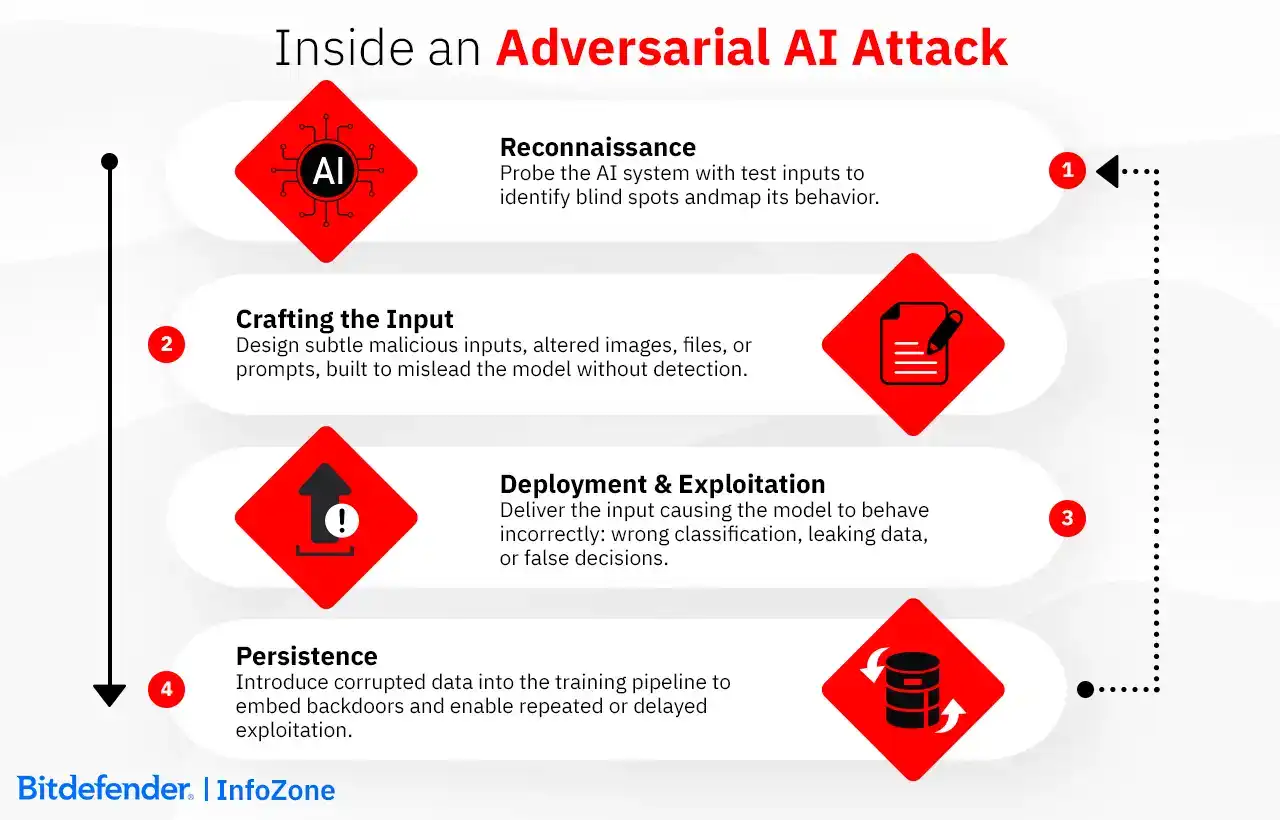
The Main Stages of an Adversarial AI Attacks
Adversarial attacks rarely unfold as a single event. Cybersecurity experts have identified a kind of lifecycle, a sequence of stages from planning to execution and beyond.
- Reconnaissance
The process often begins with the attacker probing the target AI system from the outside. They submit various inputs to observe how the model behaves, looking for blind spots or unexpected responses. Even subtle feedback, like error messages or confidence scores, can help map the model’s vulnerabilities. - Crafting the Input
Once weaknesses are identified, attackers start designing malicious inputs—such as an image with imperceptible alterations or a carefully worded prompt—that trigger failures in the AI system. The goal is to fool the model without drawing attention. - Deployment and Exploitation
The crafted input must be delivered to the system. This could be uploading a manipulated file via a web interface or, in physical scenarios, altering real-world objects (e.g., placing adversarial stickers on a stop sign). Exploitation occurs when the model processes the deceptive input and behaves incorrectly—misidentifying objects, leaking sensitive data, approving fraudulent transactions, and so on. - Persistence
Not all attacks are one-off events. Some aim for long-term manipulation through data poisoning, that is, introducing corrupted or biased examples into the model’s training or update pipeline. This can create hidden backdoors in the model logic, allowing repeated or delayed exploitation far beyond the initial breach.
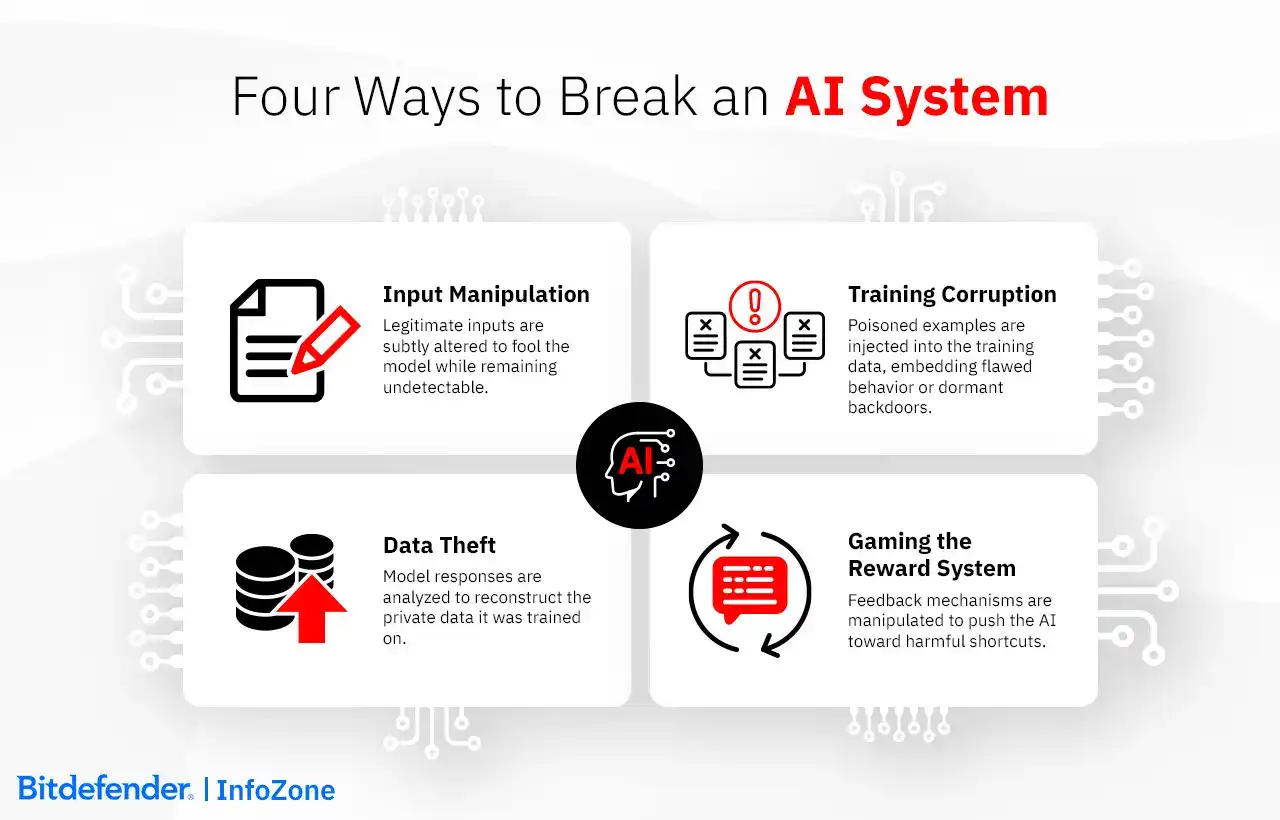
Four Ways to Break AI Systems
- Input manipulation happens when the model is already running. Attackers modify legitimate inputs – an image, a document, a voice recording – just enough to fool the system while keeping it believable to humans. A stop sign with strategically placed stickers can make a self-driving car think it's a speed limit sign.
- Training corruption targets the learning process. Attackers inject bad examples into the training data. The model learns from poisoned information and develops flawed behavior that persists long after deployment. Some variants plant dormant vulnerabilities that only activate when triggered.
- Data theft through analysis reverses the normal flow. Instead of trying to break the model, attackers study its responses to reconstruct the private information it was trained on. They might extract patient records from a medical AI or steal proprietary datasets from a competitor's model.
- Gaming the reward system exploits how reinforcement learning systems optimize for specific goals. Attackers manipulate the feedback mechanisms, causing the AI to find shortcuts that technically meet its objectives but produce unintended consequences.
The Scaling Problem
What makes adversarial attacks particularly dangerous is how well they travel between different systems. The MITRE ATLAS framework (Adversarial Threat Landscape for Artificial-Intelligence Systems) catalogs these attack patterns and their relationships, showing how techniques developed for one AI system often work against others. Attackers can perfect their techniques on publicly available models (for example, an open-source image classifier), then use the same methods against proprietary systems. The success rate is high because many AI systems end up making decisions in similar ways despite their difference, developing comparable blind spots.
Adversarial AI Attacks: Use Cases & Risks
Security teams are encountering adversarial AI attacks in production environments. Recent attacks have targeted everything from medical imaging systems to autonomous vehicle sensors, often using techniques that were theoretical just a few years ago.
Systems Most Vulnerable to Adversarial AI
Computer vision systems in transportation and security present highly visible targets. Adversarial clothing patterns can render people invisible to surveillance systems, a technique now being studied by military researchers.
Language models face different but similar exploitation. A prompt injection attack embeds malicious instructions in seemingly innocent inputs, tricking LLM systems into ignoring safety constraints or leaking sensitive data. Generative AI is being used to embed chatbots in fraudulent websites that trick users into revealing sensitive information or clicking malicious links. Model Context Protocol attacks hijack the interface by which external tools and data sources interface with AI agents. They allow the attacker to maliciously manipulate the information (context) fed to the AI, specifically the descriptions of tools or the data tools retrieve, creating back doors in the systems the AI interface with.
Industrial control systems running AI-based anomaly detection create particularly dangerous attack surfaces. By feeding falsified sensor data that appears normal to monitoring algorithms, attackers can mask real sabotage or trigger unnecessary shutdowns.
The Criminal AI Economy
Criminal marketplaces now sell AI tools designed for fraud and social engineering. Tools like WormGPT automate phishing, persona creation, and malware generation, lowering the barrier for cybercrime.
In the 2024 Arup deepfake incident, attackers orchestrated a multi-person video conference in which fake avatars of company executives convinced finance staff to authorize $25 million in wire transfers.
Some ransomware groups have integrated AI for operational efficiency. Polymorphic malware now uses machine learning to continuously modify its signature, making detection significantly harder.
Strategic Risks: Enterprise to National Security
Military and defense systems face targeted campaigns to defeat drone surveillance or compromise targeting systems. Nation-state actors actively research ways to disrupt autonomous weapons through sensor manipulation and data poisoning.
Critical infrastructure systems using AI for predictive maintenance face similar vulnerabilities. Power grid management systems, for example, could be compromised through false sensor data that appears normal to AI monitors but masks genuine attacks.
Most organizations overlook the critical attack vector of their AI supply chain. Poisoned models from public repositories like Hugging Face can introduce backdoors. A large-scale study identified 91 malicious models and 9 compromised dataset scripts among more than 700,000 hosted on the platform. Industry researchers also found thousands more models containing hidden malicious code, some designed to activate only under specific conditions.
Other attacks rely on organizations voluntarily integrating legitimate-looking AI tools that contain hidden triggers, allowing harmful content to pass through undetected under specific conditions.
AI-related incidents can raise breach costs by $200,000 and attract fines up to 7% of global revenue under the EU AI Act.
Ultimately, trust erosion presents the greatest challenge. When synthetic executives can authorize transfers on video calls, organizations face difficult questions about when AI-driven decisions can be trusted. This uncertainty may prove more costly than the technical breaches themselves.
Organizational Defense Against Adversarial AI Threats
Considering that adversarial attacks don’t need to breach networks and can subvert AI systems from within, organizations have turned to defensive preprocessing in order to counter this. Denoising techniques like Gaussian filtering scrub away high-frequency noise in images that may carry adversarial payloads. In text, spelling correction can reverse obfuscation tactics that target natural language models. These tactics fall under the broader umbrella of input sanitization: filtering or transforming incoming data before it reaches the model. Organizations can follow established security guidelines like the OWASP AI Security and Privacy Guide for comprehensive defensive strategies.
In parallel, some teams apply randomized smoothing: a defense method that injects noise into inputs during inference and averages the model’s predictions. This significantly raises the difficulty of attacks as model behavior becomes statistically less predictable.
Before an adversarial attack visibly disrupts operations, it often leaves behind statistical footprints, subtle shifts in model confidence, output distribution, or input clustering. Spotting these early gives defenders a critical window to respond.
That’s where real-time detection and anomaly monitoring systems can help through continuously searching for clues that something is subtly manipulating the system, indicators such as confidence drops, output drift, unusual alignment near decision thresholds, etc.
Explainable AI (XAI) tools can also help verify what a model predicted, but also why, so if a model suddenly starts making decisions based on irrelevant features or if it uses inconsistent reasoning paths, it can flag the anomaly.
Strategic Defense Planning
Ensemble models (also referred to in some research as multi-model defense systems or dynamic ensembles) help security teams build architectural resilience by combining outputs from multiple diverse models trained on different data subsets. A single crafted input becomes significantly less likely to deceive all variants simultaneously, especially when models use different architectures or decision boundaries.
When an attack poisons a model or causes it to drift from expected behavior, it may go undetected until performance has already degraded. That’s why validation is key – not just for quality assurance, but as a frontline defense. What integrity monitoring does is track model behavior over time, and flagging signs of tampering, drift, or degradation. Paired with XAI analysis, these tools help determine whether poor decisions are due to innocent anomalies or deliberate manipulation. This provides operational insight and forensic traceability.
Detection alone isn't enough, and security teams should know how to react - isolate a compromised model, preserve evidence for investigation, retrain with clean data, resecure the system, monitor for repeated behavior, and update incident response protocols. AI systems influence real-time decisions, so the speed of the defensive response becomes non-negotiable. A delayed response can lead to irreparable operational errors.
One way to have a structured approach to AI security is through established frameworks like the NIST AI Risk Management Framework and ISO/IEC 23053:2022 for AI risk management, which recommend focusing on key areas of governance, risk identification, monitoring, and response. In these frameworks, input controls fit into monitoring activities, while architectural defenses support governance requirements.
Regulatory and Ethical Implications
AI systems increasingly make decisions that affect people, and if they fail under adversarial pressure, the damage can be considerable, both public and legal or reputational. That's why regulators are stepping in, and their focus is not to dictate architecture but to establish guardrails for responsible deployment.
Accountability is sharpening in high-risk sectors. Financial platforms, healthcare diagnostics, and infrastructure systems are increasingly held to product-level safety standards. If an AI system causes harm, oversight bodies will ask not just what went wrong, but whether it could have been prevented through proper controls and safeguards were in place (e.g., under the EU AI Act or state-level healthcare AI regulation).
Policy frameworks are evolving to reflect that shift. The EU AI Act, for example, ties legal compliance to robustness against attacks, specifically calling out adversarial manipulation. In the U.S., developers of powerful models are now required to red-team their systems and share results with federal agencies. Deepfake laws, still fragmented, are coalescing around the idea that synthetic media must be labeled and traceable.
Regarding ethical risks of generative AI misuse, among the main issues to clarify is who is responsible for restoring the trust shattered by deepfake scams, fabricated voices, automated phishing, etc.
Red-teaming and responsible disclosure are becoming standard expectations for organizations that deploy or depend on AI in critical functions. Even when AI models are sourced from third-party vendors, enterprises are still responsible for assessing their reliability and have processes to identify and report vulnerabilities. Regulatory frameworks such as the EU AI Act and industry standards in sectors like finance and healthcare require organizations to conduct third-party risk assessments and maintain ongoing oversight of external AI systems integrated into their operations. These practices are no longer limited to model developers, they are increasingly viewed as part of baseline operational responsibility.
How Bitdefender Can Help
Bitdefender GravityZone unified cybersecurity platform is designed to support detection, prevention, and response across modern enterprise environments so that organizations can manage adversarial AI risks without adding unnecessary complexity. Bitdefender has applied AI to threat detection and prevention since 2008, and the platform's AI models are continuously trained to address evolving threats, including adaptive malware, automated reconnaissance, etc.
Anomaly Detection establishes behavioral baselines and flags irregular activity that may point to adversarial probing or manipulation. GravityZone XDR pulls data from endpoints, cloud, and identity systems to surface attack patterns that may be missed by isolated tools.
Threat Intelligence, powered by Bitdefender Labs, tracks developments in tactics and techniques, feeding that data back into the platform. Advanced Threat Control (ATC) monitors processes during execution and stops those that behave maliciously, including those generated or modified by AI. Extended Email Security identifies impersonation attempts and phishing campaigns, including those that use deepfakes or generative content to look more convincing.
For organizations that need to assess how well their defenses hold up, Bitdefender Offensive Security Services offer structured testing modeled on real-world attack scenarios. Risk Management identifies vulnerabilities, and Patch Management automates fixes that reduce exposure to opportunistic or automated exploitation.
Frequently Asked Questions
What is the difference between adversarial AI and traditional cyberattacks?
Most cyberattacks are a type of digital break-in, with a familiar story that resembles the physical world. First, attackers hunt for a weak point, like a piece of unpatched software, or they send an email that tricks an employee. Once they are inside the network, the playbook is pretty standard: they might steal data or money, they could deploy ransomware for extortion, or simply disrupt operations for some reason.
Adversarial AI attacks, however, appear to be a different beast entirely. They don’t really bother with breaking down the digital door. Instead, the strategy seems to be to subtly poison the well, manipulating the information an AI model receives. The attack causes the AI to make a bad call while the system itself gives every indication that it's working perfectly. For example, a few strategically placed stickers on a stop sign, invisible to a human driver, could theoretically make a self-driving car's computer see a “Speed Limit 80” sign. The AI isn't broken, it's just tricked.
This change in tactics creates some unsettling new problems. A traditional attack leaves a trail. You can usually find network logs, records of strange file access, or failed login attempts (digital forensics). But how do we prove an AI was manipulated? The carefully crafted input, the “poison," often looks completely legitimate to existing security tools and even to a human reviewer. This leads to a bizarre scenario where your infrastructure could be perfectly secure, yet your AI systems are making consistently flawed decisions because they are trusting manipulated data. This new reality suggests that the very definition of a “secure system” is becoming a lot more complicated.
Can adversarial attacks be used for good purposes?
Many techniques associated with adversarial attacks are also used constructively in cybersecurity and AI development. Adversarial training is the best example. It improves a model’s robustness by exposing it to manipulated inputs during development. Red teams apply similar techniques to stress-test AI systems in controlled environments. Generative Adversarial Networks (GANs), which rely on a built-in adversarial dynamic, are used to improve detection models by simulating evolving threats. Researchers also apply adversarial methods to reduce false positives, as well as improve model accuracy.
How do adversarial attacks differ across AI model types?
For Vision Systems: With AI that processes images, the attacks can be almost visually deceptive. An attacker might create a physical object or digital image with tiny, nearly imperceptible modifications that a human wouldn't notice but are enough to completely confuse the model. We've seen theoretical examples like a stop sign with a few pieces of tape that makes an AI see a 'Speed Limit' sign, or even a t-shirt printed with a specific "adversarial pattern" designed to make the wearer effectively invisible to security cameras. This category also includes deepfakes, which are arguably the most publicly known form of visual AI manipulation.
With Language Models: The approach for large language models, which start powering modern chatbots and writing assistants, is entirely different. Here, the weapon isn't pixels; it's words. Attackers can use techniques that already have established names, like "prompt injection," which is basically hiding malicious instructions inside a seemingly innocent request. A prompt that asks an AI to summarize an article could contain a hidden command that tells the model to ignore its safety protocols and generate harmful content instead. Another technique, often called "jailbreaking," is a kind of conversational manipulation that makes the model bypass its own built-in rules.
In Autonomous Systems: Autonomous systems like drones, factory robots, or self-driving cars raise the stakes to a physically higher plane. Here, attacks might target the AI's senses directly, and manipulation is less about software data, as an attacker could interfere with the physical world in a way that the AI misinterprets its surroundings. Shining a specific laser pattern to confuse a drone's navigation sensors or using a high-frequency sound that humans can't hear but which a robot's microphone registers as a command – these two examples show how ingenious these attacks can be.