
GravityZone vs. CrowdStrike Falcon
Prevention-first endpoint security, measured.
Same year, same evaluator, same tests. In 2025 AV-Comparatives Advanced Threat Protection testing, Bitdefender GravityZone blocked 87% of attacks before they reached the detection layer. CrowdStrike Falcon blocked 47%. Across 2,901 real-world attacks tested over three years, GravityZone allowed 3 system compromises. Falcon allowed 28. The architectural choice — prevention-first design versus detection-led — is what produces these numbers.
AT A GLANCE
Six metrics, one evaluator, same year.
Every figure below is taken directly from a published AV-Comparatives report. Both vendors tested against identical scenarios; both configured per their own guidelines.
|
METRIC |
GRAVITYZONE |
FALCON |
GRAVITYZONE ADVANTAGE |
|---|---|---|---|
|
ATP 2025 Enterprise: pre-execution prevention rate |
86.7% |
46.7% |
+40 points |
|
ATP 2025 Enterprise: total ATP score |
15/15 |
15/15 |
Tied |
|
EPR 2025: Phase 1 Active Response (cumulative) |
100% |
92% |
+8 points |
|
EPR 2025: 5-year cost per agent (CyberRisk Quadrant) |
$210 |
$1,245 |
5.9× lower |
|
Business Security 2023-2025: compromised systems |
3 |
28 |
9.3× fewer |
|
Business Security 2023-2025: cumulative false alarms |
11 |
144 |
13× fewer |
Sources and methodology detailed at the bottom of this page.
Multi-Year Tests Confirm The Results.
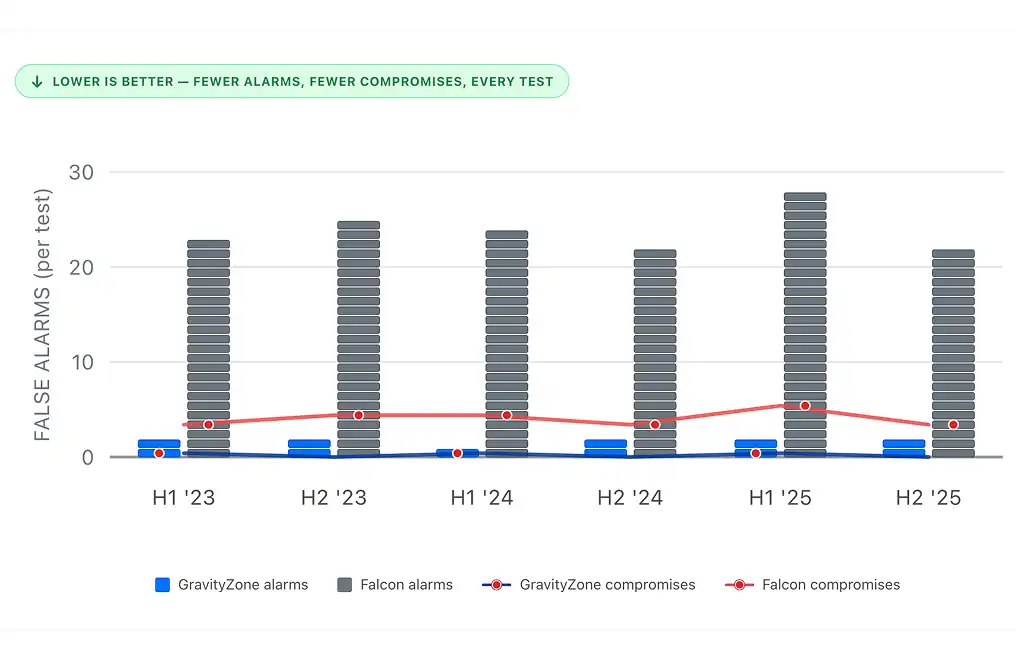
Per-test counts shown are illustrative; the cumulative totals (3 vs 28 compromised systems; 11 vs 144 false alarms) are taken directly from the six published
AV-Comparatives Business Security Test reports.
CALCULATE YOUR SAVINGS
What does the cost gap mean for your environment?
How much more affordable is Bitdefender GravityZone than CrowdStrike Falcon? Adjust the inputs below to see your environment's projected savings. Calculations are based on AV-Comparatives EPR 2025 report, which analyzed five year per-agent total cost of ownership.
TIME PERIOD
1 YEAR
FALCON TOTAL COST
$
${price} per agent over {period} years (scaled to {scaledPeriod} years)GRAVITYZONE TOTAL COST
$
${price} per agent over {period} years (scaled to {scaledPeriod} years)YOU SAVE WITH GRAVITYZONE
$
Over {period} years • {priceMultiply}× lower per agentEstimate based on AV-Comparatives EPR Comparative Report 2025 published 5-year total cost of ownership ($210 per agent for GravityZone, $1,245 per agent for Falcon). Methodology includes list price, breach-cost contribution per scenario (using IBM's $4.4M-per-breach 2025 average applied to the unblocked portion of each scenario), operational accuracy penalty, and workflow delay penalty. Real-world pricing varies; volume discounts and enterprise agreements may apply.
WHY THIS IS ARCHITECTURAL, NOT ACCIDENTAL
Prevention-first vs detection-led — different design choices, different outcomes.
CrowdStrike Falcon and GravityZone solve the same business problem — protecting endpoints against advanced attacks — through different architectural philosophies.
Falcon's design centers on detection: capture more telemetry, correlate faster, alert and respond.
GravityZone's design centers on prevention: stop more attacks before they execute so the detection layer handles a smaller, more distinguishable signal.
When 84% of high-severity attacks use legitimate administrative tools (Bitdefender Labs analysis of 700,000 incidents), the question becomes: do you detect after-the-fact, or do you prevent the legitimate tool from being abusable in the first place?
+40 points
The 40-percentage-point pre-execution prevention gap in 2025 AV-Comparatives ATP testing is what each architecture produces when measured by the same evaluator against the same scenarios.
-

PHASR — Per-user attack surface reduction
GravityZone PHASR uses AI to create behavioral profiles for each user and dynamically restricts access to tools outside legitimate patterns. An accountant who never runs PowerShell can't, even if their credentials are stolen.
-

NAD — Secure web gateway on every endpoint
Network Attack Defense (NAD) uses deep-packet inspection wherever the endpoint connects. This catches command-and-control traffic, lateral movement, ZeroLogon, PrintNightmare, EternalBlue, and more.
-

HyperDetect — Pre-execution ML detection
HyperDetect is tunable machine learning that catches malware before it executes — including signature-evading variants and obfuscated payloads that traditional antivirus misses.
-

Process Protection — Runtime behavioral defense
Process Protection catches supply-chain attacks and zero-days at runtime. It also catches trusted, signed applications that have been compromised mid-execution — when a legitimate app starts behaving like malware.
Where the architecture matters most
Two capability dimensions where Falcon cannot easily match.
Beyond the test results, two structural differences shape which environments each product can serve — and which it cannot.

Deployment flexibility
Cloud, hybrid, on-premises, and air-gapped. Required for defense contractors, classified networks, federal procurement, and regulated healthcare. Cloud-only architectures cannot serve customers where on-premises or air-gapped operation is mandated by policy or regulation.
Compliance framework coverage
GravityZone Compliance Manager maps technical controls against 16 named standards including NIST CSF 2.0, HIPAA, SOC 2, CMMC 2.0, PCI DSS v4.0.1, ISO 27001, DORA, and NIS 2. Audit-ready reports across multiple jurisdictions.
WHAT CUSTOMERS SAY


Common questions about Bitdefender vs CrowdStrike.
Is Bitdefender a cheaper alternative to CrowdStrike?
Yes. AV-Comparatives EPR 2025 published total cost of ownership of $210 per agent for GravityZone versus $1,245 for Falcon — 5.9× lower per-agent cost over a 5-year contract on a 5,000-agent baseline. The cost includes list price, breach-cost contribution per scenario (using IBM's $4.4M-per-breach 2025 average), operational accuracy penalty, and workflow delay penalty. GravityZone's 100% Phase 1 Active Response means no breach-cost contribution; Falcon's 92% leaves four scenarios for Phase 2 cleanup.
Does Bitdefender work on Mac and Linux as well as Windows?
Yes — with comparable depth. Through a single agent, GravityZone protects Windows, Linux, macOS, iOS, Android, and Chromebook environments. Process Protection (Advanced Threat Control plus Process Introspection) operates across Windows, macOS (full version), and Linux (report-only mode). The same prevention-first architecture applies on each platform — PHASR behavioral profiles, Network Attack Defense at the agent level, and HyperDetect pre-execution machine learning all extend beyond Windows.
Can Bitdefender be deployed in air-gapped environments?
Yes. GravityZone supports cloud-delivered, hybrid, and on-premises deployment, including fully air-gapped environments — confirmed in Gartner Magic Quadrant 2025 commentary. This matters for defense contractors, classified networks, regulated healthcare with strict data-residency requirements, and certain manufacturing and critical-infrastructure use cases. Falcon's cloud-only architecture cannot serve these environments.
How does Bitdefender's threat detection compare to CrowdStrike's?
GravityZone prioritizes prevention before detection. In 2025 AV-Comparatives Advanced Threat Protection testing, GravityZone prevented 87% of attacks at the pre-execution stage; Falcon prevented 47%. Across six AV-Comparatives Business Security Tests (2023-2025), GravityZone generated 13× fewer false alarms than Falcon — 11 vs 144. The architectural choice means GravityZone's detection layer handles a smaller, more distinguishable signal with less analyst overhead — and in MITRE ATT&CK® Evaluations for Managed Services 2024, that translated into 82 emails and alerts versus 579 from Falcon, with both achieving 93% actionable coverage.
Should I choose Bitdefender or CrowdStrike for my Microsoft 365 environment?
Both protect Microsoft 365 environments. The architectural difference still applies: GravityZone prevented 87% of attacks at pre-execution in 2025 AV-Comparatives ATP testing; Falcon prevented 47%. GravityZone's Microsoft 365 sensor integrates Office 365 telemetry into the same correlation engine that handles endpoint, identity, and network events — so an attacker pivoting from a phishing email through credential theft to lateral movement surfaces as a single incident, not three disconnected alerts.
What about ransomware protection specifically?
GravityZone's ransomware mitigation is independent of Windows Volume Shadow Copy — most modern ransomware strains explicitly delete shadow copies as part of standard playbooks, defeating recovery solutions that rely on them. GravityZone uses real-time tamper-proof backup of files under encryption attempt, with security teams able to restore data effortlessly through the GravityZone console. AV-Comparatives EDR Detection Validation Test 2026 awarded GravityZone certification across all 14 attack steps in APT-style intrusion testing.
Does Bitdefender include web content filtering or URL blocking?
Yes. GravityZone Content Control filters web access by URL, domain, and category — included in the standard endpoint license. The same agent that handles endpoint protection also enforces web access policies, covering both security (blocking known-malicious URLs, phishing pages, anonymous proxies, and command-and-control domains) and acceptable-use enforcement (categories such as social media, streaming, gambling, or adult content). HTTPS scanning and SSL certificate validation are built in, and policies follow the user across networks because the enforcement runs on the endpoint, not at a perimeter. CrowdStrike Falcon does not include category-based web content filtering as a built-in capability; web access control on a Falcon-protected fleet typically requires a separate secure web gateway (Zscaler, Netskope, or similar) and a second agent on each endpoint.
Every figure on this page is taken directly from a published independent third-party report.
- AV-Comparatives Advanced Threat Protection Test 2025 (Enterprise) — Autumn 2025; published November 2025. Source for pre-execution rate and total ATP score.
- AV-Comparatives EPR Comparative Report 2025 — Test June-August 2025; published September 2025. Source for Phase 1 Active Response and 5-year per-agent cost (page 14, CyberRisk Quadrant Key Metrics).
- AV-Comparatives Business Security Tests 2023-2025 — Six half-year reports. Source for compromised systems count and cumulative false alarms.
- MITRE ATT&CK® Evaluations for Managed Services 2024 — Source for the alert-volume comparison (82 emails and alerts for GravityZone vs 579 for Falcon, both at 93% actionable coverage).
- Forrester Wave for XDR Q2 2024 — Source for verbatim process-tree quote.
- Gartner Peer Insights Voice of the Customer for EPP — November 2025 data.
Configuration notes: GravityZone's HyperDetect was disabled during ATP 2025 testing — the 87% pre-execution rate is therefore a floor, not a ceiling. ATP and Business Security tested GravityZone Business Security Premium 7.9; EPR tested GravityZone Business Security Enterprise 7.9. CrowdStrike tested Falcon Pro in ATP and Business Security and Falcon Elite in EPR. AV-Comparatives chooses scenarios; vendors do not see them in advance.
All figures verified against published reports as of 6 May 2026.
Trademark Notice: CrowdStrike, CrowdStrike Falcon, Falcon, and related marks are trademarks of CrowdStrike Corporation. MITRE ATT&CK® is a registered trademark of The MITRE Corporation. Gartner® and Peer Insights™ are trademarks of Gartner, Inc. All other trademarks are the property of their respective owners. The use of these trademarks is for identification purposes only and does not imply endorsement or affiliation.
Disclaimer: The performance data cited in this document reflects results from specific third-party tests conducted under controlled conditions. Actual results may vary depending on configuration, environment, threat landscape, and other factors. This document is provided for informational purposes only and does not constitute a guarantee of performance or protection level.