
GravityZone vs. Microsoft Defender
Endpoint security from a security vendor.
Across six independent AV-Comparatives Business Security Tests over three years, Bitdefender GravityZone allowed 3 system compromises. Microsoft Defender allowed 29, 9.7× more breach moments. In MITRE ATT&CK® Evaluations for Managed Services 2024, 93% of GravityZone's alerts were rated actionable; Microsoft's: 63%. The choice is between an independent security vendor specialized in endpoint protection and a security capability bundled with the platform you're protecting.

AT A GLANCE
Four metrics, two evaluators, three years.
Every figure below is taken directly from a published AV-Comparatives or MITRE Engenuity report. Both vendors tested against identical scenarios; both configured per their own guidelines.
|
METRIC |
GRAVITYZONE |
MICROSOFT DEFENDER |
GRAVITYZONE ADVANTAGE |
|
Business Security 2023-2025: compromised systems (of 2,901 in-the-wild attacks) |
3 |
29 |
9.7× fewer |
|
Business Security 2023-2025: cumulative false alarms |
11 |
14 |
21% fewer |
|
MITRE ATT&CK® Managed Services 2024: Reported (actionable) detection rate |
93% |
63% |
+30 points |
|
MITRE ATT&CK® Managed Services 2024: total alerts generated (43-substep scenario) |
82 |
385 |
4.7× fewer |
Sources and methodology detailed at the bottom of this page.
Six tests. Three years. Verified per-test data.
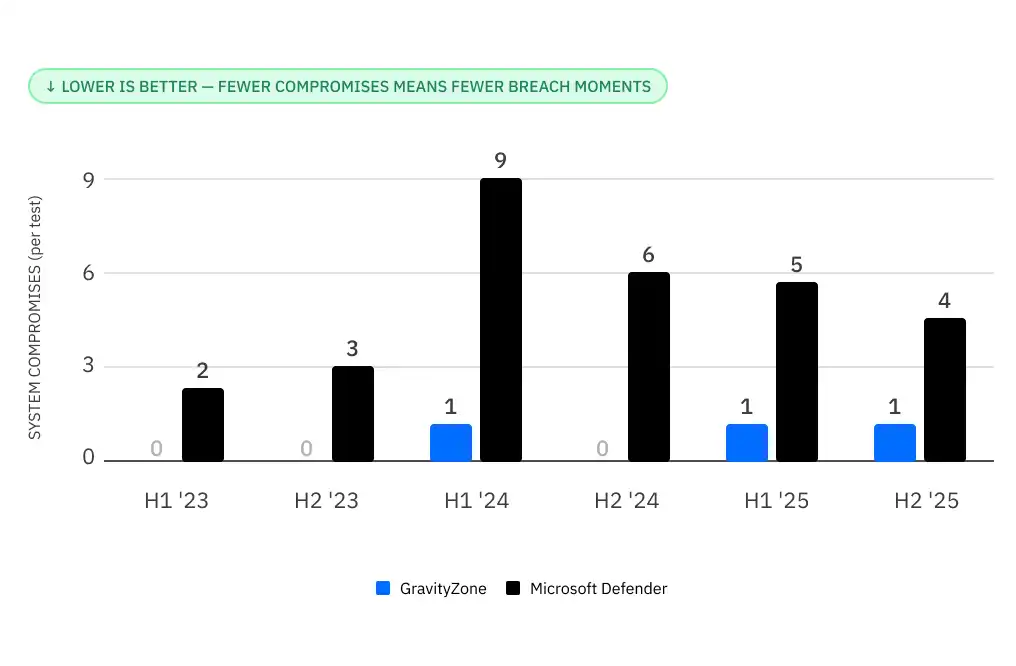
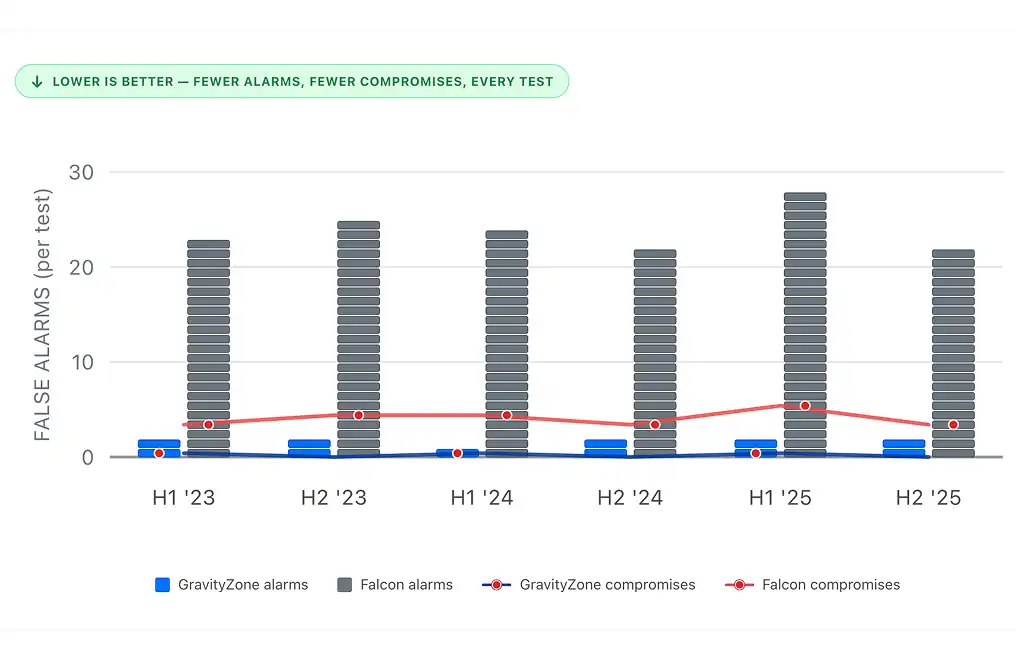
Per-test counts are taken directly from the AV-Comparatives Business Security Test reports for each half-year period (H1 2023 through H2 2025). Both vendors participated in all six reports against the same in-the-wild URL attack sets.
COST & LICENSING REALITY
Microsoft Defender isn't free. It's bundled, and servers are licensed separately.
A common assumption is that Microsoft Defender comes "for free" with Windows. The reality is more nuanced — the protection depth most security teams need is gated behind specific Microsoft 365 license tiers, and server protection is a separate product line altogether.
The bundle-dependency and server-licensing points reflect Microsoft 365 / Defender for Endpoint / Defender for Cloud licensing structure as published by Microsoft. Specific list prices are intentionally omitted because Microsoft's pricing changes; the structural points (server protection sold separately, Azure tenancy required, Defender for Business 60-server cap) are stable across pricing revisions.
WHY THIS IS ARCHITECTURAL, NOT ACCIDENTAL
An independent security vendor versus an OS-bundled add-on.
Microsoft Defender ships with the operating system. It's a feature of the platform — built by the company that also makes the platform, monetized as part of the Microsoft 365 / E5 bundle, and sold under the same vendor relationship as Windows, Office, and Azure.
GravityZone is built by an independent security company specialized in endpoint protection and managed detection — that is the only product portfolio Bitdefender sells. Bitdefender Labs runs threat research as a primary business, analyzing over 50 billion daily threat queries from hundreds of millions of systems.
When an OS vendor sells security as a feature of the platform, the question becomes: who is the security buyer's relationship with — the company whose products an attacker is exploiting, or a company whose only job is to stop the attacks?
-

GravityZone PHASR
Proactive Hardening and Attack Surface ReductionBehavioral profiles per user dynamically restrict access to tools outside legitimate patterns. An accountant who never runs PowerShell can't, even if their credentials are stolen.
-

Network Attack Defense (NAD)
Secure web gateway on every endpointDeep-packet inspection wherever the endpoint connects. Catches command-and-control traffic, lateral movement, ZeroLogon, PrintNightmare, EternalBlue.
-

HyperDetect
Pre-execution ML detectionTunable machine learning catches malware before it executes — including signature-evading variants and obfuscated payloads that traditional antivirus misses.
-

Process Protection
Runtime behavioral defenseCatches supply-chain attacks and zero-days at runtime. Also catches trusted, signed applications that have been compromised mid-execution — when a legitimate app starts behaving like malware.
Predictable = targeted
Microsoft's built-in security controls — Volume Shadow Copy (VSS), the Antimalware Scan Interface (AMSI), Windows Defender Tamper Protection, Attack Surface Reduction rules — are everywhere on Windows machines. That ubiquity is also their weakness: every attacker has unlimited time on their own copy of Windows to study and bypass them. AMSI bypass techniques are publicly documented in security research; VSS shadow-copy deletion is a standard step in modern ransomware playbooks (Conti, REvil, LockBit, BlackCat). Several controls are also tied to specific Windows versions and Microsoft 365 / Defender for Endpoint license tiers — Tamper Protection arrived in late 2019, Attack Surface Reduction rules require a Defender for Endpoint license, and feature parity differs between Windows 10 and Windows 11 and between Windows Server versions. GravityZone's prevention layers (PHASR, HyperDetect, Process Protection) and ransomware mitigation operate independently of these OS-level controls and are uniform across the supported OS list.
Where the difference matters most


Mixed-OS environments
Microsoft Defender's protection depth is Windows-first; macOS and Linux coverage is narrower than the Windows feature set. GravityZone protects Windows, Linux, macOS, iOS, Android, and Chromebook through a single agent, with 100% analytical coverage on Linux and 100% on macOS in MITRE ATT&CK Evaluations 2024 with zero false positives. Multi-OS isn't a checkbox — it's depth on every platform.

Regulated industries & data sovereignty
EU regulations including NIS 2, DORA, GDPR data residency, and the EU Cyber Resilience Act increasingly favor security stacks where the security vendor and the platform vendor are independent of each other. GravityZone Compliance Manager maps technical controls against 16 named standards (NIST CSF 2.0, HIPAA, SOC 2, CMMC 2.0, PCI DSS v4.0.1, ISO 27001, DORA, NIS 2 and more). Vendor diversity isn't a slogan; it's an audit posture.

Air-gapped & on-premises deployments
Microsoft Defender for Endpoint is fundamentally cloud-managed. Air-gapped, fully-disconnected, and on-premises-only deployments are difficult or unsupported in most configurations. GravityZone supports cloud-delivered, hybrid, on-premises, and air-gapped deployment — confirmed in Gartner Magic Quadrant 2025 commentary. Required for defense contractors, classified networks, regulated manufacturing, and federal procurement.

Operational simplicity vs portal sprawl
A Microsoft-only security team typically operates across six or more separate portals: the Microsoft Defender portal (security.microsoft.com), Microsoft Intune (intune.microsoft.com), Microsoft Entra (entra.microsoft.com), the Azure portal (portal.azure.com) for both Defender for Cloud and Microsoft Sentinel, Microsoft Purview (purview.microsoft.com), and the Microsoft 365 admin center. Microsoft itself catalogs these portals and even publishes a dedicated "Azure portal vs Defender portal feature comparison" page explaining how the same product (Defender for Cloud) behaves differently depending on which console you open. GravityZone manages endpoints, servers, mobile, and identity-aware detection from a single console with one policy model.
WHAT CUSTOMERS SAY


Common questions about Bitdefender vs Microsoft Defender.
Is Microsoft Defender enough for my Windows environment?
It depends on what "enough" means and what's at stake when prevention fails. In six AV-Comparatives Business Security Tests run between 2023 and 2025, Microsoft Defender allowed 29 systems to be compromised across 2,901 in-the-wild attacks. GravityZone allowed 3 across the same attack set. Both vendors participated in all six tests, configured per their own deployment guidelines. The 0.9-percentage-point protection-rate gap (99.0% vs 99.9%) translates into a 9.7× difference in actual breach moments — the metric that drives breach response cost and downtime.
How does Bitdefender compare to Microsoft Defender on Mac and Linux?
Microsoft Defender's protection depth is Windows-first; macOS and Linux feature sets are narrower than the Windows feature set. GravityZone protects Windows, Linux, macOS, iOS, Android, and Chromebook through a single agent. In MITRE ATT&CK Evaluations 2024, GravityZone achieved 100% analytical coverage on Linux and 100% on macOS, with zero false positives. Process Protection (Advanced Threat Control plus Process Introspection) operates across Windows, macOS (full version), and Linux (report-only mode). The same prevention-first architecture — PHASR behavioral profiles, Network Attack Defense, HyperDetect pre-execution machine learning — extends beyond Windows.
Doesn't Windows already include things like Volume Shadow Copy and AMSI? Why add a separate security product?
Built-in Windows security mechanisms — Volume Shadow Copy (VSS) for backup/restore, the Antimalware Scan Interface (AMSI) for in-memory script scanning, Tamper Protection for Defender process integrity, Attack Surface Reduction (ASR) rules — are present on every Windows installation. That ubiquity is also their weakness: every attacker has unlimited time on a Windows machine to develop and refine bypasses, and the bypass techniques are then reused at scale. AMSI bypass techniques are publicly documented in security research literature. VSS shadow-copy deletion is a standard step in modern ransomware playbooks (Conti, REvil, LockBit, BlackCat). The attacker doesn't bypass VSS, they delete the shadow copies and defeat any recovery solution that relies on them. Several Microsoft controls are also tied to specific Windows versions and Defender for Endpoint license tiers, so older fleets and lower-tier installations don't have them. GravityZone's ransomware mitigation uses tamper-proof real-time backup of files under encryption attempt, independent of VSS; Process Protection monitors process behavior directly rather than relying solely on AMSI signals; and the prevention layers are uniform across the supported OS list, with no Windows-version gating inside the OS family.
How does Bitdefender's licensing model compare to Microsoft 365 / Defender for Endpoint?
Microsoft Defender for Endpoint is sold as part of Microsoft 365 / Defender for Business / E3 / E5 licensing. Getting the full Plan 2 feature set typically requires the higher license tier — an upcharge that affects the entire user base, not just security. GravityZone is sold per-endpoint with predictable renewal pricing and no dependency on a separate productivity-suite licensing tier. The same license covers Windows desktop, Windows Server, Linux server, macOS, iOS, Android, and Chromebook through one agent and one console.
How does Microsoft Defender protect server operating systems? Is it included in Microsoft 365 E5?
No. Microsoft 365 E5 and Microsoft Defender for Endpoint Plan 2 cover workstations only — Microsoft's licensing documentation explicitly states that servers are not included. Server protection is a separate product line, Microsoft Defender for Cloud (sold as Defender for Servers Plan 1 or Plan 2), and requires an Azure subscription; non-Azure on-premises servers must be onboarded through Azure Arc to receive full functionality. There is also a Defender for Business "Servers" add-on, capped at 60 servers per tenant — above that, customers move to the Defender for Cloud SKU. By contrast, GravityZone protects Windows Server and Linux server under the same per-endpoint license, through the same single agent, managed in the same single console — no Azure subscription, no Arc dependency, no separate-product-line billing.
Does running Microsoft's security stack require multiple consoles?
Yes, typically six or more. Microsoft's own documentation catalogs the portals a security team uses (learn.microsoft.com/defender-xdr/portals): the Microsoft Defender portal (security.microsoft.com) for incidents, alerts, hunting, and EDR; Microsoft Intune (intune.microsoft.com) for endpoint policy and configuration; Microsoft Entra (entra.microsoft.com) for identity, conditional access, and RBAC; the Azure portal (portal.azure.com) for Microsoft Defender for Cloud onboarding and Microsoft Sentinel workspace management; Microsoft Purview (purview.microsoft.com) for DLP and information protection; and the Microsoft 365 admin center for tenant and license management. Microsoft also maintains a dedicated "Azure portal vs Defender portal feature comparison" page describing how the same product (Defender for Cloud) has different capabilities in each console. Common workflows cross consoles: investigating an endpoint alert with identity context, configuring server policy, or changing SIEM role assignments each typically requires switching portals. GravityZone manages endpoints, servers, mobile, identity-aware detection, and policy from a single console (GravityZone Control Center) with one policy model.
How does Bitdefender MDR compare to Microsoft Defender Experts?
In MITRE ATT&CK® Evaluations for Managed Services 2024, Bitdefender's MDR generated 82 emails and management-console alerts across the 43-substep attack scenario — the lowest of all 11 participating vendors — with 93% of detections rated Reported (actionable, the highest detection-quality tier in MITRE's MDR scoring). Microsoft Defender (with Defender Experts) generated 385 alerts with 63% rated Reported. MITRE's results table also asks whether any Red Team activities were missing from incident reports: Bitdefender's answer was No; Microsoft's was Yes. For lean security teams, fewer high-quality alerts means analyst time is spent on threats that need attention rather than on triage.
Can Bitdefender be deployed in air-gapped environments? Microsoft Defender cannot.
Yes. GravityZone supports cloud-delivered, hybrid, and on-premises deployment, including fully air-gapped environments — confirmed in Gartner Magic Quadrant 2025 commentary. Microsoft Defender for Endpoint is fundamentally cloud-managed; air-gapped, fully-disconnected, and on-premises-only operation is difficult or unsupported in most configurations. This matters for defense contractors, classified networks, regulated healthcare with strict data-residency requirements, and certain manufacturing and critical-infrastructure use cases.
Does Bitdefender include web content filtering or URL blocking? Does Microsoft Defender?
Yes for Bitdefender. GravityZone Content Control filters web access by URL, domain, and category — included in the standard endpoint license. The agent enforces policies covering both security (blocking known-malicious URLs, phishing pages, anonymous proxies, and command-and-control domains) and acceptable-use enforcement (categories such as social media, streaming, gambling, or adult content). HTTPS scanning and SSL certificate validation are built in, and policies follow the user across networks because enforcement runs on the endpoint. Microsoft Defender for Endpoint's "Web content filtering" is more limited and overlaps with Microsoft Edge for HTTPS protection; full category-based filtering across all browsers and applications typically requires a separate product.
Why would my company choose an independent security vendor over the protection that ships with Windows?
Three reasons buyers most commonly cite. First, independent third-party test outcomes — fewer compromised systems, fewer false alarms, and higher actionable-detection quality across six AV-Comparatives Business Security Tests (2023-2025) and the 2024 MITRE ATT&CK Evaluations for Managed Services. Second, vendor diversity — keeping the security vendor and the platform vendor independent of each other is increasingly favored by EU regulations (NIS 2, DORA, EU Cyber Resilience Act) and by enterprise security architecture. Third, the bypass-resistance question: built-in Windows controls (Volume Shadow Copy, AMSI, Tamper Protection, ASR rules) are uniform across Windows installations, well-studied by attackers, and tied to specific Windows versions and Defender license tiers; an independent security stack adds a layer that doesn't share those constraints.
What about ransomware protection specifically?
GravityZone's ransomware mitigation is independent of Windows Volume Shadow Copy — most modern ransomware strains (Conti, REvil, LockBit, BlackCat among them) explicitly delete shadow copies as part of standard playbooks, defeating recovery solutions that rely on them. GravityZone uses real-time tamper-proof backup of files under encryption attempt, with security teams able to restore data quickly through the GravityZone console. The same independence-from-OS-controls applies to in-memory script protection: GravityZone's Process Protection monitors process behavior directly, rather than relying solely on AMSI signals that attackers actively work to bypass. AV-Comparatives EDR Detection Validation Test 2026 awarded GravityZone certification across all 14 attack steps in APT-style intrusion testing.
Every figure on this page is taken directly from a published independent third-party report.
- AV-Comparatives Business Security Tests 2023-2025 — Six half-year reports (H1 2023 through H2 2025). Source for system compromises count, cumulative Real-World Protection rate, cumulative false alarms, and the OEM-engine footnote (page 4, August-November 2025 report). Test sets per period: 526, 503, 490, 483, 438, 461 attacks → 2,901 total. Both vendors participated in all six reports. Per-period compromise counts: GravityZone 0, 0, 1, 0, 1, 1 = 3. Microsoft Defender 2, 3, 9, 6, 5, 4 = 29.
- MITRE Engenuity ATT&CK® Evaluations for Managed Services 2024 — All-vendor results table. Source for Reported (actionable) detection rate (the highest detection-quality tier in MITRE's MDR scoring methodology), total alerts generated across the 43-substep attack scenario, and the "Were any Red Team activities missing from incident reports?" column. GravityZone: 93% actionable (40 of 43 sub-steps), 82 total alerts (54 emails + 28 console), No missing activities. Microsoft Defender: 63% actionable (27 of 43), 385 total alerts (162 emails + 223 console), Yes — activities missing.
- AV-Comparatives Advanced Threat Protection / EPR / EDR Detection Validation / Special Test reports 2023-2026 — Source for the test-family participation comparison. GravityZone appears in ATP 2023, ATP 2024, ATP 2025, EPR 2024, EPR 2025, EDR Detection Validation 2026, Anti-Tampering 2025, NGFW Egress C2 2025, OS Credential Dumping 2024, and Process Injection 2024. Microsoft Defender appears in none of these.
- Forrester Wave for XDR Q2 2024 — Source for verbatim process-tree quote.
- Gartner Peer Insights Voice of the Customer for EPP — May 2026 data.
- Microsoft Defender portals catalog and Azure-portal-vs-Defender-portal feature comparison — Microsoft's own documentation pages naming the security and admin portals a Microsoft Defender deployment typically uses, and the documented feature differences between the Azure portal and the Defender portal for the same product (Defender for Cloud). Specific pages: learn.microsoft.com/defender-xdr/portals ; learn.microsoft.com/azure/defender-for-cloud/azure-portal-vs-defender-portal-comparison ; learn.microsoft.com/unified-secops/overview-defender-portal.
- Microsoft licensing documentation and service description — Source for the structural points: Defender for Endpoint Plan 1/Plan 2 license inclusion, server-licensing-separate-from-MDE rule, Defender for Business server cap, Azure tenancy and Azure Arc requirements. Specific pages: learn.microsoft.com/azure/defender-for-cloud/plan-defender-for-servers-select-plan ; learn.microsoft.com/defender-business/mdb-faq ; learn.microsoft.com/defender-endpoint/minimum-requirements. Specific list prices are not quoted because Microsoft's pricing changes; the structural points are stable.
Configuration notes: AV-Comparatives Business Security tested "Microsoft Defender Antivirus with Microsoft Endpoint Manager." MITRE Managed Services 2024 tested Microsoft Defender for Endpoint with the Defender Experts service. Specific SKU details are in each source report. AV-Comparatives and MITRE Engenuity choose scenarios, attack tools, and scoring rules; vendors do not see scenarios in advance and configure their products per their own deployment guidelines.
All figures verified against published reports as of 6 May 2026.
Independent third-party testing is one signal. Your environment is the proof.
See how GravityZone performs against the same threats Microsoft Defender was tested against — in your network, on your endpoints, with your security team.