
What is a Cybersecurity Platform?
A cybersecurity platform is an integrated software system that unifies prevention, detection, investigation, and response under a single management interface, with shared data, unified visibility, and centralized policy control across an organization's entire IT environment.
Security gaps in most organizations are not so much because they lack tools, it is rather because those tools don't share context. Examples include a firewall that cannot see what the endpoint agent detected last night or an identity system that is unaware of the lateral movement that the network sensor flagged an hour earlier. Instruments might be doing their job, but the attack still progresses undetected between them. That's the core problem a unified cybersecurity platform is designed to solve.
Tools that address a single security function are called point solutions and are built to solve one problem well, but that focus is also their limitation. Each operates on its own data and generates its own alerts, requiring its own console. Most real, serious attacks span two or three of those domains and point solutions do not offer the full picture unless there is someone to piece it together by hand.
A cybersecurity platform changes that by building these functions into a single architecture. Not integrated after the fact, but designed that way from the start, so that what one component sees, the others already know.
Cybersecurity Tool vs. Cybersecurity Platform
|
Point Solution |
Cybersecurity Platform |
|
|
Scope |
Purpose-built for specific functions with a deep coverage where deployed |
Cross-domain coverage. Depth varies by module |
|
Visibility |
Complete within its domain, but blind outside it |
Broad but also dependent on integration quality |
|
Management |
Through a dedicated console, separate for each tool |
Single control plane across the environment |
|
Integration |
Each tool integrated separately. Connections owned and maintained outside the platform |
Native within the platform. Depth outside it depends on vendor support |
|
Scalability |
Requires procurement and onboarding of separate tools as needs grow |
Modules added within existing infrastructure; roadmap tied to one vendor |
|
Cost over time |
Lower upfront. Added tools and integration raise TCO (total cost of ownership) |
Higher initial investment, but a lower TCO with a well-executed consolidation |
The terms cybersecurity platform, unified security solution, and security operations platform are used interchangeably across the industry.
How a Cybersecurity Platform Works
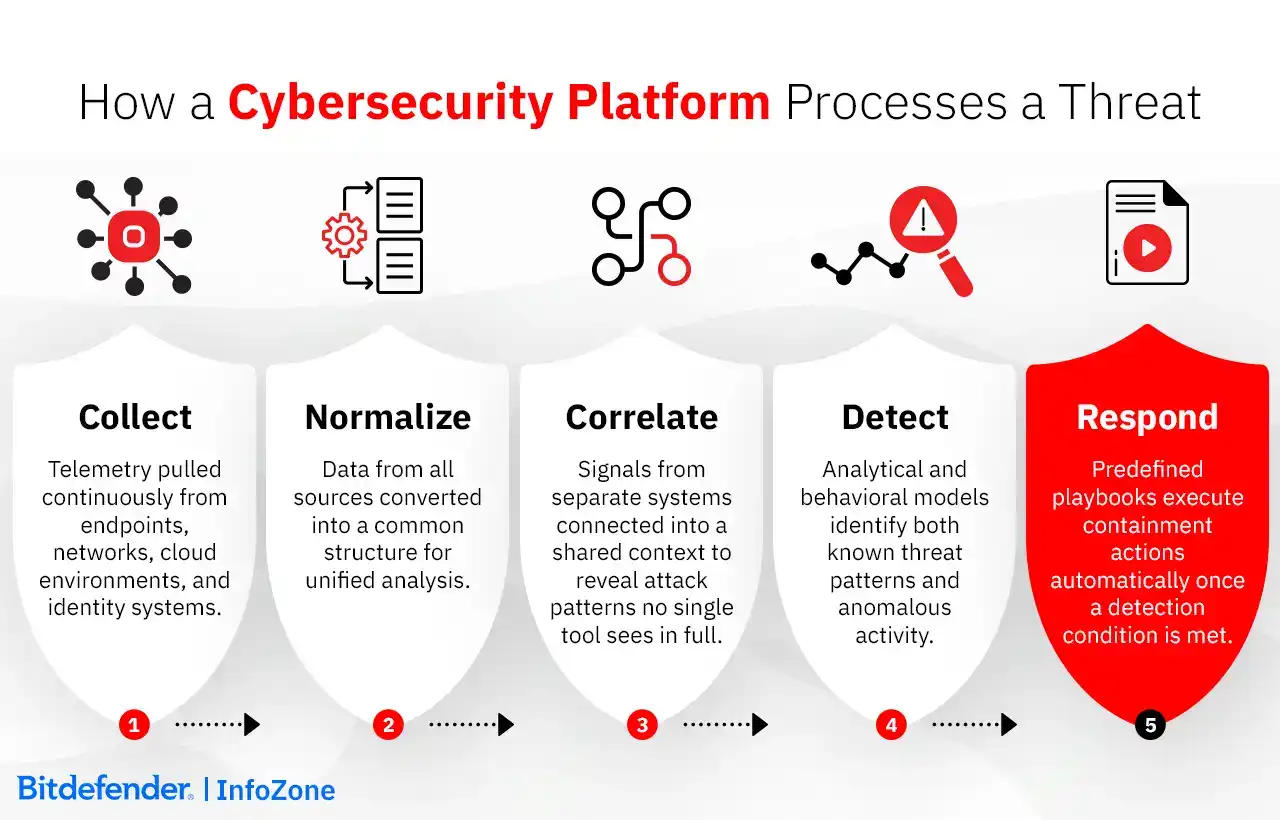
Security tools generate data. The problem is that most of that data goes nowhere useful on its own, it usually sits in a console, gets triaged manually, and often gets missed entirely. A cybersecurity platform is built around a different premise. Telemetry from endpoints, networks, cloud environments, and identity systems should feed a single processing chain where it gets normalized, correlated, and converted into something actionable. That chain is: Collect, Normalize, Correlate, Detect, Respond.
Core Architecture Components
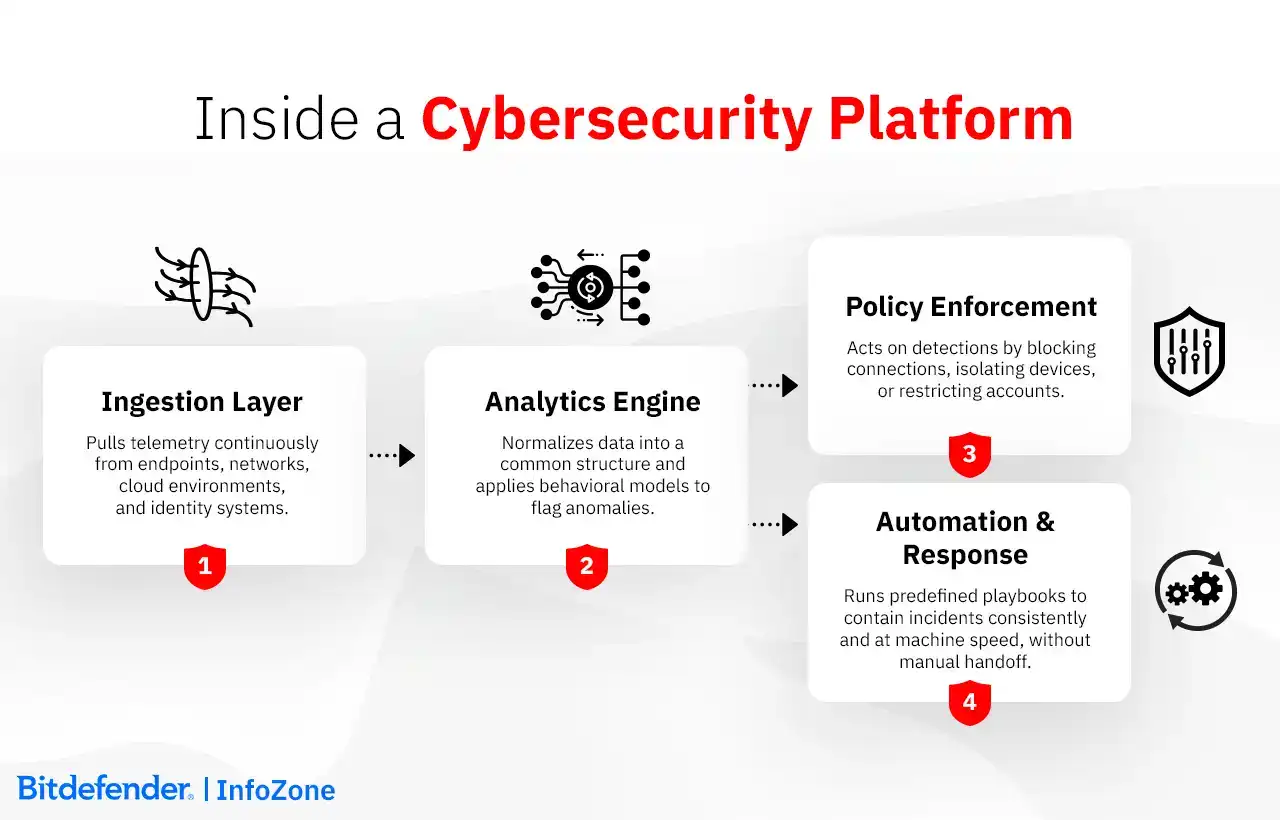
Ingestion layer. Every action an attacker takes generates a signal somewhere, such as a process execution, an authentication request, a connection attempt, or a workload behavior. The ingestion layer is what ensures none of those signals disappear into a local log, pulling telemetry continuously across all four vectors.
Analytics engine. Telemetry doesn't arrive in a usable state, because various sources use different formats, timestamps and field names. The analytics engine normalizes everything into a common structure. Then, it applies behavioral models to evaluate what's normal and flag what isn't. This layer runs either centralized (all data pooled in one place) or federated (processing distributed closer to the source), which is an architectural tradeoff between simplicity and latency.
Policy enforcement. The analytics engine's findings are what the policy enforcement layer acts on, through various actions such as blocking a connection, isolating a device, or maybe restricting an account. The reduction of false positives becomes a function of how well the correlation upstream was done.
Automation and Response
Detection without response is monitoring. What turns a cyber security operations platform into an operational tool is its response layer: the ability to execute predefined actions automatically when a detection meets a defined condition.
Reliability is ensured through playbooks, which are predefined workflows for when a confirmed pattern appears. Unlike humans, playbooks don't get tired and they don't deprioritize because there are dozens open incidents at once. That rigidity can be both a strength and a limitation, which depends on how well the playbooks were written.
Numbers do reflect this, though, through MTTD (Mean Time to Detect) and MTTR (Mean Time to Respond). If a signal is low-fidelity, it gets solved with zero human involvement, creating a threshold for human involvement. Capabilities related to Security orchestration, automation, and response (SOAR) extend this by coordinating responses across multiple tools without manual handoffs between each.
Cybersecurity Platform Integration and Data Correlation
Most attacks move across more than one system before being noticed. An unusual authentication event, followed by access to systems the account rarely touches, followed by data being moved toward an external destination might all get logged somewhere, however, separately they look like noise and do not paint a complete story. What a cyber security management platform does is put them in the same context, so that the attack can be detected and prevented rather than reconstructed during a post-mortem. Attack surface management and security posture management in practice depend less on more monitoring, and more on monitoring that connects.
This technically complicated process is made more effective through standardized integration frameworks such as OCSF (the Open Cybersecurity Schema Framework), which ensures that data from different vendors can be compared against the already-normalized platform layer. Structured threat intelligence sharing between platforms is made easier through STIX and TAXII. Without these, a cybersecurity asset management platform absorbing third-party telemetry risks fragmenting the very correlation layer it depends on. This is why “open API support” in a platform spec deserves more scrutiny than it usually gets.
Cybersecurity Platform Architecture Models
How a unified cybersecurity platform is built determines what it can do in practice, independently of the capabilities it offers.
On the processing axis, centralized architectures aggregate all data and analysis in one location, which simplifies management but introduces latency and data sovereignty considerations.
Distributed architectures push processing closer to data sources, across multiple regional points of presence, reducing latency and suiting geographically dispersed environments. This model is common in SASE (Secure Access Service Edge) deployments, where security processing needs to follow users and workloads rather than route through a central hub.
Cloud-native refers to the platforms built for cloud infrastructure from the start, not retrofitted onto it later. The practical difference is in how fast the platform updates and how well it scales.
Hybrid models mix cloud and on-premises components. For finance and healthcare, this is often less a choice than a regulatory reality, because some data legally cannot leave certain environments, so it doesn't matter if the organization would prefer another architecture.
API architecture is where procurement decisions tend to surface years later. A platform with open APIs can absorb new tools as the environment changes. One without them can't, at least not without significant custom work each time. That becomes a compounding problem in environments pursuing zero trust architecture or broader digital transformation security initiatives, where the security stack needs to grow and adapt faster than most closed platforms are designed to allow.
Key Capabilities of a Cybersecurity Platform
Cyber Asset Attack Surface Management (CAASM). Before any other capability can function reliably, the platform needs to know what it's protecting. CAASM provides continuous asset discovery and inventory across the environment, including shadow IT and unmanaged devices. It is the foundational visibility layer of any serious cybersecurity asset management platform. Without it, every capability further down this list is working from an incomplete picture, which is a more common situation than most organizations would admit.
Endpoint Security (EPP and EDR). Devices are where most attacks make first contact, and endpoint security covers the full range of what that means in practice. EPP handles prevention before execution.
Endpoint detection and response (EDR). EDR goes further and records device activity continuously in such detail that it can reconstruct what happened during an incident. That recording also feeds the platform's central analytics layer, meaning endpoint behavior contributes to detections that neither EPP nor EDR would surface working independently.
Extended Detection and Response (XDR). EDR is scoped to the device and XDR is the same detection logic, but applied at platform scale, which in practice means an incident that touches an endpoint, a cloud workload, and an email account gets investigated as one thing rather than three. This is mostly where the time savings actually come from.
Security Information and Event Management (SIEM). Log data is aggregated from across the environment, after which correlation rules are applied in order to bring patterns to surface. Also, SIEM prioritizes alerts before they reach an analyst. On a platform-native deployment it skips re-ingestion because data from the ingestion layer arrives already normalized, and what it surfaces passes directly to SOAR without a manual handoff between systems.
Network Security. Most perimeter controls handle North-South traffic reasonably well. What firewalls and IDS/IPS tend to miss is East-West movement, in other words, the lateral traffic that happens inside the environment after an initial foothold. Network detection and response (NDR) is built for that layer, analyzing internal traffic behavior and feeding what it finds into XDR and SIEM for cross-domain correlation.
Security Orchestration, Automation and Response (SOAR). Playbook-driven response across all integrated tools. On a cyber security operations platform, SOAR is what turns a detection into a contained incident at a speed no manual process can match.
Identity Security (IAM and ITDR). Identity and access management (IAM) enforces who can reach what and under what conditions, while Identity threat detection and response (ITDR) takes over once valid credentials are being used in ways that don't match established behavior patterns. A legitimate account accessing systems it rarely touches, at unusual hours, from an unfamiliar location, may not trigger a traditional alert and ITDR works for covering that gap.
Risk and Vulnerability Management. Finding vulnerabilities is the easy part; most organizations have more of them than they can realistically address. What a cybersecurity risk management platform adds is scoring by exploitability and business context, so the list of “things to fix” becomes an ordered queue rather than an undifferentiated backlog. Connected to CAASM output, this runs continuously and newly discovered assets enter vulnerability assessment automatically rather than waiting for the next scheduled scan.
Threat Intelligence. Without external context, a platform can only recognize threats it has already encountered in some form. External feeds and IoCs mapped to the MITRE ATT&CK framework change that by giving the platform a reference point for adversary behavior patterns, not just signatures, but techniques. An analyst looking at a flagged event can see which known tactic it corresponds to rather than starting the investigation from scratch each time.
Cloud Security (CNAPP and CSPM). CSPM (Cloud Security Posture Management) is mostly concerned with cloud environments that slowly drift away from their intended configuration over time. CNAPP (Cloud-Native Application Protection Platform) goes further into the application layer itself, following workloads from deployment through runtime.
Types of Cybersecurity Platforms
The term “cybersecurity platform” might sound as if it describes one thing, but in reality there are various categories. Below is what they actually cover and where they stop.
Unified / Integrated Cybersecurity Platform. The one most people mean when they say “platform”, it consolidates security functions across the full lifecycle under one management layer, which reduces the operational cost of running too many disconnected tools. Can be a single-vendor proprietary stack or an open ecosystem where third-party tools plug in via shared APIs. This last distinction matters more for procurement than for security outcomes.
Extended Detection and Response (XDR). Despite being marketed as a platform, in the full sense, XDR is in fact a detection and response layer. It sits above individual tools and connects signals across endpoint, network, cloud, and email. There are two versions: native XDR, where everything comes from one vendor and works immediately, and open XDR, which pulls from multiple vendors but requires the organization to maintain those integrations. Organizations should pick based on how complex their existing stack already is.
Security Operations Platform (SecOps). Built for SOC analysts specifically and it combines SIEM log aggregation with SOAR response automation. The more interesting development recently is the shift toward security data lakes, which let teams keep more telemetry for longer without the storage costs that made legacy SIEM architectures expensive to run at scale.
Cloud-Native Cybersecurity Platform. Covers organizations whose infrastructure lives primarily in the cloud. Agent-based deployments see more but cost more to manage; agentless ones are faster to deploy but shallower. Built around CNAPP and CSPM capabilities.
Risk Management Platform. Not primarily a detection tool. The job here is taking a list of vulnerabilities that's too long to act on and turning it into one that isn't, by correlating findings against what's actually being exploited in the wild rather than treating every CVE (Common Vulnerabilities & Exposures) equally.
Industrial / OT Cybersecurity Platform. Purpose-built for operational technology (OT) security environments. Uses passive asset discovery rather than active scanning, because active scanning can crash the legacy controllers running physical processes.
Managed Cybersecurity Platform (MDR). Most organizations licensing a security platform still need someone to operate it. MDR providers do that, usually through a Pre-Approved Actions clause, a contractual authority to isolate a host or kill a process on the customer's behalf, without a phone call first. That operational gap is what separates MDR from a monitored platform license.
At A Glance
|
Platform Type |
Main Use Case |
Best Suited For |
Key Differentiator |
|
Unified / Integrated Cybersecurity Platform |
Reducing the operational cost of managing too many separate tools |
Situations where integration overhead is its own operational burden |
Full lifecycle coverage across all security functions |
|
XDR |
Detecting attacks that cross domain boundaries |
SOC teams missing detections because endpoint, network, and cloud don't share context |
Detection and response layer only |
|
SecOps (SIEM + SOAR) |
Detection centralization & response automation |
Teams managing high alert volumes with limited analyst capacity |
Built specifically around SOC workflows |
|
Cloud-Native |
Protecting cloud workloads from misconfiguration and runtime threats |
Organizations that run primarily cloud / SaaS infrastructure |
Scoped to cloud environments |
|
Risk Management |
Turning vulnerability lists into prioritized remediation work |
Compliance-driven programs with more findings than capacity to address |
Risk quantification over real-time detection |
|
Industrial / OT |
Securing physical industrial processes |
Operators in manufacturing, energy, critical infrastructure |
Availability over confidentiality |
|
Managed (MDR) |
Fully operated detection and response |
Organizations without a functioning in-house SOC |
Operational layer included, not sold separately |
Industrial Cybersecurity Platforms: OT, ICS & SCADA Protection
Industrial security is influenced by the push toward IT/OT convergence. Once isolated systems are now increasingly exchanging data with various networks or cloud services, sometimes remote operators. True air-gapping is increasingly rare. This is an important shift that exposes operational environments to threats they were never designed to handle. A standard cybersecurity platform can extend visibility, but it does not account for how these systems behave.
This is what makes a purpose-built industrial cybersecurity platform necessary, and why extending a standard IT cybersecurity platform into OT doesn't work.
The reasons are architectural. In IT, security priorities follow confidentiality, integrity, then availability. In OT, that order inverts: availability and safety come first. A security control that locks out an operator during a physical emergency, or introduces latency into a deterministic process, is not a tradeoff, it is a failure.
Active scanning is one of the first things that breaks in an OT environment. What works in IT can overwhelm a controller here. Devices stop responding, or behave unpredictably, just from being probed. For that reason, discovery is usually passive. The platform listens to traffic and builds the picture from what is already happening on the network.
At protocol level, things don't behave the way they do in IT. Modbus, DNP3, Profinet, OPC-UA, EtherNet/IP, they all carry instructions. Security was never the main concern when most of them were designed.
In practice, traffic can look legitimate and the command itself may be valid, where the difference shows up is in timing and sequence and detection follows that. Not everything appears as a known threat. What stands out is a sequence that does not fit. A command sent too early, too late, or out of order is often the first sign.
These platforms ensure compliance with rigorous standards such as NERC CIP and NIST SP 800-82 while maintaining the highest level of cyber resilience.
At A Glance
|
Capability |
IT Platform |
OT / Industrial Platform |
|
Asset discovery |
Active scanning |
Passive discovery |
|
Detection focus |
Alerts, known events |
Process anomalies |
|
Priority |
Confidentiality and integrity |
Availability and safety |
How Bitdefender Can Help
Bitdefender GravityZone is a unified cybersecurity platform with security functions integrated and sharing context so that they are much more effective than having telemetry, detection, risk analysis, and response operating separately. The platform integrates endpoint protection, EDR, XDR, cloud security, risk management, and response workflows into the same operational environment, reducing the gaps that appear when tools function independently.
GravityZone XDR connects telemetry across endpoints, networks, cloud workloads, and identities. This way, organizations focused on detection and correlation across multiple layers can investigate attacks as a single incident rather than as disconnected alerts.
Risk Management identifies vulnerabilities and misconfigurations, while Patch Management automates fixes in order to reduce exposure to exploitation. There are also CSPM and CNAPP capabilities that cover cloud posture monitoring and workload protection in hybrid environments.
PHASR (Proactive Hardening and Attack Surface Reduction) is another included tool that offers an innovative approach to limiting unnecessary access to tools and system utilities commonly abused during attacks, reducing attack surface exposure without relying only on static restrictions.
Frequently Asked Questions
How does a cybersecurity platform differ from an antivirus?
Antivirus sofware was built around using known signatures in order to identify and block known malware, something that is done at the device level. It can see threats that have already been cataloged, but it is blind to threats that operate entirely in memory without leaving a filesystem trace, which is how fileless malware works. A cybersecurity platform operates differently: it analyzes behavior across endpoints, networks, cloud workloads, and identity systems continuously, detecting attack patterns rather than known signatures. Antivirus is one component that may exist within a platform; a platform is not a scaled-up antivirus.
Can a small business use a cybersecurity platform?
The capabilities described throughout this article are not exclusively enterprise territory. The more relevant question for smaller organizations is how those capabilities are delivered. A self-managed platform requires security staff to operate it effectively. For organizations without a dedicated security team, a managed cybersecurity platform or MDR service provides the same underlying technology with an operational layer included - 24/7 monitoring and response handled externally. This makes platform-level security accessible without the staffing overhead that a self-operated deployment requires.
How does a cybersecurity platform help with compliance?
The main way a platform helps with compliance is through generating the evidence required as part of its normal operation: access logs, configuration change records, incident timelines, and tamper-resistant audit trails. Making sure that the policies exist on paper is only the first step for frameworks like NIS2, GDPR, or HIPAA. Regulators also demand proof that those controls are operating appropriately. There is manual assembly work that compliance teams must do before every audit, and a good platform removes that work, as it can automatically map telemetry to specific regulatory requirements, generating exportable reports. The platform doesn't automatically make an organization compliant because compliance obligations can only be met if there are governance decisions and process design. What a platform can do is automate the documentation layer that proves those decisions are being executed.
What is Zero Trust, and how does a cybersecurity platform support it?
Zero Trust is an architecture, despite the fact that its name sounds like a product, and the principle behind it is that nothing is trusted automatically, not even connections that originate inside the network. What a cybersecurity platform contributes is the operational layer that makes this continuous verification practical at scale, through connecting identity, endpoint behavior, and network telemetry.
How does a cybersecurity platform detect ransomware?
Before encrypting files, ransomware attacks usually follow a sequence - a foothold is established, credentials are stolen or abused, the attacker moves laterally, and data is staged for exfiltration. This sequence can be detected during its unfolding because a good platform can correlate telemetry across endpoints, network, and identity. Behavioral monitoring also detects the encryption act itself through file entropy analysis.