

When Organizations Need a Cybersecurity Platform
A cybersecurity platform is a security environment that integrates telemetry, investigation, and response across endpoints, networks, cloud workloads, identity systems, as well as other parts of the infrastructure. Unlike individual security tools that operate independently, a platform shares context between these layers, so that what one component detects can immediately influence how another responds, without analysts having to reconstruct the incident manually across several consoles.
Most organizations accumulate tools due to infrastructure expansion, new cloud services or remote access needs, which makes security more demanding. However, the need for a cybersecurity platform usually appears not because tools failed, but because the environment gradually stops behaving like one environment. Different systems generate their own alerts, maintain their own logic, and expose their own gaps in visibility.
In practice, teams feel the need for a unified cybersecurity platform in situations such as having to move between different consoles in order to understand an incident or when there are alerts without enough surrounding context, making the manual investigation mandatory. This doesn't mean that there is no technical integration, but rather that the information is not transferred in a usable way. Another triggering issue is fragmented compliance reporting, like in environments with logs, tickets, and policy changes spread across separate systems.
Unified Cybersecurity Platform: Benefits, Challenges & Best Practices
Most organizations don't decide to consolidate because it sounds good on paper, but rather because running dozens of security tools at a certain moment simply stops working. Too many systems, too many alerts, and too much time spent trying to understand whether two tools are describing the same incident.
A unified cybersecurity platform reduces that, with data collected once and reused, with alerts that come with context, which in itself improves response time. In environments that move to an integrated model, incidents are typically detected and contained much faster, both because the integration is better, and because tools stop working against each other. That's where improvements in MTTD (Mean Time to Detect) and MTTR (Mean Time to Respond) actually come from. The reduction in alert fatigue and false positives follows from the same change. According to IBM, organizations running integrated platforms detect incidents 72 days faster and contain them 84 days faster than fragmented stacks, which is reflected in the Return on Investment (ROI) value and total cost of ownership (TCO) gap between the two approaches.
Making the decision can be difficult, but the really hard work is in the transition. The main obstacle is that, for a while, the old tools and the new platform run side by side, which creates noise. The same activity can be flagged twice. In other cases, it disappears until the new setup is tuned. Policies do not line up cleanly from the start.
There is also a trade-off that teams run into on day one of using platform modules, because these will rarely match the depth of the tools they replaced. Some things will feel like a step back before they improve. Vendor lock-in becomes more visible at this stage. Once several layers are consolidated into one platform, switching providers is no longer simple. There is also the human side. Teams used to a certain toolset do not switch overnight. Even when the new system is better, it takes time before people trust what they see.
A workable approach to cybersecurity platform consolidation includes these main steps:
- Inventory existing tools. Know what is actually in use and clean up what isn't. Old rules and unused systems don't improve just because they're moved somewhere else.
- Map tools to what they actually do. Ignore product names. Focus on function.
- Look for overlap and missing coverage. That tells you what can go and what cannot.
- Define the target state. Decide what the platform replaces and what still needs to stay. If the team cannot realistically handle the resulting alert volume, that needs to be addressed here, not later.
Move in stages. Replace one part at a time and keep the previous system running until the new one proves it can see the same things.
Cybersecurity Risk Management and the Platform Approach
Risk management is usually run through periodic assessments, spreadsheet tracking, and vulnerability scores taken at face value, and this method is the same one used over a decade ago. The problem with CVSS scores is that they measure severity in isolation, which means that a critical score like 9.8 in a content management system no one uses externally may matter less than a score of 5.9 in a core cryptographic library handling financial transactions. Without business context, the score is noise.
That model in a cybersecurity risk management platform becomes continuous quantification, in other words, risk is scored against the live environment and adjusted by asset criticality rather than recalculated at the next scheduled review.
That process only works if the asset layer is current. Without knowing what exists in the environment, risk scoring has no starting point, therefore, this is what CAASM (Cyber Asset Attack Surface Management) addresses first. CMDB (Configuration management database) and ITAM (IT asset management) integrations tie that inventory to business processes such as procurement and the HR joiners-movers-leavers lifecycle, so nothing operates outside managed oversight.
The continuous lifecycle:
- Asset discovery. Real-time inventory synchronized with CMDB and ITAM systems.
- Vulnerability identification. Continuous scanning mapped to MITRE ATT&CK.
- Risk scoring. Exploitability, asset criticality, and business context combined. Industry modifiers apply automatically, for example, when a CVE that is actively exploited by ransomware groups in healthcare gets elevated for healthcare organizations.
- Prioritization. What determines order is risk scoring output. Certain findings are actively exploited in the wild or they are on critical assets and in these cases, CVSS score is less important than their position.
- Remediation tracking. Valid closure paths, each logged with status and owner are patched, include changes in configuration, compensating controls (access restriction or network isolation) and so on.
- Audit reporting. Tamper-resistant audit trails mapped to the NIST Risk Management Framework. Worth noting that the trail only proves the process was followed, not that the risk was eliminated.
This operationalizes the Govern function of NIST CSF 2.0 inside a unified cybersecurity platform, making security posture management and attack surface management (ASM) functions that run continuously rather than on a calendar.
What to Look for in a Cybersecurity Platform?
When evaluating a cybersecurity platform, the goal is to move beyond a simple list of features and toward a system that actively reduces operational friction. A mature platform should serve as a force multiplier for your team, providing the following technical benchmarks:
- Unified Cross-Environment Visibility: Endpoint, network, cloud, OT (Operational Technology) and IoT (Internet of Things) telemetry all need to be in scope and also queryable from one place. The question to ask a vendor is not whether they support these environments, but whether an alert from one automatically carries context from the others.
- Autonomous Response Loops: It should go beyond simple alerts by executing automated remediation, such as host isolation or credential revocation, the instant specific threat conditions are met.
- Architectural Openness: Look for an API-first design with standard connectors that allow seamless ingestion of third-party data and integration with existing IT service management (ITSM) workflows.
- Elastic Scalability: The infrastructure must support rapid growth in asset counts and data volume without degrading detection performance or increasing latency.
- Predictive Analytics: High-quality platforms use machine learning to establish behavioral baselines, allowing for the prioritization of threats based on the risk of actual impact rather than just alert severity.
- Centralized Policy Orchestration: You should be able to define, deploy, and update security policies once and have them enforced consistently across hybrid and multi-cloud estates.
- Automated Compliance Reporting: The platform must generate audit-ready reports and maintain detailed, tamper-proof audit trails for frameworks like NIS2, DORA, or PCI-DSS.
- Continuous Asset Discovery: Foundations rely on real-time inventory management that automatically identifies and classifies every “shadow” or unmanaged asset entering the network.
- Granular Access Control: Integrated role-based access control (RBAC) ensures that security analysts have exactly the permissions they need for their specific workflow without introducing over-privileged accounts.
- Operationalized Zero Trust: Verification can't be a one-time event at login. The platform needs to keep checking device health and user context throughout the session, not just at the door.
How to Choose a Cybersecurity Platform
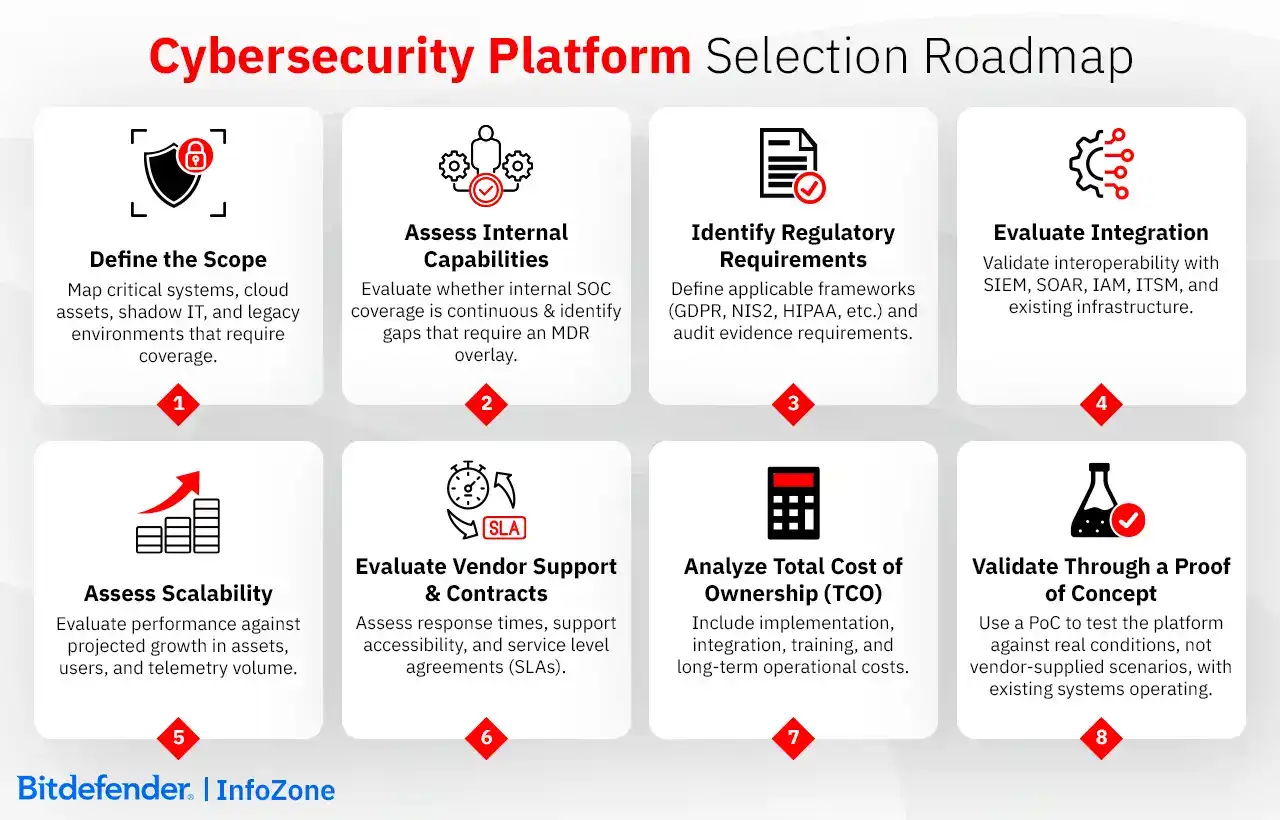
Step 1. Defining the scope
What needs coverage can be endpoints, network, cloud, SaaS, relevant OT or IoT, and they all need to be mapped. There is no need for a perfect inventory, rather, focus on systems that would hurt the business if they went down. Shadow systems, legacy environments, and unmanaged assets tend to be missed. These usually reappear later as integration problems.
Step 2. Assessing internal capabilities
More than skill, continuity is the real constraint, as an in-house security operations center (SOC) that operates only during business hours will for sure leave gaps. Continuous coverage is often not realistic, so consider adding a managed cybersecurity platform model that includes managed detection and response (MDR) in your baseline requirements.
Step 3. Identifying regulatory requirements
When it comes to minimum expectations, look at key frameworks - NIST, ISO 27001, GDPR, NIS2 Directive, HIPAA, CMMC, PCI-DSS etc. These define them well. Regarding this aspect, the practical question to ask is whether the cybersecurity platform can generate audit-ready evidence without manual effort.
Step 4. Evaluating integration with existing infrastructure
Integration issues can come from missing APIs, but that happens less often than systems that connect, but fail to exchange usable context. Therefore, check carefully your compatibility against what is supposed to remain in place, like SIEM integration, SOAR workflows, identity and access management (IAM), ITSM, ticketing systems and others.
Step 5. Assessing scalability over time
Think ahead and evaluate the platform based on projected growth in assets, users, and data volume, which tend to increase unevenly. When a cybersecurity platform depends on centralizing all data, before reaching a limit in capability, you might conclude that it became too expensive.
Step 6. Evaluating vendor support and SLAs
Response times are important, and how quickly the platform adapts to new threats is also something to assess carefully. The cadence of threat intelligence updates and the way access to support is structured have a direct effect on how incidents are handled, so do not rely solely on what is described in the contract.
Step 7. Analyzing total cost of ownership (TCO)
A realistic TCO goes beyond the license cost, and it needs to include costs related to implementation, integration, training, ongoing management, as well as other costs that might accumulate over time, with a direct impact on the return on investment (ROI).
Step 8. Validating through a controlled PoC
A proof of concept (PoC) is a short test in your own environment and it is more reliable than a demo, which is usually too clean. Alert noise, data volume, integration issues and other problems appear when you keep your existing systems running during the test.
The best cybersecurity platform fits how the organization works, scales over time, stays within budget, and continues to work when conditions are not ideal.
Cybersecurity Platforms and Regulatory Compliance
An organization is not compliant just because it uses a cybersecurity platform, the process is much more complex and the platform is just a piece in the puzzle. What a platform can and should do is produce the proofs that compliance teams usually have to chase manually: access logs, policy changes, incident records, audit trails, and risk scores. In a unified cybersecurity platform, this evidence is collected as part of normal security work, not assembled only when an audit starts.
The platform can show a variety of things through its features and capabilities, from what happened and who was involved, to what changed and what was done next. This is accomplished using compliance dashboards, automated evidence collection, exportable reports, among others. Risk quantification can also be sent into governance and compliance tools (GRC systems), transforming technical findings into business-level reporting.
At A Glance
|
Framework |
Organizations Usually Need to Prove |
Platform Help |
|---|---|---|
|
Personal data access records; support for 72-hour breach notification requirement |
Access logs, incident timelines, records of policy or permission changes |
|
|
NIS2 |
Risk management across operations and supply chains; incident reporting to authorities |
Continuous monitoring, alert escalation, incident documentation, and visibility across connected environments |
|
DORA (EU financial sector) |
Evidence of ICT resilience testing & oversight of 3rd party technology providers |
Risk scoring tied to critical systems, activity records for vendors and external services |
|
Audit trails for access to PHI (protected health information) & long-term retention of security logs |
User activity records, configurable retention policies & monitoring tied to healthcare systems |
|
|
CMMC (US defense) |
Traceability for Controlled Unclassified Information (CUI) access & documentation for incident response activity |
Endpoint monitoring, access tracking, and exportable records mapped to CMMC practices |
|
Monitoring of payment environments, network separation, unresolved vulnerabilities |
Operators in manufacturing, energy, critical infrastructure |
|
|
Proof of actual use and enforcement of security controls |
Logging & monitoring of payment systems (including checks for segmentation failures & known vulnerabilities) |
|
|
Ongoing visibility across governance, identification, protection, detection, response, and recovery functions |
Asset discovery, posture tracking, and continuous risk scoring across all six functions |
AI and Machine Learning in Cybersecurity Platforms
Generating actionable alerts is not so much a problem for security teams, what they rather struggle with is to decide which ones matter. A cybersecurity platform uses AI and machine learning to reduce that decision pressure by filtering, prioritizing, and adding context before anything reaches an analyst.
Two types of models handle this in different ways. Supervised machine learning improves detection of known threats by learning from labeled data such as malware patterns, command sequences, or network behavior. It strengthens what the platform already knows how to recognize.
Unsupervised models don’t use rules as starting points but observe what happens in the environment so that they can establish a baseline that is valid both over time, and across users, endpoints, or network signals. Something that doesn’t quite fit gets flagged, and this can include both obvious and less obvious things. This is where attacks that use normal tools or valid access tend to surface.
Automated triage takes alerts and re-scores them, this time with new context (asset criticality, user role etc.). Many lose priority at this stage, which is how false positives drop, with less alert fatigue.
Risk scoring is certainly influenced by the number of events, but also, to maybe an even larger degree, by what those events mean in a shifting context, considering that an action which is usually noise can become critical when placed in a certain zone. That shift is what surfaces real risk and improves MTTD and MTTR.
LLMs show up in this layer as well, somewhat unexpectedly, usually inside SOAR workflows, where they convert raw telemetry into summaries and help structure response steps.
Cybersecurity Platform Pricing Models and Total Cost of Ownership
Pricing for a cybersecurity platform rarely follows a single model. In practice, most environments end up mixing several.
Per-endpoint pricing is straightforward until it isn’t. It works as long as the number of assets is stable. In cloud or virtualized environments, where one system can turn into many, costs tend to drift. Per-user pricing is easier to forecast, but breaks down in places where identities do not map cleanly to usage, such as shared systems or service accounts.
Data-volume pricing ties cost to what enters the platform. The problem is that not everything entering the platform is worth the same, and the bill does not reflect that distinction.
The same applies to TCO (total cost of ownership). The platform itself is only one part of the system. The rest is everything needed to keep it aligned with the environment as it changes. Integrations drift, detections need adjustment, and operating it becomes a continuous activity rather than a one-time setup. This is usually where initial estimates break down, sometimes by 30 to 50 percent.
The point tools versus platform question sits in that gap. Individual tools follow the shape of specific problems. A platform follows the shape of the environment, which means the cost comparison depends entirely on how much that environment changes.
Cybersecurity Platform Maturity Mode
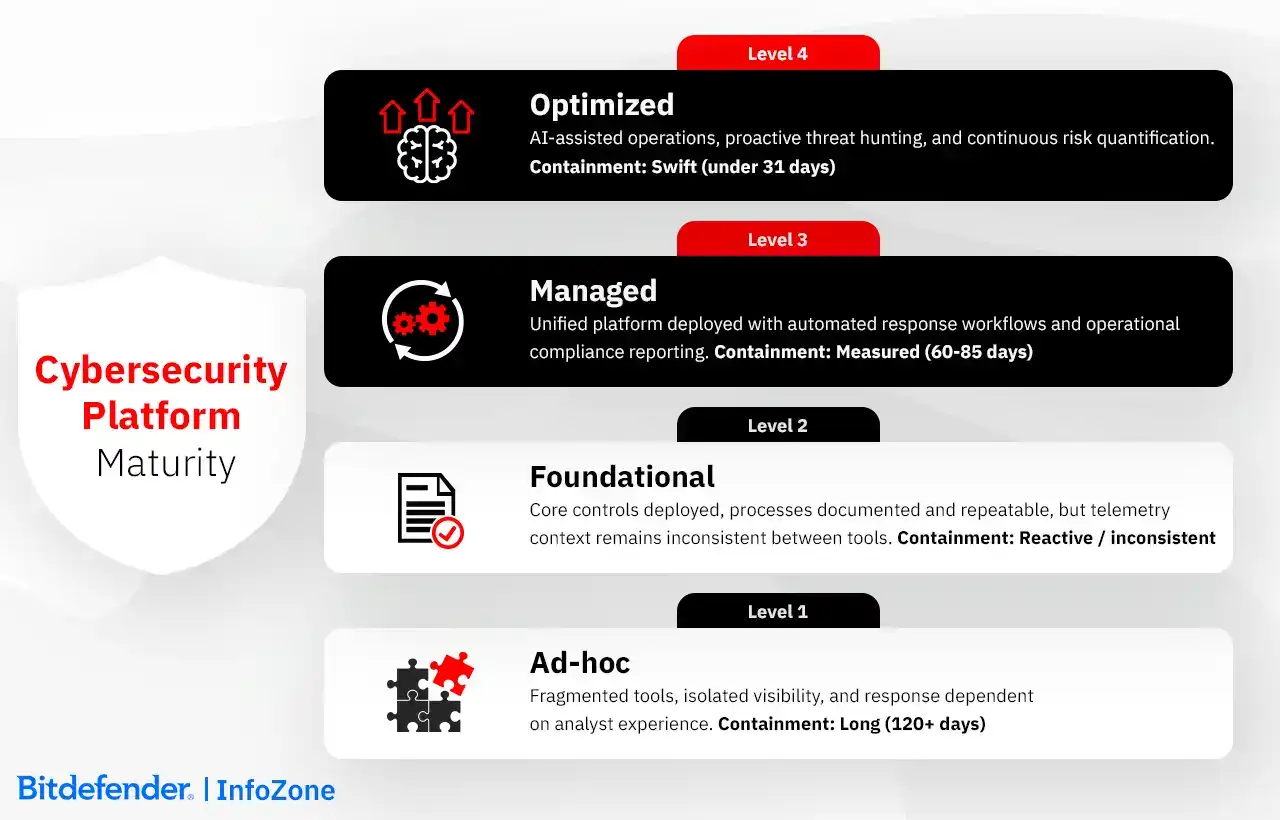
More than just the current risks, what a maturity model measures is how well-established the security practices are across an organization, more exactly, how consistent, repeatable, and operationalized they are. Two organizations with identical tooling can be at radically different maturity levels, and this can be due to how the tools are used and maintained in practice. Below is a four-level model aligned with NIST CSF Implementation Tiers and other widely referenced industry maturity frameworks.
Level 1: Ad-hoc. Reactively deployed security tools, with fragmented visibility. At this level, it is common for the response to depend largely on analyst memory or the experience of a few key individuals, with little or no documented, repeatable processes. Also, no shared telemetry between tools. Incident containment runs 120 days or longer.
Level 2: Foundational. Core controls like basic SIEM, EDR on most endpoints, some documented processes, with tools technically connected, but with context that doesn't move reliably between them. The main difference here is that security processes are now documented.
Level 3: Managed. A unified platform is used, detections are repeatable and automated response workflows are put in play. Also, there is active compliance reporting. Operations are measured now, with containment times somewhere around 60-85 days. One thing that tends to get overlooked at this level is that 24/7 SOC coverage becomes a real requirement, whether internal or through MDR, because the platform produces decisions that need someone available to act on them.
Level 4: Optimized. The platform adapts continuously, uses AI-assisted operations, and engages in proactive threat hunting. Also, the continuous risk quantification is expressed in financial terms. Average containment drops below 31 days. Security decisions and business decisions are made using the same data.
The gap between Level 2 and Level 3 is usually a platform consolidation decision. The gap between Level 3 and Level 4 comes from operational discipline, as the tooling is largely the same; what changes significantly is how it is measured and adapted to changes.
Zero Trust Architecture and the Role of a Cybersecurity Platform
Zero Trust Architecture (ZTA), defined in NIST SP 800-207, starts from a simple assumption: no user, device, or connection is trusted automatically, regardless of where it originates. Access decisions are evaluated continuously against identity, device state, behavioral patterns, and location, an evaluation that does not stop at login. If behavior changes during an active session, trust decisions change with it.
Zero Trust is often misunderstood because it is not a product category, but an architectural model, and this model depends on systems that work together consistently. This model is operationalized by a cybersecurity platform - it connects identity controls, endpoint telemetry, network visibility, policy enforcement, response workflows, and so on into the same environment.
IAM (identity and access management) integration means that identity is tied to every access request, something that is done continuously, not just at login. This way, the platform knows who is accessing what, which role is used, and if that matches what the account normally does. XDR telemetry watches what happens after access, so when an authenticated user behaves in ways not in line with their established pattern, the platform restricts or revokes access.
There is also network access control and microsegmentation. These handle the containment layer. In other words, even if a session is compromised, the damage is limited to what that session can reach in reality. In a properly segmented environment, this is much less than the full network.
In a Zero Trust model, the attack surface is not defined by the network perimeter but by every active access relationship in the environment. Managing those relationships continuously is a better fit for how modern infrastructure actually works, where users, devices, and workloads move between locations and cloud environments constantly.
Cybersecurity Platforms for MSPs and MSSPs
Operating a managed cybersecurity platform across dozens of client environments is architecturally different from running one for a single organization, and platforms built for enterprise use rarely account for that difference adequately.
For Managed Service Providers (MSPs) and Managed Security Service Providers (MSSPs), a cybersecurity platform is the core operational engine of their business. Operating on behalf of multiple organizations requires a platform designed for scale, isolation, and seamless integration into the provider's existing workflow.
Multi-tenancy is one of the core requirements. Each client environment needs isolated telemetry, policies, alerts, and reporting, even if operations are handled centrally. Role-based access control (RBAC) also becomes more granular because analysts, technicians, account managers, and customers themselves may all require different levels of access across tenants.
The PSA (Professional Services Automation) and RMM (Remote Monitoring and Management) integrations determine whether the platform is operationally viable at MSP scale:
Automated Ticketing: Security alerts are automatically converted into service tickets within the PSA, mapped to the correct client and priority level.
Billing Synchronization: Usage-based billing data is synced directly to client agreements, ensuring accurate invoicing for consumption-based services.
Cross-tenant threat intelligence extends this further and a detection confirmed across one client environment can be applied as protection across the full partner base automatically, which is a collective defense capability no single-organization deployment can replicate.
How Bitdefender Can Help
Bitdefender GravityZone is a unified cybersecurity platform that connects prevention, detection, risk management, and response in the same environment. For organizations working through consolidation, compliance obligations, or maturity progression, the platform reduces the operational overhead that comes from running those functions separately.
Compliance obligations across various frameworks (NIS2, DORA, GDPR, HIPAA, PCI-DSS, ISO 27001, etc.) require documented evidence that controls exist and, more importantly, are working. For this, GravityZone Compliance Manager handles the mapping and evidence collection automatically, so audit preparation is not a separate manual project.
GravityZone XDR correlates activity across endpoints, identities, cloud workloads, and networks, giving security teams the full picture of an attack, using all layers. PHASR (Proactive Hardening and Attack Surface Reduction) limits access to tools and system utilities that attackers frequently abuse, adjusting restrictions dynamically based on how systems are actually used rather than applying fixed rules across the board.
For organizations without continuous in-house SOC coverage, Bitdefender MDR and MDR Plus provide managed detection and response services with 24/7 monitoring and incident response support. In MSP and MSSP environments, GravityZone Cloud MSP Security adds multi-tenant management capabilities designed for operating security services across multiple customer environments from the same platform.
Frequently Asked Questions
What is the difference between a cybersecurity platform and a cybersecurity tool?
A cybersecurity tool (also called a “point solution”) is purpose-built to solve one specific problem well, such as protecting an endpoint or filtering email. These tools operate on their own data and in their own consoles, something that inherently creates visibility gaps. A cybersecurity platform, on the other hand, is an integrated system designed to unify prevention, detection, and response across the entire IT environment. A platform ensures that what one component sees, all others already know, eliminating the need for analysts to manually piece together an incident.
How does XDR relate to a cybersecurity platform?
Extended Detection and Response (XDR) is acting within the platform as a specialized layer focusing on cross-domain detection and investigation. Not a full platform on its own, it is rather the “detection logic” applied at platform scale. While standard tools are scoped to single domains, XDR connects signals across endpoints, network traffic, and cloud workloads to treat a complex attack as a single incident rather than disconnected alerts. In relation to a cybersecurity platform, XDR functions as one of its capabilities, not a replacement for it, considering that a platform may also include governance, risk management, compliance, identity functions and other areas that XDR does not address on its own.
What is the difference between MDR and a managed cybersecurity platform?
The main difference is in the operational responsibility. More exactly, while a managed platform license provides the technology, the organization's internal team is usually responsible for responding to alerts. In Managed Detection and Response (MDR), external experts operate the platform for you, as a service. Critically, MDR providers typically operate under “Pre-Approved Actions,” giving them the contractual authority to isolate a host or kill a process on your behalf the moment a threat is confirmed, without waiting for a phone call.
What are the components of a cybersecurity platform?
Three layers form the foundation of a platform from the architectural point of view. There is an ingestion layer that pulls telemetry continuously from endpoints, networks, cloud workloads, and identity systems. An analytics engine normalizes that data into a common format and evaluates it for threats. There is also a policy enforcement layer that acts on what the engine finds, blocking connections, isolating devices, restricting accounts, etc. On top of that foundation sit the specific capabilities: EDR, XDR, SIEM, SOAR, identity security, risk management, threat intelligence, and cloud security.
What is an industrial cybersecurity platform?
Industrial environments operate under a “safety-first” hierarchy where availability and physical uptime always outweigh data confidentiality. A PLC running a high-pressure production line cannot be aggressively scanned, patched on a regular cycle, or taken offline for updates like a corporate laptop. In these deterministic settings, even the minor network “jitter” caused by a standard IT security tool can trigger a mechanical failure or a physical safety incident.
To protect these systems without crashing them, an industrial platform uses passive discovery, that is, it silently “listens” to network traffic rather than sending intrusive query packets that could overwhelm fragile legacy hardware. These platforms are built to decode specialized, unencrypted protocols like Modbus and DNP3 that carry no native authentication. The focus is on early anomaly detection and enforcing the “Zones and Conduits” micro-segmentation model (IEC 62443), ensuring that a breach in one area of the plant cannot move laterally to shut down critical operations.