

What is Cyber Espionage?
Cyber espionage (or cyber spying) is the act of infiltrating digital systems to gather sensitive information without permission. This could include state secrets, trade data, internal communications, or technical plans - whatever the attacker sees as useful. Most of the time, it’s strategic: meant to support a country’s foreign policy, defense posture, or economic goals. These campaigns often run quietly in the background and aren’t noticed until well after they’ve started.
Traditional espionage hasn't disappeared, it's just adapted. Many intelligence operations now rely on cyber tools to reach targets across borders, fast and quietly. Cybercrime and cyber espionage often use similar tactics, like phishing or malware, but the endgame differs: one chases money, the other intelligence.
Targets and Motivations of Cyber Espionage
The types of organizations targeted tend to follow a pattern. Government agencies and defense ministries are common, especially during times of international tension. Corporations - particularly those in tech, energy, aerospace, or pharmaceuticals - are frequent targets. Academic institutions also see their research networks probed, especially when their work has dual-use potential or commercial value. And sometimes, individuals are the entry point, especially if they have unusual access or can be impersonated easily.
The reasons behind these campaigns vary. A government might want to monitor developments in another country's military. In other cases, the goal may be to accelerate domestic innovation by stealing R&D instead of developing it internally. Sometimes, it's about gaining insight - understanding how decisions are made or who’s making them before anything is public.
Unlike disruptive cyberattacks, which leave a trail, espionage is designed to go unnoticed. That doesn’t guarantee it will succeed, but the longer the access lasts, the more valuable the operation becomes.
Methods and Techniques of Cyber Espionage
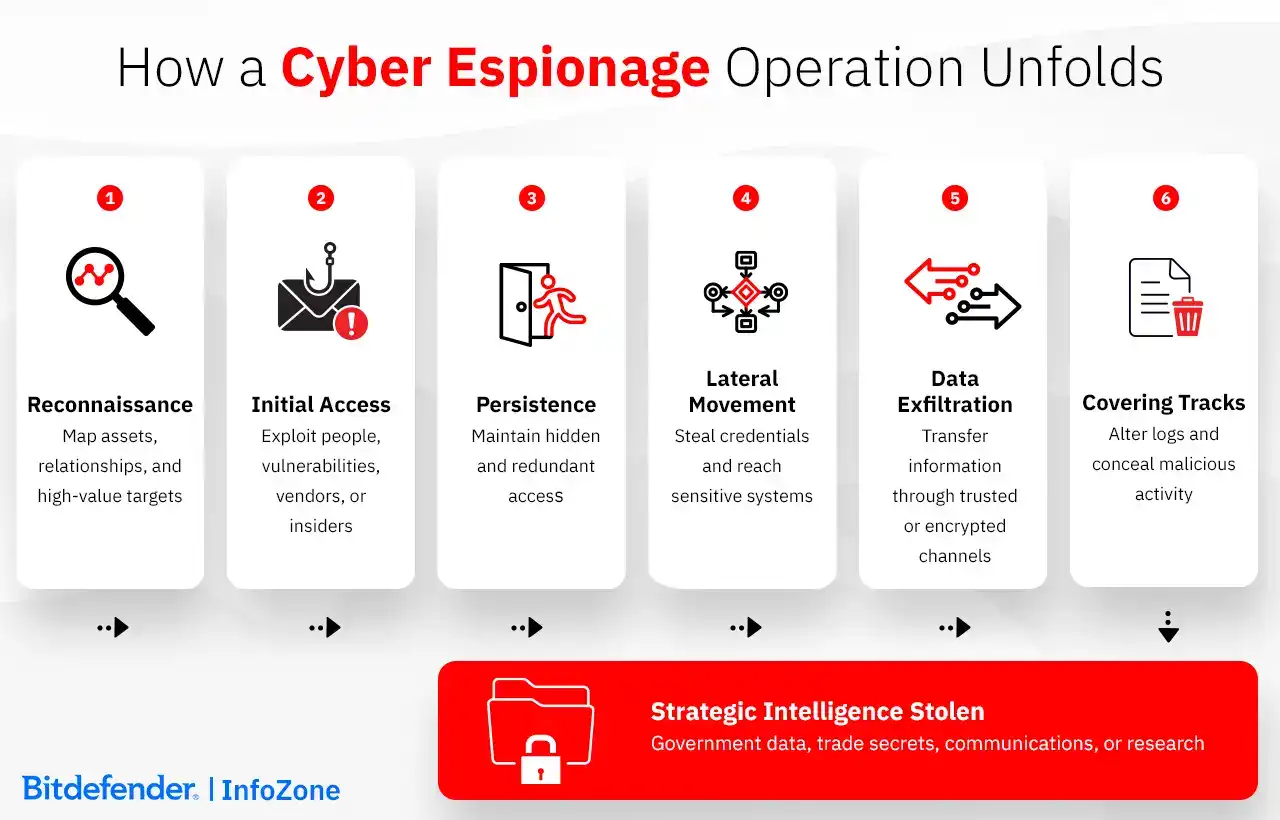
Cyber espionage usually follows a process that starts with reconnaissance. Attackers scan for exposed assets, map organizational relationships, and collect public data to tailor their approach.
- Initial Access
Entry is gained by exploiting people or systems. Phishing is the most common tactic, often aimed at privileged individuals or exploiting internal trust to gain access. Watering hole attacks infect websites frequented by targets to deliver malware.
Other methods include exploiting zero-day vulnerabilities, abusing misconfigured services, and conducting supply chain attacks - where attackers gain access via vendor credentials or compromised software updates. Insiders, whether careless or complicit, also play a role.
- Lateral Movement and Persistence
Once inside, attackers move laterally, escalate privileges, and blend in with legitimate network activity. They use stolen credentials, mimic user behavior, and often establish redundant access in case one method is detected. Malware payloads are customized to evade detection and maintain persistence, often disguising command-and-control (C2) traffic as regular network communication.
Advanced persistent threat (APT) groups don't rush. Their goal is long-term access, not speed. They might sit inside a network for weeks or longer watching, listening, and quietly pulling out what they need. This could include emails, internal files, or insights into how decisions get made.
- Exfiltration and Covering Tracks
Getting the data out without being noticed is its own challenge. Rather than large dumps, attackers often send information out slowly, masking it within normal network traffic. Logs are tampered with or deleted. Data may be hidden inside encrypted tunnels or sent via cloud services, even using techniques like steganography.
This process isn’t static, and tactics evolve as defenses improve. Tools that worked last year may be flagged today, so espionage campaigns are in constant adaptation.
Types of Cyber Espionage
State-sponsored actors run long-term campaigns, often using Advanced Persistent Threats (APTs) designed for stealth and durability. Corporate espionage might involve insiders or short-term breaches aimed at stealing trade secrets. Hacktivists, driven by ideology, leak information to incite change. Criminal groups have entered the scene too, selling stolen data or offering “espionage-as-a-service.”
These groups often use the same tools and tactics, although their goals vary. The same spyware a nation-state uses for surveillance might be used by a criminal syndicate to gather intel for extortion or sale on the dark web.
Consequences of Cyber Espionage
Cyber espionage usually isn’t visible right away. It tends to operate in the background, and by the time it’s discovered, attackers have often had enough time to extract information, observe internal systems, or weaken trust in an organization’s ability to secure itself.
Cyber espionage usually isn’t visible right away. It tends to operate in the background, and by the time it’s discovered, attackers have often had enough time to extract information, observe internal systems, or weaken trust in an organization’s ability to secure itself.
Economic Impacts
The theft of proprietary data (from product designs, to business strategies, or research) can give competitors an unfair advantage. But the financial cost isn't limited to competitive losses. Breaches often come with legal action, regulatory involvement, and internal investigation. Some businesses face penalties or have to delay projects while security gaps are addressed. There's also reputational cost, which can lead to lost contracts or lower investor confidence. And as more systems are centralized, the potential reach of an incident continues to grow.
Political and Military Repercussions
When cyber espionage targets governments, the consequences affect more than just the agencies involved. Leaked military information or diplomatic communications can disrupt international relationships and likely strategic changes. Sometimes, stolen information is made public, selectively or in full and this can be used to sway public opinion, discredit political actors, or create tension between institutions. It's part of a broader pattern where espionage overlaps with influence operations.
Privacy and Security Impacts
Cyber espionage campaigns collect personal data along with strategic or commercial information. Depending on the target, this might be communications, health records, financial documents, or metadata showing personal and professional relationships. For individuals in sensitive roles, this can lead to long-term risks, blackmail, reputational damage, or operational compromise.
For organizations, removing the visible threat doesn't always mean the system is clean. Attackers may leave behind dormant accounts, backdoors, or altered scripts that go undetected for months. You can't always know how long they were active or how far the access went. So security teams may shift from isolated remediation to continuous monitoring, treating the environment as compromised until proven otherwise.
Reputation and Trust Loss
After a breach, it’s not unusual for customers, partners, or regulators to question whether similar problems are still present. Also, in some incidents, attackers release stolen information gradually. Each new disclosure restarts public attention and may force the organization to respond repeatedly, keeping the issue in view for longer than the original breach might have suggested.
Critical Infrastructure and Strategic Risk
When attackers focus on infrastructure - such as energy systems, transportation, or communications - they're often gathering information, not causing immediate disruption. However, the knowledge collected during these operations can be used later, especially in times of conflict or political tension.
Because infrastructure sectors are interconnected, access to one often reveals information about others. These systems also tend to prioritize availability, which makes large-scale overhauls difficult. If an attacker establishes access, removing them completely can take time and may require complex operational trade-offs.
High-Profile Examples of Cyber Espionage
Cyber espionage has become an established method for states and aligned groups to access strategic information. The cases below illustrate different techniques, objectives, and consequences, ranging from intellectual property theft to interference in critical infrastructure.
- Operation Aurora (2009) targeted Google, Adobe, and a number of other U.S. companies. The attackers used spear-phishing emails and browser exploits to get into internal networks. What they wanted was source code and access to Gmail accounts linked to Chinese human rights activists. It wasn't just about corporate data, it actually marked a shift toward targeting politically sensitive material through commercial platforms.
- Stuxnet (2010) wasn't built for surveillance: it was made to break things. It collected system data, but more importantly, it quietly messed with centrifuge timing to throw off Iran's nuclear program. It took a while to figure out who was behind it, but eventually it became clear this was a targeted attempt to delay uranium enrichment without boots on the ground.Attribution took time, but eventually it was understood to be part of a broader effort to slow down uranium enrichment without direct military action.
- Operation Newscaster (2011–2014) involved Iranian-linked actors creating fake journalist profiles and using them to build relationships with targets in military and policy circles. The operation relied on gradual social engagement rather than technical sophistication, showing how identity fabrication and social engineering can be effective entry points.
- The Office of Personnel Management (OPM) breach (2015) resulted in the theft of background investigation data, fingerprint records, and other sensitive personal information of over 21 million individuals connected to the U.S. federal government. The implications extended beyond the immediate breach, raising concerns about long-term intelligence risks and potential use of the data in future operations.
- Pegasus Spyware (2016–present) came to light after a failed phishing attempt on a human rights activist led researchers to uncover a powerful surveillance tool developed by Israeli firm NSO Group. Unlike conventional malware, Pegasus used zero-click exploits (requiring no user interaction) to silently infiltrate smartphones. Once deployed, it granted full access to messages, calls, photos, cameras, microphones, and GPS data. Sold exclusively to governments under export license, Pegasus was marketed for counterterrorism but used to target journalists, dissidents, and politicians in over 45 countries. The spyware’s revelations triggered global outcry, lawsuits, trade restrictions, and an ongoing debate over the ethics and regulation of commercial surveillance technology.
- SolarWinds (2020) involved the compromise of a widely used IT management platform. Attackers modified software updates to gain access to networks across both government and private sectors. The incident led to greater scrutiny of software supply chains and exposed weaknesses in existing trust-based update mechanisms.
- APT Hackers-for-Hire Industrial Espionage case (2023) targeted an international architectural company involved in billion-dollar luxury developments across New York, London, Australia, and Oman. Hackers used a trojanized Autodesk 3ds Max plugin to gain covert access, exfiltrating sensitive design and financial data. The operation, linked to a South Korean-based command-and-control infrastructure, is believed to be the work of an APT mercenary group hired for industrial espionage.
Business and Diplomatic Repercussions
For many organizations, these incidents have changed how risk is evaluated. Security reviews now look at how deeply a company relies on external software providers and whether those providers introduce exposure through international partnerships or opaque development chains. The SolarWinds breach made this especially clear, as it showed how attackers could access critical systems by compromising a trusted vendor.
Some governments have responded to these operations by attributing them to foreign actors and issuing indictments or sanctions. Attribution in public disclosures has often cited groups allegedly linked to China, Russia, North Korea, and Iran. In many cases, the technical evidence is circumstantial or incomplete, which complicates diplomatic responses. Public attribution can strain political relationships, even when the underlying proof is open to interpretation.
Detection continues to be a weak point. In the OPM case, the breach was discovered by a contractor, not by internal monitoring. Exchange Server vulnerabilities were exploited at scale before defenders understood the scope. In both situations, attackers had time to establish control and maintain access even after patches were released.
The way stolen data is used varies. Some information, like employee records or internal communications, can be stored and analyzed long after the breach itself. It may support future targeting or be combined with other sources. The impact is often delayed and hard to trace back to the original incident.
In response, some companies have started segmenting data more carefully and reviewing how much information is accessible across internal systems. Not all breaches can be stopped, but limiting what can be taken and detecting intrusions earlier have become practical goals.
Legal Framework and International Cooperation
Cyber espionage sits in a difficult legal space. Most countries prosecute unauthorized access and data theft under general cybercrime or espionage laws, but these are rarely designed to handle cross-border operations involving state actors. In the United States, the Computer Fraud and Abuse Act covers unauthorized system access, while the Economic Espionage Act targets theft of trade secrets, including for foreign benefit. Enforcement, however, remains limited when suspects reside in countries without extradition treaties or where political cooperation is unlikely.
In Europe, legal instruments like the GDPR and the NIS 2 Directive focus more on data protection and incident response than on explicitly addressing espionage. Globally, there is no binding treaty that criminalizes cyber espionage as such. The Budapest Convention provides a framework for cooperation on cybercrime, but its signatories do not include some major cyber powers. The Tallinn Manual, a non-binding academic study, explores how international law could apply to cyber operations, including peacetime espionage, but it holds no legal force.
Recent efforts by the UN, including voluntary norms and a new cybercrime treaty adopted in 2024, reflect growing interest in coordination. Still, these efforts face delays in ratification and lack strong enforcement mechanisms. Political interests often outweigh legal consensus, and actions taken through bilateral agreements - such as the 2015 U.S.–China accord on IP theft - have had mixed results.
Attribution, jurisdictional overlap, and lack of cooperation remain the main enforcement challenges. Most operations occur across borders and involve actors shielded by state policy. Legal remedies exist but are rarely sufficient on their own. For now, cyber espionage remains a significant challenge for international legal frameworks.
Overcoming Challenges Protection and Defense Strategies Limitations
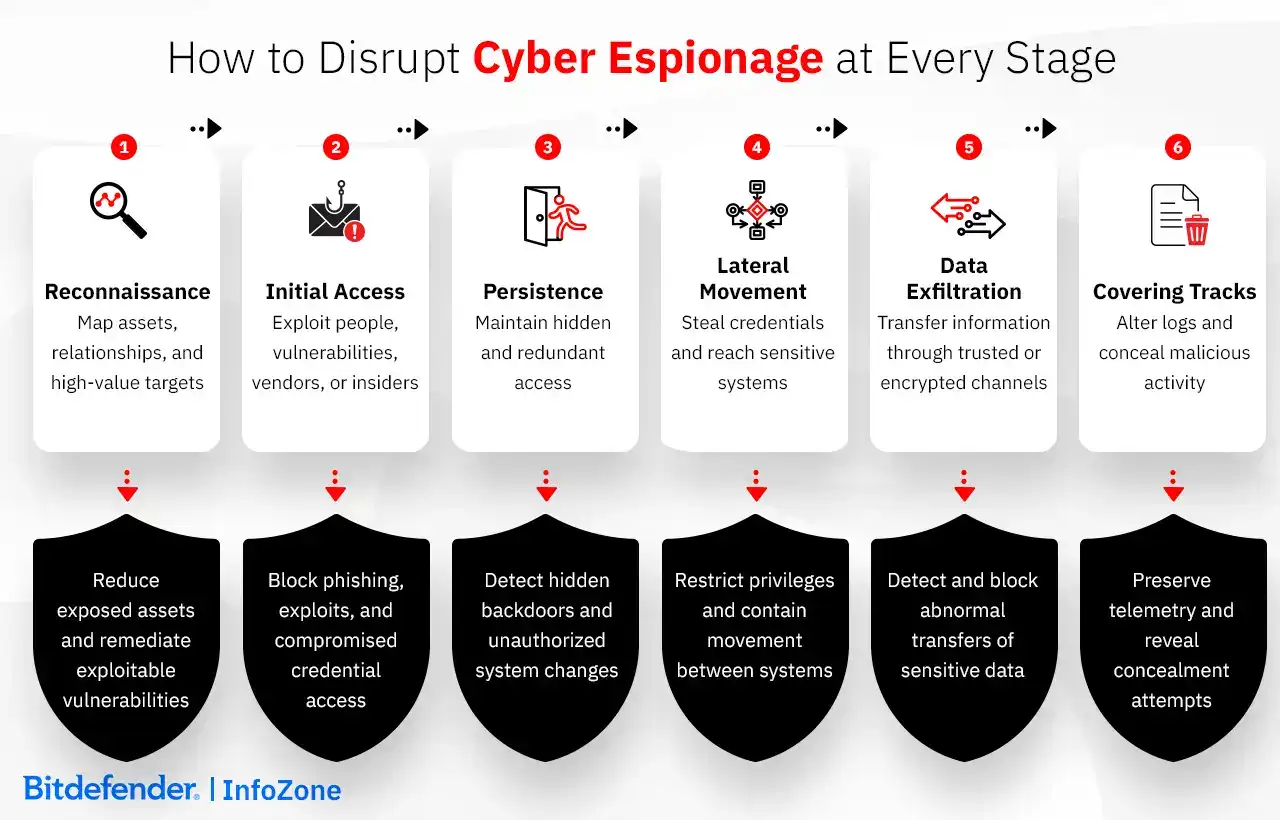
Cyber espionage requires a multi-layered security approach that combines technical controls, operational practices, and workforce readiness.
Established cybersecurity frameworks like NIST CSF, ISO 27001, or CIS Controls provide a structured way to build and evaluate such a strategy. They focus on identifying assets, managing risk, and ensuring that protection, detection, and response capabilities are in place and tested regularly.
Technical controls are the foundation of prevention and detection. Endpoint Detection and Response (EDR) helps detect activity at the device level, while Extended Detection and Response (XDR) broadens that visibility across networks, cloud environments, and email systems. These work best when integrated with real-time threat intelligence, which helps correlate observed behavior with known tactics and indicators. Threat hunting - actively looking for subtle or hidden signs of intrusion - can also improve the detection of advanced threats that evade automated tools.
Access control, network segmentation, and file integrity monitoring are key to reducing lateral movement and spotting unauthorized changes. Data Loss Prevention (DLP) adds another layer by monitoring sensitive data and limiting exfiltration. Many organizations now operate under a Zero Trust model, where no device or user is inherently trusted and every access request is verified.
Training is just as important. Employees need to know important prevention measures such as how to recognize phishing attempts, handle sensitive information, report unusual behavior, and identify manipulation tactics used in social engineering. A regular training schedule and clear reporting paths make security awareness part of daily work.
Organizations should also align their practices with legal standards and maintain documentation such as audit trails. While legal enforcement is limited, working within recognized frameworks and sharing intelligence with peers or national agencies can support faster and more coordinated responses to serious threats.
The Future of Cyber Espionage
Cyber espionage is changing. Emerging technologies are making it easier for attackers to operate and harder for defenders to spot them. Capabilities that once required state-level resources are now available on demand, while digital transformation continues to expand the range of potential targets.
One trend is Cyber Espionage-as-a-Service (CEaaS). Tools, infrastructure, and even operational support are being offered commercially, lowering the skill level needed to launch a campaign. This broadens the pool of potential actors and makes attribution more difficult.
AI and machine learning have entered into the arsenal of both attack and defense. Attackers use them to automate reconnaissance, customize phishing, and adapt malware. AI can also speed up the analysis of stolen data or help identify weak points in a network. On the other side, defenders use AI to detect anomalies, analyze behavior, and automate responses. As both sides adapt, speed and complexity increase.
Social engineering may become harder to defend against with deepfakes and synthetic media. A convincing fake voice or video from a trusted figure can now be generated quickly and used to pressure targets or bypass normal checks.
Quantum computing is not a current threat, but it may become one. Some attackers are likely collecting encrypted data today, hoping to decrypt it later - an approach known as “harvest now, decrypt later.” Long-term confidentiality is at risk.
The growing use of IoT, remote access, cloud platforms, and 5G adds complexity. Many systems are connected and distributed, but not consistently secured or monitored.
To keep up, organizations need to stay flexible. That means investing in monitoring, planning for different scenarios, and automating where possible. Security models like Zero Trust and encryption designed to resist quantum attacks will matter more over time. Training also needs to keep pace, especially with new forms of manipulation.
How Bitdefender Can Help
Cyber espionage operations often involve advanced threat actors, stealthy tactics, and prolonged campaigns. Bitdefender’s GravityZone Unified Security Platform is built to counter these risks with layered prevention, detection, and response - across endpoints, cloud, networks, and identities.
Unified Threat Prevention and Detection: Bitdefender GravityZone combines Endpoint Detection and Response (EDR) and Extended Detection and Response (XDR) to detect stealthy intrusions, lateral movement, and command-and-control traffic. These tools enable deep investigation and response across diverse environments.
Real-Time Monitoring and Expert Response: For organizations that require constant oversight, Bitdefender’s Managed Detection and Response (MDR) delivers 24/7 monitoring, expert-led threat hunting, and rapid containment.
Reducing the Attack Surface: GravityZone Risk Management and Patch Management proactively identify misconfigurations and vulnerabilities, minimizing the exploitable surface. PHASR helps prevent living-off-the-land techniques commonly used in espionage campaigns.
Email and Network Security: GravityZone Extended Email Security defends against spear-phishing, credential theft, and malware-laden attachments - common vectors in espionage. Network Attack Defense detects lateral movement, unauthorized access, and covert exfiltration attempts.
GravityZone Security for Mobile can help secure mobile devices against spyware often used in cyber-espionage operations. It can also monitor devices for vulnerabilities exploited by state-sponsored threat actors and prevent the installation of unauthorized applications that may be compromised.
Advanced Threat Insight
Bitdefender Threat Intelligence Solutions services provide contextualized data on threat actors and Indicators of Compromise (IoCs). Sandbox Analyzer is another added layer, used to detonate suspicious files in an isolated environment.
Frequently Asked Questions
What are the signs my organization is a victim of cyber espionage?
Cyber espionage is designed to be stealthy. It operates in the background, low and slow, but there are indicators you can follow.
Unusual outbound network traffic is one. You might see unusual outbound traffic such as large data transfers during off-hours, or connections to unknown IP addresses. Encrypted channels that don't normally show up in your daily operations can be a red flag.
On the user side, some of the signs are logins at odd hours or from unexpected locations, a spike in failed login attempts, or accounts accessing files outside their normal scope. New admin accounts showing up with no reason should raise an eyebrow.
At the system level, attackers will install tools outside of normal channels. That means unauthorized software, changes to system files or registry entries, or changes to security settings. If endpoint protection is disabled without explanation, that's something to look into.
Other symptoms might be slower performance, frequent crashes, or strange activity from webcams or microphones. In some cases, you may not see signs internally - information might surface elsewhere, such as on the dark web or through alerts from law enforcement or partners.
These signs individually aren’t definitive, but together they warrant further investigation. Tools like EDR or XDR, log reviews, and threat intelligence can help you dig deeper.
What to do if you suspect a cyber espionage attack?
First, don’t alert the attacker. Avoid sudden changes or shutdowns unless absolutely necessary. Premature action can cause the attacker to cover their tracks or speed up data exfiltration.
Activate your incident response plan. This should outline who does what, including communication channels and containment procedures. If you don’t have one, assign roles quickly - IT, legal, executive leadership, and communications.
Containment is next. Disconnect affected machines from the network, restrict user accounts as needed, and block suspicious external connections. Don’t destroy forensic evidence. Don’t restart machines or use cleanup tools unless guided by a specialist.
Preserve data that can be useful for investigation. This includes system logs, memory snapshots, disk images, and authentication records. Even deleted or temporary files can matter.
Start an initial assessment. Identify what systems were affected, what data is involved, and how the breach started. Look for malware, suspicious access patterns, and known indicators of compromise. If needed, bring in forensic specialists or a managed detection and response provider.
Notify internal stakeholders. If personal data, intellectual property, or regulated systems are involved, consider whether to disclose to authorities or partners.
Document everything and everyone. This will help with post-incident reviews and, if applicable, legal follow-up. The response doesn’t end when the systems are clean - it continues with understanding how the breach happened and how to prevent recurrence.
Can small businesses protect themselves from cyber espionage?
Small businesses are easier targets, as limited IT staff, outdated systems, and lower awareness make them vulnerable. However, there are simple steps to improve resilience.
Start with the basics. Software and your operating systems must be kept up to date. Use strong, unique passwords and multi-factor authentication, especially on email, admin accounts, and financial systems. Choose reliable endpoint protection with threat detection capabilities.
Limit user privileges. Employees should only have access to what they need. Segment networks so that a breach in one area doesn’t affect the rest.
Train staff regularly. Teach them to spot phishing emails, suspicious links, and social engineering tactics. Encourage them to report unusual behavior quickly. Even short, informal refreshers can help.
Back up critical data and also test your recovery procedures. Store backups separately - ideally offline or in a secure cloud service. That way, operations can continue even if systems are compromised.
Use logging and monitoring tools, even basic ones, to detect unusual access or data movement. If possible, consider partnering with a managed security service provider for 24/7 monitoring.
Review vendor access and software supply chains. Make sure third-party services meet your security expectations. If employees use personal devices for work, apply clear security policies.
These steps don’t require a big budget, especially if you prioritize what protects your most valuable assets and build from there.