

What Is an Attack Vector?
An attack vector is the path or mechanism a threat actor uses to reach a vulnerability and turn it into unauthorized access. The term has a precise meaning that is easy to get wrong: the vector is not the malware, not the ransomware binary, not the malicious script, those are payloads. The vector is what delivers them, or what allows the vulnerable condition to be reached.
NIST and MITRE ATT&CK both treat attack vectors this way, as the “how” of adversary technique, distinct from what the attacker ultimately deploys. In MITRE ATT&CK, the Initial Access tactic (TA0001) catalogs the techniques that constitute this first-contact phase. In NIST risk language, the vector is the link connecting a vulnerability to its exploitation.
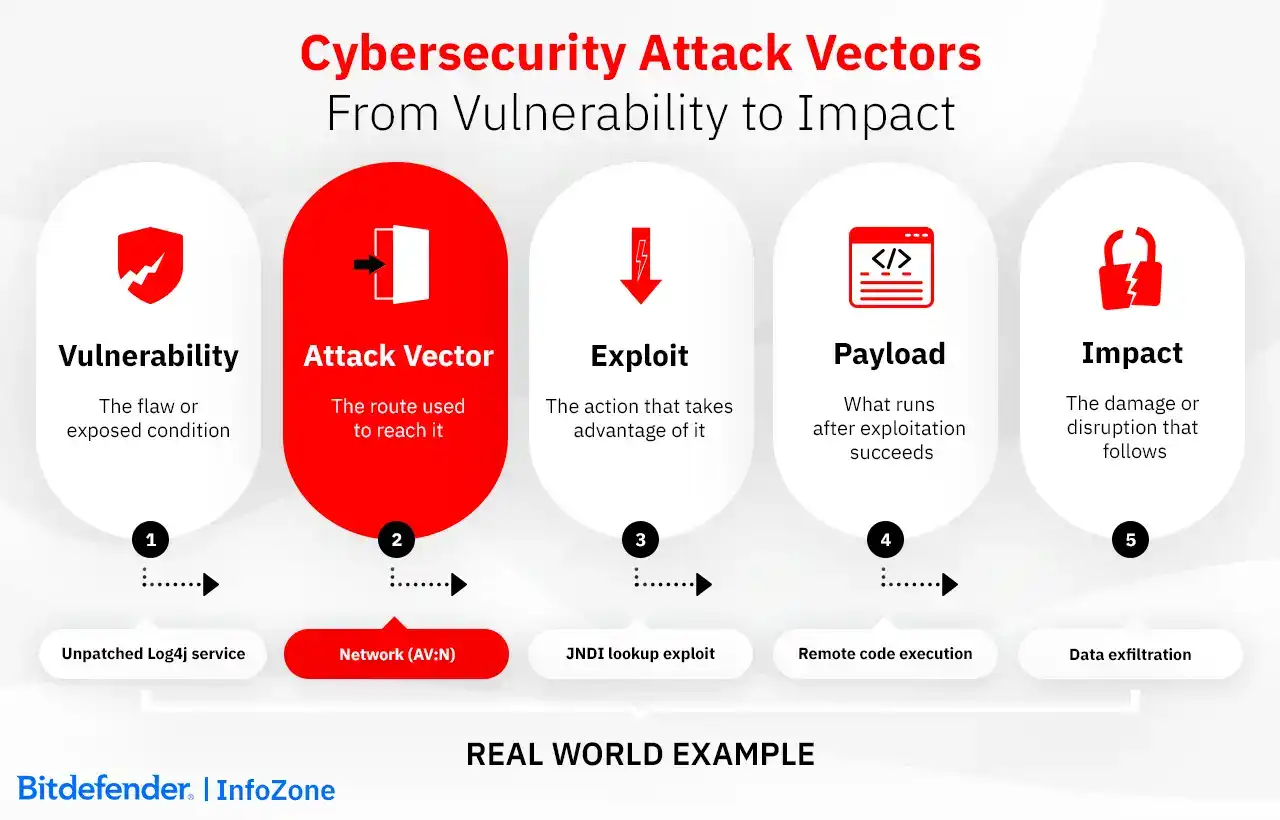
A simple way to separate the terms is to follow the sequence from weakness to consequence. First there is a vulnerability: the flaw or exposed condition. The attack vector is the route used to reach it. The exploit is the action that takes advantage of it. The payload is what runs after exploitation succeeds. The impact is the damage or disruption that follows.
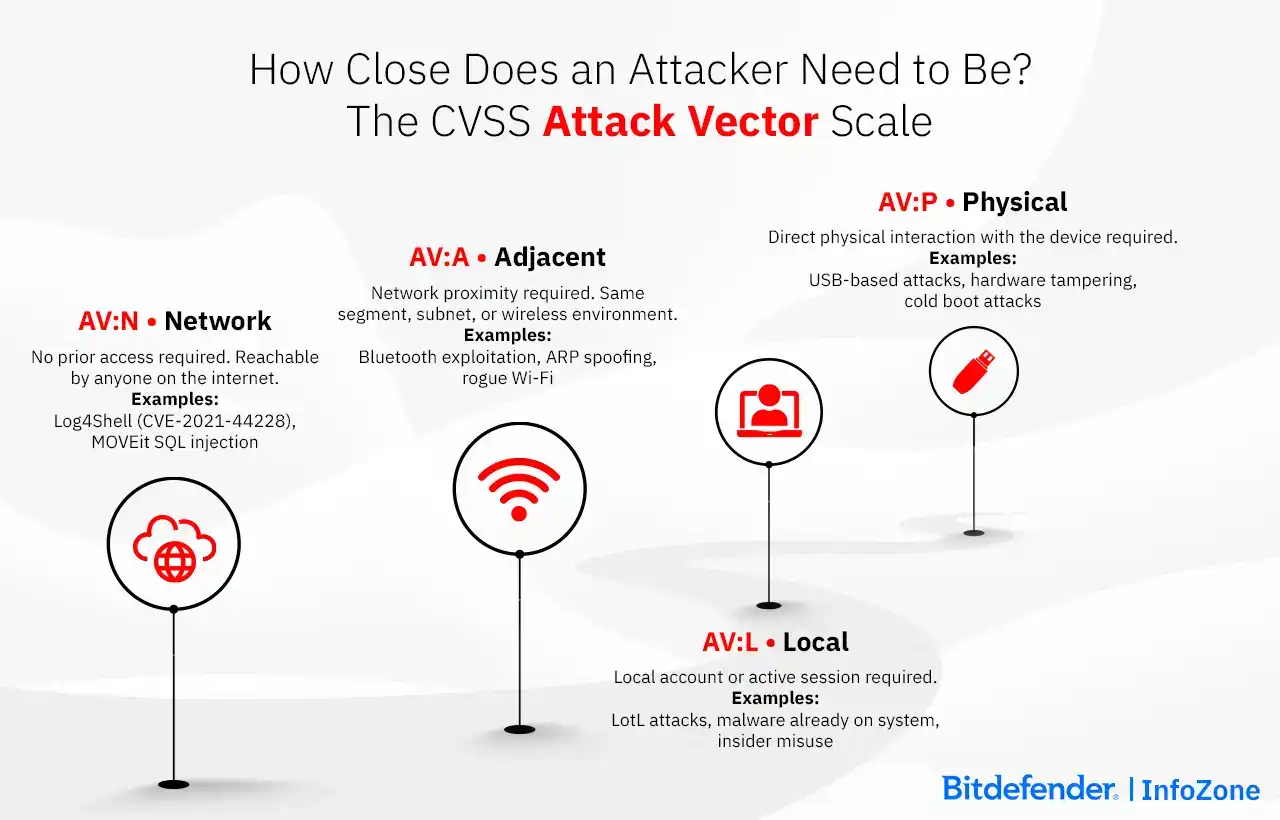
CVSS v3.1 uses Attack Vector as one of its base metrics, with four possible values: Network (N), Adjacent (A), Local (L), and Physical (P). These values describe how close the attacker must be to the target. A vulnerability exploitable over the network is generally more severe than one that requires physical access, because it can be reached by many more attackers.
How Attack Vectors Work
The attack usually starts before anything is exploited. A threat actor looks for something usable: an exposed service, a reused password, an unpatched application, a vendor connection, or a cloud account with more access than it should have. The work is to find a weakness that is not only vulnerable, but reachable.
A compromised account doesn't give unrestricted access, so what attackers typically look for is ways to move beyond the system or application they initially reach. This is done either by obtaining additional permissions and accessing other systems, or reaching more valuable data. In practice, this often involves privilege escalation, lateral movement, persistence, and, in some cases, data exfiltration.
Modern cybersecurity attack vectors rarely follow one clean path. Cyber security attack vectors now often combine identity abuse, software exploits, exposed APIs, misconfigurations, and legitimate administration tools in the same intrusion.
Types of Attack Vectors
What are attack vectors in practice? The categories below cover the routes that account for the vast majority of real intrusions, grouped by what each one abuses.
Malware Attack Vectors
Malware uses various methods to reach its targets, from phishing attachments and malvertising and drive-by downloads to trojanized installers, or exploit kits. These are the delivery paths. What gets delivered (virus, worm, trojan, spyware) depends on the attacker's objective.
In modern malware, attack vectors might avoid introducing foreign code; the so-called Living Off the Land (LotL) techniques repurpose PowerShell, WMI, and other built-in utilities, making malicious commands indistinguishable from legitimate administration. Fileless malware executes entirely in memory, leaving no filesystem artifact for signature-based tools to detect.
Ransomware Attack Vectors
Ransomware is not an entry route, it is the payload that reaches victims through various vectors, like phishing emails containing malicious links or attachments, RDP (Remote Desktop Protocol) services accessed with brute-forced or stolen credentials, and unpatched public-facing software.
There are Ransomware-as-a-Service groups today that optimize the process for volume and low friction. Phishing and exposed RDP require no zero-days and scale cheaply, which is why they remain the dominant ransomware attack vectors despite being well understood.
Phishing and Social Engineering Attack Vectors
Phishing is an attack on the person rather than on the system, which makes it effective independent of how well-patched the infrastructure is. IBM's 2025 Cost of a Data Breach Report ranks it as the leading breach vector: 16% of incidents, averaging $4.8 million each.
There are various variants based on the channel used, like smishing, which exploits the elevated trust users place in SMS, or vishing (voice calls) that is increasingly used with AI-generated audio impersonating IT support/executives. Spear phishing is a type that tailors its lures to specific individuals using harvested organizational data. Even QR codes can become a weapon, giving rise to quishing, as people tend to trust these.
Identity Attack Vectors
When focus is on accounts, credentials, sessions, and authentication systems, common techniques include credential theft, credential stuffing, password spraying, brute-force attacks, stolen session cookies, pass-the-hash attacks, and MFA fatigue campaigns.
OAuth and token abuse have become more important as access is increasingly less tied to a fixed password. Stolen tokens, consent phishing, and compromised OAuth grants can provide a valid route into an account even when credentials have not been exposed.
In MITRE ATT&CK, many identity-based techniques fall under Initial Access (TA0001) and Credential Access (TA0006).
Cloud Attack Vectors
Cloud attack vectors often originate from configuration mistakes rather than software vulnerabilities. Publicly exposed storage buckets, leaked credentials, insecure APIs, and overly permissive IAM roles can all provide access to cloud resources without requiring a traditional exploit.
Cloud environments also introduce risks that are less common in traditional infrastructure. Examples include OAuth grants, cloud-to-cloud integrations, container compromise, and SSRF vulnerabilities.
Network Attack Vectors
The target of network attack vectors is the communication paths between systems. Common examples include Man-in-the-Middle (MitM) attacks, ARP spoofing, DNS poisoning, SSL stripping, rogue Wi-Fi networks, rogue access points, Bluetooth exploitation, and Distributed Denial-of-Service (DDoS) attacks.
Port scanning is often associated with network attacks, but it is a reconnaissance technique used to identify potential attack vectors rather than an attack vector itself.
Application Attack Vectors
Common potential entry points exposed by web applications include SQL injection, cross-site scripting (XSS), cross-site request forgery (CSRF), SSRF, exposed endpoints, and insecure dependencies.
API abuse is another application attack vector. Undocumented APIs and forgotten endpoints can greatly increase exposure. Most common API abuse methods exploit issues like weak authorization controls, exposed functionality, or Broken Object Level Authorization (BOLA), a risk listed in the OWASP API Top 10.
Insider Threat Vectors
Insider threat vectors already have access, which makes them so dangerous. IBM's 2025 data puts malicious insider attacks as the costliest breach type at $4.92 million per incident, but malicious intent is the minority case. Most incidents involve negligent misconfigurations, misdirected data, or employees whose accounts were compromised externally and then used as a trusted internal vector.
Supply Chain Attack Vectors
There is an inherent trust in third-party software and dependencies, as well as update mechanisms, and this trust is what supply chain attack vectors rely on. The XZ Utils incident (CVE-2024-3094) is a concrete case: a backdoor was secretly introduced into a widely deployed Linux compression library and went undetected for months. Any dependency an organization already trusts is a potential vector if compromised upstream. A software bill of materials (SBOM) and software composition analysis (SCA) make this dependency graph visible before it is exploited. IBM's 2025 data ranks supply chain compromise as the second costliest breach type at $4.91 million per incident.
Emerging Attack Vectors in Modern Cybersecurity
Before the wide usage of AI, phishing content was easy to spot, but today, attacks made with its help can generate massive amounts of targeted phishing content that is contextually accurate and tailored to specific individuals or organizations. Deepfake social engineering extends this to real-time audio and video, impersonating executives or IT staff to authorize transactions or credential handovers.
LLM prompt injection refers to malicious instructions being embedded in various content that is fed to the model (documents, webpages, emails). SaaS application abuse often involves trusted integrations between cloud services, where access granted to one application can extend to others.
Difference Between Attack Vector, Threat Vector, and Attack Surface
Attack surface, attack vector, and threat vector describe related ideas, but they are not the same thing.
The attack surface is everything an attacker could try to reach: exposed applications, cloud assets, user accounts, remote access services, APIs, endpoints, and third-party connections. The attack vector is the method used against one of those openings. In simple terms, the surface is where an attack could happen; the vector is how it happens.
Threat vector is the looser term. In many cybersecurity documents, threat vector and attack vector are used almost interchangeably. When a distinction is made, a threat vector usually describes a possible route or risk area, while an attack vector describes the specific route used in an attack.
This is also how attack vector vs attack surface should be understood. A larger attack surface gives attackers more places to try different vectors. Reducing the attack surface does not remove every possible threat, but it does reduce the number of exposed places those vectors can reach.
|
Term |
Definition |
Example |
Relationship to Attack Vector |
|
Attack vector |
The method or path used to exploit a weakness and gain unauthorized access. |
SQL injection against an exposed web form. |
It is the specific route used in the attack. |
|
Threat vector |
A possible route or risk area a threat could use. |
Credential theft as a likely route into SaaS accounts. |
It may become an attack vector if used by a threat actor. |
|
Attack surface |
The total set of exposed systems, identities, applications, and access points. |
Internet-facing apps, cloud assets, remote access services, user accounts. |
It defines where attack vectors can be applied. |
How Attackers Select Attack Vectors — The Attacker's Perspective
Most breaches do not require custom zero-days or novel cyber attack methods. They start with something easier: an exposed service, a reused password, an unpatched system, or a phishing email that reaches the right person.
Attackers usually start with obvious candidates that are in their reach, an internet-facing service with a known CVE and a working exploit being a clear candidate. So are valid credentials from an earlier breach. In many cases, logging in creates less noise than exploiting a service. Detectability also plays a role: phishing, credential misuse, and other identity-based techniques can be harder to spot at the network layer, while activities such as port scanning tend to generate alerts much earlier.
Many attackers rely on easy to use exploit kits, phishing templates, leaked credentials, or bought access. APT groups may have custom zero-days, but using one is expensive: once exposed, it can be analyzed, patched, and lost.
Ransomware-as-a-Service groups operate on the same principle: they favor attack vectors that are cheap, repeatable, and easy to scale. Phishing and exposed RDP are common examples of such vectors. More tailored cybersecurity attack vectors tend to appear when the target is valuable enough to justify the extra work, as in finance, government, or critical infrastructure.
MITRE ATT&CK’s Initial Access tactic (TA0001), the Lockheed Martin Cyber Kill Chain, STRIDE, and PASTA are different ways of studying the same question: where an attacker is most likely to get in.
How to Protect Against Common Attack Vectors
Protection from attack vectors cannot depend on only one universal control, as modern cyber defense strategies work in layers: reducing exposure, limiting access, detecting abnormal behavior, and making response repeatable.
Best Practices to Prevent Attack Vector Exploitation
A solid starting point to take into consideration is that most modern attack vectors touch identity at some point. MFA reduces the value of stolen passwords, while least privilege limits what an account can reach if it is compromised. IAM defines access, and ITDR helps detect misuse of valid identities, especially when activity no longer matches normal behavior.
If access comes from inside the network, there might be the assumption that it is safe, but zero trust security removes this and considers users, devices, sessions, and workloads as something that needs to be checked continuously.
There is also preventable exposure to consider and a way to reduce it is through asset inventory and vulnerability management. An organization cannot patch or monitor systems it does not know exist. Prioritization should not rely only on severity scores: a lower-scored vulnerability in a critical, internet-facing system may matter more than a higher-scored issue in an isolated or unused asset. Exposure, exploitability, business importance, and evidence of active exploitation all matter.
Once access is gained, prevention is more about detection and containment and from this point of view, EDR shows what is happening on endpoints, while XDR connects activity across endpoints, identity, email, cloud, and network signals. SIEM adds the broader log view, helping teams correlate events that may look unrelated when seen separately.
Behavioral analytics and UEBA help identify activity that is unusual for a user, device, or workload, even when the action is not obviously malicious by itself. Cloud permissions, exposed storage, configuration mistakes are some of the gaps that may not appear in endpoint telemetry but can be spotted by cloud security posture management.
Cybersecurity attack vectors usually depend on human action. Security awareness training remains necessary as technology cannot completely cover the need of people recognizing phishing, suspicious requests, credential misuse, and approval fatigue. Also, reporting of these dangers should be simple and low-friction.
Turning security controls into repeatable processes requires governance, that is, policies, audits, compliance requirements, incident response plans, tabletop exercises and so on. These define who is responsible, what must be reviewed, and how teams should act when an attack vector is exploited.
Attack Vector Mapping and Risk Assessment
Attack vector mapping is all about visibility and in order to have it, start with asset inventory. Attack surface management shows what is exposed. Vulnerability management shows what is weak. IAM and ITDR show who can reach it. EDR, XDR, and SIEM show what is happening. Threat modeling connects those facts into likely attacker paths.
In theory, there are many attack vectors, but the process above is used by organizations to identify the attack vectors that are realistic in their own environment. MITRE ATT&CK mapping helps connect observed or potential activity to known adversary techniques and reveals gaps in detection coverage.
Risk scoring needs to account for exposure, exploitability, asset criticality, privilege level, threat intelligence, and evidence of active exploitation and the result should be a prioritized view of the attack vectors most likely to produce meaningful compromise.
Real World Examples of Attack Vectors
Different industries face different predominant vectors, shaped by what they expose, what they hold, and who targets them.
Healthcare environments attract ransomware through phishing and unpatched legacy systems, the combination of high-value patient data, operational urgency, and aging infrastructure making them a consistent target. In the financial services, the immediate payoff that a single valid authentication can bring makes them more prone to identity-related vectors (credential stuffing, session hijacking, account takeover driven by fraud, etc.). Critical infrastructure draws both nation-state actors and RaaS groups and the primary entry points are exposed remote access, supply chain compromise, OT-facing interfaces, among others. In the case of software and technology organizations, supply chain vectors are more frequent, with methods such as developer credential theft, a compromised dependency, or CI/CD pipeline abuse. A foothold in a software vendor scales across every downstream customer.
There are many incidents that illustrate how these attack vectors appear in practice. Looking at them through the lens of the attack route rather than the resulting breach helps clarify an important distinction: the attack vector is not the vulnerability or the payload, but the path that allowed the attacker to reach the target.
SolarWinds (2020): A trusted software update channel was the attack vector in this case, with malicious code inserted into SolarWinds Orion updates. It was enough to turn a routine vendor update process into the delivery route.
Colonial Pipeline (2021): The attack vector was exposed remote access with weak authentication. A legacy VPN account without MFA provided the entry point used to deliver ransomware.
Log4Shell (CVE-2021-44228, 2021): Log4Shell was the vulnerability; the attack vector was Network (CVSS AV:N). Exposed Log4j services could be reached remotely through user-controlled input.
MOVEit Transfer (CVE-2023-34362, 2023): In this case, the attack vector was also the network, as attackers exploited a SQL injection vulnerability in an internet-facing file transfer application gaining unauthorized access to data.
How Bitdefender Can Help
What makes an attack vector successful is attackers finding an exposed path into an environment, whether through a vulnerable system, a misconfiguration, a compromised identity, or an unnecessary service that should not have been available in the first place. Reducing those opportunities starts with understanding what is exposed and how it can be reached.
Bitdefender GravityZone helps organizations identify vulnerabilities, risky configurations, and other forms of exposure across their environment. Its layered architecture places multiple independent barriers across different attack vectors, so a single bypassed control does not result in a compromise. GravityZone PHASR (Proactive Hardening and Attack Surface Reduction) goes a step further by limiting access to tools, applications, and system utilities that attackers frequently abuse, reducing the number of paths available for exploitation.
When an attack does occur, GravityZone XDR helps security teams see how an intrusion is unfolding rather than investigating isolated alerts through the correlation of activity across endpoints, identities, networks, and cloud workloads. Organizations that need additional operational support can extend their coverage through Bitdefender MDR, which provides 24/7 monitoring and response.
Frequently Asked Questions
What are attack vector risks in OT and IoT environments?
The main risk is that many OT and IoT devices were not built to be updated often. They may run old firmware, use default credentials, or sit on the network without being fully inventoried. Another problem is added by industrial environments through protocols such as Modbus, DNP3, and BACnet which were designed for reliability in isolated systems, not for strong authentication. As IT and OT networks become more connected, a compromise in the corporate environment can become a route toward operational systems. In OT, the impact may include production downtime, safety issues, or disruption of physical processes, not just data loss.
What are Kubernetes attack vectors?
Kubernetes has attack vectors that come from orchestration itself. An exposed Kubernetes API server, misconfigured RBAC, weak network policies, malicious container images, and container escape vulnerabilities can all become routes into the cluster.
The etcd database, which stores Kubernetes cluster state and configuration data, is especially sensitive because it may also contain secrets. Secrets can also become exposed when stored in environment variables or unencrypted ConfigMaps. Once a workload is compromised, weak permissions can let the attacker reach internal services, service account tokens, other pods, or connected cloud resources.
How does Zero Trust reduce attack vectors?
Zero Trust can greatly reduce, albeit not eliminate, attack vectors and the reason for that is that it limits an attacker who successfully compromises an account or system, at least compared to a traditional environment, where access to one system can become a path to many others. Under a Zero Trust model, access is typically narrower and more closely tied to a specific user, device, or task. A compromised account may still provide an entry point, but it is less likely to provide unrestricted movement across the environment or broad access to sensitive resources.
What are API attack vectors?
APIs expose data and functionality directly and with weak access controls, abuse is quite likely through common API attack vectors such as token abuse, excessive permissions, exposed endpoints, and authorization flaws that allow users to access data or actions they should not be able to reach.
Broken Object Level Authorization (BOLA), included in the OWASP API Top 10, is a common example. An API returns an object because the request contains its ID, but fails to check whether the caller should access that object. Other API vectors include token abuse, excessive permissions, exposed endpoints, shadow APIs, and deprecated APIs that remain online after teams stop maintaining them.
What is an attack vector in CVSS scoring?
Security teams rarely look at a CVSS score in isolation. The Attack Vector metric helps answer a practical question: how easy is it for someone to reach this vulnerability? A flaw exposed to the internet usually creates more immediate concern than one that requires local access or physical interaction. That is also the reason why the metric so often influences patch prioritization. Reachability is not the only factor that matters, but it helps distinguish vulnerabilities that are broadly exposed from those that depend on additional conditions before they can be exploited.