

What is Dynamic Attack Surface Reduction (DASR)?
Dynamic Attack Surface Reduction (DASR) is an emerging cybersecurity solution category, introduced by Gartner® in 2025 and described as an approach that: “…continuously monitors, analyzes, and adapts to changes observed in the organization’s environment that might increase the attack surface. These changes can include assets, exposures, security posture, and user behaviors.” (Gartner, Emerging Tech Impact Radar: Global Attack Surface Grid, Luis Castillo et al, 17 September 2025).
So, Dynamic Attack Surface Reduction focuses on minimizing the actions an attacker can take within an environment by adjusting system configurations and access as conditions change. Traditional hardening rules are cumbersome to manage and often limited in scope to avoid productivity impact. DASR responds instead to shifts in user behavior, new attacker Tactics, Techniques, and Procedures (TTPs), and emerging attack vectors.
This idea translates cleanly to the endpoint. A DASR solution observes how a machine is actually used and restricts access to unnecessary, risky capabilities, while leaving essential functions untouched. This capability enables organizations to implement a preemptive security approach, disrupting attacks before they gain a foothold, rather than relying on reactive detection and response.
These capabilities augment existing detection and response functionality and the conventional attack surface, vulnerability, or exposure management layers. They allow organizations to stay ahead of faster, AI-enabled attacks that hide in plain sight by abusing excessive access to native OS tools, and help reduce risk across an extended attack surface.
Gartner highlights the importance of this shift extensively. It defines preemptive security as “an emerging but increasingly critical approach that aims to prevent and deter cyberattacks before they can launch or succeed, instead of responding to attacks already underway.” It stresses that “Without preemptive cybersecurity, no organization is safe. The increasing speed, sophistication, and scope of AI-enabled threats are destroying the reliability of existing stand-alone detection and response (DR) cybersecurity methods.” (High Tech FutureSight: Preemptive Cybersecurity Is the Only Way to Secure Emerging AI Attack Surfaces, Carl Manion et al, 9 May 2025).
History & Evolution of DASR
DASR emerged in response to the sharp expansion of modern attack surfaces and the growing speed and stealth of adversaries. Gartner notes that most companies now operate across a mix of on-premise, cloud, and third-party services that shift constantly, and the points of exposure shift along with them.
Earlier approaches to reducing the attack surface relied on fixed rules and occasional configuration reviews — and that worked when environments were relatively stable. Today’s environments are more dynamic, and attackers have adapted quickly.
Consider this: Bitdefender’s review of more than 700,000 incidents found that major intrusions rarely depended on new malware. Instead, most of them used tools already on the system. Eighty-four percent of the cases involved some form of living-off-the-land activity. When an attacker uses the same utilities an administrator uses, their activity blends in, and traditional rule sets struggle to spot the difference.
That’s where DASR can help. Instead of applying a one-time set of restrictions, DASR observes how a device is used over time and removes capabilities that add exposure without serving a real purpose. It makes these changes on the fly, without requiring teams to rewrite policies each time something in the environment changes.
In practice, this means attackers’ stealthy techniques are blocked early and automatically, without requiring security analysts to investigate and respond to incidents manually. Unsurprisingly, Gartner anticipates rapid adoption, predicting that “by 2030, preemptive cybersecurity solutions will account for 50% of IT security spending, up from less than 5% in 2024, and replace stand-alone detection and response solutions as the preferred approach to defend against cyberthreats.” (High Tech FutureSight: Preemptive Cybersecurity Is the Only Way to Secure Emerging AI Attack Surfaces, Carl Manion et al, 9 May 2025).
Who Should Use DASR
Dynamic Attack Surface Reduction is particularly valuable for organizations that have lean IT and security teams that struggle to keep up with emerging threats and reduce risk across a rapidly shifting attack surface.
Organizations typically limit how aggressively they apply conventional attack surface reduction to avoid impacting productivity or generating excessive administrative overhead, then rely on detection and response to fill the gap. But given the speed and stealth of modern attacks, this isn’t a sustainable strategy.
Only the largest, most well-resourced enterprises and government organizations can realistically sustain frequent manual adjustments to hardening policies, given the clear productivity impact. For most organizations, especially those with lean IT and security teams, Dynamic Attack Surface Reduction is essential to reduce risk without slowing down users or adding operational overhead.
How DASR Works
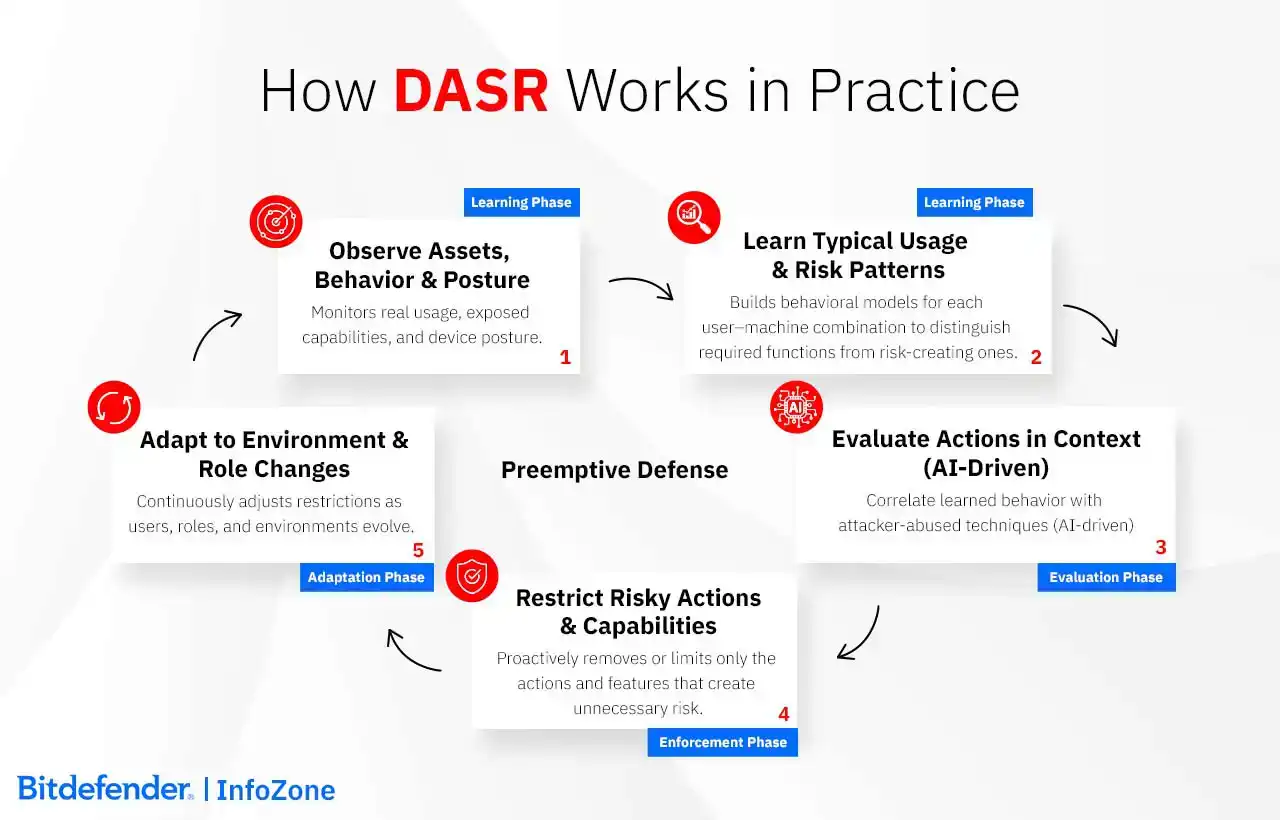
A DASR solution, begins by observing how a machine is used during normal operations. As it gathers enough routine activity, it identifies which capabilities and tools people depend on for their work and which are unnecessary. With that distinction in place, the system can tighten what isn’t needed while leaving day-to-day work untouched.
Its decisions are based on observing real behavior at each endpoint: what gets run, in what context, and how that activity compares to an AI-driven behavioral model built for that user or system. When an action deviates meaningfully from expected behavior and aligns with the steps attackers often take, DASR can narrow or block that specific capability if it has no clear role in the person’s actual job.
In solutions such as GravityZone PHASR, these behavioral models are built for each user/machine combination, rather than for users or devices in isolation. As a result, a single user operating across multiple machines, or multiple users sharing the same machine, results in distinct behavioral profiles. GravityZone PHASR also correlates these profiles with attack techniques used in the wild, continuously adapting restrictions to local behavior and to how attackers misuse legitimate tools.
DASR Operation Mode and Principles
DASR begins by observing each machine’s daily use, applying AI models to learn each user/machine combination’s normal behavior patterns. In this learning phase, it establishes a behavioral baseline that reflects how tools and system capabilities are legitimately used in that specific context. As roles, tools, or workflows change, the models automatically update what is considered normal without requiring administrators to adjust rules.
In advanced DASR solutions, these learned behavior patterns are then correlated with tools and techniques known to be abused by attackers. Capabilities commonly used in attacks but not required for that user/machine combination are proactively restricted. Proactively limiting those capabilities hardens the environment before an intrusion instead of reacting to suspicious activity.
As a result, when an attack takes place, many of the tools and behaviors attackers rely on are already unavailable. This constraint forces adversaries to switch tactics, often by introducing new tools or adopting behaviors that are easier to detect. By proactively reducing what can be misused, DASR limits stealthy progression, slows down attacks, and creates more time and visibility for response teams, while leaving everyday work unaffected.
Benefits of DASR
Stop or disrupt attacks at the earliest stages: One key benefit of Dynamic Attack Surface Reduction is preventing attacks from gaining a foothold. By limiting unused or unnecessary capabilities, many of the steps attackers rely on fail outright, reducing the risk that adversaries can progress their attack without being detected.
Creates a hostile environment blocking emerging threats defeating playbook reuse: By profiling each user’s behavior and tailoring security configurations, DASR tools create a hostile environment that can stop AI-enabled and automated attacks that often rely on ubiquitous system utilities to remain under the radar. As security becomes unique for each user-system pair, attackers can no longer reuse playbooks.
Reduces the amount of follow-up work that dual-use tools generate: Routine admin tools generate a lot of noise, making it difficult to discern whether it’s legitimate admin use or malicious activity. DASR reduces the time spent investigating these incidents by adding context based on each user’s behavior and by filtering out noisy alerts.
Counters adversaries who deliberately blend into legitimate tool usage: Bitdefender research shows that attackers regularly exploit this approach in real-world incidents. By restricting only the specific behaviors that have no meaningful role in a user’s routine, DASR disrupts techniques used for ransomware deployment, espionage operations, and data gathering.
DASR fits into day-to-day operations without disrupting legitimate tasks: The improvements show up across everyday operations:
- Less unnecessary access that could be misused
- Fewer alerts that require human interpretation
- Fewer chances for an attacker to move inside the network
- Fewer interruptions to legitimate work
Altogether, DASR produces an attack surface that stays lean even as the environment shifts. It reduces the risk that a minor incident escalates into a costly one and lightens the load on overburdened security teams.
DASR vs ASR comparison
Traditional attack surface reduction (ASR) was built around fixed rules that rarely kept pace with changing environments or modern techniques that rely on legitimate tools. DASR was created to handle the constant shifts in user behavior, software, and attacker methods that static approaches cannot accommodate.
Full Comparison
|
What |
Traditional ASR |
Dynamic ASR (DASR) |
|
Operational model |
Hardening is point-in-time and rule-based. |
Self-learning models drive continuous, adaptive controls. |
|
Maintenance |
Requires ongoing manual updates, tuning, exception handling, etc. |
Adjusts automatically (according to how users, roles, and applications change). |
|
Control type |
Tool-level allow/deny decisions. |
Tool and action-level restriction based on real usage and risk. |
|
Handling of LOTL techniques |
Limited; attackers abuse trusted binaries, because of the lack of context into how users and third-party apps are leveraging native tools. |
Deeply understands how each user and third-party tool leverages specific actions that attackers use. |
|
Speed to adapt |
Hardening measures are manual and reactive. Analysts periodically recommend hardening against new attack techniques. |
Very rapid; as soon as threat actors change their methods, hardening adapts autonomously, removing risky access before misuse occurs. |
|
Impact on productivity |
Blocking entire tools can interfere with legitimate work. |
Keeps needed functions available while removing unnecessary ones. |
|
Suitability for modern environments |
Struggles with fast-changing, distributed environments. |
Adapts continuously with minimal administrative effort. |
|
Investigation effort |
Higher (due to rigid rules), with limited hardening and context. |
Lower, as decisions incorporate behavioral context and real use patterns. |
DASR’s advantage lies in narrowing each user’s attack surface to what is genuinely needed, rather than relying on broad rules that quickly become outdated. This approach lets organizations reduce exposure without interrupting routine work and removes many of the avenues attackers rely on when operating through legitimate tools.
DASR Use Cases
Dynamic Attack Surface Reduction is particularly well-suited to attacks that rely on trusted tools or low-visibility techniques. Because it aligns system capabilities with each user's demonstrated operational needs, it intervenes at points where attackers need flexibility and ambiguity to advance.
1. Ransomware and data breach attack prevention
Modern ransomware attacks and data breaches rely on LOTL techniques and abuse different legitimate tools at each stage of an attack. By removing access to the capabilities these steps depend on, DASR makes it harder for an initial compromise to progress into a widespread incident.
Common attack tactics DASR constrains include:
- Espionage and long-term persistence, where hackers misuse administrative utilities to establish quiet footholds and maintain access
- Lateral movement and privilege misuse, where built-in tools enable expansion beyond the initially compromised system
- Data gathering and exfiltration, where attackers use native utilities to package, stage, or transfer sensitive information
By limiting these capabilities when they fall outside established usage patterns, DASR reduces the likelihood that an early compromise escalates into encryption, data theft, or widespread impact.
2. Proactively reduce the attack surface
Modern environments continuously introduce new attack surfaces as organizations adopt cloud services, enable remote work, deploy automation, and integrate third-party tools and suppliers. Each addition expands the set of available system capabilities, often faster than traditional hardening processes can keep up.
DASR proactively reduces this expanding exposure by restricting capabilities that are present but not required for normal operations. By narrowing the tools and functions available in practice, DASR limits how attackers can combine unrelated weaknesses (such as misconfigurations, delayed patching, credential exposure, or newly disclosed vulnerabilities) into a viable attack path. Even when a weakness exists, the attacker may be unable to leverage it meaningfully if the surrounding capabilities they depend on have already been removed.
This approach also applies to:
- Zero-day and unknown techniques, where DASR constrains the follow-on actions an attacker can take after gaining a foothold, even when the initial weakness is new.
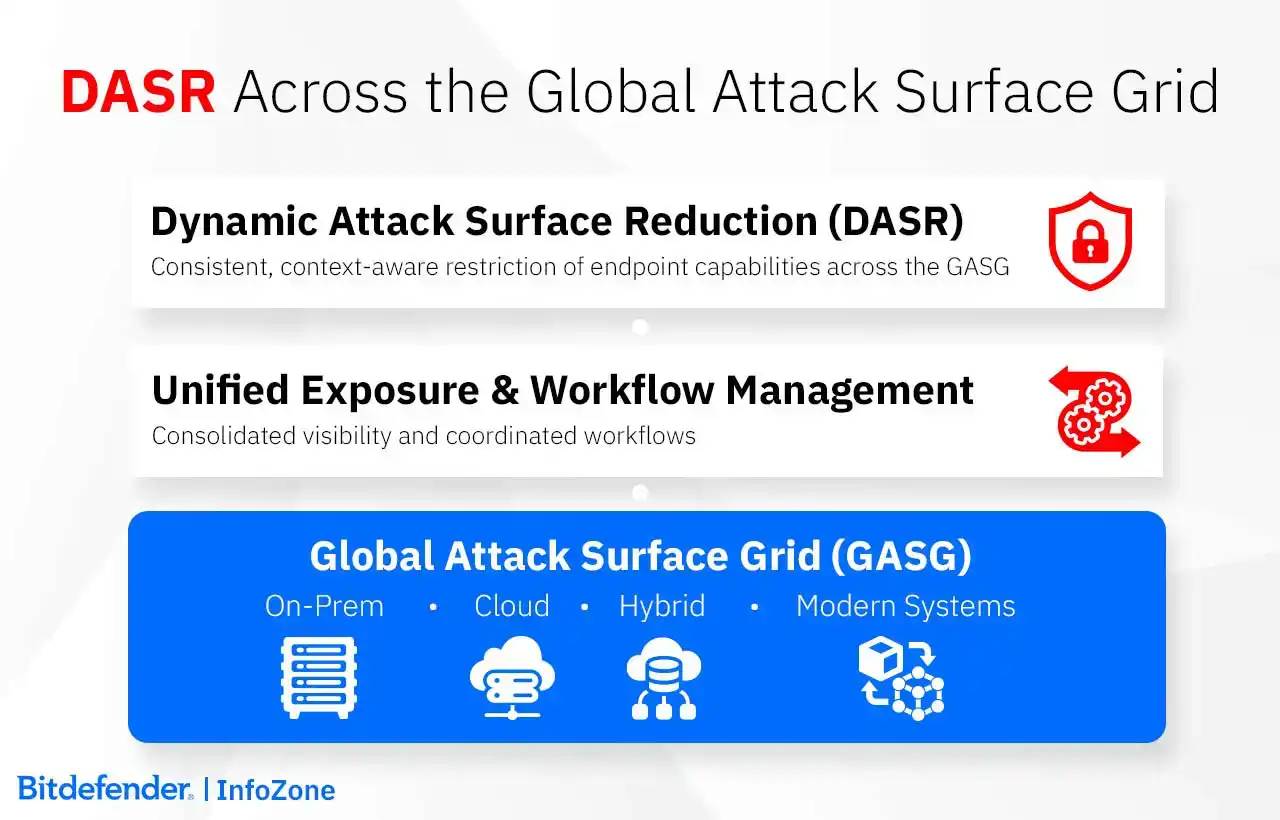
- Hybrid and distributed environments, including supplier and partner integrations, where DASR provides consistent narrowing of capabilities across on-premises, cloud, and remote workloads.
3. Improve security operations efficiency
By proactively blocking unused or risky actions while allowing normal user activity, DASR reduces alert volume generated by legitimate but ambiguous tool behavior. Fewer alerts shorten investigation cycles and reduce the effort required to determine intent behind dual-use tools, easing operational load on security and IT teams.
Implementing DASR in Your Organization
Modern organizations operate across what Gartner refers to as a Global Attack Surface Grid (GASG), a mix of on-prem, cloud, and hybrid environments that are constantly shifting. Regardless of where workloads run, the first step in deploying DASR is simply to let the technology observe. The system begins in a passive state, watching how employees use their tools and which capabilities are genuinely required.
During this learning phase, a DASR tool such as GravityZone PHASR simply watches how systems are used. Over a few weeks, it builds a picture of what “normal” looks like without any restrictions. Once enough data has been collected, the security team can review the initial recommendations. These recommendations usually address items outside daily workflows and can also be applied automatically and adjusted as needed using the Autopilot feature.
After reviewing these findings, organizations typically move into automated enforcement, where the DASR solutions continuously applies restrictions as behavior and environments evolve. This approach reflects how most teams operate in practice, allowing DASR to adapt at scale without ongoing manual effort.
For cases requiring more granular oversight, such as sensitive systems or specialized workflows, solutions like GravityZone PHASR also offer a Direct Control mode. This capability allows teams to selectively approve, adjust, or defer specific restrictions while still benefiting from the underlying behavioral models and recommendations.
Integrating DASR with Existing Security Infrastructure
DASR integrates with endpoint detection and response by reducing what attackers can do before detection and response mechanisms are engaged. By narrowing the functional capabilities available on an endpoint, DASR limits the actions an attacker can take even after initial access, thereby simplifying what EDR and XDR tools need to monitor and respond to.
When deployed as part of the GravityZone platform, DASR operates natively alongside endpoint prevention, EDR, and XDR capabilities, applying dynamic restrictions based on observed behavior and known attack abuse patterns. This preemptive hardening reduces the number of viable attack paths that EDR and XDR would otherwise need to detect and investigate, allowing those tools to focus on higher-confidence threats.
DASR can also augment third-party EDR and XDR solutions without requiring changes to the existing endpoint security stack. In this mode, it runs alongside the deployed EDR/XDR agent, proactively restricting unused or high-risk actions while leaving detection, investigation, and response workflows intact.
Overcoming Challenges and Limitations
Many organizations underestimate the extent to which attackers abuse legitimate tools and manual techniques. As these attacks have surged in scale and speed, static controls such as allowlisting and traditional detection and response often struggle to keep up. This mismatch becomes apparent when teams assume existing policies are sufficient, only to discover that many risky capabilities remain widely accessible.
The DASR discovery phase often makes this visible. By observing normal operations, DASR commonly identifies hundreds of tools, commands, or functions that are technically available but never required for everyday work. While the scale of this can be striking, it underscores the need for a more intelligent, dynamic approach to disrupt attacks before they progress.
Organizations also frequently worry about the impact on users. Features such as GravityZone PHASR’s Direct Control address this concern by allowing teams to review and selectively apply restrictions, reducing exposure without disrupting legitimate activity.
From an adoption perspective, flexibility is another important factor. DASR can be deployed to augment existing endpoint security platforms or adopted as part of a broader platform over time. This flexibility allows organizations to close immediate gaps while evolving toward more comprehensive risk, compliance, or security capabilities at their own pace.
Deployment Best Practices
- Know what lives on your endpoints. When the inventory is clear, the first round of DASR findings is much easier to interpret.
- Let the system run in non-blocking mode initially. Most teams prefer this; it gives them time to review the proposed changes and decide how far they want to go with automation.
- Use Autopilot Mode to automate hardening and minimize administrative effort. Security and IT teams struggle to continuously align system configurations to threats and required access. Automated hardening eliminates the manual work and ensures user access is limited to what they need.
- Don’t think you need to apply all changes simultaneously. Many organizations begin by tightening low-risk areas and widening the scope once they are comfortable with how the adjustments play out.
- Don’t forego detection and response. Even though DASR is narrowing your attack paths, detection and response remain important. You should still investigate and contain anything that reaches the execution stage.
How Bitdefender Can Help
Bitdefender delivers DASR through GravityZone PHASR, available both as part of the Bitdefender GravityZone and as a standalone solution that complements existing EPP and EDR deployments.
Rather than relying on a single static rule set, GravityZone PHASR analyzes how each machine is actually used and proactively pares back tool functions that are unnecessary for that user’s work. This approach removes many of the openings exploited during living-off-the-land activity and in the early post-compromise stages without getting in the way of day-to-day tasks.
Frequently Asked Questions
What are the prerequisites for implementing DASR?
A DASR rollout mainly requires deploying an endpoint agent and giving it time to observe normal activity. It also requires clear knowledge of who uses which tools, to help the system settle into an accurate baseline more quickly. Because deployments begin in audit-style mode, administrators primarily need visibility into their endpoints and time for the agent to monitor routine activity before any restrictions are applied.
In terms of coverage, DASR solutions today focus primarily on Windows endpoints, where most living-off-the-land abuse occurs, with support for macOS and Linux becoming available as the technology expands. No architectural changes or manual rule-building efforts are required; the initial learning phase remains the main prerequisite.
What is the role of threat intelligence in DASR?
Up-to-date threat intelligence highlights where attackers have been focusing their efforts, such as power features in utilities, scripting shortcuts, and other corners of the system that are often overlooked. Knowing this helps the system choose which dormant capabilities to reduce and gives extra weight to odd behavior inside tools that normally don’t raise alarms. DASR still relies primarily on what it learns from the environment. Still, live threat intelligence keeps it aligned with current attacker techniques, especially when new LOTL methods or fileless approaches emerge.
What training or skills are required to use DASR?
DASR does not require specialized training or advanced security skills to use. Organizations can simply enable the technology, allow it to observe normal activity, and then review and report the resulting attack surface reduction to management. The system handles learning and adjustment automatically, without the need to create or tune rules.
While basic familiarity with the organization’s users and workflows is helpful, ongoing operation requires minimal hands-on effort. Teams that prefer additional support or oversight can engage managed services providers to monitor results and assist with interpretation as needed.
How do we track and demonstrate Attack Surface Reduction?
Track Attack Surface Reduction by showing which tools, actions, and capabilities have been restricted over time. In solutions such as GravityZone PHASR, the Attack Surface Management (ASM) dashboard provides clear visibility into how it has narrowed exposure, allowing teams to quantify risk reduction, report results to management, and continuously monitor posture improvements.