

What is a Credential Stuffing Attack?
Credential stuffing is an automated cyberattack where attackers test stolen username and password combinations, usually obtained from unrelated data breaches, across various websites and services. Rather than guessing passwords, this method banks on the fact that users reuse their credentials across multiple platforms. By using valid login details, attackers can bypass many security barriers and often appear as legitimate users.
These attacks are primarily launched for financial gain through account takeover (ATO). Compromised accounts can be drained of stored value, used to make fraudulent purchases, or sold to other cybercriminals. In many cases, attackers exploit access to gather personal data, commit identity theft, or pivot deeper into corporate systems. Targets range from e-commerce and banking platforms to streaming services and loyalty programs - anywhere user accounts have value.
Recent industry data highlights the urgency: credential stuffing now accounts for 34% of all authentication traffic, with an average breach cost of $4.81 million. Stolen credentials were implicated in 31% of breaches reported in 2024. Once attackers succeed, they often “log in instead of breaking in,” using the access to operate quietly within the system. This opens the door to stealthy follow-up techniques, including those classified as Living Off the Land (LOTL), making early detection even harder.
How Credential Stuffing Works
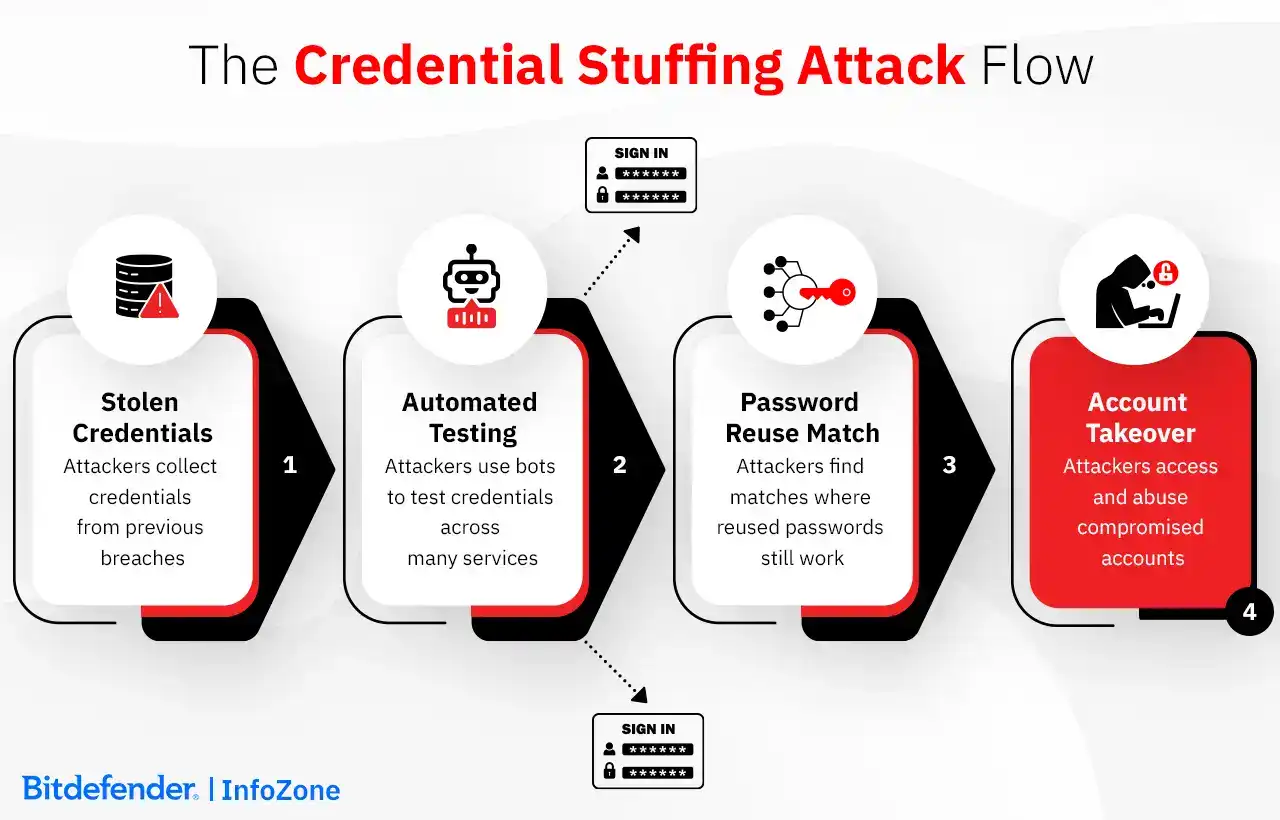
Credential stuffing attacks follow a tightly orchestrated playbook that transforms stolen data into widespread account takeovers.
It starts with data acquisition, where attackers collect large volumes of verified credentials, usually from public breach dumps, malware logs, or darknet marketplaces. These are compiled into combo lists, refined through cleaning, deduplication, and often validated on low-risk platforms to ensure they're still active.
Attackers then tailor configuration files (called “configs”) for their target site’s login flow. These files instruct credential stuffing kits like "Sentry MBA", "SNIPR", or "OpenBullet" on how to interact with the login endpoint, parse responses, and identify successful attempts. The toolset is coupled with automation infrastructure, including residential proxies, IP rotation networks, and CAPTCHA-solving plugins. User-agent spoofing and device fingerprint obfuscation further help mimic authentic user behavior.
The attack execution phase involves launching mass login attempts. Instead of hammering one account with many guesses, attackers often use “one-to-one testing” (a single password per username) to avoid detection systems and lockout thresholds. Increasingly, campaigns focus on API and mobile-app endpoints, where defenses are often less mature. Some attackers run low-and-slow operations, spacing attempts across time and geography to blend into normal traffic patterns.
When a valid match is found, the account takeover begins. Attackers exploit access to extract stored value, personal information, or launch secondary attacks. Many credentials are also resold or reused, keeping them in circulation long after the initial breach.
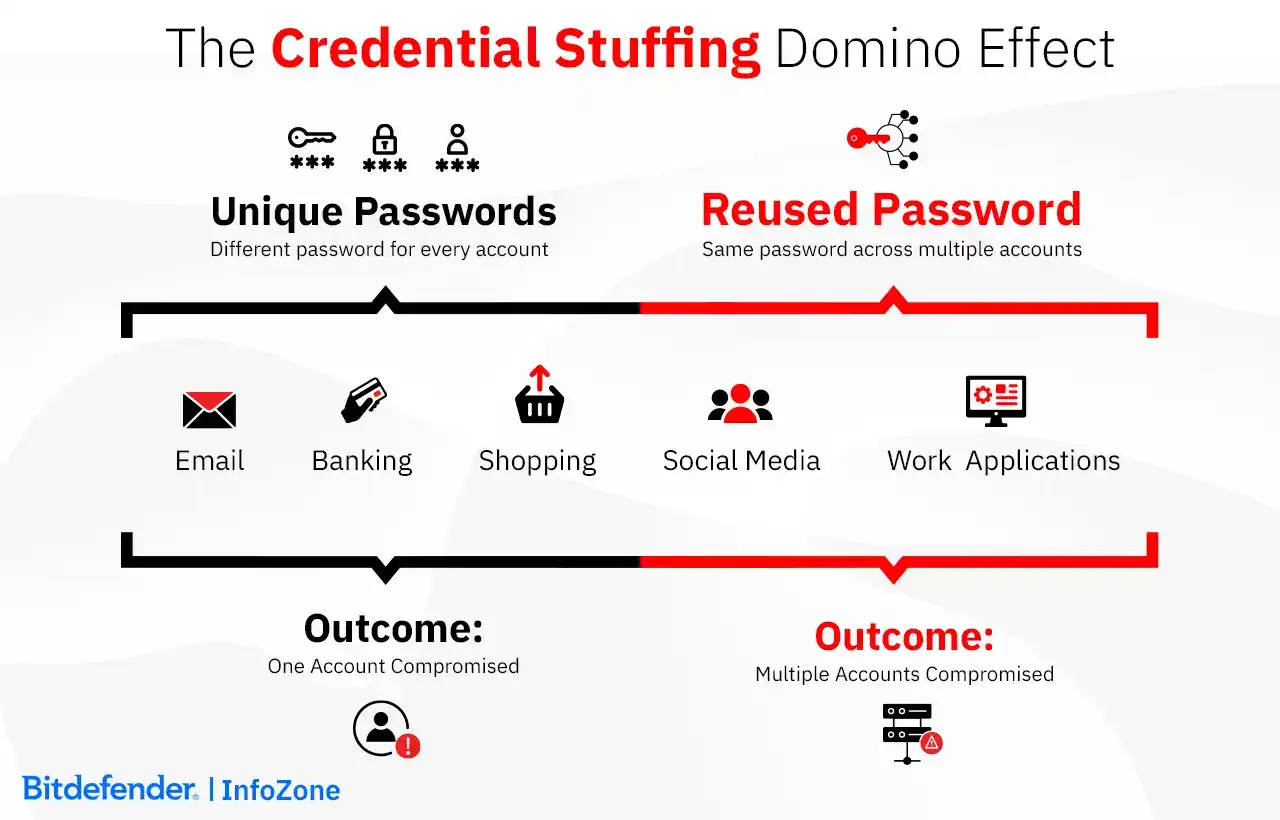
What makes credential stuffing so insidious is that breached passwords become a durable asset, and as long as users reuse them, attackers can keep logging in undetected.
Credential Stuffing vs. Other Attacks
|
Attack |
How |
Input Source |
Targeted Weakness |
Target Approach |
|
Credential Stuffing |
Tests known username-password pairs across multiple sites |
Breached credentials |
Password reuse |
Many accounts, one try each |
|
Password Spraying |
Tries common passwords on many accounts to avoid lockouts |
Common/default passwords |
Weak password policies |
Many accounts, few passwords |
|
Tries every possible character combination for one account |
Generated guesses |
Weak password complexity |
One account, many attempts |
|
|
Credential Cracking |
Offline decryption of stolen password hashes using dictionary or brute force |
Hashed credentials from data breaches |
Weak/unsalted hash protection |
N/A (offline cracking) |
|
Session Hijacking |
Reuses stolen session tokens to bypass authentication |
Active tokens or cookies |
Session management vulnerabilities |
Active authenticated sessions |
|
Tests curated wordlists of likely passwords |
Common words, leaked patterns |
Predictable human password habits |
One or few accounts, many attempts |
The Risks and Impacts of Credential Stuffing
- Data Breaches: Valid credentials give attackers a way in, often without raising alarms. From there, they can pull user data, payment details, or internal records, depending on what the account contains. When thousands of logins are compromised at once, the result is a widespread data leak that looks less like a perimeter breach and more like hundreds of small ones.
- Identity Theft: Once account-level access is achieved, attackers don't always stop with that one service. They harvest personal details (such as names, addresses, account numbers) and move on to other targets. These details show up in loan applications, fake credit accounts, and tax filings. The more complete the profile, the more damage they can do.
- Financial and Reputational Damage: Organizations typically face immediate costs, including payment fraud, chargebacks, and increased manual review processes. Then come the less tangible effects: users closing accounts, negative press cycles, and slower customer acquisition. Support teams get overloaded. In some cases, a breach like this alters how investors or partners see the business. It affects how much they trust the internal controls behind it.
- Regulatory and Legal Consequences: Under various data protection regulations, including GDPR, CCPA, and NIS2, credential stuffing incidents may qualify as reportable breaches, particularly when personal data is accessed or compromised. If security measures like MFA, anomaly detection, or rate-limiting weren’t in place, regulators may classify that as a failure to safeguard user data. The fines can be steep. So can the legal settlements that follow, especially if users weren’t informed quickly.
- Post-Compromise Techniques: Credential stuffing is just the start. Once inside, attackers may escalate privileges or spread to other systems. Sometimes, they capture session tokens or exploit OAuth misconfigurations to keep access after a password reset. In corporate environments, these tactics are often used to stage ransomware attacks or long-term surveillance.
Why Credential Stuffing is on the Rise
Several converging factors have made credential stuffing increasingly attractive to cybercriminals and more challenging for organizations to defend against.
Organizations are dealing with fragmented identity systems, often due to the unmonitored spread of SaaS tools. These platforms expand the login surface without corresponding oversight. Password reuse remains widespread. Users often apply the same login across services that have different levels of security. Some reuse corporate credentials in personal apps. Internal exposure adds risk, as staff can misconfigure tools or leak data without intending to. Attack kits are simple to deploy. Proxy services and CAPTCHA plugins are bundled in. A working campaign doesn’t require custom code or advanced access; it just needs lists and time.
The Breach-to-Stuffing Supply Chain
Credentials from old leaks continue to be recycled. Some were exposed in 2020 and are still effective. Combo lists are built from these dumps and tested against new targets. Prices are low. A fresh batch of logins can cost less than a lunch.
Scalable Automation
Tools like OpenBullet or SNIPR are widely used. They imitate browser traffic, rotate IPs, and interact with mobile endpoints. API endpoints are frequently targeted, as they may have less consistent rate-limiting implementations compared to web interfaces. Some campaigns space out login attempts across weeks, using low and slow testing to avoid detection. AI is being used to simulate user behavior. It can introduce delays, adjust headers, and solve simple CAPTCHAs. These methods reduce friction for attackers and increase success rates across a broad range of targets.
Recent Notable Incidents
- Roku (2024): Attackers reused breached credentials to access 576,000 accounts. The company forced password resets and rolled out 2FA across its platform.
- 23andMe (2023): A credential stuffing campaign exposed 14,000 accounts directly. An additional 5.5 million profiles were accessed through a related DNA matching feature. The company made authentication changes and is facing several legal claims.
- The North Face (2025): A fourth stuffing incident in five years exposed customer records. Data included shipping addresses, phone numbers, and order histories.
Preventing Credential Stuffing Attacks
Credential stuffing isn't stopped by a single control, and it demands coordination across user behavior, system architecture, and response planning. The following four areas offer practical starting points for organizations aiming to reduce their exposure.
- Credential Hygiene & User Practices
The first line of defense is reducing password reuse. Enforcing unique credentials for each service and promoting password manager adoption makes mass stuffing less effective. Mandatory multi-factor authentication (MFA) should be the baseline for all accounts with access to sensitive data. Passwordless methods like FIDO2 tokens further reduce the value of stolen credentials. Organizations should routinely screen user passwords against known breach data, both during reset and at creation, and force changes where needed. - Access-Control & Hardening
Login portals should not treat all access attempts equally. Implementing adaptive MFA, where additional steps are required under certain risk conditions, helps filter suspicious behavior. IP reputation filters and geo-fencing can block high-risk traffic before it reaches authentication endpoints. CAPTCHA enforcement at login can slow automation, but bypass tools exist, so it should not be relied on alone. Lockout thresholds and disabling unused login paths (e.g., legacy API routes) further reduce surface area. These controls should be guided by a Zero Trust security model, where no access is implicitly trusted, even from within the network. - Threat-Informed Monitoring & Automation
Credential stuffing attacks often begin with publicly available combo lists. Organizations can reduce their exposure by scanning these lists for matches against employee credentials, especially when integrated with dark web monitoring tools. Security teams can improve detection coverage by combining threat intelligence feeds with systems that flag unusual login patterns or access attempts. When alerts are triggered early, there's more time to block unauthorized access before it escalates into account takeover or data theft. - Organizational Readiness & Testing
Training users to spot suspicious login screens, unexpected authentication prompts, or phishing messages can directly reduce the number of leaked credentials. These human-layer defenses complement technical controls and reduce the likelihood of password reuse. Red team exercises and simulated credential stuffing attacks can uncover overlooked entry points, while periodic reviews of SaaS usage and password policy enforcement help keep defenses aligned with evolving threats.
Credential stuffing persists because key user behaviors remain unchanged. Breaking those patterns requires coordination across people, process, and infrastructure.
Detecting and Responding to Credential Stuffing
Credential stuffing attacks present unique detection challenges because they often mimic legitimate user behavior. Unlike brute force attacks that generate obvious traffic spikes, credential stuffing campaigns distribute attempts across many accounts and may use valid credentials, making them harder to distinguish from normal login activity.
Indicators include spikes in failed logins across unrelated accounts, login attempts from proxy networks, mismatched user agents or devices, and login success rates that deviate from baseline. API traffic is especially hard to track since it often bypasses web-layer defenses. Tools like Sentry MBA and OpenBullet produce identifiable traffic patterns, but CAPTCHA solvers and slow-rate attempts make detection less reliable.
Detection tools need to pull from multiple systems. SIEM and SOAR platforms correlate login data. Behavioral engines flag outliers like unusual travel or timing. Threat intelligence feeds add new combo lists and known malicious IPs. False positives can be frequent, requiring careful tuning of detection systems. Manual threat hunting may be needed to verify what automation can’t.
Immediate Response Strategies
To contain the attack, start with rate-limiting or blocking traffic from offending IPs or entire ASNs if proxy use is confirmed. If signals aren't conclusive, step-up MFA or introduce CAPTCHA friction. Reset passwords and kill sessions for impacted accounts. Preserve logs, quarantine affected users, and involve fraud and compliance teams where needed.
Long-Term Prevention and Monitoring
After the event, revise detection logic based on what was missed. Feed fresh indicators into monitoring. Red-team regularly against stuffing tactics, especially through mobile and API endpoints. Watch for new credential leaks and rotate exposed credentials where needed. Update training and access policies based on what the incident revealed.
How Bitdefender Can Help
Bitdefender’s GravityZone platform delivers a unified defense against credential stuffing by combining prevention, detection, and response across endpoints, networks, identities, and user behavior. Each layer reinforces the next, allowing organizations to harden their environment, detect attacks early, and respond with speed and precision.
Credential Defense and Risk Visibility
Network Attack Defense (NAD) analyzes login traffic in real time and blocks brute-force behavior, including credential stuffing patterns over HTTP, SMB, and SSH. Risk Management identifies exposure points like weak passwords, reused credentials, and misconfigured access paths.
Anomaly Detection and Threat Correlation
GravityZone's EDR and XDR layers detect stuffing campaigns by correlating signals across endpoints, identity platforms, and cloud apps. Behavioral analytics help uncover stealthy attacks, flagging anomalies such as login velocity mismatches, geolocation shifts, or proxy-based traffic patterns. With XDR Identity and Productivity modules, organizations gain visibility into credential misuse across Microsoft 365, Google Workspace, Azure AD, and other services.
Response, Containment, and Post-Breach Control
Bitdefender's Managed Detection and Response (MDR) service provides 24/7 expert monitoring for credential-based threats. MDR analysts can intervene with credential resets, session invalidation, and access controls. PHASR (Proactive Hardening and Attack Surface Reduction) helps limit the fallout of account compromise by dynamically restricting access to admin tools, remote utilities, and lateral movement paths, based on threat context and real-time behavior.
Testing Readiness and Closing Gaps
As part of red-teaming exercises, Bitdefender Offensive Services can simulate credential stuffing attacks in a controlled environment. These scenarios test whether existing defenses can detect and contain such activity, expose visibility gaps in detection systems, and help teams improve their response procedures before they're needed in a live incident.
Frequently Asked Questions
Are there any free tools or services to check if my credentials have been leaked?
Yes. One of the most widely used services is Have I Been Pwned (HIBP), which lets you verify if your email address can be found in known data breaches. It also offers a password-checking tool to see if your chosen password has ever been exposed, without storing or transmitting the password itself.
Browser-integrated tools like Google’s Password Checkup and Firefox Monitor (which uses the same breach data as HIBP) provide ongoing alerts if any of your saved passwords are later found in breach databases.
Some password managers also include breach monitoring features and notify users when stored credentials are compromised.
For broader, continuous monitoring that includes the dark web and additional personal data, commercial identity protection services are available. Regardless of the tool you choose, avoid entering your actual password into any online service claiming to check for breaches, as reputable tools only require an email address.
What’s the difference between credential stuffing and phishing?
Credential stuffing and phishing both target user credentials but in very different ways.
Credential stuffing involves taking large lists of username-password pairs that were exposed in previous data breaches and testing them (automatically) on other websites. It relies on users reusing the same login details across multiple accounts.
Phishing, by contrast, aims to collect credentials directly from the user. It does this through deception: fake emails, messages, or websites that imitate legitimate services in order to trick someone into entering their login details.
In short, phishing is a method for acquiring credentials, while credential stuffing is a method for exploiting them. The two often intersect, as credentials stolen via phishing are frequently used in later stuffing attacks.
What is the success rate of credential stuffing attacks?
Success rates can range from 0.2% to 2%, though this varies significantly based on factors such as the quality of stolen credentials, target security measures, and credential age. For attackers working with millions of credential pairs, even the lower end of that range can produce thousands of valid logins.
Freshly leaked credentials tend to yield better results, particularly when reused across similar services. Entertainment platforms, retail sites, and gaming services are often more vulnerable due to weaker controls and more relaxed user behavior, while financial institutions tend to see lower success rates due to stricter authentication requirements.
Although the per-attempt success rate is low, the scale of these attacks, combined with automation and minimal operating costs, makes them an effective method for mass account compromise.