

What Is Identity Threat Detection and Response (ITDR)?
Identity threat detection and response (ITDR) is a security discipline that encompasses both the tools and the best practices used to protect an identity infrastructure of an organization, and it focuses on detecting, investigating, and responding to threats that target digital identities, credentials, and the systems that manage them.
In ITDR cybersecurity, the scope covers the full spectrum of identities: human users, such as employees and administrators, and non-human identities, including service accounts and API keys. The discipline protects the identity infrastructure itself (such as directory services and identity providers), which attackers often target to manipulate access or move laterally through a network.
In 2022, Gartner named ITDR a distinct identity security category, an acknowledgment that identity systems had become a primary target and that traditional controls were leaving a critical detection gap.
The ITDR's meaning is best defined by its three core functions:
- Detection: Identifying suspicious or unauthorized activity involving accounts, privileges, and authentication events.
- Investigation: Providing the forensic visibility needed to understand the scope and path of an identity-related incident.
- Response: Enabling security teams to contain threats, remediate compromised credentials, and restore the integrity of affected systems.
Ultimately, what is ITDR in practice? It is the security function that monitors activity within identity systems to catch threats that unfold through legitimate access rather than technical exploitation.
Why ITDR Matters Today
Traditional network boundaries, such as firewall-defined perimeters, internal network segments, or VPN-based access controls, can no longer govern the access environments that cloud adoption, remote work, and SaaS proliferation have created. Authentication points have multiplied across dozens of separate providers. At the same time, machine identities like service accounts, API keys, automated workloads, etc., now outnumber human users over 40 to 1, and each of them represents an access path with varying levels of visibility and control.
In this environment, identity has become the primary control plane. Identity-based attacks do not need to defeat a perimeter; they need a valid credential. The exposure is structural, not incidental.
Traditional identity and access management (IAM) tools were designed to govern who gets access and under what conditions, but they have no mechanism to detect misuse once access is granted, or to respond when an authenticated session becomes malicious. That post-authentication blind spot is the operational gap ITDR fills, extending identity security from access control into active defense.
Why Identity Is a Primary Attack Surface
Attacking a hardened network perimeter carries a high operational cost in time, skill, and a high probability of triggering endpoint or network controls. Targeting identity carries none of these penalties. Once valid credentials are used, activity can appear entirely legitimate and bypass security layers that are not tuned to detecting malicious authorized access.
Privileged access complicates this risk further. A compromised privileged identity provides entry as well as range. Through existing identity attack paths and trusted system relationships, lateral movement becomes a natural extension of legitimate access and not an intrusion that the environment resists.
Directory services, identity providers, and authentication mechanisms such as Active Directory and Entra ID sit at the center of every access decision in modern hybrid and cloud-based environments, which is precisely what makes them a target. An attacker with stolen credentials and manipulated telemetry doesn't operate outside the system, but through it.
Most Common Identity-Based Attack Vectors
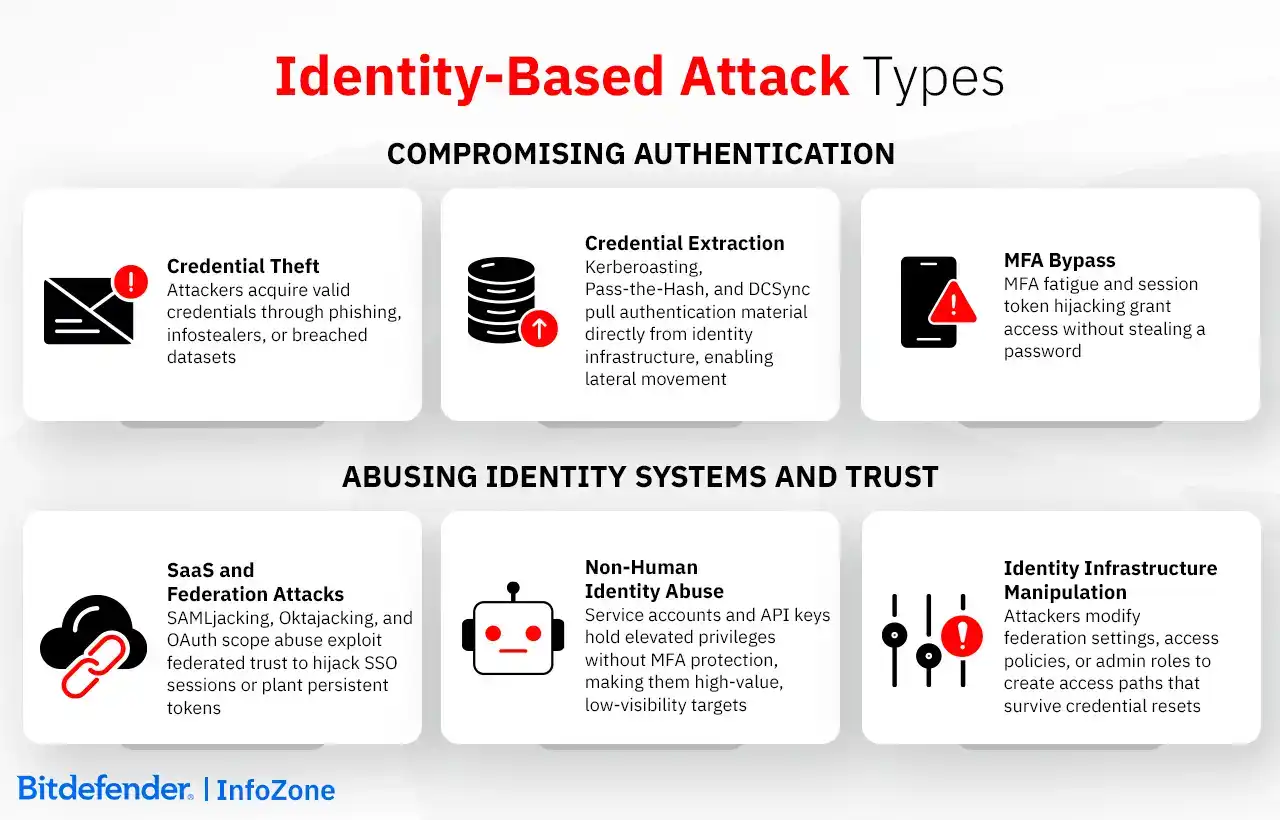
- Credential theft is usually done through the acquisition of valid credentials using phishing, infostealer malware, or credential stuffing from breached datasets purchased on the dark web.
- Credential access techniques harvest the material attackers need to escalate privileges and move laterally. Kerberoasting requests Kerberos service tickets from Active Directory security infrastructure and cracks them offline, exploiting the fact that any domain user can request them. Pass-the-hash (PtH) authenticates using a captured NTLM hash without ever knowing the plaintext password. DCSync abuses the domain controller's own replication protocol to pull password hashes in bulk, without ever touching the accounts directly.
- Lateral movement is used by attackers to reach far beyond the original point of compromise without triggering controls tuned for unauthorized access.
- MFA fatigue and token hijacking are two different ways to get past multi-factor authentication without stealing a password. MFA fatigue bombards users with repeated approval requests until they give in. Adversary-in-the-middle phishing and token hijacking steal active session tokens after authentication has already happened, so the attacker walks in as a verified user. In Entra ID security environments, an unusual sign-in pattern may be the only signal that a session has been hijacked.
- Account takeover and malicious insider activities are dangerous for the same reason: both operate through authorized access. When there are no behavioral baselines, malicious actions and routine ones are indistinguishable.
- SaaS identity attacks exploit federated trust at the application layer. SAMLjacking and Oktajacking hijack SSO flows to intercept credentials or sessions. Going even further, OAuth scope abuse plants persistent access tokens to survive after a password reset. plants persistent access tokens in order to survive after a password reset.
- Non-human identity compromise targets service accounts, API keys, and automation credentials. Machine identities are attractive because they typically hold elevated privileges, but also operate without MFA protections. This combination makes them ideal for long-term, low-visibility access.
- Identity infrastructure manipulation is a method in which attackers go after the rules, not just the accounts, and they do this by changing federation settings, access policies, or administrative roles, with the ultimate goal of creating backdoors that survive credential resets entirely.
How ITDR Works
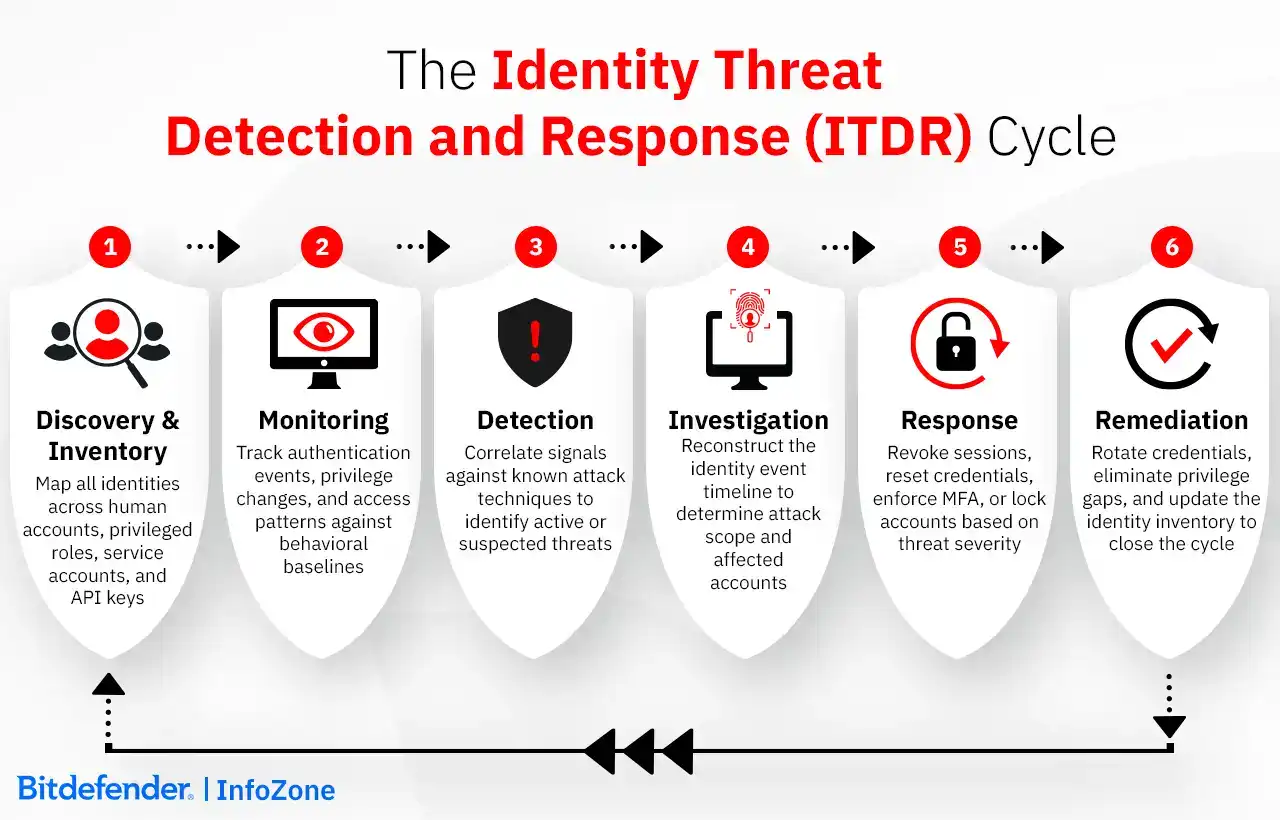
ITDR (identity threat detection and response) is based on a continuous operational cycle composed of Discovery, Monitoring, Detection, Investigation, Response, Remediation. It pulls identity signals from across systems, evaluates what they mean, and triggers follow-on actions. Each phase builds on the last.
Identity Discovery and Inventory
Monitoring and detection both depend on one thing: knowing what identities exist. In hybrid environments, that picture changes constantly as identities are created, modified, federated, and abandoned. ITDR discovery has to keep pace with that change rather than capture a moment in time. That means covering every identity type in scope: human users, privileged accounts, non-human identities such as service accounts and API keys, external identities, and SaaS application identities.
Building that inventory means ingesting login events, MFA activity, privilege changes, and risky sign-ins from authentication telemetry, alongside endpoint and cloud context, which is the foundation for identity baselining and privileged account visibility.
Non-Human Identities (NHIs)
Non-human identities are a governance blind spot by design, as service accounts, API keys, and workload credentials are created for system-to-system communication. In other words, the lifecycle controls for human users cannot apply because these usually have no clear owner, no offboarding, and no regular rotation.
In practice, this means they accumulate. An integration gets built, credentials get issued, the project moves on. The account stays active, often with the same permissions it had on day one, long after anyone remembers why it exists. Multiply that across a typical enterprise environment and the result is a large population of persistent, privileged, effectively anonymous credentials.
The authentication trail makes this worse. A compromised service account accesses a SaaS application looking like normal system activity because there is no user context or behavioral baseline to flag the access as unusual.
That gap is why ITDR must explicitly cover non-human identities not as an extension of human identity monitoring, but as a separate discipline with its own discovery, baselining, and detection logic.
Identity Posture Assessment
Posture assessment focuses on conditions that make an environment exploitable before an attack takes place. It does not track active threats. It identifies what could be used if access is gained.
These conditions are known as Indicators of Exposure (IOEs): misconfigured identities, excessive privileges, stale accounts, and weak authentication mechanisms. IOEs should not be confused with Indicators of Compromise (IOCs), which reflect confirmed malicious activity.
The goal of this step is to identify privileges and policy gaps that can create attack paths and persist over time. Evaluation is typically aligned to NIST frameworks and MITRE ATT&CK Credential Access techniques
Real-Time Identity Monitoring and Behavioral Analytics
Monitoring is the observation phase. Once the identity inventory exists and behavioral baselines are established, ITDR watches what those identities actually do.
User and Entity Behavior Analytics (UEBA) builds behavioral baselines for each identity, tracking normal login times and locations, typical authentication methods, expected access patterns, and usual privilege usage. Anomaly detection flags anything that does not match the established pattern for that identity, whether it is a login from an unexpected location, a sudden privilege change, or an unusual sequence of actions. UEBA is the analytics layer that generates the behavioral signals, while ITDR can be considered the operational system that acts on them, mapping signals to known attack techniques and triggering actions like investigation or response.
All of this runs on authentication telemetry, user activity logs, and risky sign-ins, including individual events that look routine on their own but, read as a sequence, suggest something is wrong.
Threat Detection: Indicators of Compromise and Attack Techniques
For ITDR, detection is the decision layer. Observed signals are evaluated, correlated, and classified as confirmed or suspected threats. Identity activity is usually mapped to the MITRE ATT&CK framework. More specifically, Credential Access techniques are used, including T1078 (Valid Accounts), T1110 (Brute Force), and T1550 (Pass the Hash/Ticket), along with Privilege Escalation and lateral movement tactics.
IOCs (Indicators of Compromise) confirm past activity, while IOAs (Indicators of Attack) identify behavioral sequences that match known attack techniques before any artifact is recorded. In practice, this means ITDR can flag replication requests from a non-domain-controller host, or a service account querying IAM roles it has never previously accessed, as active attack signals rather than waiting for confirmation.
Machine learning and risk-based scoring work through the volume of signals, separating genuine threats from legitimate anomalies. A user logging in from a new location while traveling looks like an IOA in isolation. With no other signals, it is noise. Centralized threat correlation and threat intelligence integration help make that distinction, feeding automated triage so analysts see what actually warrants attention.
Automated and Analyst-Led Response Actions
When a threat crosses a defined risk threshold, response begins - through automated actions, analyst investigation, or both running in parallel.
Attackers can move from initial access to data exfiltration in only 29 minutes. Automated response exists because analyst review cannot match that timeline for high-confidence detections. The moment thresholds are crossed, access can be cut off so that the attacker doesn't reach the next stage through various methods, from session revocation, forced password resets, and account lockout, to MFA enforcement or privilege revocation.
There are incidents where judgment is required. In these cases, analysts work from a centralized identity timeline, basically, a reconstruction of authentication events, access activity, and privilege changes. Where SIEM and SOAR platforms are integrated, response coordination can extend across the broader security stack. MDR can also be taken into consideration, as this solution offers external analyst capacity for complex cases.
As important as speed is, there is always a certain tension regarding accuracy. An automated response that fires too readily can lock out legitimate users and even break business-critical processes. And yet, when the responses are calibrated too conservatively, attackers might gain the time they need for escalation. Therefore, mature, effective ITDR programs should treat this as a continuous tuning problem, with thresholds being adjusted in response to the environment changes and as the team accumulates response history.
Remediation doesn't close the cycle simply with credentials being rotated and misused privileges being revoked; at this step, it is also important to review affected accounts and update the identity inventory to reflect the post-incident state. This feeds back into discovery and posture assessment for the next cycle.
ITDR vs. IAM, PAM, EDR, XDR, SIEM, MDR, ISPM
Rather than being a replacement, ITDR complements existing identity and detection technologies, filling the detection and response gap that appears when facing identity-based threats. Integration with the existing security stack is what makes ITDR operationally effective.
At a Glance
|
What |
Limitations |
Comparison |
|
|
Who gets access, under what conditions, to what resources |
It does not detect or respond to credential misuse within an authenticated session after access is granted |
ITDR extends IAM by covering the post-authentication layer that IAM cannot see |
|
|
Privileged Access Management (PAM) |
Controls, vaults, audits access for privileged accounts and administrative credentials |
Does not monitor for anomalous activity once a privileged session is active |
ITDR adds detection coverage for privileged identity abuse that PAM alone cannot catch |
|
Detects and responds to threats at the endpoint level through device and process telemetry |
No visibility of attacks executed through identity systems, cloud APIs, or SaaS platforms that never touch an endpoint |
EDR and XDR integration with ITDR connects endpoint alerts to identity context |
|
|
Correlates signals across endpoint, network, and cloud for unified detection |
Despite broad coverage, has a more limited depth on identity-specific attack paths and authentication abuse |
ITDR feeds high-fidelity identity signals into XDR for better cross-domain correlation |
|
|
Aggregates and correlates logs across the environment for alerting and compliance |
Lacks native identity behavioral analytics and generates significant noise. It relies on static rules. |
ITDR supplies identity-specific detections that improve SIEM signal quality and reduce false positives |
|
|
Delivers outsourced 24/7 threat monitoring, investigation, and response |
Effectiveness depends on the quality of underlying telemetry and tooling deployed |
ITDR provides the identity telemetry MDR analysts need to investigate and respond to identity threats |
|
|
Identity Security Posture Management (ISPM) |
Continuously assesses identity configurations, permissions, and policy gaps to surface Indicators of Exposure |
Cannot detect active attacks or respond to threats in progress. ISPM reduces the attack surface preventively |
ITDR is the detection and response layer that acts when prevention is not enough |
Key Capabilities to Look for in ITDR Solutions
When considering the right ITDR solution for your organization, the first thing to consider is how well it covers the full cycle. Broadly speaking, it should be able to discover all identities across hybrid environments while providing continuous monitoring and anomaly detection against behavioral baselines. Also, it should have threat detection mapped to known attack techniques, and automated response capabilities alongside analyst investigation workflows. Privileged account visibility, identity timelines and investigation context, and dashboards and reporting features for security operations and compliance are baseline requirements.
Solution categories
Native platform capabilities are built into existing identity providers. These offer tight integration, the possible downside being that coverage is limited to that ecosystem.
Standalone ITDR vendors usually go deeper into identity-specific attack techniques and cross-environment support.
Broader platforms such as XDR or SIEM include ITDR functions within wider capability sets, their advantage being broader correlation.
Managed identity threat detection and response suits organizations without dedicated identity security expertise or round-the-clock SOC capacity. Their services are provided by external analysts who typically cover from continuous monitoring, to threat investigation and incident response and remediation. The rule of thumb is to clearly confirm the escalation paths and coverage scope with them and establish clearly how service quality is measured, preferably using MTTD and MTTR figures specific to identity incidents.
ITDR and Compliance
Most compliance frameworks require the same things ITDR already does: continuous monitoring, access records, and documented incident response.
- NIST CSF is a framework that relies on five core functions (Identify, Protect, Detect, Respond, and Recover) that ITDR maps to.
- ISO/IEC 27001 sets requirements for how organizations manage access and handle security incidents, both being covered through audit trails and privileged account visibility.
- GDPR requires reporting of data breaches within 72 hours, a window that ITDR monitoring of compromised credentials can make a realistic goal.
- PCI DSS mandates continuous oversight of privileged access in any environment handling payment data, and ITDR can and should provide that level of visibility.
- SOC 2 requires evidence that access is monitored and controlled. ITDR generates that evidence as part of normal operations.
ITDR Best Practices
Effective ITDR programs are built on operational discipline, not just tooling. These practices translate the capabilities covered earlier into concrete actions.
Start with identity hygiene. Complete identity inventory before enabling detection. ITDR effectiveness depends on full coverage of identities, human, privileged, external, and non-human identities including service accounts and API keys. Undiscovered identities are blind spots that detection logic cannot reach.
Run monitoring in observe-only mode first. UEBA needs time to learn what normal looks like. Turning on automated responses before identity baselining is complete leads to false positives that damage analyst confidence in the system.
Map detections to MITRE ATT&CK. Most detection gaps are not obvious until someone maps existing rules against specific Credential Access, Privilege Escalation, and Lateral Movement techniques. That exercise tends to surface coverage holes that would otherwise go unnoticed.
Connect ITDR to IAM, SIEM, and XDR. Identity alerts that never leave the ITDR platform miss the bigger picture. Cross-domain attack patterns only become visible when identity signals are shared bidirectionally with the rest of the stack.
Monitor identity policy and configuration changes. Changes to access policies, federation settings, and administrative roles are both a common attacker technique and an early warning signal. They require dedicated monitoring, not just detection coverage.
Document and test response playbooks. Automated response actions need documented playbooks and this is not only because the technology requires it, but also because untested automation will eventually lock out the wrong person at the wrong time.
Maintain continuous identity security posture assessments. AD and cloud identity configurations drift over time. What helps identify IOEs before an attacker does is regular benchmarking against security baselines.
Apply Zero Trust as the architectural foundation. ITDR and Zero Trust are complementary: the assume-breach principle only works in practice if authorized identities are continuously verified, not just at login.
Add dark web monitoring as a complementary layer. ITDR catches stolen credentials when they are used. Dark web monitoring catches them before that point. Both are needed.
Track MTTD and MTTR. These are the primary KPIs for evaluating ITDR program maturity. Full treatment is in the Implementation Guide.
ITDR Implementation Guide
When an ITDR program underperforms, there is a great chance that this is due to implementing it without following a sequence. And the first mistake is starting with detection before visibility is established.
Baseline first. Inventory all identities across identity and access management (IAM) platforms, directories, and SaaS before enabling any detection. Privileged access gets priority, and the reason is simple: administrative accounts and service accounts with elevated permissions represent the highest-risk targets and are the blind spots that have the most consequential repercussions.
Connect telemetry before tuning detections. Fragmented identity signals produce fragmented detection. Pull identity sources into a single analytics layer first, then run in observe-only mode. Mapping coverage against MITRE ATT&CK at this stage tends to surface gaps that were not obvious during planning, before automated response actions go live.
Define playbook ownership before go-live. Who owns the handoff between IAM and SOC investigation functions needs to be decided before deployment. When it is left unclear, identity alerts get generated and never acted on.
Zero Trust alignment. ITDR operationalizes the assume-breach principle: even when an attacker authenticates with valid credentials, behavioral anomalies reveal the unauthorized use. The relationship with least-privilege access is equally direct. ITDR detects when those controls are bypassed and when credentials with excessive privileges are being misused.
The most common deployment mistakes are:
- Fragmented telemetry that excludes cloud or SaaS identity sources.
- Missing privileged account visibility.
- No defined IAM and SOC ownership, which means alerts pile up without resolution.
- Weak or untested playbooks.
- Overreliance on prevention-only controls and the assumption that strong IAM hygiene eliminates the need for detection.
KPIs for Measuring ITDR Effectiveness
The final implementation step is measurement. These metrics measure whether the program is working and where it needs adjustment.
- Detection coverage: the percentage of identity attack techniques the deployed ruleset actively monitors. Gaps here are gaps in protection.
- MTTD (Mean Time to Detect): This measures the gap between initial activity and visibility. An increasing trend usually signals that your telemetry is lagging or your analysts are drowning in noise.
- MTTI (Mean Time to Investigate): This tracks the velocity of context. It's a direct reflection of how quickly your team can pivot from a raw alert to a forensic understanding of the threat path.
- MTTR (Mean Time to Respond): The critical window between detection and containment. This is the primary benchmark for the effectiveness of your automated playbooks.
- Privileged-Account Exposure: This is your unmanaged risk surface. Any administrative or service account operating outside the monitoring scope represents a high-impact vulnerability that hasn't been closed.
- False-Positive Rate: More than just a metric of accuracy, high rates are a "silent killer" of SOC morale, leading to alert fatigue and systemic distrust in the ITDR platform.
- Incident severity trends: Whether confirmed identity incidents are becoming less severe over time is likely the clearest long-term indicator of program health.
How Bitdefender Can Help
Bitdefender approaches identity-based threats through the GravityZone platform, where prevention, detection, and response are handled in a single operational layer rather than separate tools. Identity signals are not treated in isolation, but correlated with activity across endpoints, cloud workloads, and network traffic.
GravityZone Identity Threat Detection and Response (ITDR) focuses on what happens after authentication. It monitors authentication flows, privilege changes, and session behavior across on-premises and cloud identity systems, looking for signs that valid access is being misused rather than legitimately exercised.
Exposure is reduced earlier in the chain. Identity posture insights and the PHASR (Proactive Hardening and Attack Surface Reduction) module limit access to administrative tools based on how users actually operate. In practice, this removes many of the paths attackers depend on once they gain a foothold.
Detection does not stop at identity. GravityZone XDR connects identity activity with endpoint and network telemetry, which makes it possible to follow how an intrusion develops instead of treating each signal separately. Where continuous monitoring is needed, Bitdefender MDR adds a 24/7 layer, with analysts investigating identity-driven anomalies and acting on them before they escalate into full account compromise.
Frequently Asked Questions
How does ITDR address AI and agentic identity threats?
AI agents have entered mainstream and are deployed to manage sensitive tasks like vendor invoices, which needs larger access, in this example, to finance systems, procurement records, and supplier databases to do its job. That access is real, persistent, and usually ungoverned. There are no quarterly access review or MFA challenge, also, no offboarding when the project wraps. An attacker can embed a malicious instruction into data the agent processes, with no need to steal credentials. It just redirects what the agent was already authorized to do.
This is where ITDR applies the same logic it uses for service accounts: what is this identity supposed to be doing, and is that what it is actually doing? Some organizations go further by issuing temporary, task-specific credentials to agents rather than persistent ones, so a compromise has a limited window.
Is ITDR a replacement for MFA, or does it work alongside it?
ITDR does not replace MFA, it covers the ground MFA cannot, as MFA only verifies identity at the point of authentication and has no visibility into what happens after access is granted. MFA can be bypassed, so ITDR picks up monitoring authenticated sessions for behavioral anomalies that indicate misuse. When a hijacked session is detected, ITDR can automatically revoke it or trigger a step-up authentication challenge before the attacker reaches anything sensitive.
Can ITDR help prevent ransomware?
Ransomware attacks rarely begin with ransomware. The typical sequence before the payload deployment involves credential theft, lateral movement through the environment, privilege escalation to reach high-value systems. It is the identity-layer stages of that chain that ITDR addresses. It can detect when stolen credentials are being used, flagging lateral movement patterns, and identifying privilege escalation activity before it reaches the point of no return. It does not stop the ransomware payload itself, but disrupting the identity-layer stages significantly reduces the probability of a successful attack reaching deployment.
What are the limitations of ITDR?
ITDR is highly reliant on the telemetry it receives and there are certain blind spots that detection logic can simply not compensate for. Incomplete identity source coverage like missing cloud IdPs, ungoverned SaaS applications, or undiscovered service accounts are such examples. Also, behavioral baselining requires time and clean data. When detection is deployed against an incomplete baseline, the resulting false positives might erode analyst confidence.
Unclear ownership between identity and security teams is also a possible real-world failure point. How this manifests is that ITDR alerts might not consistently be addressed because neither the IAM team nor the SOC considers them their responsibility.
ITDR also does not prevent credential theft, as it detects misuse only after credentials are compromised. Organizations that treat it as a substitute for identity hygiene and least-privilege controls will find it significantly less effective than those that layer it on top of a strong preventive foundation.
Does ITDR help stop insider threats?
Yes. The detection logic for insider threats differs from external attacks because insiders already have legitimate access, so their malicious activity looks mostly like normal behavior.
ITDR can catch this through behavioral baselining. Accessing data outside usual scope, using elevated privileges at unusual hours, moving files in patterns consistent with staging for exfiltration are signs that appear this way. The hard part is calibration, making thresholds sensitive enough to catch insider activity means you will most likely also flag users doing unusual but authorized things, without any malicious intent.