

What is Account Takeover (ATO)?
Account takeover (ATO) is the act of accessing and illicitly taking over an online account using valid credentials. The goal is to exploit it, and this usually happens because passwords were leaked in data breaches, reused across sites, or stolen through phishing emails. The accounts could be anything: email, banking, social media, or workplace systems.
It's different from identity theft, as the attacker isn't opening new accounts in your name, but hijacking ones you already have. Often, breaking into one account gives them a way into others or access to personal information they can misuse elsewhere.
With more of our lives moving online, unauthorized access to personal and work accounts is becoming a bigger problem. A 2024 survey found that nearly 29% of U.S. adults had experienced an account takeover.
How do Account Takeover Attacks Happen?
Account takeovers usually follow a pattern that doesn’t start with some high-tech hack, but with stolen login details, often from old data breaches or phishing scams. From there, attackers use automation and ready-made tools to break into accounts at scale.
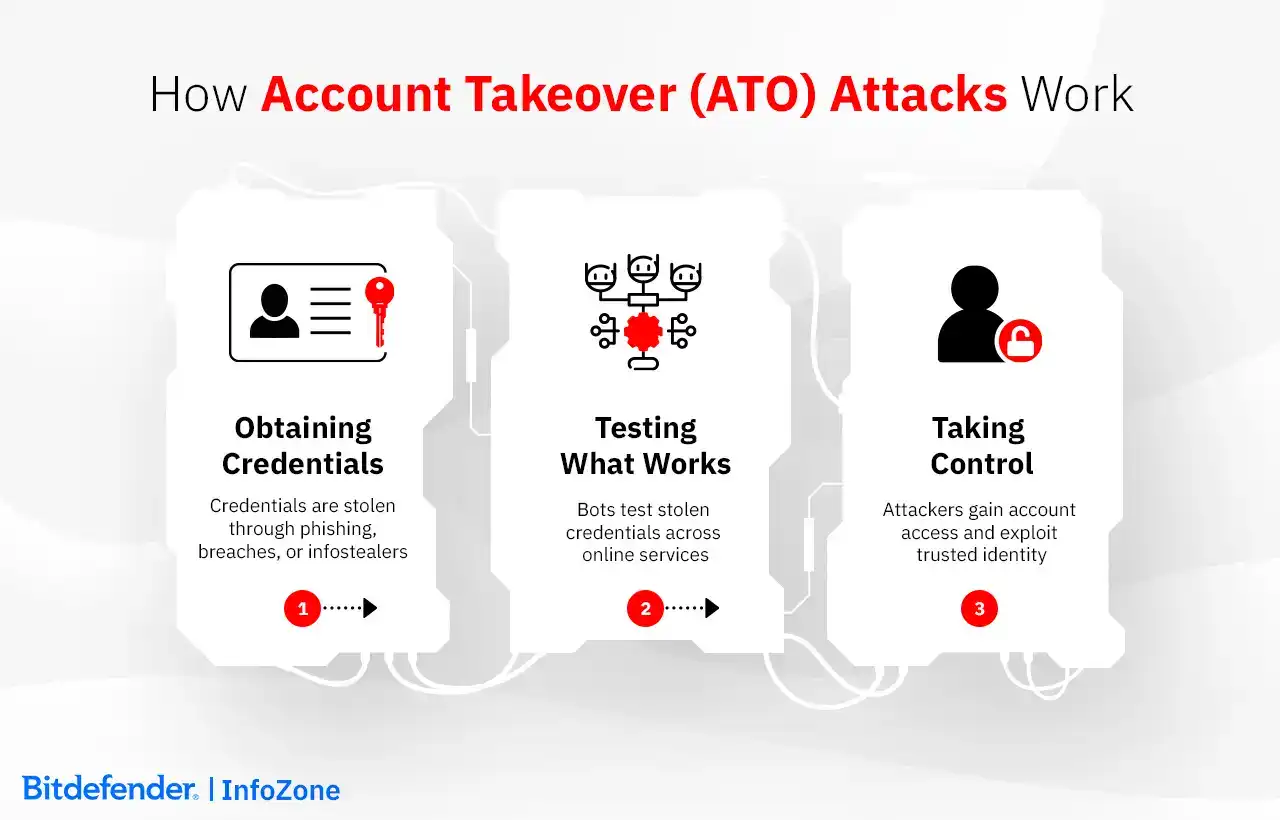
Obtaining the credentials
The first step is collecting usernames and passwords. Sometimes people hand them over by mistake, tricked by social engineering tactics like phishing emails, fake login pages, or texts that look like they’re from their bank. Other times, malware gets installed on a device and quietly pulls saved logins or session cookies. Infostealers are especially common for this. Huge data breaches are becoming more common than ever, and many of them spill billions of logins that end up being reused again and again.
Testing what works
Once they’ve got a pile of credentials, attackers use bots to try them on different websites. This is called credential stuffing, and it works surprisingly well because many people reuse the same passwords across multiple accounts. Brute-force attacks can also be used - simply guessing passwords until one works, something that bots can execute much faster and harder to detect. Tools like SentryMBA or SNIPR help automate the whole process.
Taking control of the account
If they find a match, attackers move quickly. They might change the password, lock the user out, or just check for what’s stored inside. Some accounts are used to send phishing emails to others, or to grab payment info, business data, or access to more systems.
Much of this is powered by services on the dark web. Stolen credentials are sold in bulk. Some sellers offer “validated” accounts that already work. Others provide full ATO kits (including bots, proxy lists, and tutorials) for people with little technical skill. There’s even account takeover-as-a-service, where someone else runs the attack for a fee.
These aren’t isolated attacks and look more like an assembly line: automated, cheap to launch, and designed to turn a single leaked password into a larger breach.
Types of Account Takeover Attacks
|
Type |
Target |
Motivation |
Common Points of Exploitation |
|---|---|---|---|
|
Consumer ATO |
Individual accounts for everyday use |
Fraud, reselling access, collecting personal data |
Email, social media, online stores, streaming platforms |
|
Corporate ATO (CATO) |
Business accounts and internal platforms |
Access to networks, staging BEC, data theft, or ransomware |
Employee email, SaaS tools, admin portals, cloud infrastructure |
|
Financial Account Hijacking |
Accounts tied to money or transferable value |
Unauthorized transfers, asset draining, or laundering funds |
Bank portals, crypto wallets, investment accounts, payroll tools |
|
Loyalty / Reward Program Abuse |
Points-based customer accounts |
Redeeming or reselling non-cash assets |
Airline miles, hotel rewards, retail loyalty programs |
|
Creator / Influencer ATO |
Monetized or high-follower public profiles |
Revenue theft, scams, impersonation, or ransom |
YouTube, Instagram, Twitch, TikTok, brand-backed platforms |
Consequences of Account Takeover on Individuals and Businesses
It is enough to imagine losing control of your main personal or business account in order to realize that the fallout from account takeover (ATO) reaches beyond the compromised login. Both individuals and businesses face a range of consequences, from immediate financial damage to longer-term trust and operational issues.
Financial loss is the most visible outcome. Drained bank accounts, unauthorized purchases, stolen crypto, and investment assets are common, with some victims reporting staggering losses that go into tens of thousands of dollars or more. On the business side, ATO can trigger fraud via customer accounts or internal systems, resulting in chargebacks, reimbursement claims, and fraud investigation costs. In 2023, a report estimated that ATO-related fraud was over $23 billion only in the US.
ATO can act as a gateway to broader identity theft. Once an account is accessed, attackers may harvest personal data (names, addresses, ID numbers) and use them for loan applications or for creating new accounts. Around 40% of ATO victims later report identity theft.
The effects extend beyond the original target. A personal email breach can let attackers reset passwords on financial or work-related platforms. For businesses, one compromised employee login can lead to internal access, data theft, or a broader breach.
Reputation and trust take a long-term hit. Only 43% of users are notified when their account is compromised. Also, 80% of consumers say they would stop using a service after an ATO. For public figures and creators, loss of access can mean impersonation, lost revenue, and reputational damage.
Operations can also be disrupted. Individuals may be locked out of email or platforms tied to their work. Compromised accounts bring real damage to companies, as they can delay workflows, expose systems to ransomware, or strain IT teams with remediation.
Notable examples include billions of accounts resold on the dark web, fraudulent livestreams on hijacked YouTube channels using impersonation and deepfakes, and a 2024 breach of the U.S. SEC’s X account that briefly affected cryptocurrency markets.
Account Takeover Fraud Detection
Modern detection of account takeover (ATO) no longer relies only on spotting strange login attempts; it uses intelligent systems that monitor subtle behavior changes, context-aware anomalies, as well as synchronized signals across devices and environments. What users see are alerts about odd activity, but what's really at work behind the scenes is far more complex: a multilayered detection infrastructure powered by AI, behavioral analytics, anomaly detection, and real-time
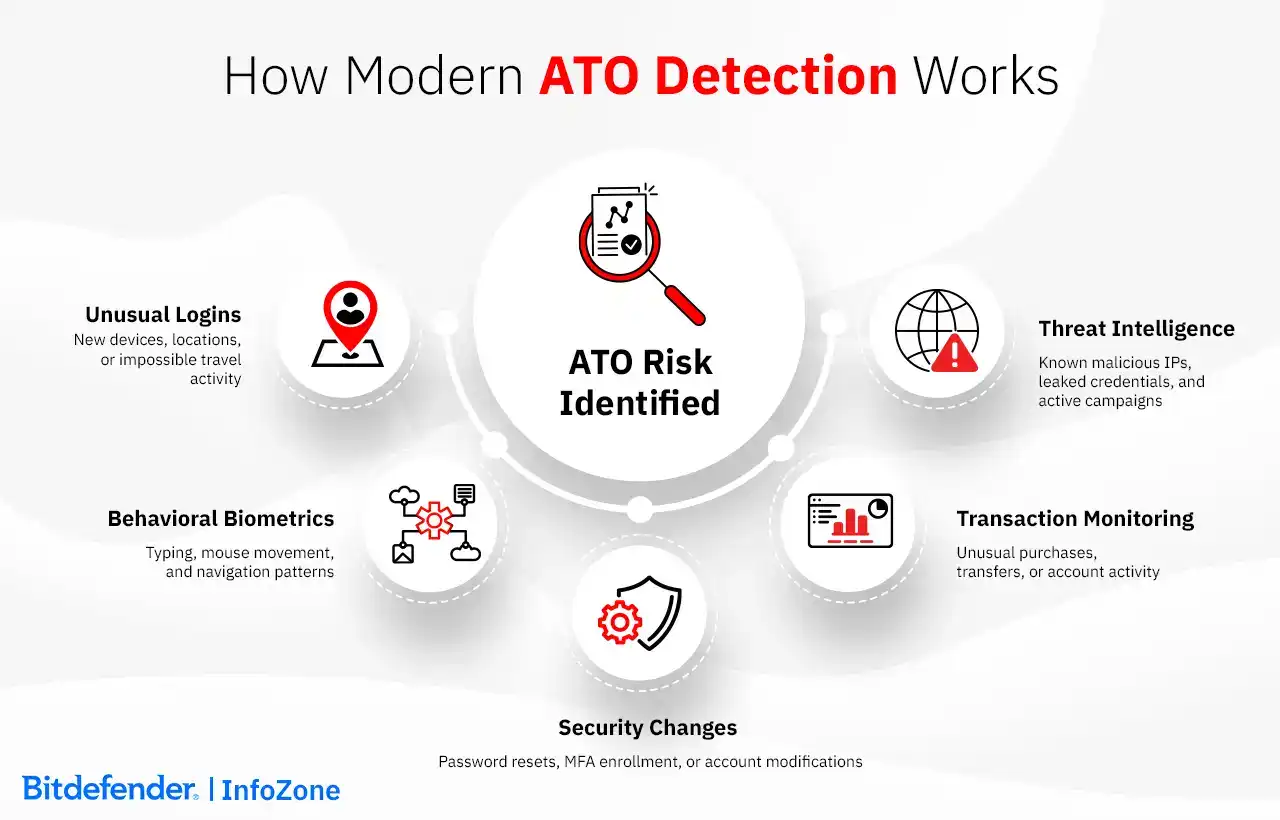
Unusual Access Patterns and Identity Deviations
Unusual logins - whether from unexpected geographies, unknown devices, or occurring at improbable speeds - remain early indicators of compromise. But standalone alerts aren’t enough. Effective systems correlate these anomalies across time, device profiles, and location data to identify high-risk sessions. In particular, “impossible travel” logins (e.g., New York at 10:00, Berlin at 10:20) are classic signals of account abuse, especially in environments where VPN use is restricted or closely monitored, making such anomalies harder to explain as legitimate behavior.
Advanced platforms also flag brute-force attempts, credential stuffing behavior, and repeated login failures, escalating risk scores based on contextual clues.
Behavioral Biometrics and Session-Level Monitoring
Behavioral biometrics focus not only on what users access, but also on how they interact with systems. Subtle things such as the rhythm of typing, mouse movement styles, or in-app navigation paths are captured over time to form unique behavioral signatures. Even if attackers have the correct credentials, these subtle mismatches expose them.
This model is extended by session analytics through the tracking of unusual interaction sequences: seldom-used features suddenly accessed, attempting high-risk transactions, deviating from known workflows, etc.
Real-Time Modification and Transactional Surveillance
Changes to security settings - like resetting recovery emails, enrolling new MFA devices, or updating contact details - can signal a takeover in progress. Modern detection systems treat these events as high-sensitivity triggers, especially when coupled with changes in device or location.
In financial and loyalty accounts, what often gives away a full-scale fraud is anomalous transactions such as sudden high-value purchases, new payee setups, or uncharacteristic shipping addresses. Here, machine learning models flag deviations from the user's historical behavior before damage occurs.
Integrated Intelligence and Cross-Signal Correlation
Advanced detection platforms - especially those built on Extended Detection and Response (XDR) - gather telemetry across cloud workloads, identity providers, endpoint agents, and productivity apps. By correlating signals across these domains, XDR platforms reconstruct entire attack chains that may otherwise appear as isolated events.
An integrated security stack uses this approach to trace ATOs from their earliest indicators, whether it’s a malicious email attachment or a suspicious login, linking them into a cohesive narrative for faster, more decisive intervention.
Live Threat Feeds and Predictive Analytics
Real-time threat intelligence feeds help security systems preempt attacks by flagging known bad IPs, compromised credentials, and emerging phishing campaigns. Integration of these feeds enables predictive blocking and automated user risk re-evaluation before credentials are ever misused.
How to Protect Against Account Takeover Fraud
Securing access means protecting identity, and that’s where account takeover (ATO) defenses begin. From personal email to enterprise cloud systems, attackers target credentials to quietly gain control. Preventing that means more than passwords. It’s about making sure the right person is always the one logged in, and no one else.
- Start with What They Want: Strong Authentication
One solid fix is to make the password useless on its own, and Multi-Factor Authentication (MFA) does exactly that. By requiring something you know (a password) plus something you have (a mobile app, hardware key, or biometric check), you block attackers, even if they’ve already got your login. To go further, organizations are moving toward passwordless authentication using standards like FIDO2. These methods are resistant to phishing and SIM-swapping because they don’t rely on text messages or reused codes. Risk-based authentication kicks in when something looks off – it can be a new device, an odd location, or an unusual login pattern. And when this is paired with rate limiting, CAPTCHA, and IP throttling, even automated bot attacks get at least slowed, if not completely stopped.
- Educate Users, Enforce Better Habits
Phishing still works because it tricks people, and no amount of technology can give 100% guarantees without cybersecurity training being considered key defense. Knowing how to spot fake emails and unexpected MFA prompts makes it less likely to hand over access without realizing it. Good password hygiene helps, too. Requiring unique, strong passwords and encouraging the use of password managers cuts down on credential stuffing. Organizations should set clear policies that block reused or compromised passwords before they become a problem.
- Build a System That Doesn’t Assume Trust
Zero Trust architecture flips the default. Instead of letting users roam freely after login, every request is verified based on user, device, and behavior. That limits what attackers can do even if they break in.
- Make Tools Comunicate to Each Other
ATO defense isn’t just about good tools; it’s also about tools that work together. Identity and Access Management (IAM) systems have strict control over who gets access to what. Endpoint protection blocks malware before it can steal passwords. SIEM and SOAR platforms tie the whole picture together, spotting patterns across devices, networks, and users. Finally, threat intelligence adds outside awareness, flagging compromised credentials, botnet IPs, and new attack campaigns before they reach your systems. The result is a defense that doesn’t wait to react, basically adjusting and responding in real time.
How to Respond to an Account Takeover Incident
A fast, structured response is useful for both individuals and security teams. Responding to an account takeover (ATO) is first about regaining access, but focus should also be on stopping further damage, restoring trust, and discovering what went wrong.
1. Regain Control
- Start by changing the password on the compromised account.
- If you can’t get in, use the provider’s recovery options.
- Remove any suspicious devices or login methods added by the attacker.
- For businesses, immediate actions should include terminating sessions, disabling compromised accounts, and revoking access tokens across cloud and identity platforms.
2. Contain and Assess
- Individuals should check related accounts (especially email and banking) for signs of misuse.
- Consider if placing a fraud alert or credit freeze is necessary.
- Businesses should isolate affected systems.
- Activate your incident response team to examine logs, access histories, and authentication patterns.
3. Secure the Ecosystem
- Reset any reused credentials.
- Enable or reset multi-factor authentication.
- Revoke third-party integrations that could have been exploited.
- If attackers contacted your network or clients, notify them promptly to prevent further abuse.
4. Communicate Calmly and Clearly
- Inform customers, partners, or staff about the incident. Make sure that you use secure, direct channels when doing that, considering the circumstances.
- Keep messages focused on what happened, what was done, and what to expect.
- Internally, ensure leadership, IT, and security teams stay aligned as the investigation evolves.
5. Review, Document, and Adapt
- Document the full timeline and steps taken. This should include things like screenshots, reports, taken decisions, etc.
- Individuals may also report the incident to local cybercrime authorities.
- Businesses should run a post-incident review to identify gaps and update future response plans accordingly.
Legal and Regulatory Considerations
Legal responsibility in the wake of an account takeover (ATO) is about reporting, but also about proving the organization did its due diligence. Regulatory frameworks like GDPR, PCI DSS, GLBA, NIS2, and DORA demand continuous oversight of identity and data access, along with evidence of preparation.
These laws set clear expectations: GDPR requires breach notification within 72 hours and allows enormous fines (up to €20 million). PCI DSS v4.0 mandates multi-factor authentication for all cardholder environments by 2025. GLBA, as of 2024, requires reporting breaches impacting 500+ customers within 30 days.
Cyber insurance policies may help cover ATO fallout, but only if the organization can show it had commercially reasonable protections, like MFA and employee training, already in place. Incident logs aren’t just operational artifacts; they serve as legal proof. Contractual clauses also play a role. Providers and customers alike must understand who bears the risk when credentials are misused.
In the efforts taken to disrupt ATO rings and reclaim stolen assets, there is law enforcement collaboration (like FBI IC3 filings or industry sharing initiatives) that made a real difference.
How Bitdefender Can Help
Bitdefender's GravityZone Unified Security Platform offers identity-centric protection against account takeover fraud, combining visibility, prevention, and expert-led response in a single, integrated ecosystem.
GravityZone's Risk Management identifies vulnerabilities like reused passwords and misconfigurations. Network Attack Defense blocks brute-force and credential stuffing attacks, while Extended Email Security neutralizes phishing campaigns designed to steal credentials.
Digital Identity Protection scans the surface and dark web for leaked credentials tied to your domains. Password Manager enforces strong, unique password hygiene across users and devices.
GravityZone Endpoint Detection and Response (EDR) and Extended Detection and Response (XDR) correlate identity, endpoint, and cloud signals to detect threats like session hijacking and MFA fatigue. Identity Threat Detection and Response (ITDR) adds deep insight into authentication misuse and lateral movement. The PHASR engine dynamically restricts post-compromise access to critical tools and lateral movement paths, limiting attack progression in real time.
Bitdefender's Managed Detection and Response (MDR) service delivers continuous monitoring and hands-on response, including credential resets and session invalidation. Bitdefender MDR also offers services tailored to monitor the dark web for stolen or leaked credentials, while Offensive Security Services simulate ATO scenarios to expose gaps and refine defenses.
Frequently Asked Questions
How often should I change my passwords to prevent ATO?
Frequent password changes aren't as important as using strong, unique ones. Today's best practice is to change a password only if there's a sign of compromise, like a breach alert, unexpected login activity, or a reused password showing up in a data leak. Replacing passwords too often can backfire if users create weak or predictable versions. A better strategy: use a password manager to generate and store long, unique credentials for every account, and update them only when needed.
Can multi-factor authentication (MFA) fully prevent account takeover?
MFA dramatically reduces the risk of account takeover, but it’s not foolproof. Attackers can still bypass it through advanced techniques like SIM swapping (intercepting SMS codes), session hijacking (stealing browser tokens to impersonate you), or “MFA fatigue” attacks that trick users into approving login attempts. To stay ahead, opt for app-based or hardware-based MFA over SMS, and pair it with phishing-resistant methods, real-time monitoring, and smart user training. Think of MFA as a lock on the door, not a security system on its own.
What is session hijacking, and how does it relate to ATO?
Session hijacking happens when attackers steal your active login session, usually a “cookie” stored by your browser after you log in. With it, they can impersonate you without needing your password or MFA code. In an account takeover scenario, it's like a thief getting your hotel keycard and walking into your room unnoticed. This often happens through malware, phishing links, or unsecured Wi-Fi.