
What is DFIR (Digital Forensics and Incident Response)?
DFIR, or Digital Forensics and Incident Response, is the practice of identifying and interpreting digital evidence from a security event and managing the actions taken as that event is addressed. The work links fact-finding with operational decision-making so that the investigation proceeds without interrupting the response, and the response proceeds with an accurate understanding of what has occurred.
Digital forensics looks at the traces a system leaves behind so you can tell what was done earlier. Incident response focuses on what is happening now and what needs attention, so things don’t get worse. If the two run separately, they often pull in different directions. Treating them as one discipline helps avoid that.
Because DFIR is mentioned next to many other security terms, it helps to be clear about the differences. A SOC (Security Operations Center) deals with monitoring and first-line alert handling. DFIR gets involved when something needs a closer look than the SOC can provide. EDR (Endpoint Detection and Response) technology supplies endpoint data, but interpreting that data and determining its relevance is DFIR’s role. MDR (Managed Detection and Response) is a service model that may deliver these capabilities on behalf of an organization, but the practice of DFIR itself is independent of how or where it is staffed.
At its core, DFIR gives security teams a way to detect an issue, understand it based on defensible evidence, and coordinate the response needed to bring systems back to a trusted state, three tasks that are far more effective when handled as a unified discipline.
How a DFIR Investigation Works
A DFIR investigation has multiple parts that inform each other. They’re usually shown for clarity, but in real cases the team may revisit earlier steps as new information shows up.
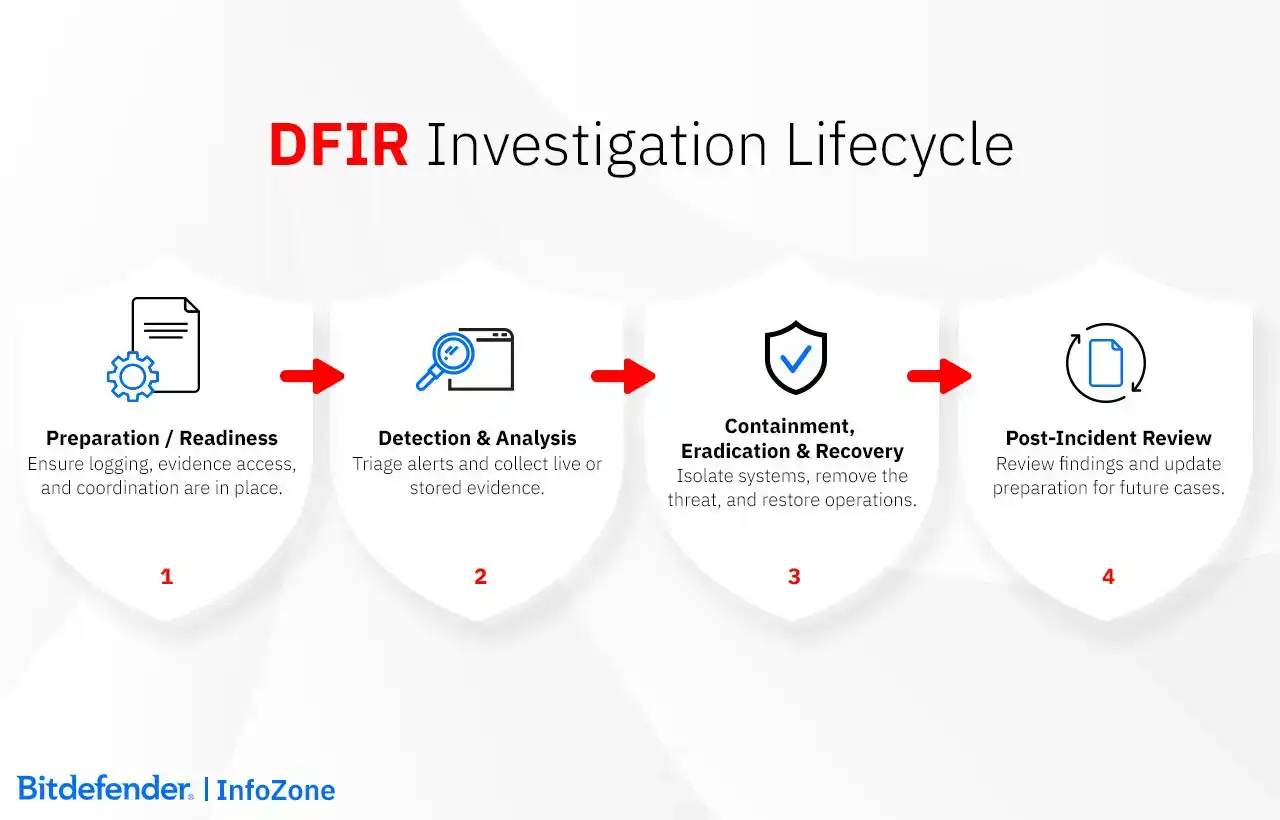
1. Preparation / Readiness
This part of the work is about making sure useful information will be there when needed. Teams verify that logging is turned on in the right places, that they can collect data without delays, and that everyone involved knows how to coordinate. In environments spread across endpoints, cloud, and on-prem, the main goal is simply understanding where evidence lives and how to reach it.
2. Detection and Analysis
The first job is to see what can still be collected and decide what needs attention right away. When a machine is still powered on and the short-lived data is important, the team captures it through live response. If the system has already been taken offline, they switch to reviewing whatever was saved earlier. Live response helps with understanding what’s happening at that moment; the offline work helps explain the events that led up to it.
3. Containment, Eradication and Recovery
Containment is about stopping the situation from spreading without disturbing what the team still needs to examine. That usually means isolating the affected systems or limiting their access. Once things are stable, they remove whatever caused the issue and then move into recovery, where the systems are brought back online and checked to confirm nothing unwanted is left behind.
4. Post-Incident Review and Lessons
After everything is under control, the team reviews the case—what happened, how the response went, and what should be improved so they’re better prepared next time.
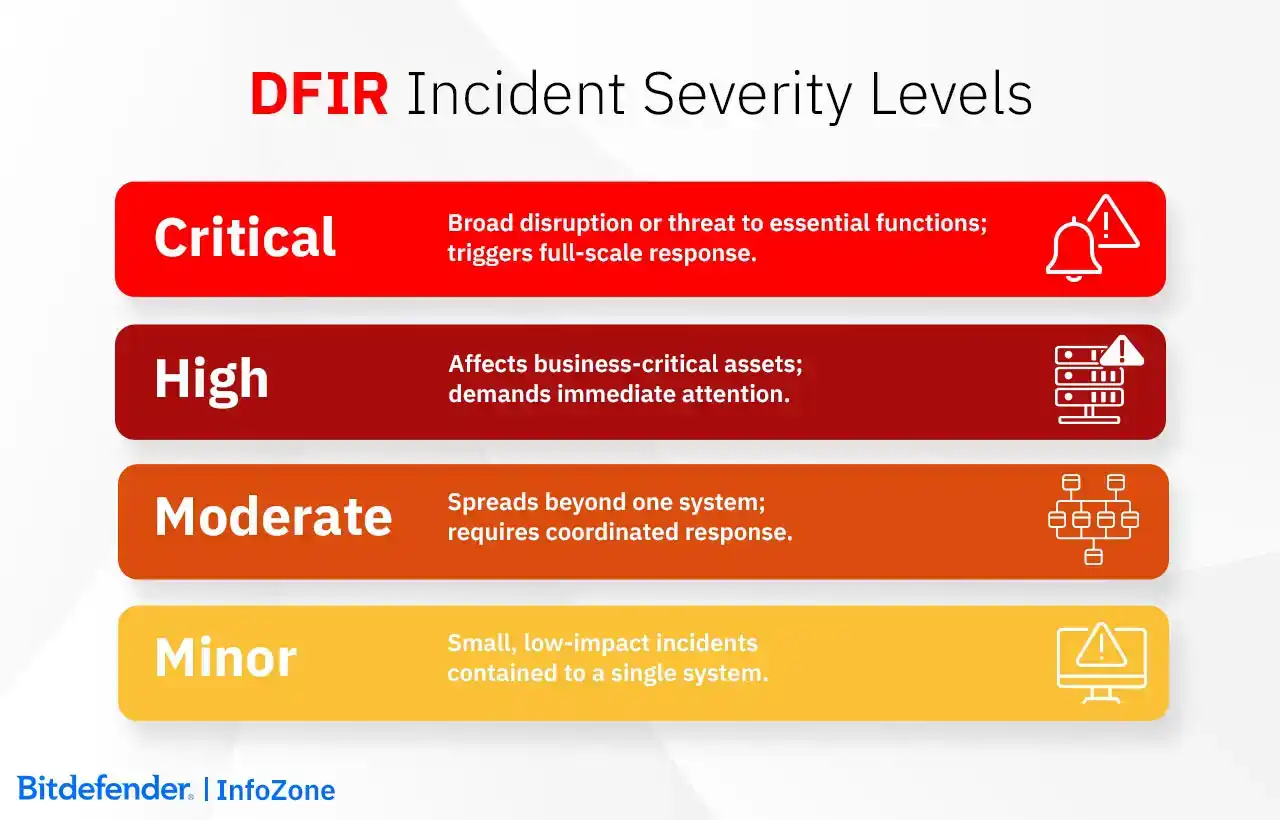
Incident Classification and Severity
Incidents can be grouped into broad severity levels so that judging how much effort to commit becomes easier. Minor cases are small and low-impact. Moderate cases spread beyond a single system and need joint handling. High-severity incidents involve assets that the business depends on and get immediate attention. Critical incidents create broad disruption or threaten essential functions and trigger the highest level of response.
Integration with Security Operations
DFIR work depends on the information coming in from the rest of the security stack. The SOC usually raises the alert in the first place. EDR and XDR (Extended Detection & Response) tools show what was happening on the affected systems, and the SIEM (Security Information and Event Management) platform helps connect those events across the environment. DFIR pulls these pieces together instead of working in isolation.
DFIR Team Roles
The Incident Response Manager coordinates the work and communicates with the rest of the organization. The Forensic Analyst looks at the material gathered from affected systems and pieces together the sequence of events. A Malware Analyst handles any files or code that need a closer technical review.
In some cases, a Threat Intelligence Analyst adds context from outside reporting, and a DFIR Consultant joins the team when extra capacity or a specific skill set is required.
Common Cyber Threats Requiring DFIR
When regular monitoring leaves gaps in understanding incidents, DFIR is brought in to fill in the missing information. In ransomware cases, DFIR usually needs to identify where the entry point was, but also to identify the affected systems and check if data was taken before encryption. APTs operate quietly over time and leave bits of evidence in many places, making them hard to understand without a deeper review that a DFIR can offer.
Insider cases (whether intentional or accidental) often end up with DFIR because someone has to separate everyday activity from actions that don't fit a person's normal job. When credentials are abused, the work usually turns into figuring out how they were taken and where they were used, whether it came from a simple guess, a reused password, or something more deliberate.
If the attacker moved around inside the network, DFIR helps trace the path from one system to the next and see what traces are still left to work with. The same applies to “living off the land” or other fileless approaches, where the activity hides behind legitimate tools and only leaves small clues behind.
Data-access cases like breaches or exfiltration require a different kind of review: confirming what was reached and how it left the environment, which also feeds into regulatory reporting. Problems that come in through a supplier or through a vulnerable application follow a similar pattern; DFIR has to pinpoint where the first foothold appeared and whether it was used to reach anything else. In the case of web-application exploitation and zero-day attacks, what DFIR typically needs to pinpoint is the entry vector and assess if there are follow-on actions inside the network.
Investigation teams also find attempts to hide what attackers did by erasing logs or changing timestamps. Certain types of evidence vanish on their own as well. Modern environments often spread their systems across endpoints, cloud services, and third-party platforms. This can make evidence collection harder and exposes limits in how much a response team can handle at once. Because of this, DFIR becomes the only reliable way to piece together what happened and to confirm how far an incident reached.
The Evolution of DFIR in Cybersecurity
Originally, examiners spent most of their time checking an individual computer in isolation. This worked when incidents were limited in scope. It became harder to rely on that method once attackers started moving through multiple systems instead of leaving everything on one device. By the 2010s, many organizations had little choice but to link forensic work with their response efforts so they could follow activity as it moved across the network instead of treating each device as an isolated case.
The next major shift came with cloud use and hybrid setups. Evidence spread across cloud services, mobile devices, and remote work setups instead of sitting on one system. Once EDR and XDR were added to the mix, analysts suddenly had far more endpoint data to sift through, which changed how they judged whether they were seeing enough.
Attackers also changed their habits, moving more slowly and leaving bits of evidence scattered around the environment instead of drawing attention to themselves. That combination of more to look at and less obvious behavior made it impractical to keep forensics and response as separate efforts, so they ended up being treated as one discipline in practice.
Why DFIR Matters in Modern Cybersecurity
Many organizations discover the value of DFIR the moment they try to answer basic questions during a breach: “How long was the attacker in the environment? What did they reach? How far did they move?” Those answers directly influence cost, and recent data makes that easy to see.
When an intrusion sits unnoticed for months, which still happens in many cases, the effort required to unwind it rises quickly. Industry averages put that undetected period above 190 days, and recovery usually stretches well beyond detection. When that much time passes between the first breach and the point where someone notices, the situation usually spreads beyond the initial system. More machines get pulled in, and the bill goes up.
Recent studies put the average impact of a breach at around $4.4 million (2025), with higher costs in cases where visibility was limited or the investigation started late.
Meeting Reporting Duties During an Incident
Regulatory obligations have tightened over time, and understanding and reporting a breach has become almost like an against-the-clock race. For example, GDPR and NIS2 require early findings to be presented within hours. Also, HIPAA, PCI-DSS, and SOC 2 expect incident reports to be based on verifiable evidence, expectations that require a provable confirmation of systems involved, data exposed, and timing. These details come from the investigative side of DFIR because it provides the documented evidence that regulators, insurers, and legal teams rely on when evaluating an incident
Business Value and Risk Reduction
Organizations that are familiar with DFIR work usually move through incidents with less disruption. They can focus on the systems that were actually affected instead of rebuilding everything, and they're better at spotting any remnants that could cause trouble later. When these pieces come together, outages tend to be shorter and the overall cost of the incident drops.
Indicators That Matter
Enterprises tracking their own performance usually monitor a small set of metrics to judge whether their DFIR efforts are improving:
- MTTR (how quickly containment happens)
- dwell time (how long an attacker remained active)
- evidence acquisition time
- cost per incident.
These numbers rise or fall depending on how well the investigative and response functions work together.
Why It Matters Today
Breaches today don't give teams much time, and the evidence they leave behind isn't always consistent. Add tight reporting deadlines, and it becomes clear why DFIR matters: it helps teams work out the facts, see what was touched, and decide how to fix things so recovery goes more smoothly.
Real-World Examples of DFIR Use
After a ransomware event, DFIR helped a large retail organization establish which systems were compromised. This meant that the rest of them could be restored immediately, and this allowed them to bring critical services back online instead of keeping regional operations offline for an extended period.
A separate case involving a business email compromise in London followed a different pattern. Investigators reviewed mailbox activity and message routing to confirm how the attempt was carried out and prevent a fraudulent transfer.
DFIR work is also applied before a breach occurs. In an assessment for a critical-infrastructure operator, the review identified weaknesses that would have slowed the response to an actual incident, giving the organization time to correct them.
Types of DFIR Services
DFIR services come in several forms, and organizations usually mix them depending on what they can handle internally and how quickly they need help.
A retainer is the simplest arrangement: the terms are agreed in advance, so investigators can start work immediately when something goes wrong.
When no such agreement exists and an attack is already unfolding, companies request emergency incident response. This is short-notice support meant to help contain the situation and work out what the attacker reached. Some requests aren't tied to an active incident at all. Digital forensics work is often done for internal reviews, legal matters, or documentation needs where the aim is simply to confirm what happened and keep a clear record of it.
Some services focus on checking systems even when there is no confirmed incident, like threat-hunting, whose goal is to look for activity that may point to an intruder that has not been detected yet. For companies that do not want to run their own investigation team, DFIR-as-a-Service gives them access to people who can review machines and logs when something needs to be checked. MDR services that include DFIR support add constant monitoring and can pass confirmed issues to investigators when needed.
Handling DFIR inside the company is possible, but not very easy to cover, as it requires staff with different areas of expertise, as well as the means to store and work with evidence correctly. This is difficult for many organizations to cover on their own and therefore, a common approach is to bring in outside specialists when a case is too complex or when skills the internal team does not have are required.
DFIR Best Practices
Strong DFIR programs are built long before an investigation begins. Playbooks, clear escalation paths, and recurring tabletop exercises give teams a practical way to coordinate their actions and check whether they can retrieve the information they will need in an actual case. Evidence readiness plays a part here as well: logs must be available, retained for a useful period, and reachable by the people who handle investigations.
DFIR also fits into the larger security program rather than standing apart from it. EDR and XDR supply the system activity that investigators rely on. SIEM platforms gather the surrounding records that show how events relate to one another. SOAR systems can take on routine steps so analysts can focus on interpretation. Threat intelligence sources and internal indicators give context, helping teams see whether an issue fits a known pattern or stands on its own. When that context is available, the investigation tends to move more smoothly.
In practice, teams pay attention to whether they're stopping incidents sooner, finding the evidence they need without delay, and avoiding the same missteps from previous cases. These observations show more than formal metrics ever could and reveal whether the day-to-day routines are improving and whether the organization is meeting the expectations that frameworks like SOC 2 place on documentation and consistency.
DFIR Tools and Techniques
Data sovereignty brings control, but that comes at a cost. Running parallel systems for each region, translating the same rules into different legal languages, coordinating across regulators that rarely agree, etc. All these things amount to what’s often informally called the “sovereignty tax.”
And the price isn’t only financial. The loss of simplicity is also considered a burden. Every new jurisdiction adds another layer of contracts, audits, and operational limits. These can seriously slow the flow of information that companies once treated as seamless. Conflicts between laws deepen that friction. One authority demands transparency; another forbids disclosure. In global operations, a single transaction can sit inside several legal regimes at once, none fully compatible. Interoperability is promised far more often than it exists, and businesses spend more time mapping compliance overlaps than innovating.
Privacy and security are part of it, but so is the economics, in other words, keeping data and the wealth it generates close to home. The policy could have a positive effect on the local economy, but there is also the danger of breaking the digital market into many pieces. Most likely result is that small players will have trouble competing globally.
How Bitdefender Can Help
GravityZone supports investigation and response by giving analysts access to the endpoint activity, alerts, and remote actions needed during a case. Responders can take action directly from the platform when they need to, such as isolating a system, pulling a small evidence bundle for review, checking recent changes, or sending a file to a sandbox. When they need to look for something specific, they can run quick endpoint queries to check for files, processes, or registry entries tied to the case.
GravityZone XDR brings in additional signals from identity systems, network activity, and cloud workloads, giving responders more context when checking how an incident developed. It also offers a clear view of the actions that led up to the issue through its Root Cause Analysis feature. Integrity Monitoring is available as well and reports when important files or registry entries change in ways that may require a closer look.
Bitdefender MDR adds a staffed response layer. The service reviews alerts around the clock, uses Pre-Approved Actions to contain confirmed threats quickly, and prepares the information needed if the situation requires a deeper forensic review. This support is useful for organizations without their own DFIR team or when internal staff are already occupied with other priorities.
For investigations that involve broader evidence collection or require recovery work after a major incident, Bitdefender works with CYPFER. The partnership provides access to specialists in detailed forensics, documentation, and post-incident restoration.
Frequently Asked Questions
How long does a DFIR investigation take?
There isn't a set duration. If the logs are still available and the affected machines are easy to reach, the team may get a clear picture within a day. When evidence sits across multiple systems or some machines need to be isolated before they can be checked, things naturally take longer. Most of the time, the delay comes from tracking down gaps in the timeline rather than analyzing what's already in front of the team. If older cloud records need to be pulled or the attacker moved between different environments, the investigation naturally takes longer.
Do small businesses need DFIR?
Yes. Attacks hit smaller companies all the time, and they still need someone who can look at what was affected and what needs to be fixed. Most small businesses don’t have a team for this, but they can rely on outside help when something serious occurs. Even basic access to responders makes a difference when a breach interrupts operations.
Can DFIR findings be used in court?
They can, as long as the evidence was handled properly. DFIR teams usually hash the material they collect and keep a record of who touched it, mainly so they can show that a file or disk image hasn’t changed since the moment it was copied. Courts are looking for that kind of documentation. If the notes are incomplete or the original data wasn’t preserved, it’s harder to rely on the findings later.