

What Is Threat Detection and Response?
Threat detection and response (TDR) is a cybersecurity discipline and technology category focused on identifying, investigating, and containing threats that have bypassed preventive controls. Unlike firewalls or antivirus software, blocking attacks at the perimeter, TDR operates on the assumption that determined adversaries will eventually find a way in, and that the priority then shifts to minimizing how long they go undetected and how much damage they can do.
In operational terms, TDR lives inside the security operations center (SOC), the place where security telemetry converges and analysts make the calls that matter: contain, escalate, or close. It supplies the detection logic, the investigation workflow, and the response capability that transforms raw security data into decisive action, applying continuous monitoring across endpoints, networks, cloud workloads, and identity systems to correlate signals that would otherwise go unconnected.
What separates TDR from older security paradigms is this active, assumption-of-breach mindset. Rather than asking “did something bad get in?”, TDR continuously asks “what is happening right now, and does it require a response?”
Why TDR Matters Today
Today's attackers have largely abandoned the tools that legacy defenses were built to catch. Instead of deploying recognizable malware, many operators now run attacks using nothing but legitimate system utilities (PowerShell, WMI, built-in admin tools) that look identical to normal IT activity. This approach, known as living-off-the-land, means there is often no malicious file to detect, no signature to match. Zero-day exploits, ransomware staging, and APT persistence all increasingly rely on this same principle: stay invisible by staying legitimate. Infostealers follow a similar logic, with no exploitation required, just quietly harvested credentials that open doors to identity-based attacks weeks later.
AI has shifted both sides of the equation. Attackers now automate what once took skilled operators, like reconnaissance, large-scale phishing, or malware that rewrites itself when it must evade pattern matching. On the defensive side, AI and machine learning are the only realistic answer: processing the volume of telemetry that modern environments generate is simply beyond what human analysts can do alone, which is where behavioral analysis fills the gap.
According to recent reports, the global median attacker dwell time (how long a threat actor operates undetected inside a network) is 11 days, which is certainly long enough to finish the job: map the environment, escalate privileges, stage data, position ransomware, etc. Legacy “detect-and-alert” architectures weren't built to catch this. The most damaging intrusions succeed not because prevention failed once, but because nothing caught the attacker during the time they spent moving through the environment, according to CISA's advisories on advanced persistent threats. And a single structural shift from reactive alerting to active, cross-domain investigation is what endpoint threat detection and response and cloud threat detection and response are built to deliver.
How Threat Detection and Response Has Changed
|
Then |
Now |
|
|
Detection |
Scheduled scans, known signatures |
Continuous telemetry, behavioral analytics |
|
Tooling |
Separate tools, separate consoles |
Single platform, unified visibility |
|
Response |
Manual triage, high alert volume |
Automated containment, analyst focuses on what matters |
|
Coverage |
Endpoint-centric |
Endpoint, cloud, and identity |
How TDR Works
Threat detection and response solutions work by bringing together security telemetry from across the infrastructure into a single layer where data event correlation can do its job. A suspicious login, an unusual PowerShell command twenty minutes later, a file archive appearing shortly after - none of these triggers an alarm on its own. Together, they tell a different story. That is what threat detection and response tools are built to catch.
That telemetry comes from four domains: endpoint activity, network traffic analysis (NTA), cloud environments, and identity systems.
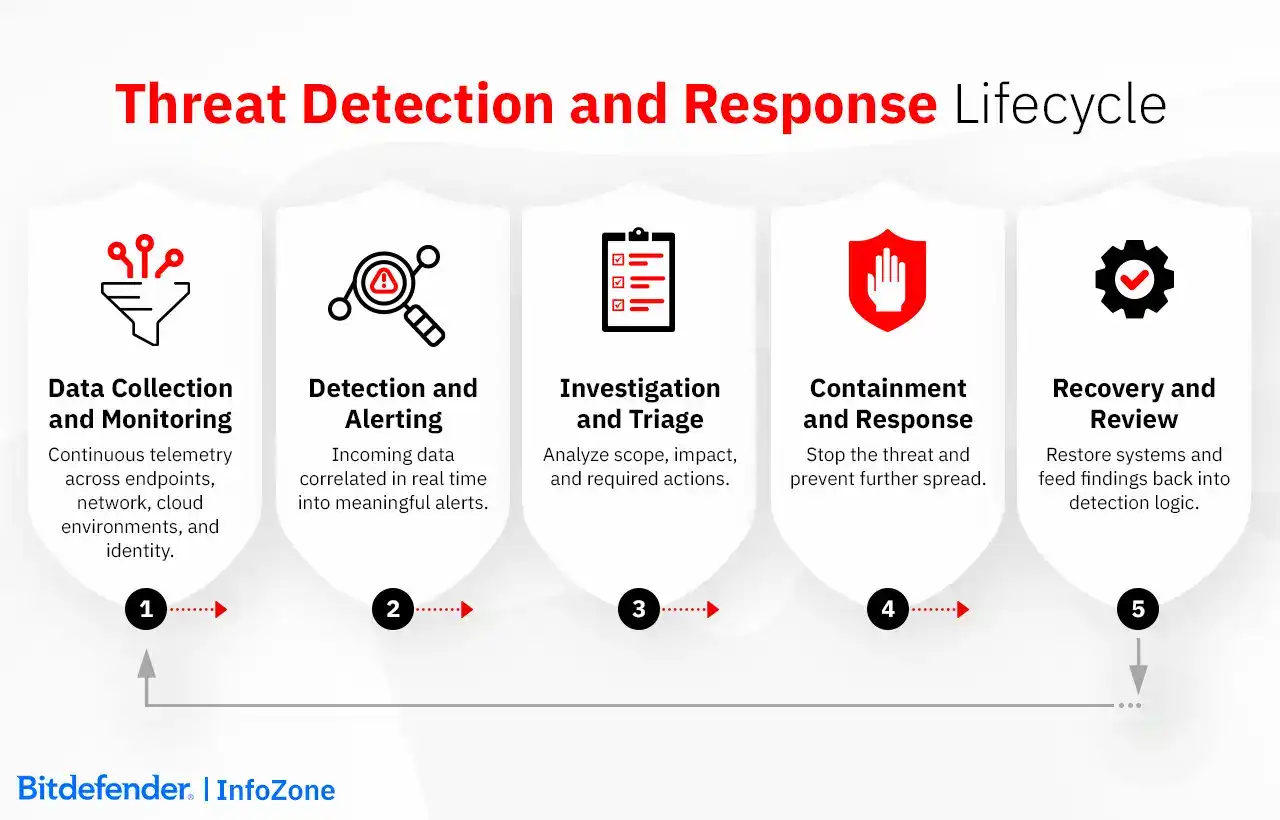
The lifecycle runs in five stages and each pass through this cycle tightens the next one:
- Data collection and continuous monitoring. Telemetry is ingested continuously across all four domains, not as periodic snapshots.
- Threat detection and alerting. Detection analytics process incoming data in real time, correlating signals into contextualized alerts.
- Investigation and triage. Analysts determine what actually happened, how far it reached, and what needs to happen next.
- Containment and response. Stopping the attack from spreading takes priority. Remediation comes once the immediate threat is under control.
- Recovery and post-incident review. Systems are restored, and findings feed back into detection logic. Digital forensics and incident response (DFIR) helps with bringing concrete improvements based on what was learned.
Detection Methods
No single detection method catches everything and to have results, modern TDR layers several methods, with rules mapped to specific adversary tactics defined in the MITRE ATT&CK framework.
- Signature-based detection matches files and traffic against known indicators of compromise (IoC) - hashes, domains, IPs. Reliable against known threats, useless against anything new.
- Behavioral analysis watches for deviations from established patterns - a user who suddenly starts accessing file shares they have never touched, or an admin tool running in a context where it has no business being. This is the domain of user and entity behavior analytics (UEBA).
- Anomaly detection flags statistical outliers in traffic or system activity that don't match any known signature, but don't look right either.
- Threat intelligence feeds bring in external context - what attackers are doing elsewhere, mapped to MITRE ATT&CK techniques so detection rules stay current.
- Deception technology plants fake assets and “honeytokens” in the environment. No legitimate user has any reason to touch them, which makes any interaction an immediate high-confidence alert.
- Threat scoring ranks alerts by combining signal severity with asset criticality. Not every alert is equally urgent, and this is how the system reflects that.
Response Mechanisms
Once a threat is confirmed, speed determines how much damage gets done. It takes only milliseconds for automated actions such as endpoint isolation, process termination, traffic blocking, access revocation, and so on, which is obviously faster than any human workflow.
Security orchestration, automation and response (SOAR) coordinates these actions through playbook-driven response, predefined workflows that move across tools without manual handoffs. A phishing incident, for example, might automatically pull indicators, check them against threat intelligence, quarantine matching emails across the organization, and open a case before an analyst has finished reading the initial alert.
Human analysts handle what automation cannot. Ambiguous alerts that require judgment, complex multi-stage incidents, escalation decisions, and post-incident review are things that create tension. More automation means faster automated response and remediation, but also more risk of acting on a false positive. Where exactly that line sits is one of the more consequential decisions a security team makes.
TDR Solutions & Tools
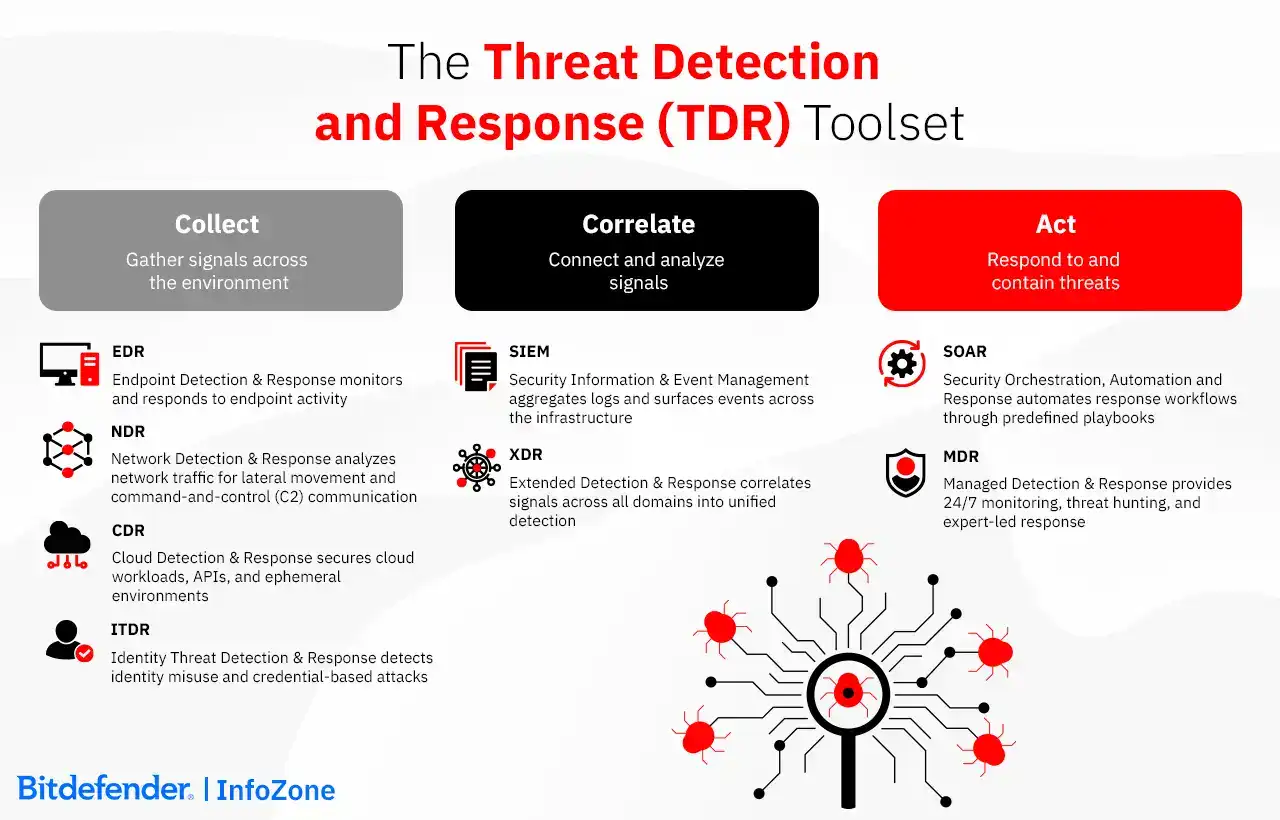
Threat detection and response is rarely delivered by a single tool, but rather a stack of technologies is used, and the suite has usually converged toward a unified platform. Organizations traditionally relied on point tools - endpoint protection, network monitoring, log management - each operating in isolation and producing disconnected alerts. The shift toward consolidation is a direct response to that: shared telemetry and coordinated response replacing fragmented visibility across a dozen separate consoles.
In practice, TDR solutions come in three models. Point tools cover a single domain, like an endpoint, a network, a cloud environment. Integrated platforms pull telemetry from all of them and coordinate response across the stack. Managed services (MDR) hand the whole operation to an external SOC team. The reason these models exist in this order is straightforward: attacks don't stay in one place, and neither can detection.
Not all platforms are equal, but the ones worth evaluating share a few traits. Detection coverage across all four domains, detection rules mapped to MITRE ATT&CK, AI-driven analytics, and threat intelligence that's part of the platform, rather than a third-party feed stapled on at the end.
At a Glance
|
Role |
Strength |
Limitation |
|
|
Aggregates and correlates logs |
Centralized visibility, compliance reporting |
Surfaces alerts but cannot act on them |
|
|
Monitors endpoint behavior |
Visibility and containment at a deep host-level |
Anything that runs without an agent is not visible |
|
|
NDR |
Network traffic analysis |
Lateral movement and C2 communication detected |
Payload inspection can be limited by heavy encryption |
|
Correlates telemetry across domains |
Detection and investigation are unified |
Coverage influenced by how sensors are deployed |
|
|
Automates response workflows |
Consistent, scalable response execution |
Only as good as the detections feeding it |
|
|
CDR |
Secures cloud workloads and APIs |
Visibility into ephemeral environments |
Coverage varies significantly by provider |
|
Detects identity and credential misuse |
Catches attacks EDR never sees |
Narrow by design (complements, not replaces) |
|
|
Managed 24×7 TDR operations |
Expert monitoring, hunting, and response |
Less direct control over SOC decisions |
It is worth making a distinction related to SIEM and SOAR. These are often deployed together, but they serve different functions. SIEM correlates and surfaces events, while SOAR executes response through predefined playbooks. In other words, one observes, the other acts.
Endpoint Detection and Response (EDR) deploys agents on workstations and servers to continuously record process activity, file changes, registry modifications, and network connections. EDR can reconstruct exactly how an attacker moved through a host, making forensic depth one of its notable strengths, but what stays outside that picture are any unmanaged devices, cloud control planes, and network-level movements.
Network Detection and Response (NDR) requires no agents. It works by analyzing traffic across the network, both at the perimeter and between internal systems and where EDR stops, NDR keeps watching. It is particularly good at catching lateral movement and command-and-control traffic. TLS 1.3 is the limiting factor: widespread encryption makes payload inspection difficult without decryption in place.
Extended Detection and Response (XDR) came out of a straightforward problem. EDR, NDR, and SIEM each produce their own alerts, and nobody was connecting them. XDR does that. It pulls telemetry from all domains and reads the signals together considering that a low-confidence alert from one source often looks very different once two or three others weigh in.
Cloud Detection and Response (CDR) addresses environments where traditional controls simply don't apply. Most Kubernetes containers live for minutes, which is too short for a traditional agent deployment. CDR uses kernel-level visibility (eBPF) to monitor ephemeral workloads without heavy instrumentation. It also covers SaaS-to-SaaS lateral movement, where attackers pivot between connected applications through APIs and OAuth tokens rather than network segments.
Identity Threat Detection and Response (ITDR) covers the blind spot that even fully deployed EDR leaves open. EDR watches what happens on the device (the “where”). ITDR watches what happens to the identity (the “who”): authentication anomalies, privilege escalation, and credential misuse that appear legitimate at the endpoint level.
Managed Detection and Response (MDR) delivers the full TDR stack as a service, with 24×7 monitoring, threat hunting, and incident response run by external specialist teams. For most organizations, it is the fastest path to operational TDR coverage.
TDR vs. Other Technologies and Cybersecurity Approaches
It is a mistake to view threat detection and response as a product competing against EDR or SIEM. TDR is the overarching strategy; the technologies below are the specialized instruments used to execute it. In a well-functioning SOC, the goal is not to choose between them but to make sure no domain is left unwatched.
At a Glance
|
Strategic Role |
Weakness |
For TDR |
|
|
EDR |
Deep host-level forensics |
Blind to IoT, unmanaged devices, and network traffic |
Foundational Provides granular telemetry for host containment |
|
NDR |
Monitors east-west movement |
Cannot see inside encrypted host memory or processes |
Complementary Tracks network movement |
|
SIEM |
Log aggregation & correlation |
No native real-time response and possible high false-positive rate |
Historical System of record for compliance and long-term correlation |
|
XDR |
Cross-domain integration layer |
Effectiveness tied to breadth of native integrations |
Operational Correlates signals across all domains |
|
Threat Hunting |
Proactive human-led investigation |
Resource-intensive; not a continuous automated capability |
Elite Finds LotL attacks and other threats that bypass automation |
A high-performance TDR program ensures that when EDR loses sight of an unmanaged device, network detection and response picks up the trail. SIEM provides the historical context, and threat hunting uses that same data to uncover sophisticated adversaries that have successfully mimicked legitimate user behavior. Findings from hunting feed back into detection logic, which is how the whole system gets sharper over time.
TDR Implementation Guide
Building a TDR program starts with accepting that attackers will get in, so the only question to answer is how fast you can find them. Lateral movement nowadays occurs within minutes of initial access, and this means that detection and response have to operate closer to machine speed.
Four frameworks do most of the structural work here. MITRE ATT&CK consider real adversary behavior and maps detection rules to it. NIST SP 800-61 covers the incident response lifecycle. For teams building or formalizing their incident response capability, FIRST's CSIRT services framework offers practical guidance on structuring response roles and coordination. CTEM handles the ongoing gap analysis between current controls and actual exposure.
Best Practices for Implementing Threat Detection and Response
- Review every incident and act on what you find. Every breach or near-miss offers a roadmap to where detection was slow, exploited weak points, as well as what failed in previous approach. But all that information is only useful if it feeds back into the rules and processes. Tracking MTTD and MTTR is extremely helpful here because each incident tells you whether those numbers are moving in the right direction.
- Practice the response plan before you need it. Run realistic attack scenarios with the actual team that would respond. Gaps will surface during an exercise, and they are far cheaper to fix this way.
- Hunt proactively, and pay attention to what moves inside the network. Automated detection catches what it was configured to catch, but skilled analysts searching through telemetry find the attacker who has been sitting quietly in the environment for a while. Most teams watch the perimeter closely and leave internal east-west traffic undermonitored, which is exactly where lateral movement happens.
- Automate the predictable alerts. What often exhausts the team is low-confidence, repetitive alerts handled manually. To help analysts spend more time on cases that actually need a human decision, use SOAR playbooks to take those off the queue.
- Build detection rules around what attackers do, not what they use. The same credential theft technique can be executed with dozens of different tools. A rule that looks for the behavior (an unusual memory access, specific API calls, some abnormal process relationships) catches all of them. But a rule that looks for a specific file catches only one. Identity follows the same logic. An attacker uses valid credentials and endpoint tools see nothing unusual, which means that authentication patterns and privilege changes need their own detection layer.
Programs that follow this consistently get faster at detection, at containment, and create a smaller window for the attacker to do damage. SOC maturity models like SOC-CMM give organizations a way to benchmark that progress and identify the next meaningful step rather than measuring completeness against an unreachable standard.
Metrics and KPIs for TDR Success
To transition from reactive firefighting to a mature, data-driven SOC, organizations must track metrics that reflect actual operational resilience. While many focus solely on detection, the most critical indicator of success is dwell time reduction. With the average eCrime breakout time plummeting to just 29 minutes and the fastest recorded at 51 seconds, the metrics that matter most are the ones that measure speed.
|
Metric |
Definition |
Operational Goal |
|
MTTD |
Mean Time to Detect: time from initial compromise to discovery |
Validate visibility and sophisticated analytics |
|
MTTR |
Mean Time to Respond: time to begin investigation after an alert |
Measure analyst readiness and triage efficiency |
|
MTTC |
Mean Time to Contain: time from detection to threat neutralization |
The gold standard - stops damage and data exfiltration |
|
False Positive Rate |
Percentage of benign alerts incorrectly flagged |
Reduce noise to prevent analyst burnout and alert fatigue |
|
Response Effectiveness |
Ratio of incidents contained without escalation |
Measures the quality of automated protection workflows |
Compliance & Regulatory Considerations
Modern compliance requirements used to rely on "check-the-box" logging, but today, they make real-time incident response mandatory. TDR acts as the audit engine that proves an organization maintained “duty of care” during an attack.
At a Glance
|
Requirement |
TDR capability |
|
GDPR: Breaches to be reported within 72 hours |
Rapid detection and a documented incident timeline |
|
NIS2: Early warning within 24 hours and a full report within 72 hours |
Continuous monitoring and audit trails |
|
DORA: ICT incident reporting and resilience testing |
Unified monitoring and automated response |
|
EU Cyber Resilience Act: Ongoing vulnerability handling across the product lifecycle |
Continuous vulnerability detection |
|
HIPAA: Audit controls and incident response procedures |
User behavior monitoring and log retention |
|
PCI DSS: Continuous monitoring of cardholder data environments |
Real-time alerting and lateral movement detection |
|
SOX: Protecting the integrity of financial reporting systems |
File integrity monitoring and access logging |
|
Full telemetry coverage |
In practice, a well-instrumented TDR program generates audit trails, incident timelines, and response documentation that regulators require as a byproduct of normal operations rather than a separate compliance exercise. That is the difference between cost and reputation protection and scrambling to reconstruct what happened after the fact.
Cost & ROI of TDR Investments
The financial case starts with what breaches actually cost. TDR pays off in more ways than just avoiding breaches. IBM's 2025 data puts the global average breach cost at $4.44 million, and organizations using AI-driven security tools saved close to $1.9 million of that compared to those without, and the reason is that they found and stopped attackers faster.
This is part of a shift that is only going to accelerate. Not only are platforms increasingly consolidated, but inside them, AI is taking over more of the routine triage and the detection window keeps shrinking. Organizations that build this capability now will not need to rebuild it every time the threat changes.
How Bitdefender Can Help
Effective threat detection and response requires visibility across the entire environment, not just the endpoint. GravityZone brings detection, investigation, and response into a single platform, so security teams are not stitching together signals from disconnected tools when it matters most.
GravityZone XDR correlates activity across endpoints, networks, cloud workloads, and identity systems. When an attack spans multiple stages and layers (which most do), XDR assembles the full picture and surfaces it through built-in Root Cause Analysis, so teams know what happened, where it started, and what it touched.
GravityZone EDR handles the endpoint layer with continuous monitoring and real-time visibility. Analysts can act directly from the platform, isolating a system, pulling an evidence bundle, or sending a suspicious file to the Sandbox Analyzer, all without switching context.
GravityZone PHASR (Proactive Hardening and Attack Surface Reduction) reduces what EDR and XDR need to monitor in the first place. By restricting access to tools that users don't actually need, it cuts off the living-off-the-land paths attackers rely on, lowering alert volume and improving the signal-to-noise ratio across detection workflows.
The GravityZone Security Data Lake centralizes security telemetry in a scalable, cost-effective repository. Longer retention and broader data access directly improve the ability to detect slow-moving threats and run retrospective investigations.
For organizations that need coverage beyond business hours or lack dedicated analysts, Bitdefender MDR provides 24/7 monitoring, threat hunting, and pre-approved response actions, so that confirmed threats are contained quickly, without the need to wait for someone to log in and review an alert.
Frequently Asked Questions
What is a real-world example of threat detection and response in action?
Most common scenarios begin with a compromised user account, like an attacker that logs in using valid credentials, but acting from an unusual location. Another sign can be that the user starts accessing database segments which are typically not accessed. In isolation, these actions often pass as legitimate activity.
Threat detection and response correlates these signals (the anomalous login, the atypical data access, and the new internal connections) into a single incident. Apparently benign events looked at together, in conjunction can become a clear indicator of misuse.
Containment is immediate and it manifests the session being terminated and the access being revoked. Affected systems are isolated before data can be exfiltrated. The result is that instead of a breach unfolding over weeks, the intrusion is identified and stopped within minutes. This was possible because the system recognizes behavior instead of just known threats.
Is MDR better than building an in-house SOC for threat detection and response?
The choice depends on what an organization can realistically operate, but there are general aspects to consider. A good in-house SOC can provide full control over important factors such as detection logic, tooling, how to respond and this is an important advantage. But it comes at a large cost, as it requires not only continuous staffing with experienced analysts, but also sustained investment. The primary challenge is running the operation consistently, including during off-hours when serious incidents often unfold.
Managed Detection and Response (MDR) trades some control for immediate coverage and expertise. It provides a functioning 24/7 operation with monitoring, threat hunting, and response already in place. For organizations without the scale to maintain round-the-clock operations, MDR is often the more practical path.
Many organizations use a hybrid model where internal teams retain oversight and business context while an MDR provider handles continuous monitoring and initial response. The deciding factor is which model can be sustained in daily operations.
What do TDR solutions cost?
The answer is influenced primarily by two factors: how much coverage is needed and what is the operating model. Platforms increase in cost as visibility extends across endpoints, networks, cloud workloads, and identity systems. Running these tools internally adds a second layer of expense (analysts, training, and ongoing operations) that is easy to underestimate.
Managed services shift this to a predictable operational expense by bundling technology and expertise into a single subscription. For many organizations, this is a more realistic path to sustained coverage than building and staffing an equivalent capability in-house.
The relevant comparison is between the cost of the solution and the cost of exposure. Faster detection and real-time response reduce dwell time, which directly limits the scale of an incident. In this context, TDR investment is about controlling how expensive a breach becomes.
What is the difference between TDR and SIEM?
Although they operate on the same data, Security information and event management (SIEM) and threat detection and response (TDR) have different roles. The first one focuses on collecting, storing, and correlating logs across the environment, primarily for visibility, investigation, and compliance. The questions it is meant to answer is: What happened? Where can we find it?
Building on that foundation, TDR extends into action and combines real-time detection analytics with investigation and response capabilities. This allows it to have threats not only identified, but also prioritized and contained, all while they unfold. SIEM is used to surface alerts, TDR is connecting them into incidents and also drives containment.
In practice, many environments have SIEM as part of the data layer, with TDR being the operational layer that turns data into decisions and response.
How do TDR solutions reduce false positives and alert fatigue?
This objective is possible by moving from isolated alerts to correlated incidents. TDR doesn't treat every signal as equally important, in fact, it uses data event correlation to connect related activity from endpoints, networks, cloud environments, identity, and so on.
Behavioral baselines refine this process by understanding what normal activity looks like for users and systems. TDR filters out expected variations and focuses on deviations that matter and this is in essence how low-value alerts reach analysts in smaller numbers.
There is also automation in the process, so that repetitive, low-confidence alerts can be handled using predefined workflows. Fewer alerts also means that there are fewer decisions that need to be made under pressure, ultimately reducing alert fatigue.