

What Is Exposure Management?
Exposure management is the cybersecurity discipline of continuously identifying, prioritizing, and remediating security exposures. Within the broader field of exposure management cybersecurity, the objective is to understand which conditions create meaningful business risk and address them before attackers can exploit them. Cyber exposure management correlates vulnerabilities, misconfigurations, identities, and asset context into a unified view of cyber risk exposure, changing the central question from “what is broken?” to “what actually puts the business at risk?”, and it is not an approach that evaluates findings in isolation, as most organizations already know how to find vulnerabilities. The harder problem is deciding which findings create meaningful risk, and that is what risk exposure management exists to determine.
What Counts as an “Exposure”
An exposure is any condition that increases the likelihood or potential impact of a security incident, a definition that is deliberately broader than “vulnerability.”
A vulnerability is a specific flaw in software or a system. A threat is the actor or event capable of exploiting it. Risk reflects the potential business impact if exploitation occurs. An exposure is the underlying condition that makes exploitation possible. An unpatched CVE (Common Vulnerability and Exposure) on an internet-facing server is an exposure. So is a misconfigured cloud storage bucket, or an overprivileged service account with access to sensitive systems, and neither requires a software flaw to create a genuine attacker opportunity. Neither does an asset the organization doesn't know exists: an untracked cloud instance carries real cyber risk exposure without a single CVE attached.
When multiple exposures align on the same path to a critical asset, the aggregate risk exceeds what any individual finding suggests, a dynamic that we explore later in the article.
Exposure Management vs. Vulnerability Management (and Where ASM Fits)
Vulnerability management identifies flaws within known assets and prioritizes them by severity. The structural limitation is that CVSS (Common Vulnerability Scoring System) measures how dangerous a vulnerability is in the abstract, in other words, not whether it's reachable, actively exploited, or tied to something operationally critical. A large score can be a lower operational priority than a lower score; in other words, severity is not risk.
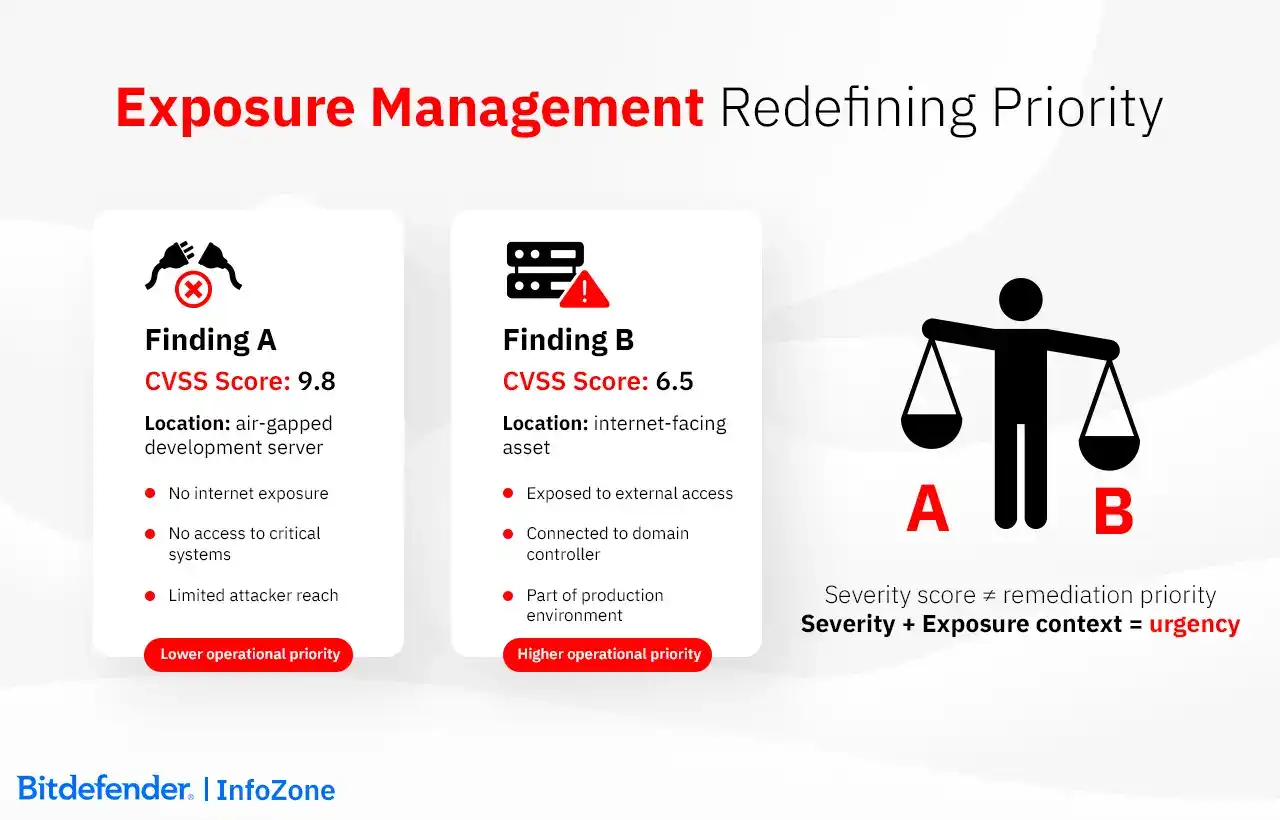
Exposure management addresses this by evaluating vulnerabilities alongside misconfigurations, identity risks, exposed assets, and business context, so that the prioritization is based on what an attacker could realistically exploit.
|
Vulnerability Management |
Exposure Management |
|
|
Scope |
CVEs, missing patches |
CVEs, misconfigurations, identity risk, and unmanaged assets |
|
Inputs |
Scanner findings, data from National Vulnerability Database (NVD) |
Asset context, config posture, identity risk, threat intel |
|
Outputs |
Remediation of software flaws |
Prioritized remediation of security exposures |
|
Prioritization |
CVSS severity |
Exploitability + criticality + business context |
|
Cadence |
Periodic |
Continuous |
|
Primary KPI |
Vulnerabilities remediated |
Reduction in cyber risk exposure |
Both of the disciplines above depend on Attack Surface Management (ASM), the visibility layer that continuously discovers known infrastructure, shadow IT, and external-facing assets. It answers what exists and is exposed, while vulnerability management answers what is vulnerable; exposure management answers what matters most.
The Cyber Exposure Management Lifecycle
The lifecycle is composed of six stages in a continuous loop, with each feeding the next, and the cycle restarting whenever the environment shifts or a new threat surfaces.
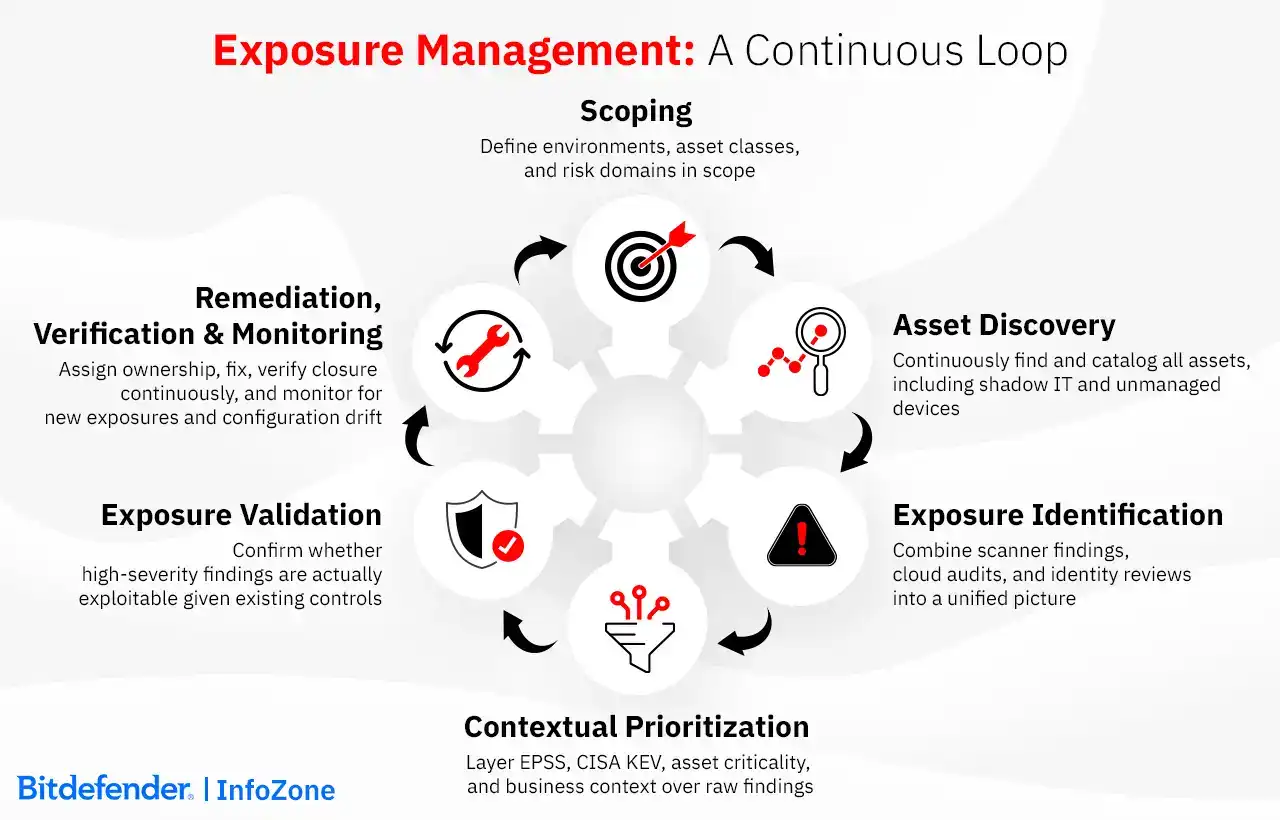
- Scoping
At this stage, the program defines the environments, asset classes, and risk domains that are in play. Without this foundation, cyber exposure management becomes a permanent scanning exercise with no clear finish line. In this process, External Attack Surface Management (EASM) maps what attackers can see from the outside, while through the CAASM (Cyber Asset Attack Surface Management) approach, there is a consolidation of what the organization knows about its own internal and hybrid infrastructure. - Asset Discovery
Organizations add cloud services, spin up new systems, and onboard third-party tools at a pace that manual tracking cannot keep up with. An asset that nobody in the security team is aware of is still an asset that an attacker can find and probe. This is why asset discovery, that is, the continuous process of finding and cataloging everything across the environment, including shadow IT, unmanaged devices, and forgotten infrastructure, runs as a background process rather than a periodic project. The inventory is never finished; it is maintained. - Exposure Identification
When a scanner report, a cloud audit, and an identity review are in three separate dashboards, that cannot be called an exposure assessment, because it is basically three partial views of the same problem. Exposure identification is the stage that combines them into one picture that none of the individual tools could produce on their own. - Contextual Prioritization
CVSS scores measure how severe a vulnerability is under controlled conditions, but they do not account for other important factors, like “is the affected system reachable?”, “is the vulnerability currently being exploited in the wild?”, “is the asset critical to business operations?”. In order to produce a ranked list, Exploit Prediction Scoring System (EPSS), which estimates real-world exploitation probability, and Cybersecurity and Infrastructure Security Agency Known Exploited Vulnerabilities (CISA KEV) catalog, which reflects confirmed active exploitation, are layered over asset criticality and business context. - Exposure Validation
Not every finding that looks critical on paper is actually exploitable in practice, and that is why validation checks whether a high-severity finding can realistically be exploited given the security controls already in place. If existing controls already neutralize it, it gets deprioritized. If it is confirmed exploitable, it moves to the front of the remediation queue. - Exposure Remediation, Verification, and Continuous Monitoring
Fixing an exposure is not something that always falls on the security team alone; in fact, more often than not, the teams that own the cloud operations, infrastructure, development, or identity also must take care of part of the remediation process. When there is no explicit ownership assigned to each finding, tickets remain untouched. Once remediation is complete, verification confirms the exposure is actually closed, not just marked resolved. Continuous monitoring is important because new vulnerabilities are published, configurations drift, and assets get reclassified.
Why Attack Paths Change Prioritization
Most security findings are evaluated one at a time. Attackers don't think that way. A vulnerability, misconfiguration, or excessive permission may appear relatively low risk when viewed in isolation. The picture changes when that same exposure sits on a route to a business-critical asset. A moderate weakness that helps an attacker move from an internet-facing system to a privileged account can become more important than a critical vulnerability on an isolated system.
This is why exposure prioritization cannot rely on severity scores alone. The real question is not simply how severe a finding is, but what that finding can lead to. Attack path analysis helps answer that question by highlighting how individual exposures relate to one another and whether they contribute to a realistic route to compromise.
Gartner's Continuous Threat Exposure Management (CTEM) framework applies this principle directly by building a continuous program that relies on real-world attacker opportunity. But there are also other frameworks that support the same objective more broadly and from different angles. The most widely used are NIST Cybersecurity Framework 2.0 (helps organizations align remediation priorities with business risk) and MITRE ATT&CK framework, that provides an adversary behavior model.
Exposure Management Software & Platforms
Modern exposure management software connects the outputs of existing security tools like vulnerability scanners, Cloud Security Posture Management (CSPM) solutions, IAM platforms, endpoint agents, etc. into a shared risk model. On this, they apply contextual scoring and route prioritized findings into remediation workflows. The goal is a coherent ranking of what needs fixing, not a larger collection of alerts.
When evaluating exposure management software, several capabilities are particularly important:
|
Capability |
What to look for |
|
Attack surface discovery |
Average tools scan what they know about. Good ones find assets the organization didn't know existed. |
|
Continuous assessment |
Does it require someone to trigger a scan? |
|
Correlation & deduplication |
Three tools flagging the same asset should produce one record, not three tickets. |
|
Contextual risk scoring |
A score that ignores whether the asset is internet-facing or business-critical is just CVSS with extra steps. |
|
Risk-based prioritization |
Does the platform tell teams what to fix today? A sorted list to interpret themselves is not enough. |
|
Attack path analysis |
A finding's severity matters less than what an attacker can reach from it. |
|
Integrations |
Findings don't leave the security dashboard? Nothing will get fixed. |
|
Compliance reporting |
Translating technical findings into regulatory language manually doesn't scale. |
Several related product categories commonly support exposure management programs:
EASM (External Attack Surface Management) provides an outside-in view of the organization by continuously discovering internet-facing assets, services, certificates, domains, and other externally visible exposures.
CAASM (Cyber Asset Attack Surface Management) focuses on internal visibility, aggregating asset data from security and IT systems to improve cyber asset inventory and governance.
RBVM (Risk-Based Vulnerability Management) extends traditional vulnerability management by incorporating exploitability and business context into remediation decisions rather than relying solely on CVSS severity.
DASR (Dynamic Attack Surface Reduction) takes a preventative approach by continuously reducing unnecessary capabilities, permissions, or attack opportunities that could be abused by attackers.
These categories are complementary rather than competing. The purpose of a modern exposure management platform is to bring its outputs together and turn them into a coordinated remediation strategy.
Key Benefits of Exposure Management
Proactive risk reduction is the most obvious one: exposures closed before attackers reach them don't become incidents.
Prioritized remediation is less intuitive but arguably more valuable. Not all findings deserve equal attention, and exposure management is what allows organizations to focus limited resources on the conditions most likely to enable actual compromise rather than those with the highest severity score.
Improved mean time to detect (MTTD) and mean time to respond (MTTR) come from having a clearer starting point for investigation and response.
Reduced alert fatigue is due to exposure management helping to reduce the number of low-value findings competing for attention. Instead of treating every alert the same way, teams can focus on the exposures most likely to create risk.
Better communication of cyber risk to executive stakeholders is another benefit. However, rather than talking about patch counts or scanner outputs, it is more effective to report risk trends, remediation progress, residual exposure, etc., in business terms.
Regulatory alignment with frameworks such as NIS2, DORA, and ISO 27001 comes from continuous, documented security posture management.
Exposure Management Implementation Starter Plan (90 days)
Most exposure management programs do not fail because of technology. They fail because teams try to cover everything at once, never agree on ownership, or generate more findings than they can realistically address.
Stage 1 (Days 1–30): Establish Scope and Ownership
One internet-facing application, one critical business service, or one cloud environment is usually enough to prove the model before expanding; therefore, there is no point in starting too broad, use just a defined portion of the environment. For that scope, build a baseline inventory, assign ownership by system type, and define prioritization criteria, everything before the first finding is even made. Also, document what is not yet covered rather than assuming the baseline is complete.
Stage 2 (Days 31–60): Prioritize and Remediate High-Risk Exposures
With scope and ownership settled, the action should move to the exposures that present real risk within the defined scope. There are two essential questions to ask: who is responsible for fixing it, and what does fixing it actually look like? How many tickets close is not the main measure, whether the right things get resolved is the one to evaluate.
Stage 3 (Days 61–90): Build a Repeatable Operating Rhythm
The third stage is about making the process stick in the long run, and one way to ensure this for the security, IT, and DevOps team is by imposing a shared review cadence. The goal is to keep findings moving without depending on someone to manually chase them. What gets tracked matters: not how much the tools ran, but whether open exposures are getting resolved and new ones are getting caught.
Common Pitfalls
For most programs that stall after only one month, a situation that is possible for a new program, one of the main reasons is usually the fact that they started too wide before ownership and workflow were settled. Another contributing factor is that exposure management gets treated as something the security team handles and then hands off. However, long-term success depends on building the cross-team process before it is needed, not after the first backlog accumulates.
Metrics & KPIs
The table below lists the most relevant metrics, grouped by who they serve (Tier) and whether they measure conditions that predict future risk reduction (Leading) or confirm what has already happened (Lagging).
|
Metric |
Tier |
Type |
|
Exposure reduction trend by risk tier |
Executive |
Lagging |
|
MTTR by risk tier |
Executive |
Lagging |
|
Validated exposures closed rate |
Executive |
Lagging |
|
Crown jewel asset coverage rate |
Executive |
Leading |
|
Asset inventory coverage rate |
Operational |
Leading |
|
% exposures with assigned owner |
Operational |
Leading |
|
Ticket aging / SLA adherence |
Operational |
Lagging |
|
Exposure recurrence rate |
Operational |
Lagging |
Exposure recurrence rate is worth tracking separately from closure rate. A closed ticket and a resolved exposure are not always the same thing, and recurrence shows which one actually happened.
Key Domains of Exposure Management
Exposure Management in Cloud Environments
Cloud security challenges appear because environments change constantly: new assets appear, existing ones get reconfigured, others simply get forgotten. And these changes happen quickly enough that security teams often find out about them after attackers already have. A development environment left running after a project ends, a storage bucket with permissions that were never tightened, an API endpoint deployed without a security review, are examples of issues that, although do not carry a CVE identifier, are the kind of thing that external scanners could find within hours.
There is also the shared responsibility model that needs to be taken into consideration, as it adds another layer to the discussion. What this refers to is a model in which cloud providers secure the infrastructure, but organizations own the security of everything they deploy on it. Most cloud exposure occurs in that boundary.
A complete cloud exposure program needs both Cloud Security Posture Management (CSPM) and Attack Surface Management (ASM). The first one addresses exposure from the inside, continuously checking Infrastructure as a Service (IaaS), Platform as a Service (PaaS), and Software as a Service (SaaS) configurations against standards like CIS Benchmarks and the security baselines of AWS, Azure, and Google Cloud Platform (GCP). The latter adds the outside-in view, more precisely, it shows which assets are actually visible and reachable from the internet.
Identity Exposure: The Overlooked Attack Surface
In the modern cybersecurity landscape, attackers use identities at least as often, if not more often than, systems in order to gain access. In the majority of significant breaches, what we notice is that credential theft, privilege escalation, and lateral movement are almost always present. What makes these possible is the fact that scanners rarely flag the conditions in which these appear. Overprivileged accounts, stale credentials from employees who left months ago, MFA gaps on administrative interfaces, shadow admin accounts that were never removed, service accounts running with permissions set during initial deployment and never reviewed since. All these are difficult to monitor and therefore abused.
It is not enough to consider that a service account with excessive permissions is contained without making sure that it doesn't also have access to production infrastructure. If that turns out to be true, at that point it becomes a path across the environment. NIST SP 800-63 framework establishes the identity baseline covering authentication, credential management, and federation. Exposure management builds on that by identifying where identity conditions create viable attack paths, not just policy violations.
Exposure Management and Threat Intelligence Integration
Vulnerability data tells you what is wrong, while threat intelligence helps determine what matters now.
The key distinction is between asset-agnostic and contextualized intelligence. Asset-agnostic threat intelligence (TI) says a CVE is being actively exploited somewhere in the world. Contextualized TI says that same CVE exists on an internet-facing system tied to a critical business process in your organization. The first is a signal. The second is a prioritization decision.
EPSS estimates how likely a vulnerability is to be exploited in the real world within a defined time window. This is a different question than “how severe it is in theory?”. CISA KEV also answers a different question, searching not for a prediction, but for a clear confirmation: these vulnerabilities are being exploited right now. STIX and TAXII, standards for structuring and exchanging threat intelligence, handle the interoperability layer, standardizing how threat intelligence is structured and exchanged so that different tools can act on the same data consistently.
How Bitdefender Can Help
Bitdefender GravityZone is a platform that connects risk management, endpoint protection, identity security, cloud security, and response without requiring separate tools for each layer. It sustains exposure management in multiple ways.
Internet-facing assets and unmanaged systems are discovered through GravityZone EASM, helping organizations identify exposures that may otherwise remain unknown. Inside the environment, Risk Management and Patch Management help identify and remediate vulnerabilities and misconfigurations, while CSPM+ extends that visibility into cloud environments and CIEM highlights excessive cloud permissions.
Identifying an exposure and proving it can be exploited are not the same thing. Bitdefender Offensive Security Services helps organizations validate security assumptions through penetration testing and red team exercises.
Not every exposure requires remediation. In some cases, the better option is to reduce the opportunities available to an attacker. PHASR helps do that by restricting tools, privileges, and system actions that are not required for normal work.
Identity-related risk requires a different approach. A valid account can be abused even when authentication succeeds. GravityZone ITDR is designed to identify that type of activity, while XDR provides investigators with a unified view of related events across endpoints, identities, cloud workloads, and networks.
Organizations that prefer around-the-clock monitoring can supplement these capabilities with MDR services.
Frequently Asked Questions
How does exposure management support Zero Trust?
Zero Trust is based on a simple rule: do not trust access by default. Users, devices, applications, and workloads should be verified before they are allowed to reach sensitive systems.
Exposure management supports this by keeping an up-to-date view of the environment. It helps security teams see which assets exist, which identities have access, and where risky conditions are present.
Exposure management and Zero Trust solve different problems. Exposure management identifies vulnerabilities, misconfigurations, excessive permissions, and other conditions that create risk. Together, they help organizations reduce the likelihood that attackers can gain or expand access to sensitive systems.
How does exposure management support compliance with NIS2 and DORA?
What NIS2 and DORA, but also ISO 27001 and other compliance standards and regulations, have in common is a clear expectation regarding risk management: it needs to be continuous and documented rather than in the form of periodic audit outputs. In fact, if we look at NIS2 Article 21, we see that it requires ongoing asset management, vulnerability handling, and monitoring as operational practices. At the same time, DORA mandates a documented ICT risk management framework with continuous oversight for financial entities.
Having a mature exposure management program can satisfy these requirements at a structural level because it brings evidence that regulators expect. That is, asset visibility that does not switch off between audits, remediation workflows with assigned ownership, as well as documented records of what was found and closed.
How is AI changing exposure management?
If we examine the situation from the attacker's perspective, AI makes it much easier to find exploitable conditions and accelerate the time between an exposure appearing and being discovered externally, even when the skill level is low. But as with every weapon, AI and ML bring defenders clear advantages, such as faster processing of the prioritization logic and signals correlation, greatly surpassing what manual analysis can do. This helps keep risk rankings current as environments change rather than waiting for scheduled reviews.
But we can also notice that there is a less obvious and self-inflicted shift that comes from organizations adopting AI so quickly that it creates new exposures. This occurs through unsanctioned integrations, unmanaged services, data inputs that bypass existing security governance. These conditions belong inside the exposure management scope, not outside it.
DASR (Dynamic Attack Surface Reduction) is one application of defensive AI currently in use: behavioral models observe how each user and machine actually operates and continuously restrict capabilities that fall outside those patterns, particularly the legitimate tools attackers rely on in “living off the land” techniques. The goal is to remove attacker opportunity before it is exploited rather than detect it afterward.
How do we decide what to fix first when everything looks urgent?
Even when everything looks equally urgent, there are factors that we can use to reliably separate what needs attention today from what can wait.
The first is whether the vulnerability is being actively exploited. CISA KEV lists vulnerabilities with confirmed real-world exploitation and anything on that list moves up regardless of its severity score. EPSS adds a probability layer, estimating how likely a vulnerability is to be exploited in the near term. Together, they narrow the field.
Context does the rest after that and there are helpful questions to ask in order to determine it. Is the affected system internet-facing? Does it have a path to something critical? If existing controls already contain the exposure, urgency drops. If validation confirms it is genuinely exploitable in the current environment, it does not matter where it ranks on a severity chart, it must get fixed first.
Does exposure management software replace existing security tools?
For most organizations, that is not the case, as most mature security stacks already include vulnerability scanners, CSPM tools, identity platforms, endpoint agents, threat intelligence feeds and so on. What exposure management software does is not to replace these, in fact, it connects them.
What that means in practice is that findings from across the stack get pulled into a single platform through APIs and integrations, cleaned up, deduplicated, and enriched with asset and business context. The output is a prioritized list of what actually needs fixing, rather than several separate lists that nobody has time to reconcile. Some platforms also include their own scanning or discovery capabilities, but that is secondary to the integration function.