

What Is Behavioral Analytics?
Behavioral analytics is the systematic collection and analysis of behavioral data to identify patterns, trends, anomalies, and useful insights about how people, groups, or systems act over time.
The same discipline serves very different goals. When it is used by product and customer teams, it is helpful for understanding how people interact with websites, applications, or services, that is, where they engage, where they leave, and what influences adoption or conversion. In that setting, the objective is to improve the customer journey or product experience.
What Is Behavioral Analytics in Cybersecurity?
In cybersecurity, the same approach serves a different purpose. Instead of asking what encourages a customer to buy or return, it evaluates what a user, account, device, application, or workload is actually doing, whether that means checking if the activity still fits how the entity normally operates, or recognizing a pattern already known to be malicious no matter what's normal for it. Behavioral analytics security capabilities can, therefore, reveal patterns that deserve investigation even when individual events appear legitimate on their own. Related approaches, including User and Entity Behavior Analytics (UEBA) and anomaly detection, apply this broader discipline to specific security problems.
Why Behavioral Analytics Matters in Cybersecurity
Signature-based defenses catch what they've been taught to recognize, things like a malware hash or an indicator of compromise from a past incident. That's a real strength when the threat has shown up before. That approach has limited usability in the context of modern cyber threats.
Behavioral analytics earns its place not by ticking off a predefined list, but by assessing what an account or system actually does. Current activity might simply stop matching what's normal for that account, the deviation anomaly detection is built to catch. Or it might match a sequence of actions already known to be malicious, something that would count as suspicious wherever it happened, not just because it is out of character for this particular system. While it is true that signatures can still catch known threats, behavioral analytics extends threat detection and covers aspects such as compromised credentials, insider threatdetection, cases where access was never illegal, only inconsistent with a pattern the account had already established. These approaches do not replace each other and a program that drops either one might create a blind spot.
How Behavioral Analytics Works in Cybersecurity
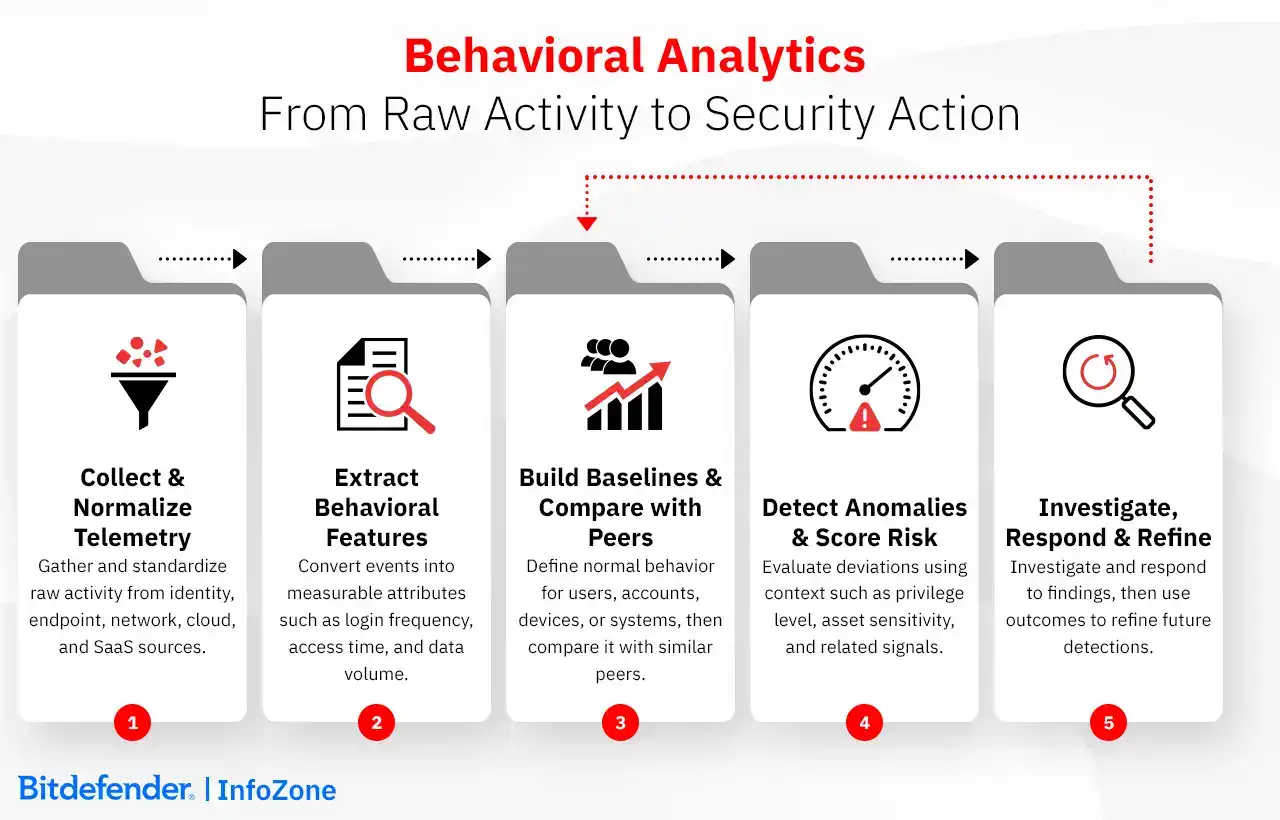
Behavioral analytics starts with collecting activity from the systems being monitored. Because those sources describe events in different ways, the data has to be normalized before it can be compared. Feature extraction comes next. This turns raw events into measurable details such as login frequency, access time, device information, data volume, or process activity.
Behavioral analytics does not always need a history to work with. Some activity can be recognized because it matches behavior that is already known to be malicious. Where enough history does exist, the analysis can also look at what is normal for that particular account or device, and sometimes at how its peers behave. A deviation from normal, a known pattern, or several weaker signals appearing together can all be relevant. None of them necessarily tells the whole story, which is why account privilege, asset sensitivity, and related activity elsewhere also become part of deciding whether something needs investigation.
In support of this come statistical techniques and machine learning. Statistical methods are useful when normal behavior can be described through thresholds, ranges, frequencies, or distributions. Machine learning becomes more valuable when the relationships are too numerous or subtle for fixed rules and manual review. It can compare many variables at once and identify recurring combinations that would be difficult to notice by examining each event separately.
That is its main advantage: it allows the analysis to scale and helps connect weak signals across large volumes of activity. It does not remove the need for analyst judgment, and the result still has to be explainable enough for someone to understand why the activity was flagged.
Poor data quality, weak tuning, model drift, false positives, and false negatives can all reduce accuracy. Investigation results are therefore fed back into the system so that baselines, thresholds, and models can be adjusted as normal behavior changes.
Predictive behavioral analytics does not forecast a specific attack. It estimates whether current and historical signals point to elevated risk or possible escalation.
Data Sources and Telemetry Used for Behavioral Analytics
Various sources are often consolidated in a security data lake or another analytics platform, and these can include various elements, like authentication logs and identity events, which cover who's logging in and how. On the endpoint side, system events and process telemetry show what's actually happening on a device. Network traffic, database activity, and file access are also important, as they are all related to where data movement itself becomes visible. Cloud audit logs plus Software-as-a-Service (SaaS) activity extend the picture into hosted services and third-party apps that a traditional network view never reaches.
Baselines, Anomalies, and Risk Scores
Baseline comparison is one important way behavioral analytics evaluates activity, built around normality rather than a known malicious pattern. At the foundation of this method is the baseline, that is, a record of what's normal for a given user, account, device, application, or workload, covering usual login times, common resources, expected administrative actions, and typical data-transfer volumes. When that record exists, it becomes easier to identify a login from an unfamiliar geography, an unusual privileged action, or a data transfer well above normal volume.
There are many variations that influence a baseline, and that is why baselines are built during a learning window that takes into consideration things such as month-end processing, software releases, seasonal demand, role changes, new tools, and all possible sources of shift in normality. Peer group analysis adds another reference, comparing an account or system against others doing similar work, which can surface behavior that looks ordinary in isolation but isn't for that particular role or asset.
The gap between current activity and that baseline is expressed as an anomaly score, and this is what anomaly detection measures. Going even further, risk scoring weighs that deviation against other factors, such as account privilege, asset sensitivity, related activity elsewhere, how many weaker signals have accumulated over time. It is important to note that an unusual event isn't automatically treated as malicious; it is, in fact, evaluated in context and prioritized for review.
That comparison is also helped by statistical methods and machine learning. In statistical approaches, deviations are flagged through thresholds, distributions, and frequency ranges. Machine learning is able to model more complex relationships, using many variables at once. Both depend on data quality and tuning. Also, it is important to produce something that is explainable enough for an analyst to trust the result.
Changes are inevitable and constant in an organizational landscape, and these can vary from simple, natural changes in roles and behaviors, to new tools getting adopted or unaccounted business cycles. Models that aren't reviewed against these changes fall out of step with reality, which is referred to as model drift. A model that is not retuned often enough lets false positives pile up in an analyst's queue. The opposite failure is less visible: a model retuned without enough control can absorb a slow, deliberate intrusion into the baseline as though it were routine. Continuous validation is what keeps the system useful without overwhelming the people watching it.
From Alert to Response
The usual procedure for elevated risk identified by behavioral analytics is to insert the finding into the organization's existing threat detection and incident response workflow. Triage determines urgency. Enrichment adds identity, asset, vulnerability, and threat-intelligence context. From there, the alert is escalated for analyst investigation or handled through a predefined response.
Within a Security Operations Center (SOC), repeatable steps can be automated, and this is usually done by Security Orchestration, Automation, and Response (SOAR) platforms. These steps can include requesting additional authentication, restricting a session, isolating an endpoint, opening a case, etc. Anything ambiguous still goes to a person, but this setup can help keep alert fatigue in check. Attention is directed toward higher-context findings instead of every isolated deviation, while investigation results feed back into refining future detections.
What Is Behavioral Analytics Used For?
Real incidents usually do not begin with one obviously bad action. What behavioral analytics security programs usually flag instead is a short run of steps, an access request, an unfamiliar process, that look unremarkable on their own and only add up once they're seen in order. Security teams apply this across access, system relationships, process execution, and data movement. Mapping that sequence to MITRE ATT&CK gives it a shared vocabulary, tying separate findings to a recognized stage of an intrusion instead of judging each one in isolation.
Misuse of legitimate access. When a permission dormant for months is suddenly exercised, or a user starts pulling data well outside their normal responsibilities, that is a shift that insider threat detection watches for. Compromised credentials and account takeover often produce the same shift. The login checks out; the pattern around it doesn't. That's usually enough to justify a closer look, well before anyone can say for certain that access was abused.
Movement, persistence, and data handling. One signal can be an account or host reaching into systems outside its established path. Then, there is a change in how much data moves, where it goes, or how often. Data exfiltration also carries its own behavioral footprint apart from lateral movement.
Low-volume activity like this, especially when it is connected across several systems and continues over weeks, can contribute to Advanced Persistent Threat (APT) detection. Duration alone does not establish that an intrusion is an APT. The surrounding context is what makes a prolonged pattern worth investigating as a possible advanced persistent threat.
Process, cloud, and SaaS behavior. Fileless malware rarely leaves a dependable file signature behind due to the fact that it runs in memory or through trusted system tools. There is something that it does leave, and this is revealed by behavioral analysis, from an unusual process relationship, to a script that runs with no obvious reason, to a configuration change that was never approved by anyone. Not all of it needs to look unusual to be worth flagging, either. Credential dumping is one example. An LSASS credential dump is a good example of behavior that does not have to be unusual for a particular host before it becomes relevant: the action itself can match a known credential-dumping technique. Other threats leave a different kind of behavioral trail. With ransomware, this might be a sudden burst of file access, renaming, or encryption. In cloud and SaaS environments, it could be a permission change or a sharing pattern that doesn't fit the context.
Investigation support. Behavioral history remains just as important for analysts who use it for various purposes, like reconstructing a timeline, pulling in related accounts or assets, and checking whether the pattern can be found elsewhere. That work feeds both threat hunting and incident response, which are already underway. In behavioral analytics cyber security programs, this trail is often what turns an isolated alert into a full picture of scope and impact.
Behavioral Analytics in the Security Stack: UEBA, SIEM, EDR/XDR
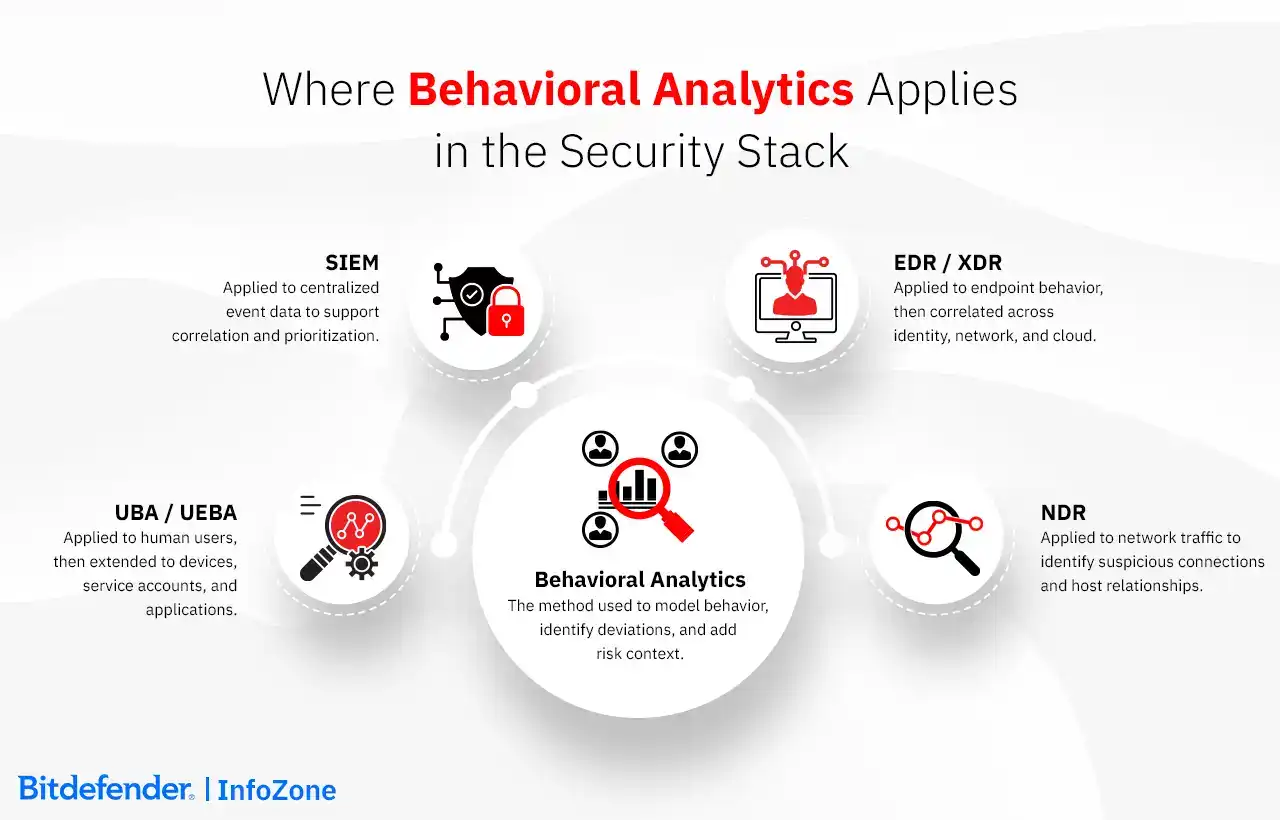
Behavioral analytics security capabilities are distributed across several parts of the stack. UEBA (User and Entity Behavior Analytics), Security Information and Event Management (SIEM), Endpoint Detection and Response (EDR), Extended Detection and Response (XDR), and network-focused platforms can each apply behavioral models to the telemetry they collect or ingest. UBA (User Behavior Analytics) focuses on human users, while UEBA extends the approach to devices, applications, service accounts, and other entities. These technologies do not form a mandatory sequence. Their roles overlap because each evaluates behavior with a different scope and type of context.
|
Technology or Capability |
Typical Scope |
Role of Behavioral Analytics |
|
Behavioral analytics |
Any telemetry domain |
Provides the analytical method used to model behavior, recognize malicious patterns, identify deviations, and add risk context. |
|
UBA (User Behavior Analytics) |
Human user activity |
Applies behavioral models to individual user activity. |
|
UEBA (User and Entity Behavior Analytics) |
Users and entities |
Extends behavioral analysis to devices, service accounts, applications, and other non-human entities. |
|
SIEM (Security Information and Event Management) |
Enterprise event data in aggregated form |
Behavioral models applied on centralized events; it enriches correlation, prioritization, investigation. |
|
EDR (Endpoint Detection and Response) |
Endpoint and process activity |
Analyzes device, process, and execution behavior at the endpoint. |
|
XDR (Extended Detection and Response) |
Multiple integrated security domains |
Correlates behavioral signals across the endpoint, identity, network, cloud, and other connected domains. |
|
NDR (Network Detection and Response) |
Network communications and traffic |
Uses behavioral analysis to identify suspicious traffic and host relationships. Network Traffic Analysis (NTA) focuses more specifically on analyzing traffic patterns. |
Benefits for Security Teams
Behavioral analytics security flags suspicious activity before a signature or indicator exists for it. Analysts stop working from a bare timestamp and an IP: account history, asset sensitivity, and related activity arrive with the alert instead, something worth triaging against.
Threat hunting can also greatly benefit, as analysts can search for entities or relationships that nobody flagged the first time around. Incident response moves faster as well, pulling related accounts and prior activity together instead of assembling them by hand, one query at a time.
Behavioral records are useful for compliance reporting, more specifically, audits and access reviews can benefit from this type of information. However, simply having these records does not prove compliance, and it doesn't replace governance controls; it only holds up combined with decent data quality, wide telemetry coverage, and a model that actually gets retuned.
What to Look for in Behavioral Analytics Tools or Platforms
When comparing behavioral analytics tools, use the same practical criteria for each behavioral analytics platform or behavioral analytics software offering. Assess whether it can collect the right telemetry, connect related signals, explain its conclusions, and work within existing security operations.
|
Capability |
What to Verify |
|
Telemetry coverage and correlation |
Can it collect telemetry from various environments (identity, endpoint, network, cloud, and SaaS)? Can it correlate the signals? |
|
Explainability and risk scoring |
Risk scores should be understandable. Analysts need to see which observations influenced a score instead of treating it as a black box. |
|
Peer-group modeling |
Check whether peer groups are meaningful and whether they can be reviewed or adjusted when the default comparisons don't reflect your environment. |
|
MITRE ATT&CK mapping |
A simple display of MITRE ATT&CK technique or tactic label should not be enough; the platform needs to show how detections relate to the framework. |
|
SIEM, SOAR, EDR, and XDR integration |
Importing alerts is mandatory, but integration needs to go beyond that, with context moving between tools. Also, response workflows shouldn't need too much customization in order to work. |
|
Privacy controls |
Data collection, retention, and access should work together, so that monitoring is aligned with regulatory requirements and internal policies in a practical way. |
|
Tuning and reporting |
As part of routine work, analysts need to adjust thresholds, review false positives, monitor model drift, pull reports - how easily can they do this? |
Implementation Best Practices
The first thing to do is use a limited set of clearly defined use cases connected to the high-value telemetry that is needed to evaluate them. When the scope is narrower, it becomes easier to verify data quality, but also to understand legitimate variation and measure whether detections improve the intended outcome. Also, define a baseline period. It should reflect relevant business cycles and operating conditions, while specifying which detections remain active during learning. Before enabling automated response, don't forget to review the baseline.
Tuning is something that should be continued throughout the deployment by adjusting thresholds, as new information is acquired through false positives and missed detections. Map detections to MITRE ATT&CK as investigations turn up more context about what each one really represents. Baseline-driven detections need that kind of threshold tuning, while pattern-based ones need coverage validation to make sure behavioral detection keeps pace with known attacker techniques. Integrate response workflows with guardrails too, letting low-risk, reversible actions run automatically while the higher-impact ones still wait on a person, which in practice is most of what "guardrails" ends up meaning.
Measuring effectiveness is best done when you record pre-rollout performance, and the best things to watch include alert quality, investigation time, detection coverage, false-positive rate, and mean time to respond (MTTR). These measures should be evaluated together, including analyst workload in the review. The reason is that improvement in one metric may conceal weaker coverage or continued alert fatigue. Trends against the organization's own starting point are usually more meaningful than universal benchmarks for behavioral analytics cyber security programs.
Privacy-by-design refers to applying data minimization to each use case, as well as restricting access by role, and defining a retention policy that reflects legal, investigative, and operational requirements. Anonymization or pseudonymization, where feasible, should be applied (without undermining the analysis). When needed, establish controlled re-identification procedures. Before the production deployment, the design should be reviewed by all relevant governance teams, such as, but not limited to, security, privacy, and legal. Moreover, revisit the deployed solution as data sources or use cases change.
A mature SOC is usually defined around capabilities that build on one another rather than replacing earlier practices, while different use cases may progress at different rates.
At a Glance: SOC Maturity Model
|
Stage |
Primary Capability |
|
Rule-based detection |
The primary detection approach continues to depend on static rules, signatures, and manual investigation. |
|
Behavioral baselines |
Baseline behavior is established for selected users, entities, or assets. |
|
Behavior-aware detection |
UEBA adds broader user and entity analysis together with behavioral risk context. |
|
Cross-domain visibility |
Identity, endpoint, network, and cloud activity is correlated into a single behavioral view. |
|
Operational optimization |
Response automation must be added only alongside guardrails and performance measurement. Regular model reviews remain mandatory. |
Behavioral Analytics over Different Environments
Related activity is an ongoing source of risk context acquired through patterns related to login, how privilege is used, indicators of impossible travels, session reuse, access changes, and so on. All these are evaluated against baselines built separately for human and non-human identities, and this includes service accounts. Some identity-related behavior can also match a known risky technique without requiring an established baseline. Adding an unexpected privileged role or modifying an account's permissions, for example, can correspond to known account-manipulation behavior. Identity analytics can use both kinds of signals, whether the activity departs from a baseline or matches behavior already known to be risky. Adaptive authentication and risk-based access decisions within a Zero Trust architecture can then take that information into account together with policy, asset, and authentication context.
Cloud and SaaS activities are important at the baseline level. More specifically, their baselines place greater emphasis on administrative and control-plane behavior compared to network or endpoint baselines. Control-plane actions can shape what happens to data long after the session in which the change was made has ended. This is why cloud behavior is evaluated differently. A single permission change or new sharing rule can affect access to many resources without generating much traffic, so raw activity volume doesn't always say much about the risk involved. Baselines aren't the only reference either. Disabling audit logging around changes to sensitive configurations, for example, can point to known defense-evasion behavior.
Network and endpoint behavior is also related to baselines. In the case of networks, these focus on communication relationships and changes in network traffic. They cover unusual lateral connections, destinations, protocols, frequency, or volume. Network Traffic Analysis (NTA) focuses specifically on traffic patterns, while Network Detection and Response (NDR) uses network analysis more broadly for detection, investigation, and response. DNS lookups that resemble those generated by domain-generation algorithms, for example, can point to known malicious behavior without first having to stand out from a host's baseline. Baselines for endpoints track process execution, services, applications, as well as other endpoint telemetry. Here, context is also key. For example, a routine action on a developer's laptop might look like a policy violation on a finance workstation running the same process. The same logic applies to living-off-the-land activity. A built-in utility such as certutil downloading a remote file can match a known attacker technique even if the tool itself is legitimate and the endpoint has no useful behavioral history.
How Bitdefender Can Help
Effective security solutions that manage to combat modern cyber threats require a deep understanding of the unique environment in any organization, adapting to subtle behavioral deviations rather than relying solely on static rules. Bitdefender’s GravityZone Platform integrates advanced behavioral analytics across its unified security architecture to help organizations detect stealthy threats and reduce operational complexity.
By continuously analyzing telemetry across your infrastructure, Bitdefender provides actionable intelligence and automated response through the following capabilities:
- Anomaly Defense: Rather than applying a one-size-fits-all approach, Bitdefender deploys custom machine-learning models trained individually on each customer’s system. These models establish a unique behavioral baseline for every environment, identifying deviations and comparing them against MITRE ATT&CK® indicators to spot elusive threats.
- Proactive Hardening and Attack Surface Reduction (PHASR): PHASR dynamically adapts to user behavior by generating unique behavioral profiles for every machine-user combination. By comparing these profiles against threat actor tactics, PHASR enables precise, action-level blocking, for example, restricting specific obfuscated PowerShell commands, so that "Living off the Land" (LOTL) attacks can be prevented without disrupting business operations.
- Extended Detection and Response (XDR) & Identity Security: GravityZone XDR correlates telemetry across endpoints, networks, cloud workloads, and identities. XDR minimizes false positives and drastically reduces alert fatigue for security operations teams through the use of artificial intelligence that illuminates behavioral patterns and assigns incident severity scores.
- Managed Detection and Response (MDR): For organizations lacking a dedicated internal SOC, Bitdefender MDR provides 24/7 monitoring, risk-based threat hunting, and rapid response. The MDR team continuously analyzes user and system behavior deviations across various dimensions to identify and neutralize advanced threats, zero-day exploits, and insider risks.
Frequently Asked Questions
How much historical data is needed to build reliable behavior baselines?
A useful baseline may start to emerge after several weeks, but there is no fixed amount of historical data that works everywhere. The learning period needs to be long enough to capture the organization's normal operating cycles, and that can take considerably longer where activity is seasonal or highly variable. Baselines also need continued adjustment as normal behavior changes.
Is behavioral analytics the same as UEBA?
Not exactly: behavioral analytics is the broader method, UEBA applies it to users and entities, while Network Detection and Response (NDR) uses similar analysis for network traffic. Therefore, UEBA is one application of behavioral analytics rather than another name for the entire field.
How is behavioral analytics different from anomaly detection?
Anomaly detection is one technique used within behavioral analytics, flagging activity that deviates from an established baseline. Behavioral analytics is the broader discipline behind it, one that also recognizes behavior sequences already known to be malicious, credential dumping or a specific process chain, for instance, whether or not they deviate from anyone's baseline. Anomaly detection is a technique within behavioral analytics, not another name for it.
How does behavioral analytics handle new users, devices, or service accounts with no established baseline?
There is little individual history available in the beginning, and this means that behavioral analytics has to rely more on peer groups, role information, asset context, wider organizational patterns, etc. As the user, device, or account builds its own history, that history becomes more useful. Findings from the early period may still justify review, although automated action normally requires more supporting evidence.
Can behavioral analytics analyze encrypted traffic?
Yes, behavioral analytics can analyze encrypted traffic without necessarily decrypting its content, and it does this through the analysis of various metadata: destination, session length, traffic volume, port, frequency, the connection-opening process, etc. This allows it to identify unusual communication patterns, although detections that depend on the actual content of the traffic may still require payload visibility.
Who should own behavioral analytics in an organization?
Since these signals feed directly into alert triage and response, ownership of behavioral analytics usually belongs to the SOC team. Teams responsible for IAM also contribute to the context, while CISO support becomes important when several departments need to share data or agree on responsibilities. Legal and privacy teams also play a role, they set the boundaries for collection, access, and retention.
Is behavioral analytics worth it for small security teams?
As long as the team can maintain it and act on the results, this type of solution can be useful, but in this case, data quality and tuning capacity matter more. For a smaller team, pre-tuned behavioral analytics already available in an existing platform, or support from a managed provider, may be more practical than building and maintaining custom models internally.