

What is Data Poisoning?
Data poisoning, also known as AI poisoning or AI data poisoning, is a cyberattack in which an adversary intentionally manipulates the training dataset or data inputs used by a machine learning or AI model to influence its behavior. In practical terms, what data poisoning is doing is to deliberately corrupt the data a model learns from, causing it to produce inaccurate, biased, or attacker-controlled outputs while continuing to operate normally.
The core mechanism targets the AI learning process itself. Data poisoning does not target application code or network exposure. The point of interference is the data path used during model training. Altered records enter the training pipeline and are processed as valid inputs, which changes how the model parameters are updated. In systems that ingest data continuously, the same effect can occur after initial training, provided the incoming data is accepted without isolation or validation.
Adversaries typically rely on three primary manipulation methods:
Injection. Records that were not present in the original dataset are added. These entries can be fabricated or carry incorrect labels, but they are processed as legitimate during training.
Modification. Affects data that already exists. Labels, feature values, or associated metadata are altered so that the statistical relationships the model relies on no longer reflect the original distribution.
Deletion. Removes selected records from the dataset. The model is then trained without those cases, which leads to consistent errors when similar situations appear later.
These techniques lead to training data poisoning, also referred to as AI model poisoning, where corrupted patterns become embedded in the model during training.
The systems most commonly affected are the ones that depend directly on the integrity of their training data, such as machine learning models, large language models (LLMs), and generative AI systems. Organizations increasingly rely on AI for automation, analytics, and even decision-making, which means that this type of systems are a high-value targets within adversarial machine learning.
From a security standpoint, data poisoning is included in the OWASP Top 10 for Large Language Models as LLM04:2025 (Data and Model Poisoning). The objective is not to disrupt availability, but to compromise model integrity, the trustworthiness of its outputs, while leaving the system operational.disrupt availability, but to compromise model integrity, the trustworthiness of its outputs, while leaving the system operational.
AI systems are trained on larger and more diverse data sources, often collected or maintained outside the organization. Training data is also no longer limited to controlled internal datasets, and external inputs are incorporated more frequently during development and updates. This expands the number of points where data can be altered before it reaches the model, making data poisoning a realistic operational concern.
Data Poisoning vs. Other Adversarial AI Attacks
To understand the broader threat landscape, it is important to distinguish data poisoning attacks from other adversarial machine learning techniques based on where they occur in the AI lifecycle.
At a Glance: Adversarial AI Attacks
|
Attack Type |
Attack Stage |
Target |
Difficulty to Detect |
Primary Goal |
|
Data Poisoning |
Training |
Training dataset / training pipeline |
High |
Corrupt behavior / degrade accuracy / embed triggers |
|
Evasion Attack |
Inference |
Model inputs |
Medium |
Cause misclassification at runtime |
|
Model Inversion Attack |
Inference |
Model outputs |
Medium |
Extract sensitive training data |
|
Training |
Model logic (trigger-based) |
Very High |
Activate hidden behavior (under specific conditions) |
|
|
Prompt Injection |
Inference (runtime) |
LLM prompts / input context |
Low–Medium |
Override model behavior with no alteration of training data |
The key distinction is whether the attack targets the training phase or the inference phase. Data poisoning affects the model during training, where data is used to update parameters. Other adversarial techniques, such as prompt injection or evasion, act on a model that has already been trained, by manipulating inputs at the point of use rather than altering the data it learned from.
How Does AI Data Poisoning Work?
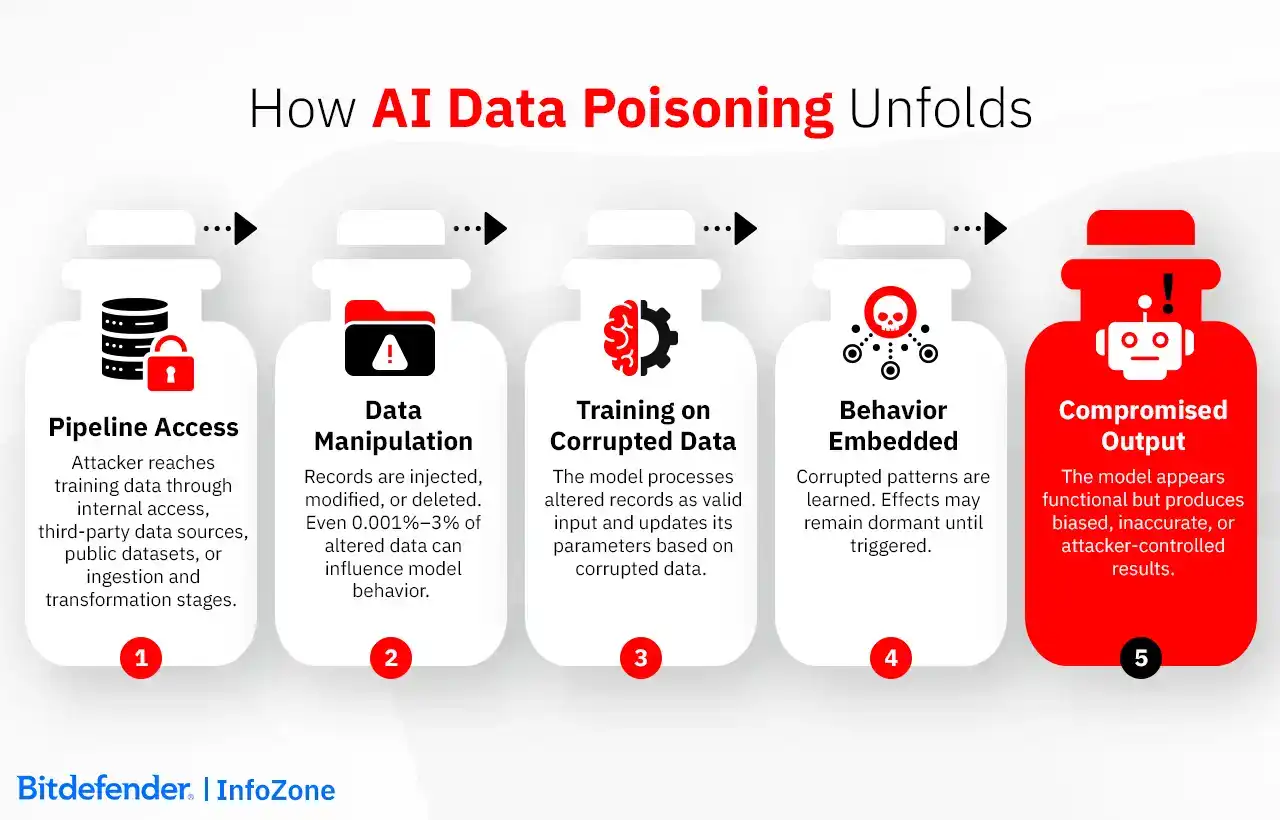
AI data poisoning can enter during pre-training, during fine-tuning, or in systems that continue to ingest data after deployment. What is common is that the process follows a simple structure: data is collected, altered, used in training, and the effect persists in model behavior. Also, very little interference is required. Research shows that modifying between 0.001% and 3% of a training dataset can already produce measurable changes. A sleeper agent model behaves normally until a specific input activates the poisoned logic.
AI Poisoning Attack Vectors: How Attackers Gain Access to Training Data
Access to the training dataset is the starting condition. In some cases, this comes from inside the organization, from a developer, contractor, or compromised account with write permissions who can change records directly within the training pipeline.
External data introduces a different risk. Many systems rely on third-party datasets or providers. When that data is altered before ingestion, the model receives it as legitimate input without visibility into its origin.
Public datasets are also reused across projects. If those sources are modified or republished with embedded errors, the same poisoned data can propagate into multiple models.
Data does not move directly into training. It passes through storage, ingestion, and transformation steps. Interference at any of these stages allows records to be changed or inserted without affecting the rest of the system, especially when data provenance is incomplete.
Automated web collection creates another entry point. A crawler may receive content that differs from what a human sees. This is known as Split-View poisoning. Frontrunning relies on timing. Data is placed where it is expected to be collected, then removed or changed after ingestion.
LLM Poisoning: How Data Poisoning Affects Large Language Models
Large language models are exposed at multiple stages of their training pipeline.
Fine-tuning is one of the most sensitive points. The datasets are smaller, so each record carries more weight. A small number of manipulated examples can shift how the model responds to specific prompts.
Reinforcement Learning from Human Feedback (RLHF) depends on human feedback. If that feedback is biased or intentionally skewed, the model learns incorrect response preferences rather than correct alignment.
Retrieval-augmented generation does not modify the model itself. Instead, it changes what the model reads at runtime. When external sources are poisoned, the model incorporates that data into its output. This includes cases where retrieved documents contain hidden instructions that influence the response.
Control over incoming data is the common element. Once the model has been trained on it, the effect remains.
Types of Data Poisoning Attacks
Data poisoning produces various types of failure that are easier to differentiate based on two axes.
The first one is intent, in other words, targeted attacks aim for a specific outcome (a particular input misclassified, a specific user wrongly denied access, etc.); non-targeted attacks degrade overall model performance without a defined goal, just make outputs broadly unreliable.
The second axis is related to access. From this point of view, there are:
- White-box attacks - done by someone with direct knowledge of or access to the training pipeline, for example, an insider or a compromised contractor;
- Black-box attacks - data is manipulated from the outside, using public datasets, scraped sources, supply chain vectors, done with zero visibility into the model itself.
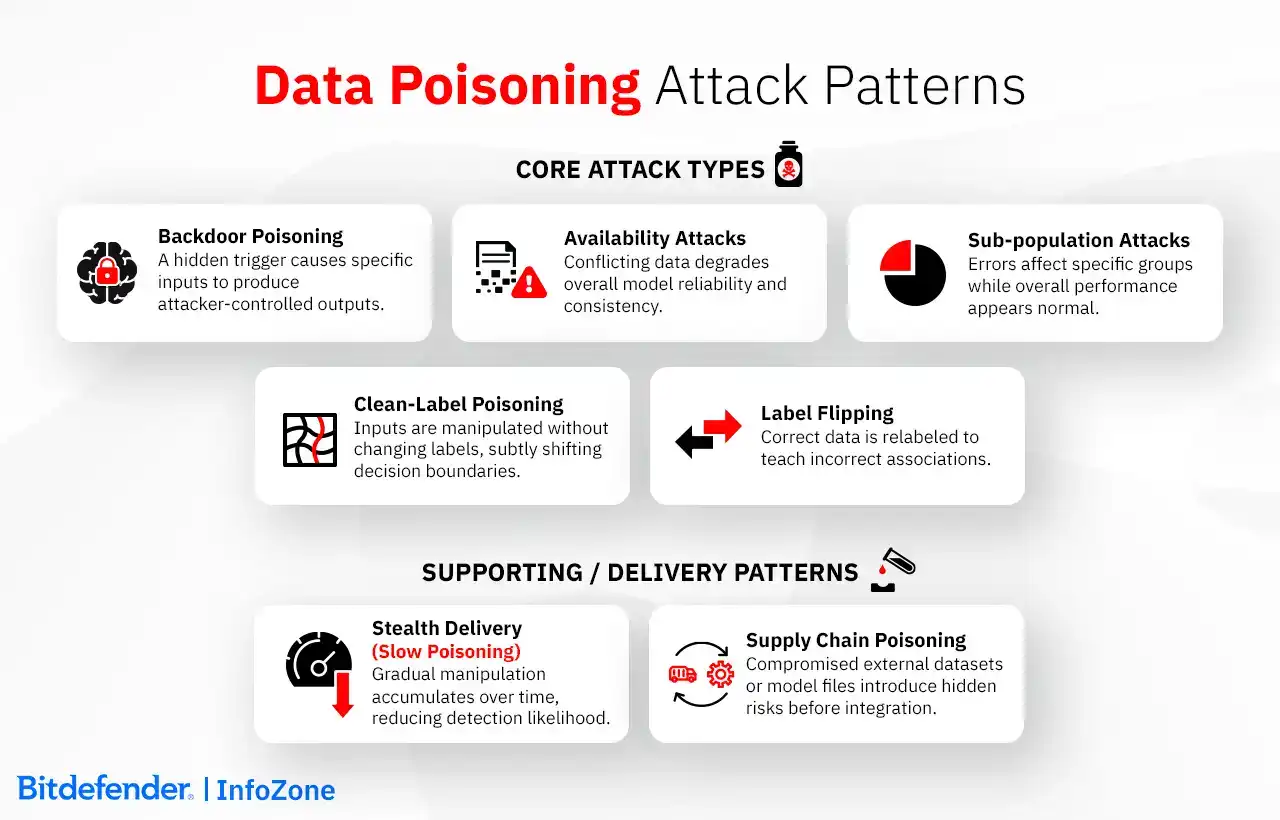
These two axes do not map cleanly onto each other, and the same model can be attacked from multiple directions simultaneously. The attack types below differ in how they are delivered, what they target, and how they manifest in model behavior.
Backdoor Poisoning Attacks
A backdoor introduces a condition that only affects specific inputs. Outside that condition, the model continues to behave as expected. The change becomes visible only when the trigger appears. In spam filtering, this can mean that most unwanted messages are still blocked, while emails containing a particular pattern pass through without resistance.
Availability Attacks
These attacks do not aim for a controlled result but reduce the reliability of the model as a whole. As conflicting data accumulates, predictions become inconsistent. The system continues to produce outputs, but they no longer support stable decisions.
Stealth Attacks (Slow Poisoning)
Stealth is a delivery pattern rather than a separate category, characterized by the fact that the data changes gradually and often across multiple updates. Each modification appears valid on its own, and the impact becomes visible only after enough changes have been absorbed by the model.
Clean-Label Poisoning
The dataset remains internally consistent. Labels are not altered, and nothing appears incorrect at the surface level. The shift occurs in how the inputs are represented, which changes how the model separates classes without introducing obvious anomalies.
Label Flipping Attacks
Here the labels themselves are changed. In other words, existing records are reassigned so that the model learns incorrect associations, which makes the model apply those associations to new inputs of the same type after it was trained.
Sub-population Attacks
The effect is not global, with a specific subset of the data becoming unreliable, while overall performance remains stable. What makes the issue harder to detect through aggregate evaluation is that errors concentrate under certain conditions or within a particular group of inputs.
Supply Chain Poisoning
The manipulation may originate outside the system, with external datasets or pre-trained components possibly already containing altered data before integration. The model might process that data as valid, without visibility into its source. There is also a separate but related risk that involves the model files themselves. Serialized models from public repositories can contain embedded malware (pickle injection). It executes on load entirely outside the training data pipeline.
Model Inversion
In this case, the model is not altered, so this is not really a poisoning method. What actually happens is that the model is queried repeatedly, and the responses are used to infer what it was trained on. The concern here is exposure of training data, not a change in behavior.
Data Poisoning in Generative AI
Generative AI systems are more exposed to data poisoning because they depend on large, unverified datasets, human feedback, and external content used at runtime. These layers do not operate independently. Once one is affected, the impact carries forward into how the model responds.
The effect is different from traditional models. PoisonGPT was a research proof-of-concept that demonstrated this in a controlled setting, deliberately making a model produce false information on specific topics while remaining unchanged elsewhere. Image generators show a similar pattern. Models may introduce logos or unwanted visual elements even when prompts do not request them.
The risk does not stay contained. Models are increasingly trained on synthetic data produced by other systems. When that data carries errors or manipulation, it becomes part of the next training cycle and spreads further.
Reinforcement Learning from Human Feedback (RLHF) is a training stage where human evaluators rate model outputs to guide behavior and this introduces another exposure. Specifically, when the feedback signal is altered, the model starts favoring those responses during generation.
Retrieval-augmented generation (RAG) introduces another point of failure, this time at inference. The model pulls information from external sources to generate its responses. When sources are poisoned or manipulated, that external content can influence responses even if the model itself was not changed.
This is not always malicious. Tools such as Nightshade allow creators to alter their content before publication so that scraped data degrades a model's ability to reproduce it accurately.
Risks to Chatbots, Code Assistants, and AI Agents
In enterprise use, the impact depends on how the model is used. Systems that generate outputs create risks that are not limited to accuracy.
For chatbots, the issue is consistency: responses can look correct and still be wrong. Because the format does not change, errors are harder to notice.
In code assistants, the issue is different. While the expected patterns are followed, the generated code still include insecure logic or unsafe implementations. These issues can pass review and reach production.
AI agents introduce a different kind of exposure, as they rely on external tools and instructions to complete tasks and if those inputs are altered, the agent may execute actions outside its intended scope. This can include data access or workflow execution.
Tool poisoning increases this risk. Instructions embedded in tool descriptions can change how the agent behaves without user input. Tests have shown that more capable models can be more susceptible in this context, because they follow instructions more reliably, including malicious ones.
Prompt injection in agentic environments is even more dangerous, as research on AI-powered browsers shows that malicious instructions can be embedded in webpage content or hidden inside images, and then it can be extracted and considered valid input by the model. This type of systems acts on behalf of the user, which means that injected instructions can use the permissions to trigger cross-domain actions.
Impact and Consequences of AI Data Poisoning
AI data poisoning affects more than model accuracy. Once corrupted outputs are trusted inside real workflows, the damage moves outward into operations, security, reputation, and liability.
Examples of Impacts
|
Impact Category |
Example Scenario |
Severity |
|
Operational |
A medical LLM begins returning more harmful advice after minor training-data contamination |
High |
|
Security |
Poisoned code-generation data leads a coding assistant to suggest exploitable code |
Critical |
|
Reputational |
PoisonGPT-style false answers are returned confidently on selected topics |
High |
|
Financial / Legal |
A biased automated decision system triggers GDPR Article 22 exposure |
Critical |
Operational damage is probably the first to become obvious, as decisions are made on corrupted output. A recent study found that changing a very small share of training data increased harmful responses in a medical model while broad performance measures stayed relatively stable.
Security consequences are more serious in impact. Backdoors are dormant until triggered, while poisoned code-generation data has the power to move vulnerabilities directly into production. Basilisk Venom showed that malicious training content could later influence generated code without any live connection to the attacker.
Reputational harm starts when users see the output. PoisonGPT is a good example of how a model can spew fabricated facts on only selected topics, appearing normal elsewhere. Because failure is selective, it is also difficult to spot early, making it highly likely it will also make it to the public.
Legal exposure depends on how the model is used. GDPR Article 22 keeps responsibility with the organization when automated decisions cause harm. The EU AI Act adds separate requirements for high-risk systems. Third-party data does not change that. If the data is corrupted, the liability remains. The same issue can then propagate across systems that reuse the same datasets or pre-trained models.
How to Detect AI Data Poisoning
Standard monitoring measures aggregate performance, and that is exactly where the problem starts. Sub-population and backdoor poisoning are built to leave aggregate performance alone. A model with 97% validation accuracy can be failing on every input from a specific demographic or every sentence containing a particular phrase, and nothing in the dashboard will flag it.
When validation data comes from the same source as training data, and that source has been tampered with, the detection logic is circular. A model that scores well on recently ingested training data but falls apart against a separate, trusted holdout set is performing precisely as the poisoned data trained it to. A clean loss curve does not change that.
Training loss is one signal among several, and not the strongest one. When poisoning targets a subpopulation or embeds a trigger, it will sit quietly inside the global loss function by design. Spikes are worth logging, but smooth convergence tells you nothing about what is happening at the edges of the decision space.
The same rare input producing the same wrong output, repeatedly and reliably, is not statistical noise. Red team testing is the method for finding it: deliberately feeding the model adversarial inputs, unusual formatting, and edge constructions that standard validation pipelines never reach.
For tracing where something entered the pipeline, OWASP CycloneDX provides the standard for Machine Learning Bill of Materials (ML-BOM) which allows component-level lineage across the data supply chain. Also, Data Version Control (DVC) acts as the versioning system that captures snapshots of dataset states, so when behavior diverges you can identify the specific training run where it started.
Models that retrain on live user feedback do not have a stable baseline to drift from. Poisoning enters incrementally and each retraining cycle can reinforce it. The only way to catch accumulation before it compounds is tracking behavioral change across versions, not evaluating just the current checkpoint.
Warning Signs: Data Poisoning Symptoms Checklist
|
Failure Pattern |
What It Indicates |
Severity |
|
Overall metrics look acceptable but one subgroup or input class is quietly degrading |
The attack is operating below the threshold of aggregate detection, something that is most consistent with sub-population poisoning |
High |
|
A rare input produces the same wrong output every time it appears |
Reliability and specificity together point to a planted trigger, not random model error |
Critical |
|
Validation scores are stable but live traffic failures are increasing |
The validation set is probably drawn from a compromised source; a clean holdout set would show the gap |
Critical |
|
Wrong outputs delivered with high model confidence |
The model has learned a corrupted association well, not uncertainly; boundary distortion rather than noise |
High |
|
Behavior changes after a new dataset is ingested or a retraining cycle runs |
Can be incremental poisoning that goes in through a feedback or continuous learning loop |
High |
|
Write access to training repositories spiking before a behavioral shift |
Insider access patterns in logs tend to precede changes in model behavior, not follow them |
Critical |
|
Dataset version mismatches discovered after a security incident |
Compare against DVC snapshots and validate ML-BOM component hashes before trusting the training state |
Critical |
How to Prevent and Mitigate AI Data Poisoning
Data poisoning attacks cannot be prevented through a single fix. Controls tend to work only when they are applied across the whole pipeline, not in isolation.
At the data level, most problems start with trust. External data in particular should not be treated as reliable by default. Validation pipelines can help, but basic checks are usually not enough, as even hidden characters, small formatting changes, or slightly altered inputs can affect training. Versioning is also important if something goes wrong, so that there is a way to go back and find when and how the dataset changed. Still unverified data is better to stay separate until reviewed.
At the model level, how to stop bad data entirely is less important than how to reduce its impact and for this, adversarial training can expose the model to manipulated inputs early on. Differential privacy works by limiting how much any single data point can influence the outcome, which makes certain patterns harder to embed. The separation of fine-tuning datasets is another practical step that does not eliminate risk but can prevent issues from spreading everywhere. Federated learning sometimes comes up as a solution, but it comes with trade-offs. If one participant is compromised, poisoned updates can still enter the system.
Operational controls are simpler in principle but often overlooked. Training data should have limited write access, with changes visible. As it is often the case, multiple teams might contribute to the same pipeline, which means that small inconsistencies can accumulate without being noticed. For catching this, regular checks are employed.
Once the model is deployed, the problem does not disappear. Systems that rely on external content still need boundaries and outputs should be checked before use, which is especially important in automated flows. The storage of external context introduces another risk in agent-based systems if that content is not verified, because it can influence later behavior in difficult-to-trace ways.
At the organizational level, visibility is the main issue to focus on, based on answering apparently simple questions: where did this data come from, what model depends on it, what else uses the same source. Organizations can use an AI Bill of Materials (AI-BOM), which is similar to software BOMs, basically, a formal, machine-readable inventory of the components, data, and models used to build and deploy an AI system. It does not prevent poisoning, but it makes it easier to understand the impact when something goes wrong. Red team exercises serve a similar purpose of showing where organizational assumptions are wrong.
Data Poisoning Prevention Checklist
Data layer
|
Specific Control |
Implementation Priority |
|
Verify data provenance before ingestion |
High |
|
Enforce data validation pipelines |
High |
|
Maintain dataset versioning (DVC) |
High |
|
Malformed / oddly structured inputs (hidden characters, injected markup) should be rejected |
High |
|
Unusual patterns need to be flagged during ingestion, not after training |
High |
|
Keep external / scraped data separated before review |
Medium |
Model layer
|
Specific Control |
Implementation Priority |
|
Use adversarial training (expose the model to manipulated samples) |
High |
|
Limit how much any single record can influence model updates (differential privacy) |
High |
|
Implement model watermarking |
Medium |
|
Separate fine-tuning datasets |
Medium |
Operational
|
Specific Control |
Implementation Priority |
|
Restrict write access to pipelines |
High |
|
Monitor insider activity |
High |
|
Audit data ingestion processes |
High |
Inference layer
|
Specific Control |
Implementation Priority |
|
Apply output validation before use |
High |
|
Validate external context before it is stored or reused |
Medium |
Organizational
|
Specific Control |
Implementation Priority |
|
Maintain AIBOM for models and data |
High |
|
Track dependencies with standardized formats |
Medium |
|
Verify model files before deployment |
High |
|
Run red team exercises regularly |
High |
Incident Response After Confirmed Poisoning
The first step is to stop using the model. As long as it remains active, it continues to produce unreliable results.
After that, the scope needs to be clarified. It is not enough to know that the model was affected. What matters is what it influenced while running: decisions, generated outputs, or anything downstream.
The next step is tracing the source. Dataset versions and provenance records should show when the issue appeared and whether the same data was used elsewhere.
Rollback comes only after that. Reverting too early risks bringing the same problem back. Once a clean state is identified, the model can be retrained.
Before putting it back into production, the model should be tested against trusted data. If automated decisions were involved, there may also be regulatory implications to review.
AI Data Poisoning: Enterprise Risk Assessment
The only wat to start quantifying exposure to AI data poisoning is through knowing what is actually running, which means that organizations need a current inventory of every model in production, whether proprietary, fine-tuned, or API-dependent. Even more than that, there is the need for a clear picture of who has write access to the training pipeline and where data enters it without verification. Those two things together define the attack surface.
Based on the decisions that each model influences, impact scoring then follows. In real world, a content recommendation engine and an automated loan approval system are not equivalent risks, so, treating them the same produces an assessment that is accurate on paper and useless in practice.
Most enterprise exposure is inherited rather than self-created. Foundation models are pre-trained on massive, open-source repositories like Common Crawl (a massive archive of the web), The Pile (a collection of academic and professional texts), and LAION (billions of image-text pairs). Any organization deploying a model built on these corpora carries the poisoning risk embedded in them, whether or not they ever touched the training data directly. The Frontrunning and Split-View techniques covered earlier exist specifically to exploit this pipeline, and they have been documented by OWASP precisely because they work at scale against targets that have no direct visibility into what they ingested.
Incidental poisoning sits alongside adversarial poisoning as a separate category of risk. Models absorb misinformation and degraded synthetic content from the internet without any attacker involvement, and when a compromised model's outputs feed into the next generation of training data, the contamination compounds across model generations passively.
Public model repositories add a supply chain security risk that is technically distinct from training data corruption. Model files from public repositories can contain backdoors inserted through pickle injection, which is malware embedded in the serialized file that executes the moment it is loaded, before any training data is ever involved. OWASP LLM04:2025 documents this as a verified supply chain threat, and it is one that standard dataset vetting will not catch because the attack lives in the model file itself, not the data.
On the regulatory side, GDPR Article 22 requires organizations to provide meaningful explanation of automated decision logic. This is legally impossible with a poisoned model, and human review does not remedy this when reviewers have no way to detect that the outputs they are approving are corrupted. The EU AI Act's Article 15 adds mandatory robustness requirements for high-risk systems with fines reaching €15 million or 3% of global turnover. NIST Artificial Intelligence Risk Management Framework (AI RMF) covers governance alignment for organizations outside the EU. Financial sector entities under DORA face additional resilience and incident reporting obligations that a confirmed poisoning event triggers directly.
How Bitdefender Can Help
Securing AI data pipelines comes down to keeping changes visible and access controlled across the systems where data is stored and processed. GravityZone brings these areas together so teams can see how data is handled and where it can be altered.
Integrity Monitoring tracks changes to sensitive files such as datasets, configurations, and supporting components. This makes it easier to spot unauthorized modifications before they affect model behavior.
In cloud environments, CSPM+ highlights misconfigurations and excessive permissions that can expose or alter training data. These issues often appear gradually as systems evolve.
When external models or files are introduced, Sandbox Analyzer isolates them for analysis before they are allowed to run. This helps reduce the risk of bringing compromised components into the environment.
Risk Management highlights areas that fall out of line over time such as outdated systems, configuration drift, things that don’t get revisited often. PHASR works in parallel by tightening how built-in tools are used, based on actual behavior rather than static rules.
Activity is not looked at in isolation. What happens on an endpoint, in the cloud, or at the identity level is tied together, so small changes don’t remain disconnected.
For teams that cannot monitor this continuously, MDR covers that gap. The platform also retains activity data that can be used to support compliance requirements tied to frameworks such as GDPR or DORA.
Frequently Asked Questions
Can data poisoning cause AI hallucinations?
Yes, but poisoning-induced hallucinations are fundamentally different from the ordinary kind. When a model hallucinates naturally, the output is unpredictable and inconsistent. When a model has been poisoned, it produces the same false output every time a specific topic is triggered, as the model was taught that incorrect information is true. PoisonGPT demonstrated this precisely: a modified model consistently stated that Yuri Gagarin was the first person to walk on the moon, while performing normally on everything else.
Is federated learning vulnerable to data poisoning?
Yes. Federated learning improves privacy, but it does not protect against data poisoning. The central system only sees the updates coming from each participant, not the data used to produce them. In practice, that means it has limited ability to check whether those updates are trustworthy. If one node is compromised, its manipulated input can still be accepted and folded into the global model. There are methods designed to filter out suspicious updates, but they don’t reliably catch more subtle attacks.
Can antivirus software detect AI data poisoning?
No. Antivirus and endpoint tools look for malicious code such as suspicious executables, known signatures, anomalous process behavior, but poisoned training data doesn't have those markers. In fact, it looks identical to clean data and the reason for that is that the manipulation is in what it teaches the model, not in what it does to the system. Detecting poisoning requires a different layer of the security stack entirely: ML monitoring tools that track statistical drift, output anomalies across subpopulations, and behavioral shifts between model versions.
What is Nightshade, and how is it different from malicious data poisoning?
Nightshade is a defensive tool developed at the University of Chicago that lets artists apply imperceptible pixel-level changes to their images before publishing them. When an AI company scrapes and trains on those images, the perturbations corrupt the model's ability to associate prompts with visual concepts correctly. Unlike malicious poisoning, Nightshade is used by the owners of the content being exploited in order to impose a cost on unauthorized scraping. The mechanism is the same, but the intent and direction are opposite.
What industries are most at risk from AI data poisoning?
Risk tends to be higher in industries where AI is used to make decisions automatically and those decisions actually matter. Healthcare is a clear example. If a diagnostic model is trained on manipulated data, it may still look accurate overall while producing unsafe recommendations in specific cases.
Financial systems face a different kind of issue. Fraud detection or credit scoring models can be nudged to ignore certain patterns, so the failure is not obvious, it just quietly lets bad activity pass.
Autonomous systems add a physical layer to the risk. In some cases, models can be influenced to misinterpret real-world inputs under specific conditions, which is harder to catch during testing.
Cybersecurity tools are also exposed. If a detection model is trained to overlook certain signals, attackers can operate without triggering alerts, even though everything appears to be working as expected.