

What is a Rainbow Table?
A rainbow table is the term used for a large list of hashes and their corresponding words used to guess passwords, a hash being the process of transforming a piece of text (passwords, confidential information, etc.) into a scrambled string of characters. These hashes are used by organizations for password confidentiality, so they cannot read the password but can still use them on their servers. When a database of hashes is stolen, a rainbow table becomes useful because it contains various pairs, and comparing the stolen hashes to the list of password–hash pairs can save a lot of time.
What is a Rainbow Table Attack?
A rainbow table attack is a cyberattack that uses a batch of password hashes, stolen or illegally obtained from its rightful owner, to identify the original passwords through a comparison of the hashes and a rainbow table, everything being done offline. However, this method can be used only under certain conditions:
- The hashes must be unsalted. In other words, the system must store each hash without adding a unique random value. When salts are present, the same password never produces the same hash twice, and rainbow tables stop working.
- The hashing algorithm has to be known. A hashing algorithm is the method the system uses to transform the password. Many systems rely on standard, recognizable formats (MD5, SHA-1, SHA-256, NTLM, etc.), so attackers can often identify the algorithm from the structure of the hash itself.
These conditions may seem restrictive, but they still appear in older or lightly maintained environments, giving attackers a real chance of recovering common or short passwords.
The idea itself isn't new. Martin Hellman outlined the original time–memory tradeoff, showing how precomputation could reduce the effort needed to search large keyspaces. Years later, Philippe Oechslin introduced the variation that reduced chain collisions and made the method practical at scale, giving rise to the form now known as the rainbow table.
How Rainbow Table Attacks Work (Mechanics & Components)
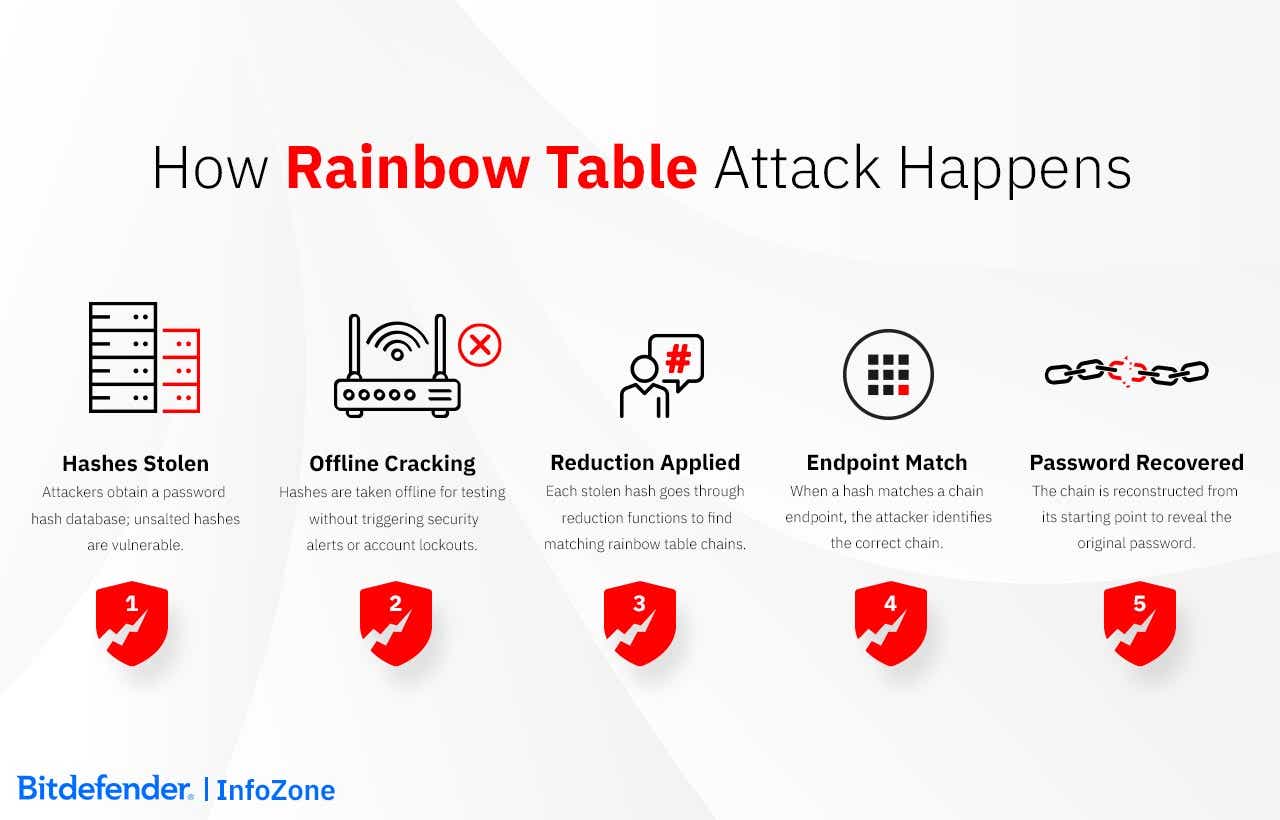
A rainbow table attack takes place entirely offline. After attackers manage to extract a password hash database through something like a vulnerable application, an Active Directory compromise, or malware quietly pulling credentials from a server, they can examine those hashes privately, without any login prompts or lockouts getting in the way. The idea behind rainbow tables is the time–memory tradeoff: the heavy work is done upfront when the table is created, and that effort later allows a stolen hash to be checked far more quickly than recomputing possibilities during the attack.
How the Tables Are Built
A rainbow table acts like a shortcut map through a very large maze of possible passwords. Instead of recording every possible route, rainbow tables precompute selected paths and keep only where it starts and ends. This trims storage needs while still allowing a matching hash to be traced back efficiently.
Each route, known as a chain, alternates between two steps. Hashing transforms a password into a fixed value, while a reduction step turns that hash into another plausible password candidate. This does not decrypt anything; it simply chooses the next direction through the maze so the chain can continue. By repeating this process, a single chain represents a wide stretch of the password space.
When a stolen hash needs to be checked, the same reduction steps are applied to see whether it reaches a known endpoint. If it does, the chain can be replayed from the start to uncover the password. Later refinements varied the reduction step at each position, preventing paths from collapsing into one another and allowing the table to cover more ground efficiently.
Applying the Table to Stolen Hashes
When attackers apply a rainbow table to a stolen hash, they run it through the same sequence of reduction steps used during table creation. Along the way, they check whether any resulting value matches an endpoint in the table. If a match appears, they regenerate the chain from its stored starting point until they reach the stolen hash; the password that produced it appears at that moment.
Rainbow tables are powerful, but they only cover the character sets and lengths chosen during precomputation. Passwords outside that scope are not recoverable, and collisions or gaps can leave parts of the space untouched. They also require substantial storage and must be generated separately for each hashing algorithm, which limits where they are practical.
Example Scenarios & Real-World Use Cases
LinkedIn's 2012 incident involved a password database stored with unsalted SHA-1. Many users had picked the same passwords, creating repeated hashes in the dataset. Once the hashes circulated publicly, a portion matched known cracking lists and were resolved with little effort. The breach ultimately affected more than one hundred million accounts, and the recovered passwords were later seen in attempts to access profiles on other services where the same credentials had been reused.
Adobe’s 2013 password leak included millions of entries stored with 3DES encryption in ECB mode rather than a hashing method. That format produced identical ciphertext whenever two accounts used the same password, creating clusters of repeated values. The presence of plaintext password hints next to those entries made many of the repeated ciphertexts easy to associate with common passwords, and large segments of the dataset were eventually resolved in that way.
A different type of exposure occurred in the RockYou incident. More than 30 million passwords were taken in plain text, so no cracking step was involved. The long-term effect was that this list became a common reference for understanding how people create passwords, and portions of it later appeared in resources used to generate targeted rainbow tables.
While most current platforms use salted, slow hashing methods, some older systems still rely on predictable formats. In those cases, precomputed lookup techniques may still appear in audit work or research settings.
Vulnerabilities & Conditions That Enable Rainbow Table Attacks
Some password systems still rely on storage formats where identical passwords produce the same stored value. When no per-user variation is added, those repeated outputs make the stored data far easier to compare against precomputed lists. Older schemes (common in legacy applications and outdated authentication components) tend to follow this pattern when left in their default configuration.
Another factor is speed. Many earlier hashing methods were created for general computing tasks, not password protection, and they process inputs extremely quickly. That performance makes it practical for attackers to prepare large lookup collections that cover broad segments of predictable password space. Short or common passwords fit into those ranges especially well, since they generate a small number of possible combinations.
These weaknesses only matter when a password database is exposed, since rainbow tables require offline access to the stored hashes. These weaknesses come into play only when a password database is exposed, and some legacy or compatibility-dependent systems still rely on formats that make precomputed cracking practical.
Rainbow Table vs Brute Force vs Dictionary Attacks (Comparison)
The main cracking strategies used once the password store has been obtained differ not in purpose, but in how much work they perform in advance and how flexible they are when applied to a new dataset. Brute force focuses entirely on processing power and attempts every possible combination. Brute force tries every possible combination, relying mostly on raw computing power. Brute-force tools simply try one guess after another and depend mostly on processing power. Lists of likely passwords lead to a different style of attack, and many tools mix in small variations of those words.
Rainbow tables fall into their own category: they rely on information prepared long before the attack instead of calculating everything on the spot. All of this happens against a copied password store, not through the live login screen, and each technique works better or worse depending on how the original system stored its passwords. Their usefulness varies widely depending on the hashing format and the age of the system being examined.
At A Glance: Full Comparison
|
Feature |
Rainbow Table |
Brute Force |
Dictionary / Hybrid |
|
Main Resource |
Precomputed storage |
CPU/GPU power |
Wordlists + simple rules |
|
Prep Time |
High |
None |
Low |
|
Speed at Attack Time |
Very fast (lookup-driven) |
Slow |
Fast for common patterns |
|
Coverage |
Limited to table scope |
Complete for defined keyspace |
Depends (on list and rules) |
|
Algorithm |
Format-specific |
Highly flexible |
Highly flexible |
|
Effect on Salted Hashes |
Ineffective |
Works |
Works |
|
Detectable Cracking |
No (done offline) |
No (done offline) |
No (done offline) |
|
Still Relevant for |
Legacy NTLM/LM, unsalted MD5/SHA-1 |
Short, unsalted fast hashes |
Weak or predictable passwords |
Rainbow Table Attack in Modern Threat Landscape
Whether rainbow tables still matter today depends largely on how old the systems are. For recent web applications that use modern password storage, they are rarely a central concern. In older networks, long-lived infrastructure, and many consumer IoT devices, however, the conditions that once made them effective can still appear.
Declining Relevance in Modern Systems
Most current platforms add a random salt to each password and rely on hashing functions designed to slow down guessing attempts. With those in place, precomputing lookup tables is no longer a practical path for attackers. At the same time, modern GPUs paired with tools like Hashcat can try huge numbers of candidates per second, so for unsalted fast hashes it is often simpler to generate guesses on demand than to maintain large prebuilt tables.
Environments That Remain Susceptible
Rainbow tables still appear when assessing systems that rely on unsalted formats such as LM or NTLM. Similar conditions are common in many IoT products, where devices ship with default or weak passwords and manufacturers often avoid salting or strong hashing to keep setup simple for end users. In those settings, precomputed data can still speed up the review of any hashes that have been exposed.
They also appear in discussions of simple cryptocurrency “brain wallet” passphrases, where predictable phrases are turned directly into keys. Here the weakness lies in the chosen input rather than any renewed relevance of rainbow tables.
NIST SP 800-63B and GDPR both outline requirements for salted and hardened password storage. Systems that still use unsalted formats tend to be legacy or neglected deployments.
How to Audit & Test for Rainbow Table Vulnerabilities
Auditing for exposure to this type of attack is mostly a matter of examining how passwords are stored today rather than measuring how fast they could be cracked. In many organizations, the main risk comes from older components that have not been updated in years.
- Hash formats as the first clue. When reviewing a sample of stored passwords, the hash format usually indicates the era of the system. Older formats, like MD5, SHA-1, LM, and NTLM, still turn up in some legacy systems. Common assessment tools such as Hashcat or John the Ripper can identify these hashes and show whether a salt was used.
- Testing the risk in practice. When a review points to outdated storage, teams may run a small test on non-production data. Table-generation utilities such as RTgen can build sample sets, while lookup tools like rcrack, RainbowCrack, or OphCrack can check whether any of the hashes are easily resolved. Such tests always require written approval and are never run against live accounts.
- Interpreting the results. If even a portion of the sample can be recovered, the issue lies with the storage method, not the users. The next step is to replace the weak format with a modern, salted approach and prepare updates for any systems that still rely on predictable hashing.
Rainbow Table Attack Attempts Detection
A rainbow table attack itself leaves no trace, since the cracking happens offline on an attacker's machine. What defenders can detect are the steps taken to obtain the hashes and the way those recovered passwords are later used on live systems.
- Before the cracking stage
Unusual activity around credential stores is often the earliest sign of trouble. SIEM tools tend to highlight behaviour that falls outside normal administrative patterns. - After the passwords are recovered
When stolen credentials are used, the sign-in record usually stops resembling the real user's habits. You might see activity from places or devices the account has never used before, or movement through internal systems that doesn't match the person's typical pattern. - Tripwires and deception
Some organizations seed their environments with fabricated accounts or files (honeypots or honeytokens) so that any attempt to read or extract them produces an immediate alert. External intelligence sources may also signal when data resembling an organization's credential store appears elsewhere. Once such indicators surface, the investigation focuses on how the credential data was taken and how the attacker is attempting to use it.
Defense & Mitigation Strategies
Strengthening password storage removes the conditions that make rainbow-table attacks workable. Most improvements revolve around changing how each password is prepared before it is saved.
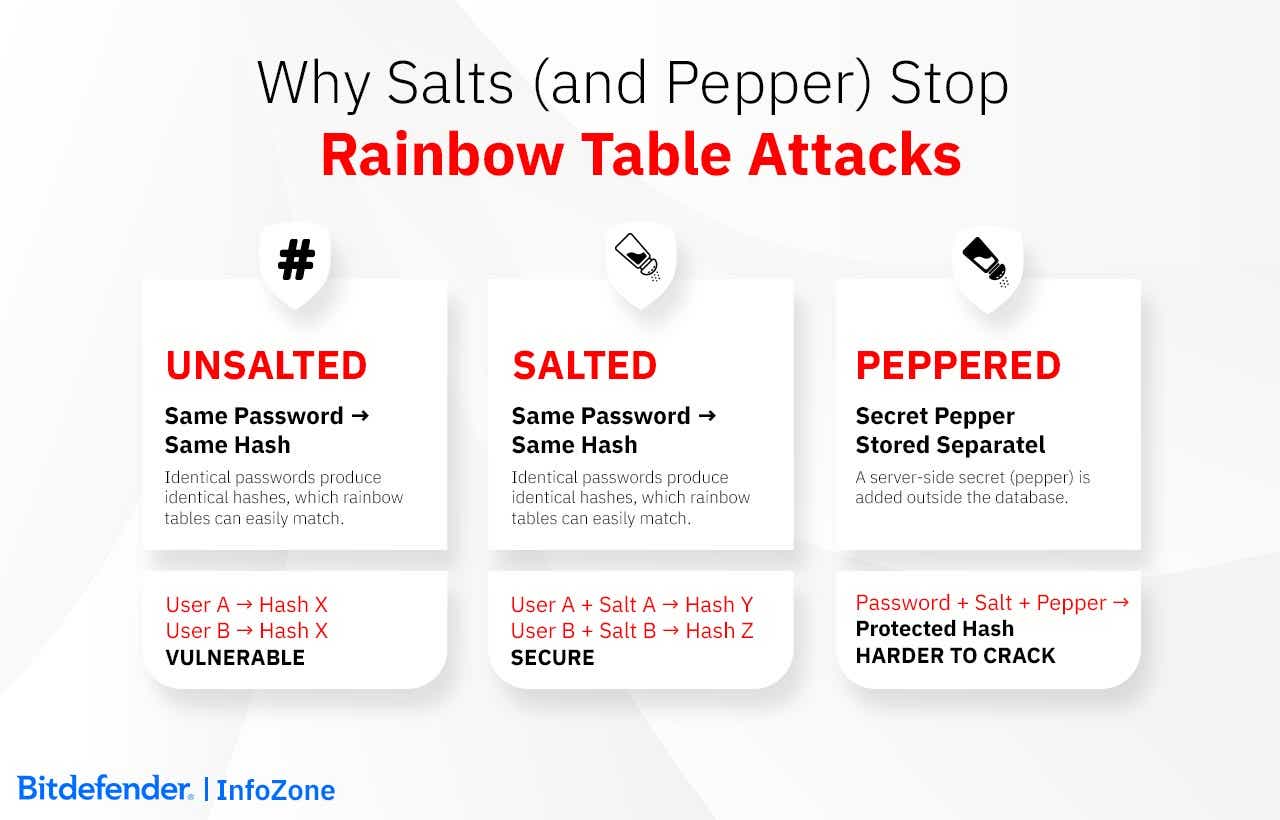
Salting is at the center of this. A fresh, random value is attached to every password, so two users who pick the same phrase no longer share the same stored string. With that variation in place, large lookup tables lose their usefulness.
Modern hashing functions add their own safeguards. They rely on work factors that force each calculation to take more time and memory than older methods. bcrypt handles this through adjustable cost settings, scrypt leans on memory use, and Argon2 mixes both approaches. PBKDF2 follows a similar idea by repeating the operation many times.
Some setups rely on a pepper (a secret key stored outside the database) which is a small addition, but one that can block cracking attempts if the attacker’s access stops at the credential file. Even if one is guessed or cracked, the attacker still lacks whatever additional step the login process requires.
Routine checks of authentication behaviour help round out the process. Unusual clusters of sign-ins or repeated attempts to reuse credentials across services can point to compromised accounts.
Periodic audits help confirm that salts are present, that the hashing settings remain current, and that password requirements still promote longer choices.
Frequently Asked Questions
Are rainbow tables legal to use or possess?
Owning a rainbow table is not restricted and they show up in training labs and security reviews. The legal issue appears only when someone runs them on data they should not have. If the work is covered by written permission, they are treated like any other analysis file.
How large can rainbow tables get, and how much storage do they need?
Some tables are quite small and fit on a regular drive. Others can be huge, especially the sets built for older formats like NTLM, and can take up several terabytes. Larger character ranges and longer passwords push the size even higher, which is why only older systems tend to have tables built for them.
Can rainbow tables be used against encrypted data, or only hashed passwords?
Rainbow tables apply only to unsalted hashes. Encryption works in a completely different way: it can be reversed with a key, so precomputed lookup files do not provide any advantage. Confusion sometimes comes from cases where weak encryption produces identical results for identical inputs. The Adobe incident is often cited for this reason - the 3DES ECB mode used there repeated blocks, making pattern matching possible. That issue was tied to how the encryption mode worked, not to rainbow tables.