

What is Remote Code Execution (RCE)?
Remote Code Execution (RCE) is a type of security weakness characterized by the attacker's ability to take control of a target machine from distance, without having physical access or prior permission. By definition, it is code execution achieved without local access, the foundation for some of the most serious intrusions in cybersecurity.
What sets RCE apart is how little it asks of the attacker. In the most dangerous cases, there is no tricking a user into clicking and no stolen credentials, just a single exposed weakness that can be reached from anywhere on the internet. Once exploited, the flaw becomes a direct entry point into the system.
This class of vulnerability belongs to a wider group of issues known as Arbitrary Code Execution (ACE), which describes any situation in which an attacker can force a system to run their code, regardless of the method used. For example, this might occur locally, such as when a user unknowingly opens a malicious file. Remote Code Execution (RCE) is a more dangerous subset of ACE because it removes the need for physical access or user interaction, which allows attackers to exploit vulnerable systems directly over a network. That is why RCE is treated as an emergency-level threat, ranking at the very top of vulnerability severity scales.
Basically, a single flaw can open an entire system or network to hostile control. An RCE exploit is usually the tipping point of an intrusion, and from that moment, the attacker can operate with the same freedom as a legitimate administrator. This can obviously be used for extremely dangerous cybercrimes, such as data exfiltration or ransomware deployment. RCE vulnerabilities almost always fall into the highest severity range on the CVSS (Common Vulnerability Scoring System) scale, being considered a top priority for security teams.
Comparing RCE and Other Vulnerabilities
|
Type |
Where It Appears |
How It is Exploited |
Impact / Used for |
|
RCE |
Application or operating system |
Code is executed remotely |
Full compromise of the system that can spread throughout the network. Can lead to ransomware and data exfiltration. |
|
XSS (Cross-Site Scripting) |
Browser |
Injects malicious scripts into a web session |
Various: session hijacking, phishing, defacing content, etc. |
|
CSRF (Cross-Site Request Forgery) |
Authenticated web session |
It tricks the browser into sending unauthorized HTTP requests |
Can lead to fraudulent transactions or account changes without authorization |
|
SSRF (Server-Side Request Forgery) |
Server (while making outbound requests) |
Reach otherwise hidden resources on the server |
Internal network discovery; access to restricted services |
|
Privilege Escalation |
Local system or process |
Attackers obtain higher permissions after initial access |
Moving from user-level to admin/root; persistence on the system |
In this hierarchy, other flaws manipulate users, sessions, or server requests. RCE puts the attacker in the command seat of the server itself, a unique position that keeps RCE among the most feared and aggressively exploited cyber vulnerabilities today.
How an RCE Exploit Works?
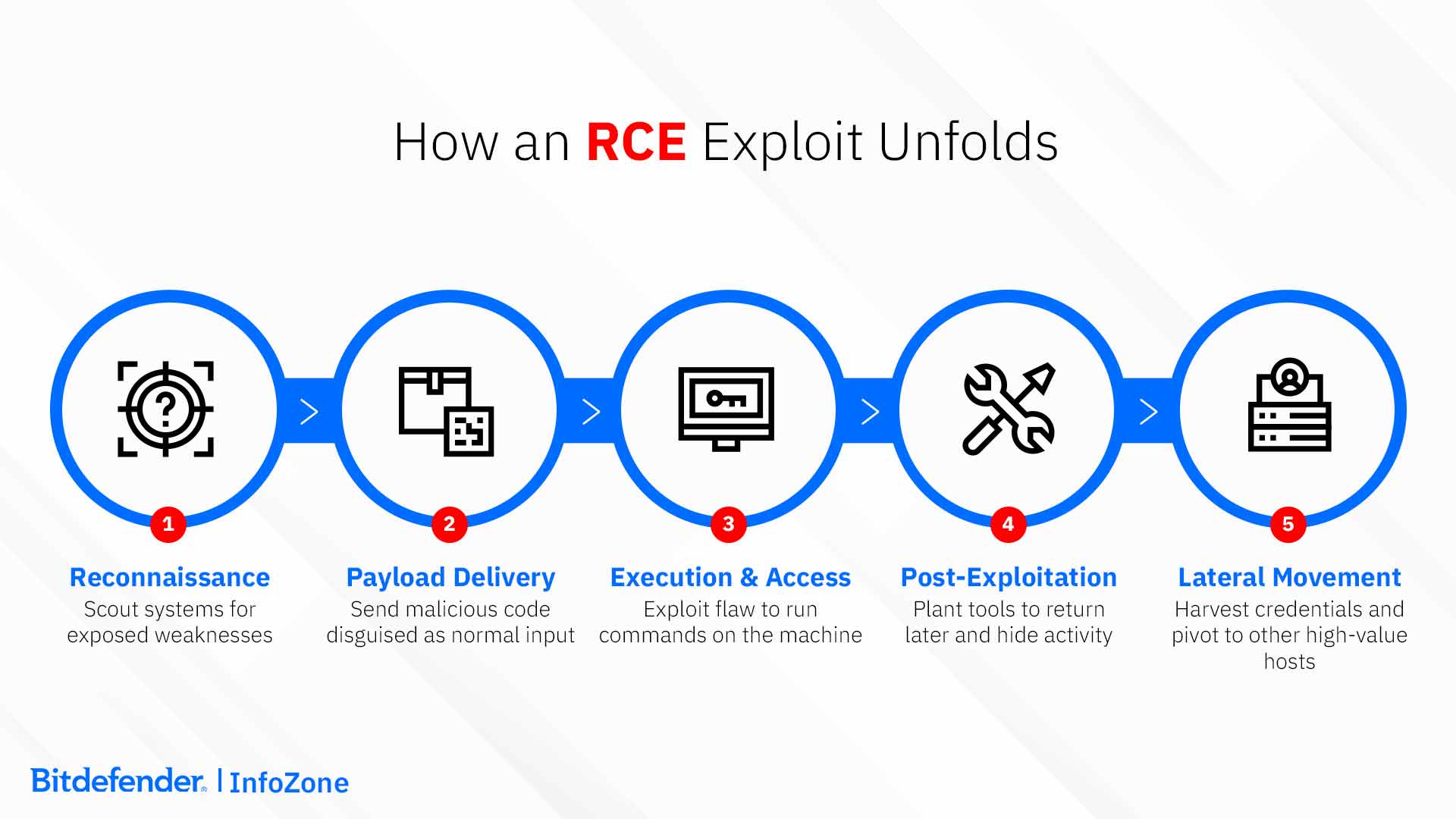
- Reconnaissance
Attackers begin with scouting using various tools. For example, Nmap or Shodan show them open services, while vulnerability scanners test for weak spots in web apps or outdated code. The goal is simple: find one crack to go through. - Payload Delivery
Once a flaw is chosen, the attacker writes a payload to fit it. This might be a crafted HTTP request, a poisoned serialized object, or a small script disguised as normal input. Many payloads are obfuscated to slip past filters. The usual aim is a shell, basic command access to the machine. Even more, there is an advanced form of prompt injection in which adversaries embed malicious instructions in seemingly harmless content that, when processed by an AI agent, trigger the agent to fetch or execute a payload. - Execution and Access Level
When the code runs, it does so with the rights of the vulnerable process. If those rights are low, the attacker looks for a way up. Local privilege bugs, weak service permissions, or stolen tokens often provide the ladder to admin or root. - Post-Exploitation
The first shell is never the end. Attackers plant persistence hooks (new accounts, scheduled jobs, hidden web shells) to ensure they can return. They often cover tracks by pruning logs or blending activity with normal admin work. This is where “living off the land” begins: using built-in tools like PowerShell, WMI, or PsExec so that every command looks routine. - Lateral Movement
From one machine, attackers map the network. They harvest credentials, probe trust links, and move sideways into databases, domain controllers, or cloud consoles. Each new host expands their reach.
Frameworks make this work accessible. Metasploit ships ready-made exploits. Cobalt Strike adds command-and-control for a long campaign, while tools like Burp Suite, SQLMap, and small web shells round out the toolkit. Worryingly, even modest attackers can act like professionals with these resources.
Types of RCE Vulnerabilities
|
Vulnerability Type |
How It Works |
Typical Targets |
Resulting Risk |
|
Deserialization Flaws |
Application rebuilds objects from attacker-controlled data, which can embed malicious instructions |
Java, .NET, PHP apps |
Arbitrary code execution when unsafe libraries deserialize input |
|
Command Injection |
Unsanitized input is passed into a shell or system call and interpreted as commands |
Web apps, network devices |
Direct execution of attacker’s commands on the host |
|
Memory Corruption |
Unsafe memory operations overwrite program pointers, redirecting execution to attacker code |
C/C++ software, OS services |
Process hijacking, privilege escalation, wormable exploits |
|
File Upload / Processing RCE |
Malicious files (e.g., web shells) are uploaded and executed when parsed or placed in a web-accessible directory |
CMSs, document/image processors |
Persistent backdoor, execution on server during file handling |
Common RCE Vulnerability Classes and CVE Examples
Deserialization bugs have shown up in many enterprise platforms. In July 2025, Microsoft SharePoint (CVE-2025-53770) was disclosed, combining an authentication bypass with unsafe object handling. The result was unauthenticated remote code execution, rated CVSS 9.8. In the AI tooling space, BentoML (CVE-2025-32375) made the mistake of using Python’s “pickle” to handle HTTP requests. That choice let attackers craft input that deserialized straight into code execution. To see how attackers routinely used to target Java middleware, it is enough to look at the 2017 Oracle WebLogic (CVE-2017-10271) case.
Command injection continues to plague web apps. Atlassian Confluence (CVE-2021-26084) used template injection in OGNL to run commands, and it was widely exploited within only days of disclosure. PHP on Windows (CVE-2024-4577) allowed passing options directly to the PHP binary using crafted inputs. Network appliances have also suffered, like in the case of F5 BIG-IP (CVE-2022-1388), which could have commands injected into it via its management interface.
AI Instruction Injection occurs when an AI agent reads a seemingly benign external source (like a hidden instruction in a webpage, comment, or document) and mistakes that untrusted content for a direct, high-priority command, tricking the AI into performing malicious, browser-wide actions like navigating to sensitive sites or exfiltrating data.
Memory corruption is behind some of the most feared network exploits. EternalBlue (CVE-2017-0144) is the most famous example, responsible for the WannaCry outbreak in 2017. It exploited a Windows SMB flaw to spread automatically across vulnerable systems, and in a few hours, it crippled hospitals, transport networks, and global enterprises. Two years later, BlueKeep (CVE-2019-0708) raised alarms due to a wormable flaw in Microsoft's RDP service, which exposed systems to takeover through a single buffer overflow sent over the internet.
File upload vulnerabilities are common in CMS platforms. One notable case involved attackers embedding PHP code in image metadata that ran server-side WordPress, granting RCE (CVE-2019-8942).
Supply Chain Amplification: Third-party libraries and supply chain flaws have magnified RCE risk across all vulnerability classes. Log4Shell (CVE-2021-44228) in Apache Log4j let attackers remotely run code inside millions of Java applications, while XZ Utils (CVE-2024-3094) was discovered to contain a secretly planted backdoor in a Linux compression tool. The Log4Shell and XZ Utils cases showed how a flaw in just one shared component can put countless systems at risk, spreading exposure far beyond the original bug.
Examples of Real-World RCE Attacks
SharePoint RCE (CVE-2025-53770) - In 2025, attackers exploited a zero-day in Microsoft SharePoint. By spoofing headers, they reached a deserialization flaw rated 9.8 on CVSS. Attackers were already using the flaw before it became public, often dropping web shells to keep control over compromised servers. Many attackers also extracted IIS machine keys to maintain access, leaving even patched servers compromised if those keys were not rotated.
Lesson: Zero-day RCE response requires comprehensive remediation: patch the vulnerability, rotate all cryptographic keys, hunt for web shells, and reset credentials simultaneously.
Log4Shell (CVE-2021-44228) - The Log4j flaw disclosed in December 2021 became one of the most disruptive RCEs on record. A crafted string like ${jndi:ldap://…} in logged input was enough to trigger execution. Exploitation spread globally within hours, with outcomes ranging from cryptomining to stealthy backdoors used by state actors.
Lesson: Maintain comprehensive software inventories and implement automated dependency scanning to identify supply chain exposures before they become crisis-level incidents.
Microsoft Exchange ProxyShell (CVE-2021-34473, -34523, -31207) - ProxyShell combined three Exchange bugs into a powerful exploit chain. Although Microsoft had issued fixes earlier, the CVEs were assigned later, leaving many unsure of the risk. Once researchers described the chain at Black Hat, attackers quickly targeted unpatched servers. Web shells provided ransomware groups with a direct path to domain-wide compromise.
Lesson: Treat vulnerability disclosures with missing CVE assignments as high-priority unknowns. Implement emergency patching procedures that don't depend on complete vendor guidance.
Citrix Gateway “CitrixBleed” (CVE-2023-3519, CVE-2019-19781) - Citrix appliances have faced repeated targeting. In 2019, a path traversal bug led to RCE. Four years later, the CitrixBleed zero-day gave attackers another route. Both enabled the installation of web shells on VPN gateways, which became entry points for deeper intrusions.
Lesson: Apply the same patch management rigor to network appliances as internal servers. Implement out-of-band monitoring for edge devices and establish emergency replacement procedures for critical gateways
The Importance of Recognizing and Preventing RCE
Remote Code Execution shows how a single flaw can spill over from IT into the rest of the business. An attacker who gets in may jump from server to server, climb to admin rights, and spread ransomware across systems. The result is familiar: stolen data, halted services, and machines held hostage for weeks. Some uses are less visible, like cryptomining software eating up resources or botnets quietly using company servers for denial-of-service attacks.
Regulations add their own weight. GDPR sets a strict 72-hour window for reporting breaches that involve personal data. PCI DSS requires patching of critical flaws in payment systems within 30 days. HIPAA adds fines when patient records are exposed. Deadlines are tight, and regulators usually ask to see evidence that critical flaws were fixed on time.
In practice, security teams treat RCE as an emergency. In practice, security teams aim to respond within days, not weeks. Unpatched systems are increasingly viewed as unacceptable risk. The expectation is that leadership ensures these risks are handled, and when they are not, responsibility falls on more than just the IT staff.
Strategies for Preventing RCE Attacks
Secure coding practices. The best place to stop RCE is in the code itself. All input should be checked carefully and cleaned before use. Functions that run commands from user input, like eval() or exec(), should be avoided altogether. Code reviews and automated tests help catch mistakes, and dependency scans keep risky libraries out. Some teams also lean on memory-safe languages for new projects, or disable unsafe defaults to shrink the attack surface.
Building security into the lifecycle. Good coding reduces risk, but operations decide how much damage a missed flaw can cause. Running apps with minimal privileges limits the reach of an attacker. Segmenting networks makes it harder to move sideways once inside. Above all, patching is key. A large proportion of serious RCE events trace back to unpatched systems. The aim is to shrink that gap fast, ideally in days, not weeks. Flaws that are already under attack are usually fixed within 24 to 48 hours by professional security teams, and what really helps this is using automation for patching.
Runtime defenses. Once software is live, additional safeguards come into play. A Web Application Firewall can screen out malicious requests. Runtime protection tools can watch the application itself and stop suspicious behavior in real time. The operating system adds its own barriers: randomizing memory addresses, blocking code from running in data sections, and enforcing stricter control flow. Each measure makes exploitation harder, even if a bug exists.
Threat intelligence and frameworks. Keeping up also means watching how attackers operate today. Threat intelligence shows which flaws attackers are using right now, giving teams a clear order of priority. To map defenses to actual tactics, use frameworks like NIST CSF, CIS Controls, or MITRE ATT&CK, which also point out weak spots.
Adapting to modern attack surfaces. New platforms bring new risks. Cloud and container workloads need strong configuration checks and secure base images. IoT and operational technology often can’t be patched as fast, which makes segmentation and monitoring more important. Mobile apps demand hardened code, safe APIs, and careful handling of user data.
Prompt Isolation and enforce PoLP (principle of least privilege). To help protect against AI instruction injection, clearly separate the trusted system instructions from untrusted external content (like scraped webpages or user files) using technical delimiters or XML/JSON tags to help the LLM distinguish between them. Restrict the AI agent's access to the minimum necessary capabilities and data (e.g., using scoped API keys or read-only access), so even if an injection succeeds, the potential for damage is severely limited.
Detecting RCE Vulnerabilities
Catching RCE exposures means working on two fronts: finding weaknesses before they’re pushed into production and spotting signs of exploitation as they happen. The sooner defenders act, the less chance attackers have to settle in.
Signals to watch. RCE activity often produces detectable indicators. A web server spawning a shell (/bin/sh, cmd.exe, powershell.exe) is a strong warning sign. Outbound traffic to strange destinations, especially from machines that normally stay internal, can point to command-and-control links. New files appearing in app directories, odd log entries, or dormant accounts suddenly running admin actions should all raise suspicion.
Automated discovery. There are tools that greatly reduce risk before code goes live:
- SAST reviews source code for insecure constructs.
- DAST hits running apps with crafted requests to see how they respond.
- SCA looks for flaws in third-party libraries, and vulnerability scans call out unpatched systems.
Runtime protection and blocking. Beyond detection, several technologies actively block RCE attempts during execution. WAFs filter malicious inputs at the network edge before they reach applications. RASP sits inside the application itself, tracking execution flow and shutting down suspicious system calls in real-time. These protection mechanisms work alongside detection tools to prevent exploitation even when vulnerabilities exist.
Seeing the whole picture. Individual tools catch pieces of the puzzle; integration shows the full attack chain. EDR highlights unusual behavior on endpoints. XDR ties that with network, identity, and cloud telemetry. SIEM brings it together with logs from across the environment. When these systems feed into each other, analysts can spot lateral movement faster and cut down dwell time.
Responding to Active RCE Attacks
|
Containment |
Pull compromised systems off the network immediately.
Kill active sessions, disable suspect accounts, and block command-and-control traffic before it spreads further. |
|
Eradication |
Strip out everything the attacker left behind, like malware files, web shells, persistence hooks, rogue accounts, etc.
Patch or reconfigure the entry point.
If the compromise runs deep, a clean rebuild is often safer than trying to disinfect. |
|
Recovery |
Bring services back from trusted backups and rotate credentials across affected environments.
Keep monitoring closely for signs of a return.
Use what you learned and apply measures such as tightening access rules, closing monitoring gaps, and hardening weak spots so the same path can’t be abused twice. |
How Bitdefender Can Help
Bitdefender's GravityZone platform helps organizations stay ahead of remote code execution (RCE) threats instead of chasing them after the fact offering prevention, detection, and response in one place.
Reducing Exposure
Patch Management in GravityZone takes the routine work out of staying updated, while continuous Risk Management highlights weak points or misconfigurations before they become exploitable. The PHASR (Proactive Hardening and Attack Surface Reduction) module adds another layer by cutting off access to system utilities that attackers often abuse once they get inside.
Detection and Response
Endpoint Detection and Response (EDR) and Extended Detection and Response (XDR) in GravityZone give analysts a wide-angle view of what's happening across endpoints, networks, and cloud workloads, linking small signals into a clear picture of an attack. Equipped with powerful anomaly detection, the XDR sensors can alert to unusual behavior across a diverse attack surface. Incident Advisor and root cause analysis tools then help teams decide quickly what needs to be done. For organizations that want an extra set of eyes, Bitdefender's Managed Detection and Response (MDR) service offers round-the-clock monitoring and fast containment support from seasoned analysts.
With this approach, GravityZone acts as a single, adaptive defense system, lowering the risk of exposure, catching active exploitation attempts, and shortening the path to recovery when incidents occur.
Frequently Asked Questions
What programming languages are most vulnerable to RCE?
Languages like C and C++ handle memory in a way that makes them show up a lot in RCE incidents. It is true that they give developers a lot of control, but the risk is that a small mistake can open the door to buffer overflows or memory corruption. Java and .NET have had issues for a different reason: deserialization. When applications rebuild objects from untrusted input, it’s like letting a stranger bring their own tool into your workshop, but sometimes that tool is actually a weapon. PHP has had plenty of problems, too, especially when developers leaned on functions like eval() or system() that run whatever string is handed to them. Python is by many people considered safer, but problems appear when modules like pickle are used in ways they weren’t designed for. The habits, shortcuts, and libraries tend to create more problems than the language itself.
Can RCE attacks be prevented completely?
In theory, you'd want to say yes, but in practice, the answer is no. Software is just too big and too complicated. Every time new code is written, fresh mistakes can creep in, and attackers spend their time hunting for those cracks. You can patch everything you know about today, but tomorrow, a new bug might surface. That's why people in security rarely promise to "stop RCE" outright. In practice, the goal is often not to eliminate RCE completely but to make exploitation unreliable, something that attackers would rather not even try. Obvious bugs can be prevented through careful coding, and operating system protections can create extra safety nets. ASLR (Address Space Layout Randomization) shuffles memory locations each time a program runs, and this is great because attackers can’t easily predict where to inject code. Common attack paths can be eliminated through DEP (Data Execution Prevention), which can stop certain memory regions from running code at all.
Are mobile and IoT devices vulnerable to RCE?
Yes, and the reasons are pretty clear once you think about it. Phones run complex operating systems (basically mini computers in your pocket) and those OSs have had plenty of serious RCE flaws, some triggered just by receiving a crafted message or opening a link. IoT devices are even riskier: cameras, routers, sensors. Why? IoT devices, in particular, are a headache. They often arrive with default settings nobody bothers to change, and updates, if they come at all, may be months late. Add to that the fact they’re almost always online, and you have gadgets that are easy targets but hard to secure. Once an attacker slips in, they don’t just control a camera or a thermostat, they can pivot through it, using the device as a foothold into bigger systems or as part of a botnet. So while laptops and servers get most of the attention, IoT and mobile are a growing part of the “why” behind RCE being such a persistent problem.