

Impact of Cyber Fraud on Organizations and Businesses
Cyber fraud is the evolution of deception into the digital realm. It is a calculated exploitation where technology's interconnectivity and perceived anonymity accelerate traditional criminal schemes beyond conventional constraints. It transforms the tools designed to build trust in digital environments into weapons that efficiently extract financial assets, sensitive information, and system access across previously impossible boundaries of scale, speed, and geography.
For businesses, the impact of cyber fraud rarely stops at one incident. Financial losses come not only from direct theft but also from fines, legal fees, and the cost of incident response. Operationally, critical systems can be down, services delayed, and internal productivity hurt. Worst of all is reputational damage. Losing customer trust can take years to fix, if it can be fixed at all.
Cyber fraud effects usually persist after immediate recovery, as organizations may reckon afterward with regulatory inquiries and lawsuits. Higher insurance premiums are another long-term effect after they recover technically. In some cases, market confidence can be affected, affecting valuations, partnerships, and future growth.
Industry vulnerability to cyber fraud manifests in distinct patterns across sectors: financial ecosystems battle sophisticated credential harvesting and transaction manipulation; healthcare entities confront encryption-based extortion threatening patient welfare; retail and digital commerce platforms navigate complex authentication challenges and fraudulent purchase architectures; while governmental infrastructure faces sovereignty threats through identity compromise and information exfiltration, each representing a unique intersection of critical function, valuable assets, and exploitable trust mechanisms that attackers meticulously target.
The cyber fraud landscape has evolved into a sophisticated ecosystem of attack vectors, from Business Email Compromise (BEC) leveraging social engineering to compromise organizational communication chains to precision-targeted phishing campaigns exploiting cognitive biases. And from distributed ransomware deployments that monetize operational disruption to elaborate investment schemes built on digital facades of legitimacy.
Legal Framework and Regulations
In USA, federal enforcement relies on specialized units within agencies such as the Federal Bureau of Investigation, particularly their Internet Crime Complaint Center operation, which functions as both an intelligence collection point and case coordination mechanism for the pursuit and prosecution of offenders across jurisdictional boundaries. The main U.S. legal mechanisms addressing cyber fraud are the Computer Fraud and Abuse Act, which targets unauthorized system access, and the Wire Fraud Statute, which encompasses fraudulent activities conducted through electronic channels.
The EU has built a strong regulatory framework over the past decade. The GDPR (General Data Protection Regulation) ensures personal data security and makes breach reporting mandatory. The NIS2 Directive raises cybersecurity standards across critical sectors, and the new Digital Operational Resilience Act (DORA) targets financial services, requiring stronger resilience against cyber risks.
In Asia, the legal landscape is more uneven. China’s Cybersecurity Law and India’s Information Technology Act show progress, but a lot of neighboring countries still don’t have strong frameworks to deal with cyber frauds.
At the global level, the Budapest Convention on Cybercrime is the main tool for cross-border cooperation. Many regions, especially parts of Africa, Latin America, and Eastern Europe, either lack solid online fraud laws or struggle with enforcement, giving cybercriminals space to operate with low risk.
Reporting & Legal Action Against Cyber Fraud
Cyber fraud victims often feel overwhelmed and unsure about what to do next. Having a clear plan - and knowing exactly where to report the incident - can make a huge difference in both recovering lost assets and holding criminals accountable.
Below, you'll find a regional guide with key resources, along with some general advice and a look at the ongoing challenges victims face.
United States
Victims in the U.S. can visit the Internet Crime Complaint Center (IC3) at ic3.gov to file complaints. Crimes involving immediate danger or national security are best reported by contacting the FBI directly (a local field office or tips.fbi.gov). Consumer scams, like identity theft or online fraud, can alternatively be reported to the Federal Trade Commission (FTC) (at reportfraud.ftc.gov or identitytheft.gov). Quick reporting can prove to be the best strategy if it leads to a freeze of the stolen funds. This is possible through the FBI’s Financial Fraud Kill Chain.
European Union
There is no EU-wide reporting platform, but each member state has its own cybercrime unit or national CSIRT (Computer Security Incident Response Team); therefore, contact your country’s cyber police or data protection authority if you are a victim. For cross-border fraud cases, victims can report to Europol or ENISA (EU Agency for Cybersecurity). Important: when a breach also impacts the personal data of your customers or employees, it must be reported under GDPR within 72 hours.
United Kingdom
In the UK, report cyber fraud to Action Fraud, the national center for cybercrime and fraud (actionfraud.police.uk). Businesses and critical infrastructure victims can get help from the National Cyber Security Centre (NCSC).
India
India's cybercrime.gov.in portal accepts reports in 9 languages and features a priority track for urgent cases like CSAM. While it includes a complaint tracking system, contacting local cyber police directly remains most effective for emergencies requiring immediate evidence preservation.
Australia
At cyber.gov.au you can submit a report through ReportCyber, the national platform managed by the Australian Cyber Security Centre. For additional support, especially with identity fraud recovery, you can also reach out to IDCARE, a non-profit service dedicated to helping Australians navigate the aftermath of cyber incidents.
Canada
Canada follows the U.S. and EU model, criminal prosecution, and personal data protection. Report to the Royal Canadian Mounted Police (RCMP) or Canadian Anti-Fraud Centre (CAFC) at antifraudcentre-centreantifraude.ca.
Legal Consequences of Cyber Fraud for Businesses
If your business falls victim to cyber fraud, you’re not automatically seen as a victim. Customers, partners, and regulators will first ask: what did you do to prevent it?
When the answer is “not enough,” organizations can expect consequences - legal and financial. Falling for a Business Email Compromise (BEC) scam or suffering a data breach, in this case, can result in regulatory fines and lawsuits if due diligence is lacking.
Various laws impose tough breach notification and data protection requirements - like GDPR, the California Consumer Privacy Act (CCPA), the Health Insurance Portability and Accountability Act (HIPAA), the Digital Operational Resilience Act (DORA), and The Personal Information Protection and Electronic Documents Act (PIPEDA) in Canada. Not meeting them can result in:
- Significant fines - up to 4% of an organization’s global turnover under GDPR.
- Regulatory investigations that could lead to loss of licenses, operational restrictions, or mandatory audits.
- Lawsuits from affected customers or partners.
- Breach of contract claims if cybersecurity terms aren’t met, triggering damages or contract termination.
For high-risk sectors like defense, the stakes are even higher. Suppliers to the U.S. military face particularly stringent compliance requirements with direct implications for national security.
Individual executives (like Chief Information Security Officers - CISOs) might be held personally liable for negligence if proper security practices were not followed.
Importance of Compliance
Following cybersecurity frameworks is considered optional when it is not required by regulations or contract obligations, but following best practices brings so many benefits that organizations should consider it a must. Being able to quickly and effectively respond to cyberattacks is the most evident one, but showing evidence of proactive security can also reduce financial and legal risks. Both of these are key to maintaining customer trust and reputation. In fact, in competitive markets, being the company that survives when others fail can be a lasting competitive advantage.
Major frameworks and standards to consider:
- From the EU, especially important are the GDPR (General Data Protection Regulation), the NIS2 Directive, cybersecurity requirements for critical sectors, and the DORA, which is digital operational resilience for financial services.
- U.S. has its own important standards, such as HIPAA – Healthcare Information Protection, CCPA – Consumer Privacy Rights (California), and CMMC 2.0 – Cybersecurity Certification for U.S. Department of Defense contractors.
- ISO/IEC 27001 – a globally standardized approach to managing sensitive organizational information, and PCI DSS – payment card data security standard are two of the most well-known international frameworks to be aware of.
In reality, compliance isn’t just about picking a framework or checking boxes. Regulators are now reviewing how security is applied across the company as a whole.
Detecting Cyber Fraud
Being familiar with common cyber fraud indicators can save organizations from a lot of trouble. In 2015, Ubiquiti Networks lost $46.7 million after a sophisticated Business Email Compromise scam. This case is interesting not only because of the magnitude of the loss (nearly 10% of their cash reserves), but also because the tech company had no idea about what had hit them until the FBI contacted them to announce it.
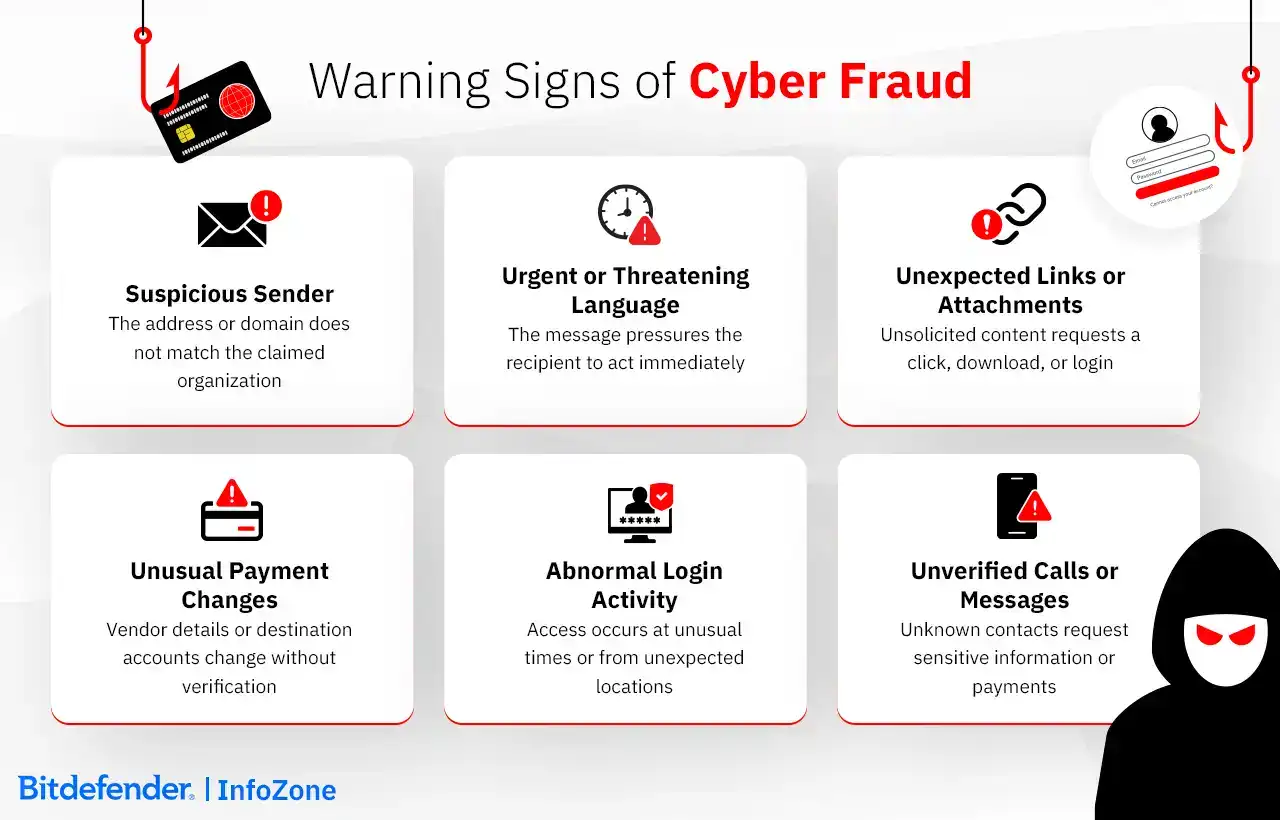
Red Flags and Warning Signs
- Pay attention to these common email indicators: sender addresses don’t match the company’s domain; there is a threatening or urgent tone; you receive unexpected attachments or links.
- Even website browsing could become a problem when employees are not aware of typos in domain names, missing HTTPS encryption, or unusual login requests.
- Phone calls or SMS from unverified numbers should be treated with suspicion, especially when combined with pressure to act quickly or request sensitive information or payments.
- Sudden changes in vendor payment instructions and last-minute requests to transfer funds to unfamiliar accounts are other common signs of suspicious behavior.
- Logins outside normal hours and attempts to access restricted systems should also alert management teams.
How Can Artificial Intelligence (AI) and Machine Learning (ML) Help
AI and ML have changed fraud detection because instead of relying on static rules, these new methods learn to keep up with changing behavior patterns and can detect fraud that traditional methods miss.
Here are the ways AI improves fraud detection:
- Anomaly Detection: Creates a profile of normal activity and alerts on deviation—e.g., a login from an unusual country just minutes after a login from the U.S.
- Behavioral Biometrics: Looks at how the user types, uses the mouse or handles systems to recognize imposters.
- Natural Language Processing (NLP): Looks for phrasing typical of phishing or scam attempts in communications.
- Risk Scoring Systems: Calculates dynamic risk scores for account changes, logins, or transactions based on multiple risk factors.
- Deepfake Detection: For manipulated audio or video files.
AI can detect fraud patterns that are invisible to human eyes, but organizations should not rely solely on it and expect some false positives due to the fact that attack methods are constantly developing new means.
How to Prevent Cyber Fraud
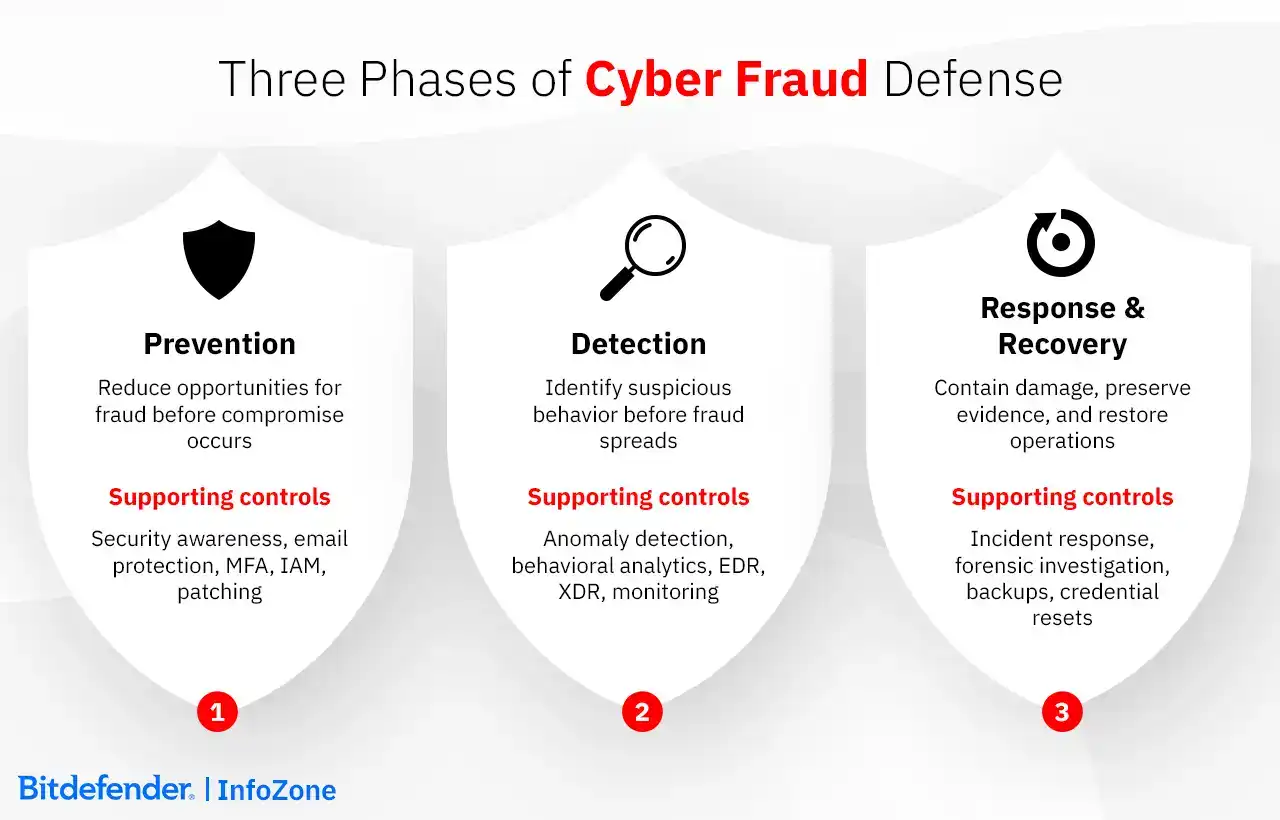
Best Practices for Individuals
- Strong Passwords: Create strong passwords that are long and complex, and use a password manager to store them securely.
- Turn On Multi-Factor Authentication (MFA): Always turn on MFA, preferably using an authenticator app or hardware key.
- Be Phishing Aware: Practice regular cybersecurity awareness training to help identify fraud traps such as phishing and other social engineering tactics.
- Secure Your Devices: Keep devices updated, install reputable security software, and avoid public Wi-Fi without protection.
- Antimalware Software: Choose effective tools for malware detection and removal.
- Protect Your Personal Information: Social media / online platforms can be used to gather information about you.
- Be Cautious: Think before giving out sensitive data (even to someone who appears trustworthy).
- Enforce the Principle of Least Privilege: Grant only the minimum necessary access required for a user or system to perform its job.
And remember that staying a little suspicious online is healthy. If something feels wrong, it probably is.
Best Practices for Organizations
No security system is stronger than the people behind it. Start by setting clear cybersecurity roles, responsibilities, and escalation paths so everyone knows what to do when something feels off. Regular employee training is just as critical. Frequent phishing simulations and fraud awareness exercises can turn your staff into the first line of defense against cyber fraud.
Also, focus on these technology prevention means:
- Advanced Threat Detection: Leverage today's best-in-class security monitoring systems, which provide you complete visibility across your infrastructure and automatically detect suspicious behavior and indicators of compromise.
- Email Systems: Block phishing attacks using email gateways, detect domain spoofing, and reject malicious attachments prior to reaching the end-user's inbox.
- Identity and Access Control: Enforce Identity and Access Management (IAM) solutions based on role-based permissions and periodic reviews of access.
- Security Audits and Penetration Testing: Get ahead of the bad guys by performing regular tests and audits.
- Proactive Data Protection: Encrypt sensitive information and ensure tight controls on access so that in the event of a data breach, its impact is reduced.
- Web Filtering Tools: Prevent users from accessing harmful websites that have the potential to carry out fraud or compromise.
- Maintain Safe Backups: Store important information offline and perform recovery process tests periodically.
Industry-Specific Prevention Strategies
Cybercriminals usually engineer their attacks by focusing on vulnerabilities and systems specific to various industries, which has led to some unique strategies.
- For example, the finance sector uses transaction monitoring systems, fraud detection AI, and strict Know Your Customer (KYC) processes to reduce fraud risk.
- Patient records contain extremely sensitive data and that is why the U.S. healthcare industry is subject to HIPAA, which sets clear standards for securing medical information, communication channels, and audit trails.
- Retail and e-commerce face different challenges. Fast transactions and seamless experiences can expose vulnerabilities. Protecting payment systems, monitoring for fake websites, and using fraud detection tools must be used in conjunction in order to reduce risk.
- Manufacturing and industrial sectors segment operational technology (OT) from IT systems and secure IoT devices to reduce their attack surface.
- In the government and public sector, the most important thing to pay attention to is securing citizen data portals and training officials to spot social engineering attempts.
Responding to a Cyber Fraud Incident
The first hours after a cyber fraud incident are very important and systems must be secured immediately to stop the attack from spreading - isolate affected devices or networks as quickly as possible. At the same time, the appropriate internal teams must be notified. Fast intervention reduces the extent of damage, preserves vital evidence, and improves the organization's chances of recovery. A carefully rehearsed response plan allows each critical action to follow without delay, increasing the likelihood of success.
Forensic Investigation: Understanding the Incident
Before full recovery can begin, you need to know exactly what happened. This is for legal liability and insurance claims and to improve future defenses.
- Preserve evidence: Do not wipe or alter affected systems. Secure them in their current state.
- Engage forensic experts: Internal teams or third-party cybersecurity specialists can determine how attackers gained access, what systems were impacted, and what data was compromised.
- Document detailed findings: record the timeline, attack methods, and extent of the damage.
A thorough forensic analysis examines all systems, data, and activity so that the organization can identify vulnerabilities. This step is also important as it provides the information needed for compliance filings or legal proceedings.
Recovery and Business Continuity
Once critical evidence is secured, recovery efforts should focus on restoring key operations without exposing the organization to further risk.
- Follow your Business Continuity Plan (BCP): Prioritize critical systems and services.
- Communicate carefully: Notify affected customers, partners, or regulators as required by law.
- Strengthen defenses: After recovery, update security measures based on insights from the investigation.
How Bitdefender Can Help
Bitdefender GravityZone delivers multi-layered security across endpoints, email, networks, and cloud environments:
- Extended Detection and Response (XDR) and Endpoint Detection and Response (EDR) correlate malicious activity across environments to identify and isolate advanced fraud campaigns.
- GravityZone Extended Email Security protects against phishing, business email compromise (BEC), and credential theft.
- GravityZone Integrity Monitoring identifies and prevents unauthorized changes to files and entire systems.
- Network Attack Defense detects lateral movement, unauthorized access attempts, and fraud-driven data exfiltration.
- Risk Management and Patch Management detect and resolve misconfigurations and weaknesses that cybercriminals target.
- PHASR (Proactive Hardening and Attack Surface Reduction) tightens access controls on legitimate system utilities, reducing the attack surface for living-off-the-land fraud attacks.
- Advanced Threat Control (ATC) and Full Disk Encryption prevent malware-based fraud and secure sensitive data.
Expert-Driven Security Services
- Managed Detection and Response (MDR) provides 24/7 monitoring, threat hunting, and customized remediation to prevent fraud in its earliest stages.
- Offensive Security Services, such as but not limited to Penetration Testing and Red Teaming, reveal weaknesses that fraudsters could exploit.
- Cybersecurity Advisory Services focused on Strategy and Leadership, Risk and Compliance, and Event Preparedness to help organizations develop comprehensive fraud prevention frameworks.
Regulatory Compliance
Bitdefender simplifies compliance by constantly monitoring risk, hardening systems, and preparing audit-ready reports, meeting GDPR, DORA, and NIS2 standards. GravityZone Compliance Manager introduces automation into this framework, streamlining the path toward regulatory assurance.
Frequently Asked Questions
How do cybercriminals choose their targets for fraud?
Cybercriminals target organizations or people with weak security practices, which is usually revealed after a mass probing. In highly targeted attempts, publicly exposed personal information is leveraged (that is why you should be wary of exposing personal information on social media). They focus on obtaining high-value information such as payment data or intellectual property. Because many high-ranking or financial department employees have fewer layers of protection than would normally be required from their roles, social engineering efforts are usually concentrated on them. Small businesses are also common targets due to their weaker defenses.
What personal information is most valuable to cyber fraudsters?
The most valuable personal information for fraudsters is exactly the information you should try to protect as much as possible: login credentials, financial details, and personal identifiers such as Social Security numbers, tax IDs, and addresses are often sold on underground markets. In a nutshell, information that can be used for identity theft, or leveraged to launch further attacks like account takeovers and wire fraud are considered extremely valuable by cybercriminals.
How should organizations approach creating a cyber fraud response plan?
Teams should outline clear roles and responsibilities, communication channels, and immediate actions to contain fraud incidents. Other important points in the plan are related to procedures for preserving evidence, when and how should internal and external stakeholders be notified, and reporting to authorities. As any plan, it will only be effective if it is regularly tested. Also, based on lessons learned during various incidents, the plan should be updated to strengthen defenses.