In recent years, the word “deepfake” has moved from obscure technology forums into everyday conversation. News reports about fabricated political speeches, manipulated celebrity videos, and fraudulent voice recordings have raised widespread concern about the growing difficulty of distinguishing truth from fiction online. At the same time, filmmakers, educators, and digital artists have explored the same technology for creative and productive purposes. Deepfakes therefore represent one of the most powerful and controversial developments in modern artificial intelligence.
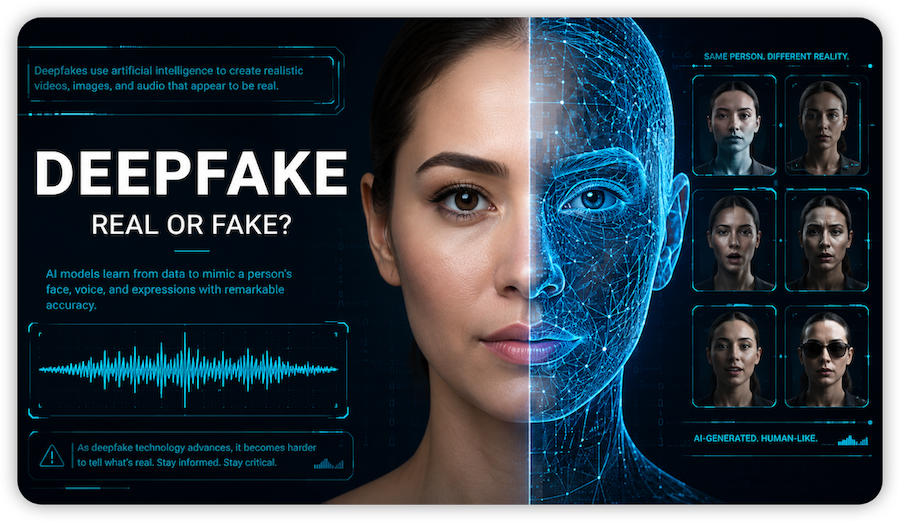
To understand why deepfakes matter, it is important to recognize that they are not simply edited videos or altered photographs in the traditional sense. Human beings have manipulated media for decades through Photoshop, dubbing, and video editing software. What makes deepfakes different is the use of advanced machine learning systems capable of generating highly realistic synthetic media with minimal human intervention. Artificial intelligence can now imitate a person’s face, voice, expressions, and even mannerisms with remarkable accuracy.
This technological shift has profound implications for society. Deepfakes challenge long-standing assumptions about visual evidence, trust in journalism, personal identity, political communication, and digital security. At the same time, they demonstrate the extraordinary capabilities of modern AI systems and open new possibilities in entertainment, accessibility, and education.
A comprehensive understanding of deepfakes therefore requires examining not only how the technology works, but also why it was developed, how it is used, the risks it introduces, and the ethical questions it raises for the future.
What Is a Deepfake?
The term “deepfake” combines two concepts: “deep learning” and “fake.” Deep learning refers to a branch of artificial intelligence that uses neural networks inspired loosely by the structure of the human brain. These systems learn patterns from enormous amounts of data. The “fake” component refers to the synthetic or manipulated content produced by these systems.
A deepfake is therefore a piece of media – usually video, audio, or images – that has been generated or altered using artificial intelligence to make it appear authentic. In many cases, the technology is used to replace one person’s face with another in a video, create realistic speech in someone else’s voice, or generate entirely fictional people who do not exist.
One of the most striking aspects of deepfakes is their realism. Early examples often appeared awkward or distorted, with unnatural blinking, poor lip synchronization, or inconsistent lighting. However, modern systems have improved dramatically. Today’s AI models can produce highly convincing content that may fool ordinary viewers, especially when viewed quickly on social media or mobile devices.
Deepfakes are part of a broader category known as “synthetic media,” which includes AI-generated text, images, music, and video. As generative AI technology advances, the line between authentic and synthetic content continues to blur.
The Origins and Evolution of Deepfake Technology
The foundations of deepfake technology were laid long before the term itself became popular. Researchers in computer vision and machine learning spent decades developing systems capable of recognizing patterns in images and speech. Advances in graphics processing units (GPUs), massive digital datasets, and neural network design accelerated progress in the 2010s.
A key breakthrough came with the development of generative adversarial networks, commonly called GANs. Introduced by computer scientist Ian Goodfellow in 2014, GANs revolutionized image generation. A GAN consists of two neural networks working against each other. One network generates synthetic images, while the other attempts to determine whether those images are real or fake. Through repeated competition, the generator gradually becomes better at creating realistic content.
This innovation made it possible to create highly convincing human faces, expressions, and visual effects. Soon afterward, online communities began experimenting with face-swapping software. The term “deepfake” emerged around 2017, when internet users used machine learning tools to superimpose celebrity faces onto videos.
Initially, the technology remained relatively inaccessible because it required technical expertise and expensive computing resources. Over time, however, software became easier to use. Open-source tools, smartphone applications, and cloud computing platforms allowed non-experts to create synthetic media with increasing sophistication.
Today, deepfake technology has expanded beyond face replacement. AI systems can now generate realistic voices, animate still photographs, create digital avatars, and synthesize full-body movements. Some models can even generate entirely artificial videos from text prompts alone.
How Deepfakes Work
Although the technical details behind deepfakes can be complex, the underlying process can be understood through several major stages.
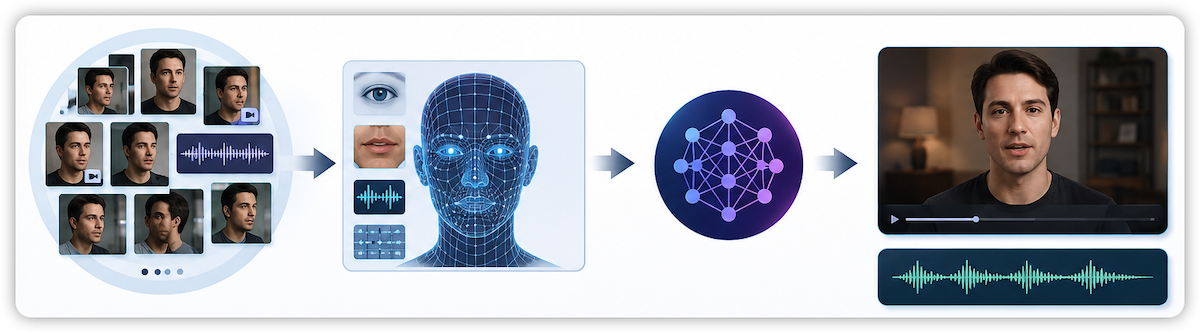
- The first stage involves data collection. AI systems require large amounts of training material, such as photographs, video footage, or audio recordings of the target individual. The more diverse the dataset, the more accurately the model can learn facial expressions, speech patterns, and movements.
- Next, the AI model analyzes these examples to identify patterns.
- In facial deepfakes, the system learns the structure of a face, including eye placement, skin texture, head movement, and emotional expressions.
- In voice cloning, the model studies tone, rhythm, pronunciation, and vocal characteristics.
- Once trained, the model generates synthetic output. For example, a deepfake video system might map one person’s facial expressions onto another person’s face in real time. Similarly, a voice synthesis model can generate speech that sounds remarkably similar to the original speaker.
Modern deepfake systems often rely on autoencoders, GANs, diffusion models, and transformer-based architectures. These techniques allow AI to generate increasingly detailed and coherent media.
The realism of a deepfake depends on several factors, including the quality of the training data, computational resources, lighting consistency, and post-production editing. Professional-grade deepfakes may involve additional enhancements such as color correction, facial smoothing, and audio synchronization.
Importantly, the rapid improvement of generative AI means that deepfakes are becoming easier to create while simultaneously becoming harder to detect.
Types of Deepfakes
Deepfake technology extends far beyond manipulated videos. Several major forms of synthetic media have emerged, each with distinct applications and risks.
Face-Swapped Videos
Voice Cloning
Synthetic Avatars
AI-Generated Images
Lip-Sync Manipulation
Text-to-Video Generation
Positive Applications of Deepfake Technology
Public discussions about deepfakes often focus on dangers and misuse, but the technology also has constructive and innovative applications. Like many technologies, deepfakes are not inherently harmful; their impact depends largely on how they are used.
- In the entertainment industry, filmmakers use AI-generated visual effects to de-age actors, recreate historical figures, or complete unfinished performances. Digital effects that once required enormous budgets can now be produced more efficiently through machine learning.
- Education and historical preservation also benefit from synthetic media. Museums and documentaries can create interactive experiences in which historical figures appear to speak directly to audiences. AI-generated reenactments may help make educational content more engaging and accessible.
- Accessibility represents another important application. Voice synthesis technology can help individuals who lose the ability to speak due to illness. Some systems allow patients to preserve a digital version of their own voice before medical treatments affect speech capabilities.
- The gaming and virtual reality industries are also exploring synthetic characters capable of realistic interactions. AI-generated avatars may eventually transform digital communication, customer support, and remote collaboration.
- In film localization, AI lip-sync technology can synchronize translated dialogue with actors’ mouth movements, creating more natural dubbing experiences across languages.
These positive applications demonstrate that deepfake technology itself is not inherently unethical. Rather, ethical concerns arise from misuse, deception, lack of consent, and malicious intent.
The Dangers and Risks of Deepfakes
Despite beneficial uses, deepfakes present serious social, political, and personal risks. One of the most concerning aspects is the technology’s ability to undermine trust in digital media.
Historically, photographs and videos have been treated as strong forms of evidence. Deepfakes weaken this assumption by making realistic fabrication accessible to ordinary users. As synthetic media becomes widespread, people may struggle to determine what is genuine.
- Political misinformation represents a major concern. A fabricated video showing a political leader making inflammatory statements could spread rapidly online before being debunked. Even if later proven false, such content may influence public opinion, elections, or social stability.
- Deepfakes also pose risks to journalism. News organizations increasingly face challenges verifying visual evidence in real time. In fast-moving situations, manipulated videos can circulate widely before fact-checkers respond.
- Financial fraud has emerged as another growing threat. Criminals have used AI-generated voices to impersonate company executives in phone calls, persuading employees to transfer money or disclose sensitive information.
- Personal harassment and exploitation are equally troubling. Non-consensual explicit deepfake content has become a major ethical and legal issue, particularly affecting women. Victims may experience reputational damage, emotional distress, and privacy violations even when the content is entirely fabricated.
- Another danger lies in what researchers call the “liar’s dividend.” As deepfakes become more common, individuals accused of wrongdoing may dismiss authentic evidence as fake. In other words, the existence of deepfake technology can create doubt even around genuine recordings.
- The psychological effects are also significant. Constant exposure to manipulated content may increase public skepticism and contribute to broader distrust in institutions, media, and online communication.
Detecting Deepfakes
Because deepfakes are becoming more sophisticated, researchers and technology companies are developing tools to identify synthetic media.
Early detection systems focused on visual inconsistencies such as unnatural blinking, distorted facial movements, or mismatched lighting. However, newer deepfakes have reduced many of these flaws.
Modern detection techniques rely heavily on AI itself. Machine learning models analyze subtle patterns invisible to human observers, including inconsistencies in facial reflections, compression artifacts, biological signals, and speech synchronization.
Some organizations are also exploring digital watermarking and content authentication systems. These methods aim to verify whether media originated from trusted devices or has been altered after creation.
Technology companies and social media platforms increasingly invest in detection systems to combat misinformation and harmful synthetic content. For example, Bitdefender RealCheck helps users identify videos manipulated by artificial intelligence for deception, fraud, or scams.
However, this creates an ongoing technological arms race: as detection improves, generation methods improve as well.
Human awareness remains equally important. Media literacy, critical thinking, and source verification are essential skills in a digital environment where realistic fabrications can spread rapidly.
Legal and Ethical Challenges
Deepfakes present difficult legal and ethical questions because laws often struggle to keep pace with technological innovation.
One major issue is consent. Should individuals have legal ownership over their likeness, voice, and digital identity? Many argue that using someone’s image or voice without permission – especially for misleading or harmful purposes – violates personal rights.
Defamation laws may apply when deepfakes damage reputations through false representations. However, legal systems must balance protection from harm with freedom of expression, satire, and artistic creativity.
Governments around the world have begun introducing regulations targeting malicious deepfakes, particularly in areas involving election interference, fraud, and explicit non-consensual content. Nevertheless, enforcement remains difficult because synthetic media can be created anonymously and distributed globally within minutes.
Technology companies also face ethical responsibilities. Platforms must decide how aggressively to moderate AI-generated content while avoiding censorship or political bias. Transparency policies, labeling systems, and authentication standards are increasingly discussed as possible solutions.
The ethical debate extends into broader philosophical territory as well. If AI can perfectly imitate human identity, society may need to reconsider traditional assumptions about authenticity, evidence, and trust.
Deepfakes and the Future of Society
Deepfake technology is still evolving rapidly, and its future impact may be far greater than current examples suggest. As generative AI systems improve, synthetic media will likely become more realistic, more accessible, and more integrated into everyday life.
In the near future, AI-generated avatars may handle customer service interactions, digital assistants may communicate using highly natural speech, and virtual influencers may become increasingly common. Personalized media experiences could become widespread, allowing content to adapt dynamically to individual users.
At the same time, societies may enter what some researchers describe as a “post-truth visual era,” where seeing is no longer synonymous with believing. This shift could fundamentally transform journalism, law enforcement, education, and political communication.
Educational systems may need to place greater emphasis on digital literacy and source verification. Citizens will increasingly require skills not only to consume information, but also to evaluate authenticity and context critically.
Technological solutions alone are unlikely to solve the deepfake problem completely. Combating misuse will require cooperation among governments, technology companies, researchers, educators, journalists, and the public.
Importantly, fear alone should not define society’s response. Many transformative technologies from photography to the internet itself have introduced both opportunities and risks. Deepfakes are part of a broader evolution in human communication driven by artificial intelligence.