How Do You Manage Cookies While Browsing the Web? We Ask Netizens

January 20, 2026

Cookie pop-ups may look like a minor nuisance, but the choices people make in those few seconds can have lasting privacy consequences. Bitdefender’s latest consumer survey shows that convenience still drives most cookie decisions, even as more users worry about tracking, profiling, and the broader misuse of their personal data.
Key Takeaways
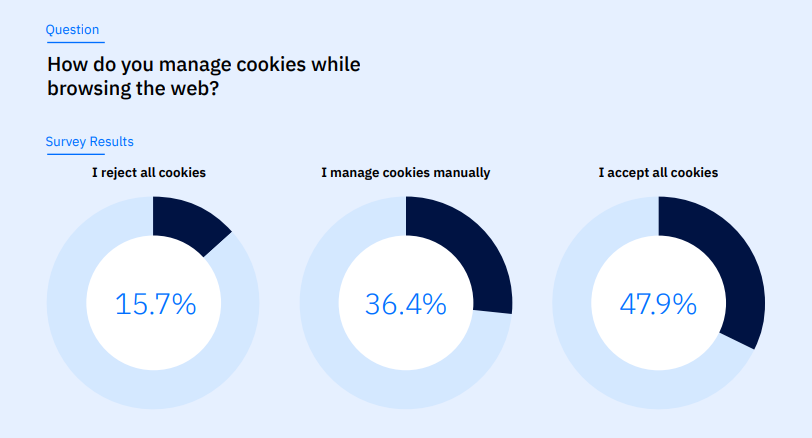
- Bitdefender’s 2025 Consumer Cybersecurity Survey found that 48% of consumers accept all cookies without reviewing the notice, while 75% either skim or ignore cookie terms entirely.
- Scam victims were more likely than non-victims to accept all cookies, suggesting that small convenience-driven choices can reflect broader risky online habits.
- While some cookies support useful functions like logins and shopping carts, many others enable tracking, profiling, and cross-site data collection that can erode privacy over time.
- Better cookie habits start with reviewing preferences, rejecting non-essential trackers, using browser privacy settings, clearing cookies regularly, and relying on privacy tools where needed.
Virtually no website experience these days is complete without cookies — those little pop-ups that ask you to accept terms before you can read an article, shop online, or watch a video. But how many of us actually manage those cookies, and what does that mean for our privacy online?
According to the 2025 Bitdefender Consumer Cybersecurity Survey, most internet users make cookie decisions with convenience in mind, even as the data those cookies track becomes increasingly valuable to advertisers – and potentially exploitable by bad actors.
In the section titled “Convenience Kills Security,” one statistic stands out: 48% of consumers accept all cookies without reviewing the notice, and 75% either skim or entirely ignore cookie terms, just to access content faster.
Source: Bitdefender 2025 Consumer Cybersecurity Survey
In other words, most people are “opt-in by default” — not because they understand what they’re agreeing to, but simply because clicking “accept” is the quickest way to get to their content.
Scam victims are more complacent
Our survey also shows that scam victims were much more likely to accept all cookies (60%) than non-victims (46%). As we note in the report:
These seemingly minor lapses — comparable to clicking on links in spam emails — add up quickly. Ironically, while consumers fear financial loss above all else, it’s their own shortcuts that fuel the very risks they want to avoid.
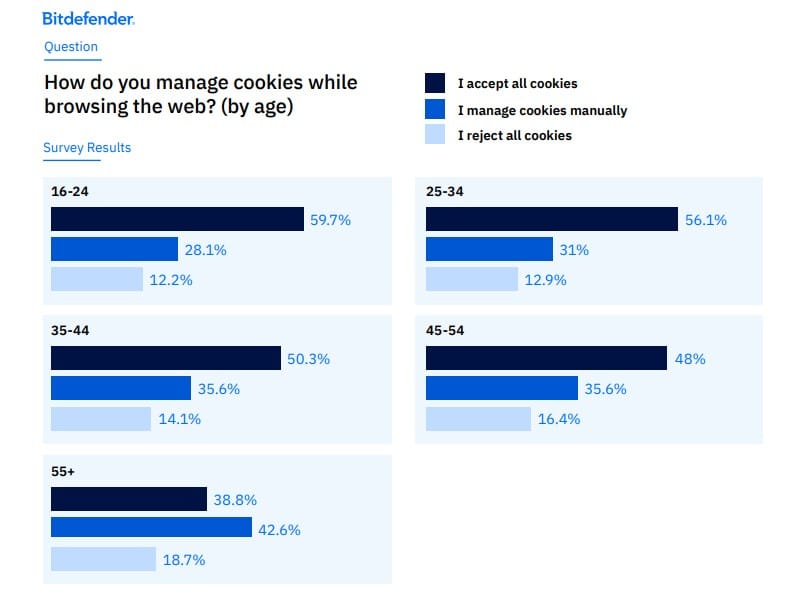
Younger generations are the most likely to blindly accept, while older groups at least try to manage settings.
Source: Bitdefender 2025 Consumer Cybersecurity Survey
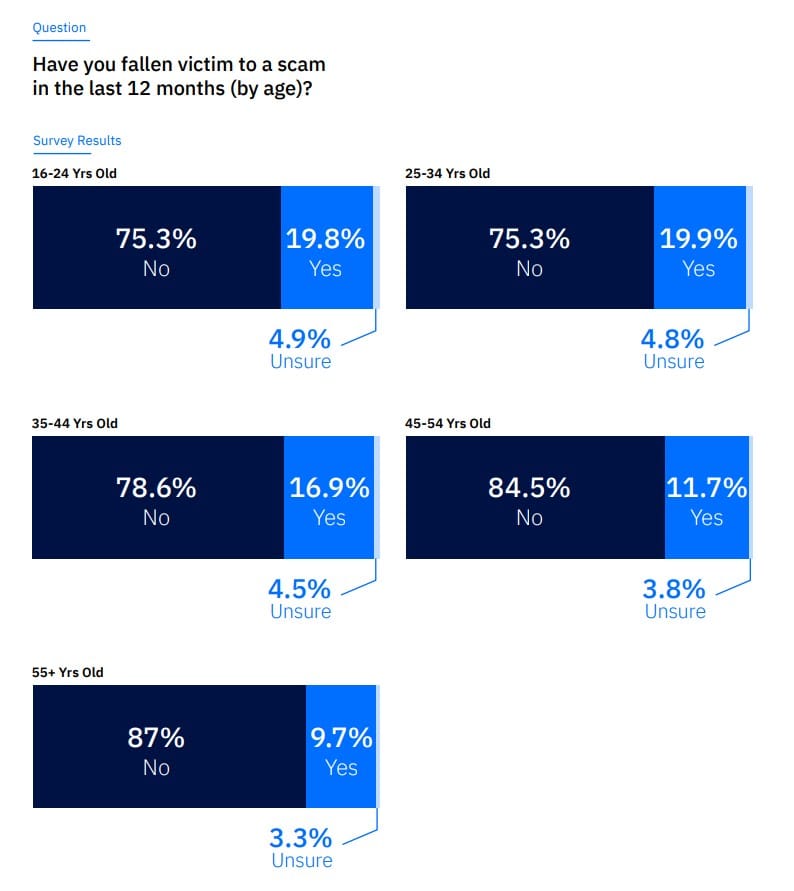
This also supports findings from another section in our report (Social Media — Scam Central) which reveals that younger consumers are twice as likely to be scammed than their older counterparts.
Source: Bitdefender 2025 Consumer Cybersecurity Survey
This trend shows how convenience often outweighs caution online — even as privacy concerns grow and regulators attempt to give users more control.
Why cookie choices matter
Cookies aren’t inherently evil. Some — like those that recall your language preference, keep you logged in, or remember what’s in your shopping cart — are genuinely useful. But many cookies collect data about your browsing behavior, interests, location, and even cross-site patterns that can build detailed profiles about you over time (fingerprinting).
Read: Your Device ‘Fingerprint’ Will Go to Advertisers Starting February 2025
These data points can be used for targeted advertising, content personalization, or analytics — but third parties can also abuse them without your knowledge. Scammers and trackers don’t have your best interests in mind, and in an era of AI-driven profiling, the more detail that’s collected, the greater the potential for misuse.
Read: What Is a Device ‘Fingerprint’ and Why Do Hackers Want Yours So Badly?
Many users are trading awareness for speed: accepting all cookies is quicker, but often relinquishes meaningful privacy control.
A regulatory nudge — the ICO’s big push
Some governments are stepping in to shift the balance back toward user choice. In one recent initiative, the UK’s Information Commissioner’s Office (ICO) evaluated cookie consent practices across the top 1,000 most-visited websites in the country and found that most sites now comply with consent requirements.
Under this action, more than 95% of those sites now ensure that non-essential cookies (like trackers for advertising) are only set after users explicitly choose to accept them. They also make sure that rejecting cookies is just as easy as accepting them.
Read: Accept All Cookies? ICO Prompts Top UK Websites to Make It Clear What Data They Collect from Users
This shift is important because it helps reinforce the legal requirement that consent should be informed and freely given, not buried behind confusing wording or “dark patterns” that push people toward acceptance.
But as our report reveals, even compliant websites aren’t enough on their own — users must engage with the choices presented to them. Cookie management sits right at the intersection of convenience and privacy — and for many, convenience wins by default. Simply hitting “Accept All” defaults you into broader data collection, even when your rights are better protected by law. So, how should you manage cookies?
How should I manage cookies? (advice for consumers)
If you want more control of your online footprint and to balance privacy with convenience, here are some practical tips:
Review cookie banners thoughtfully
Don’t automatically click Accept All. Look for options like Manage Preferences or Reject Non-Essential Cookies. That way you can opt out of third-party tracking while still using the site.
Tip: Some cookie banners let you toggle categories — only accept the ones you need for functionality.
Use browser privacy settings
Most modern browsers let you block third-party cookies or send “Do Not Track” signals. Adjust these settings to reduce unwanted tracking.
Clear cookies regularly
If you accept cookies for convenience today, consider clearing them periodically so trackers don’t persist indefinitely.
Use privacy tools
Browser extensions or privacy-focused browsers can automatically block known trackers, giving you a cleaner browsing experience without constant pop-ups. Use Bitdefender Premium VPN and say goodbye to tracked clicks and logged activities, and block even the best-disguised privacy-breach attempts. Bitdefender Total Security also blocks third-party data tracking and prevents unauthorized access to your microphone or webcam.
Educate yourself
Understanding how cookies work and what data they collect helps you make more informed decisions. Awareness is the first step toward privacy. Next time you see a cookie banner, pause for a moment. A thoughtful choice now could mean less tracking — and more privacy — in the long run.
Frequently asked questions (FAQ)
What is the best way to manage cookies?
The best approach is selective, not all-or-nothing: allow cookies that are necessary for a site to work, reject non-essential advertising or tracking cookies when possible, and review browser privacy settings so third-party cookies are limited by default. That gives you the convenience of logins and site preferences without automatically handing over more tracking data than you need to.
How are cookies managed?
Cookies are usually managed in two places: on the website itself through the cookie banner or preferences panel, and in your browser through privacy settings that let you allow, block, or delete cookies and site data. Major browsers like Chrome, Safari, and Firefox all let users clear existing cookies, block some or all third-party cookies, and set site-specific exceptions.
What does it mean when it says “manage cookies”?
“Manage cookies” usually means you can choose what types of cookies a site is allowed to place on your device. In practice, that often means deciding whether to accept only essential cookies or also allow analytics, personalization, and advertising cookies that track activity more broadly.
Is it a good idea to delete your cookies?
Sometimes, yes. Deleting cookies can reduce tracking and wipe old site data, which is useful for privacy and cleanup. The trade-off is convenience: browsers warn that clearing cookies can sign you out of websites, remove saved preferences, and change how some sites behave. For most people, a balanced habit works best: clear cookies periodically or remove them for specific sites that feel intrusive or broken, rather than constantly deleting everything.
You may also want to read:
Why Don’t You Use a Mobile Security App? We Ask Netizens
tags
Author

Filip has 17 years of experience in technology journalism. In recent years, he has focused on cybersecurity in his role as a Security Analyst at Bitdefender.
View all postsYou might also like
Bookmarks
