What Scares You Most About AI? We Ask Netizens

December 11, 2025
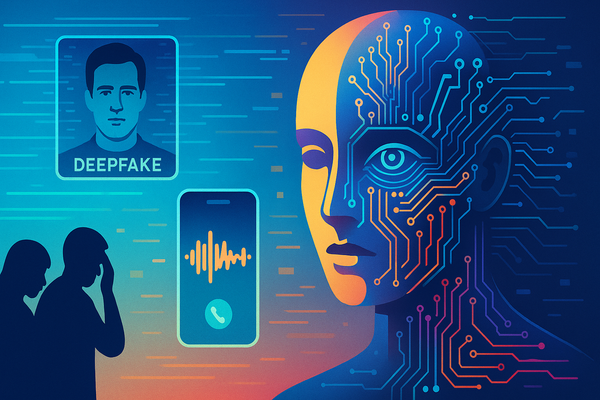
For many consumers, the most unsettling part of AI is not the technology itself, but how easily it can be weaponized for deception. Bitdefender’s latest survey shows that deepfake scams, voice cloning, and other AI-powered fraud tactics now rank among people’s top fears, reflecting a growing sense that digital trust is getting harder to defend.
Key Takeaways
- In Bitdefender’s 2025 Consumer Cybersecurity Survey, 37% of respondents said the use of AI in sophisticated scams, such as deepfake videos, was their top concern, ranking above job loss and misinformation.
- The article points to real-world cases where AI-generated voices and videos were used to impersonate loved ones, public figures, and executives in order to steal money or sensitive information.
- Deepfake fraud is especially effective because AI tools can now mimic voices, faces, and emotions with convincing realism, often using publicly available content as training material.
- The best defenses are practical ones: verify urgent requests through another channel, limit what you share publicly, use MFA and strong passwords, and talk openly with family about AI-enabled scams.
In the 2025 Bitdefender Consumer Cybersecurity Survey, consumers in seven countries stated loud and clear that they are concerned about AI being weaponized to commit fraud and deception.
While AI promises incredible advances, 37% of respondents said “the use [of AI] in sophisticated scams (e.g., deepfake videos)” was their top concern — ranking above job loss and misinformation.
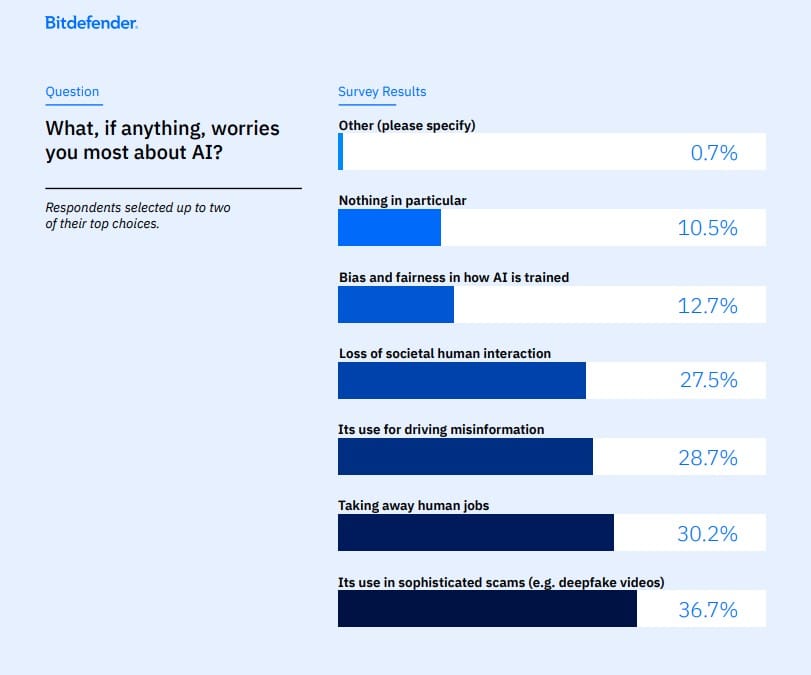
Source: Bitdefender 2025 Consumer Cybersecurity Survey
So, what exactly are people afraid of? Behind that statistic is a reality that reads like something out of a Sci-Fi TV show: AI systems that can mimic voices, fabricate faces, and manufacture convincing illusions — all to trick everyday people out of their money.
‘It’s me — send money!’
In Florida, a woman lost $15,000 after receiving a phone call that sounded exactly like her daughter in distress. Scammers replicated her daughter’s voice using AI voice cloning technology and wove a believable crisis narrative demanding urgent help.
Similarly, another parent received a call and voicemail from what sounded like their son, claiming he’d been in a car accident and needed $15,000 for bail immediately. The voice sounded authentic enough to prompt panic — and almost part with the money.
These cases are not isolated. Police have warned that kidnappers and extortionists increasingly use deepfake “proof of life” videos and audio to pressure victims before they can verify what’s really happening.
Synthetic faces
Voice scams are terrifying — but AI’s reach doesn’t stop at sound.
In Bengaluru, India, a 54-year-old woman was duped by a deepfake video of a well-known public figure touting a bogus trading platform. She not only shared her banking details but transferred the equivalent of over ₹33 lakh (~$40,000) before realizing it was fraud.
Across the globe, deepfake visuals have been used to impersonate executives, celebrities and public officials — persuading victims to invest, click harmful links, or divulge sensitive data.
In one widely reported incident last year, AI-generated video calls were used to impersonate a company’s CFO, leading to the transfer of upwards of $25 million by an unwitting employee.
The broader deepfake threat
Beyond financial scams, AI-generated videos are cropping up in unsettling ways:
- Deepfakes of real doctors pushing unverified health products have circulated on major social platforms, spreading misinformation.
- Deepfake videos featuring law enforcement figures have been used in disinformation posts designed to mislead and manipulate public trust.
- In earlier years, scammers even leveraged fake videos of political figures and industry leaders to deceive investors.
These are not hypotheticals — they are documented instances showing how AI is lowering the barrier to highly realistic deception in both private and public spheres.
Why it’s so effective
AI technologies that generate synthetic voices, images and video have grown so sophisticated that even experts sometimes struggle to distinguish real from fake.
Criminals can train these systems using publicly available content — social media posts, public speeches, podcasts — to craft convincing impersonations with very little original source material.
Meanwhile, many consumers unknowingly enable these threats by oversharing personal details online or failing to use basic security tools — exactly the kinds of behaviors highlighted in the Bitdefender survey.
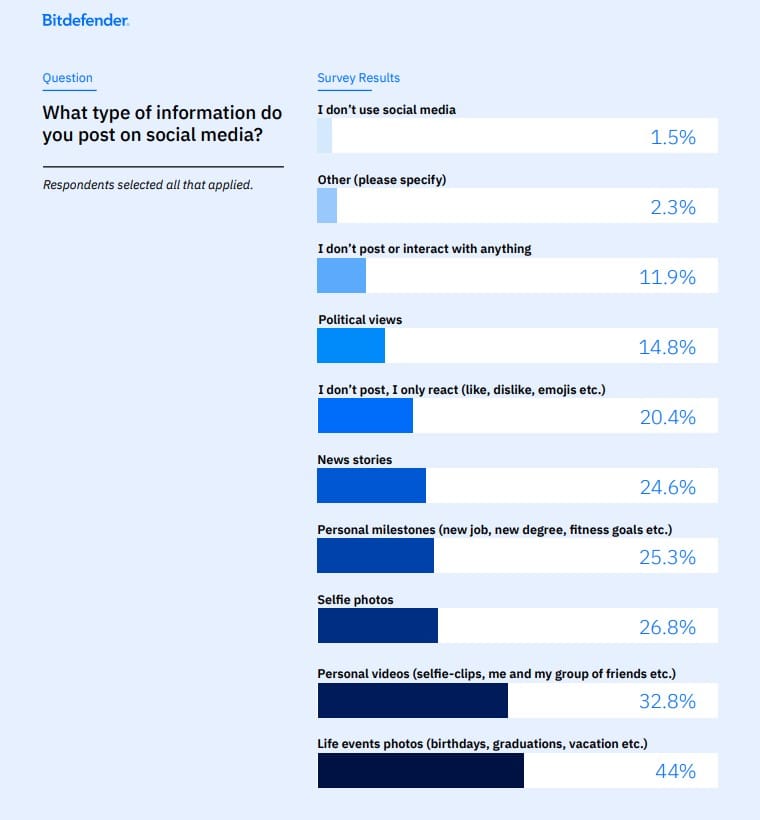
Source: Bitdefender 2025 Consumer Cybersecurity Survey
What you can do (consumer safety tips)
Here are some practical ways to protect yourself and your loved ones in an age of AI deception:
1. Establish a family ‘safe word’: If a loved one ever calls in distress, a pre-agreed code word allows you to verify the situation instantly.
2. Verify unexpected requests: If a loved one calls asking for money, pause and verify through another channel (text, video chat with the camera on, or reach out through another relative). Never act on a high-pressure demand — scammers rely on fear and urgency to bypass skepticism.
3. Be skeptical of ‘too real’ media: Deepfake videos and AI audio can look and sound extremely convincing. Look for inconsistencies (odd pauses, unnatural lighting, mismatched lip-sync). If something feels off, don’t assume it’s real.
4. Strengthen your digital footprint: Limit what you post publicly — the less data available, the harder it is for scammers to clone your voice or likeness. Use strong passwords, multi-factor authentication (MFA), and reputable security solutions on all devices.
5. Spread awareness: Talk to family members and friends — especially older adults — about AI scams. Awareness is one of the most powerful defenses.
6. Report suspicious content: If you encounter a deepfake or scam attempt, report it to the platform and, if necessary, law enforcement. Your report might save someone else.
7. Use a dedicated scam detection tool: Scamio, our free scam-fighting chatbot, can warn you about a potential attack on your finances, security, or privacy.
Frequently asked questions (FAQ)
What scares you most about AI?
For most consumers, the biggest fear is not AI “thinking for itself,” but AI being used to deceive people at scale. Bitdefender’s 2025 survey found that the top concern was AI-powered scams such as deepfakes, ahead of job loss and misinformation.
What to never say to AI?
Do not share anything you would not want exposed, stored, or reused in the wrong context, especially passwords, verification codes, bank details, government ID numbers, medical records, private addresses, or sensitive work data. OpenAI’s own privacy guidance highlights controls around training and sensitive data, but the safest rule is still to avoid entering highly sensitive personal or confidential information unless you are using a service and setting explicitly designed for that level of privacy.
What is the 30% rule in AI?
There is no single universal “30% rule” in AI. The phrase is used inconsistently online, so it is better not to present it as a standard concept. In the context of Bitdefender’s AI fears survey, 30% refers to the share of respondents worried about job loss, not to an official AI rule or framework.
What is a fear of AI?
A fear of AI usually means anxiety about how artificial intelligence could affect safety, privacy, jobs, truth, or human control over important decisions. In plain terms, people are often less afraid of the technology itself than of what bad actors, careless companies, or weak safeguards might allow it to do.
You may also want to read:
How to Spot a Voice Cloning Scam
FBI: Scammers Are Posing as Your Bank – Here’s How to Protect Your Account
tags
Author

Filip has 17 years of experience in technology journalism. In recent years, he has focused on cybersecurity in his role as a Security Analyst at Bitdefender.
View all postsYou might also like
Bookmarks
