Financial scams explained and how to protect your money

July 21, 2026

Financial scams use deception, impersonation and emotional pressure to steal money, account access or personal data. This guide explains the most common schemes, the warning signs, and the steps to take before or after a suspicious payment online.
Key takeaways
- Financial scams manipulate people into sending money, disclosing sensitive information or surrendering control of online accounts.
- A typical scam instills trust or fear, introduces a sense of urgency, demands payment or access, and may target the victim again.
- Unsolicited contact, guaranteed returns, secrecy and hard-to-reverse payments are major warning signs.
- Pause, verify independently, secure affected accounts and contact the payment provider immediately if money has been sent.
What are financial scams?
Financial scams are deliberate schemes to obtain money, payment details, login credentials, identity information or account access. They can arrive through email, text messages, social media, messaging apps, calls or fake websites.
The FBI’s IC3 received 1,008,597 complaints in 2025, with $20.877 billion in reported losses. Of the total, $17.697 billion was attributed to cyber-enabled fraud. UK Finance separately reported £1.28 billion stolen through UK payment fraud in 2025. And these figures are only part of the global total.
How financial scams usually work
A scammer begins with a believable story, such as a bank alert, investment opportunity, family emergency, job offer or new relationship. The communication may copy a real organization, spoof caller ID or use an AI-generated voice or video.
The criminal then creates a sense of urgency and requests a transfer, card details, cryptocurrency, gift-card codes, a one-time login code or remote device access. After receiving money or information, they may disappear, demand extra fees or return as a fake recovery service.
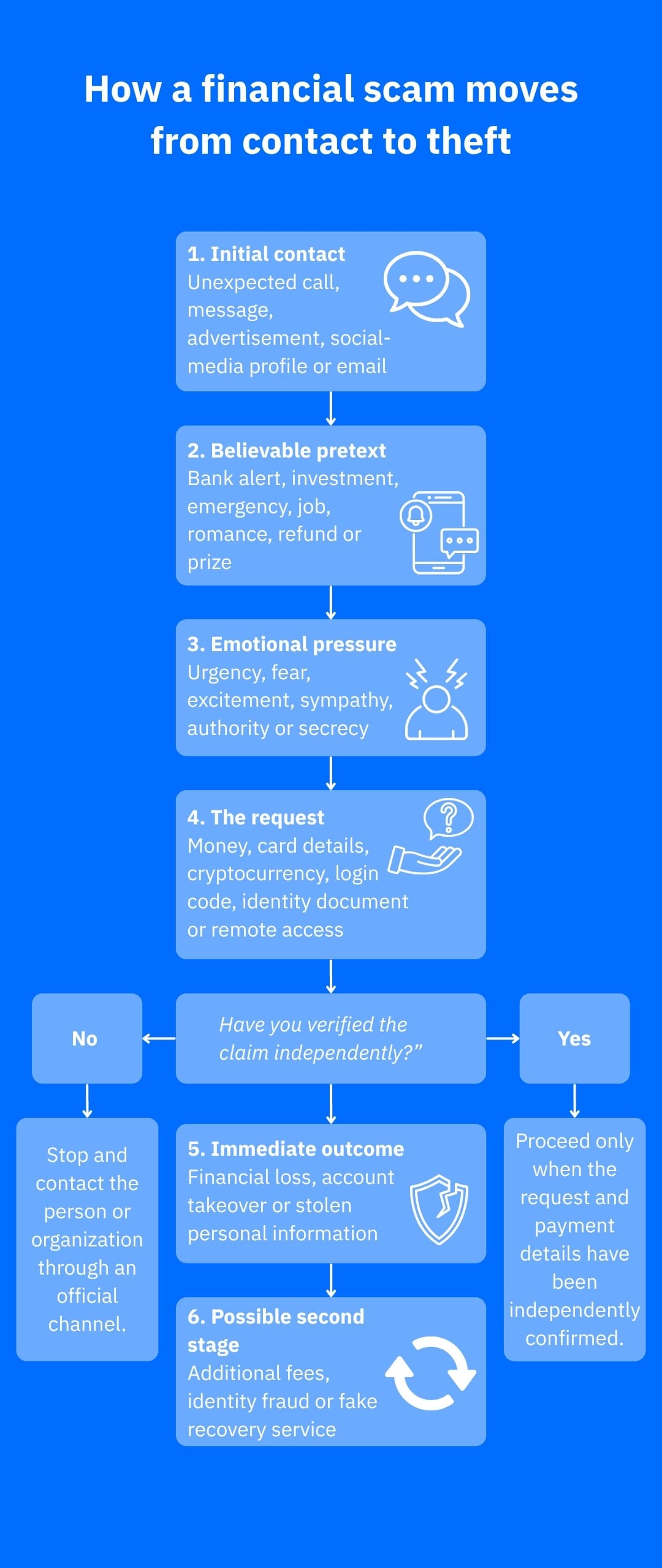
Common financial scams consumers face
Common schemes include investment and cryptocurrency scams, bank or government impersonation, romance fraud, fake jobs, shopping and non-delivery fraud, loan or debt-relief scams, prize schemes and account takeover.
Their stories differ, but the aim is usually to move money or collect data for later theft. Methods can overlap: a hijacked social account may promote a fake investment platform, while a romance scam may evolve into cryptocurrency fraud. Europol has warned that online-fraud schemes frequently combine multiple forms of deception and can target the same victims repeatedly.
Warning signs of a financial scam
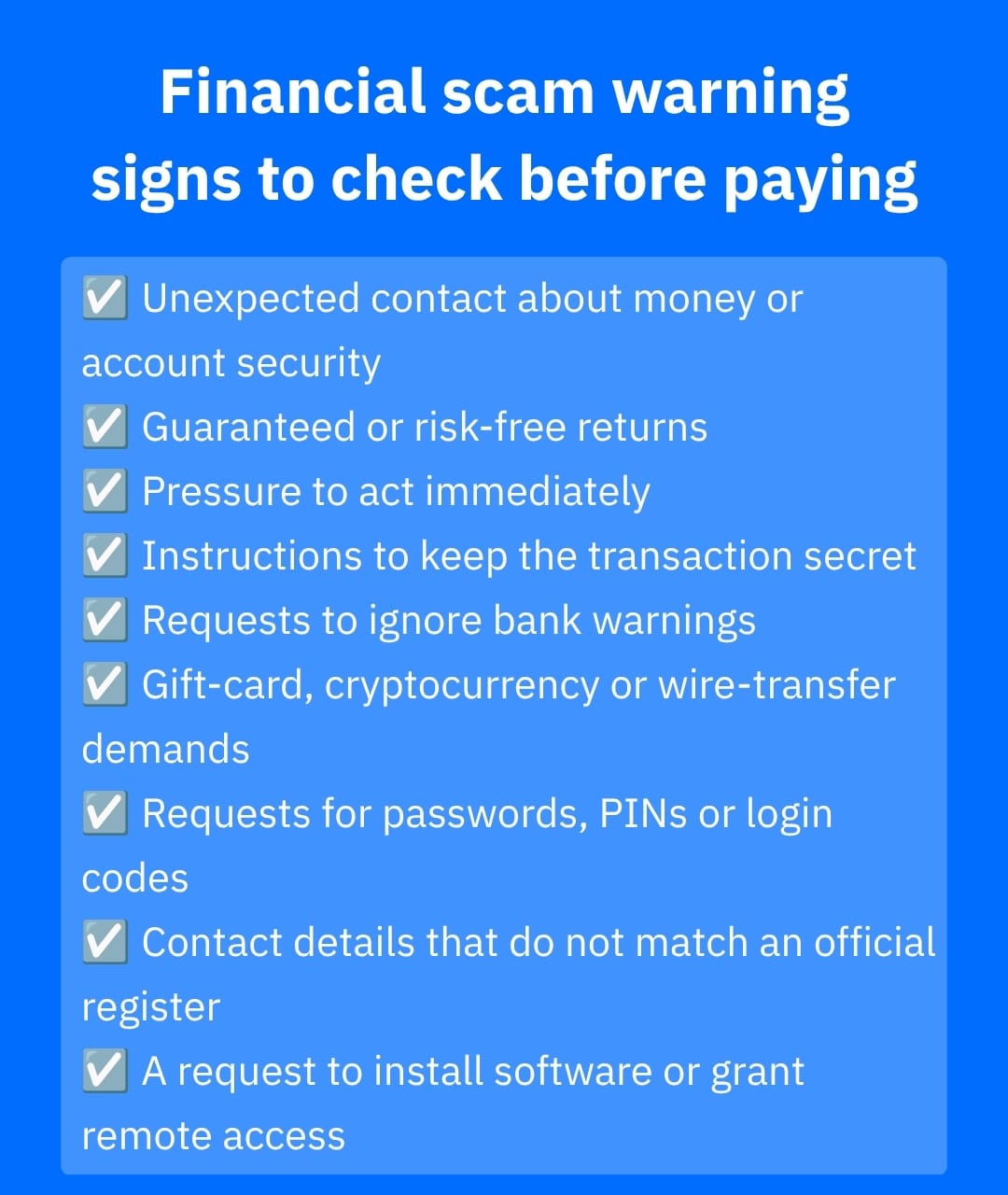
Stop when several warning signs appear:
- Unexpected contact involving money, security or an emergency
- Guaranteed profits or unusually high, “risk-free” returns
- Pressure to act quickly, keep secrets or ignore bank staff
- Payment by gift card, cryptocurrency, wire transfer, cash courier or unfamiliar app
- Requests for passwords, PINs, one-time codes or remote device access
Urgency, secrecy and demands for difficult-to-reverse payment methods are recurring scam indicators identified by the FTC, Europol and financial regulators.
Verify the claim through a channel you find yourself. Do not use the link or phone number in the message. For investments, check the national regulator and match the firm’s contact details against its official register where available.
How to protect yourself before money moves
Slow the interaction down and discuss unusual requests with someone you trust. Never move savings to a “safe account” on a caller’s instructions, and do not treat caller ID, a “verified” badge or a familiar profile as proof of identity.
Use unique passwords and multifactor authentication for email, banking and social accounts. Keep devices updated, avoid software installed at a stranger’s request and enable transaction alerts. These steps can limit damage from stolen credentials or malicious downloads.
What to do if you have paid, clicked or shared information
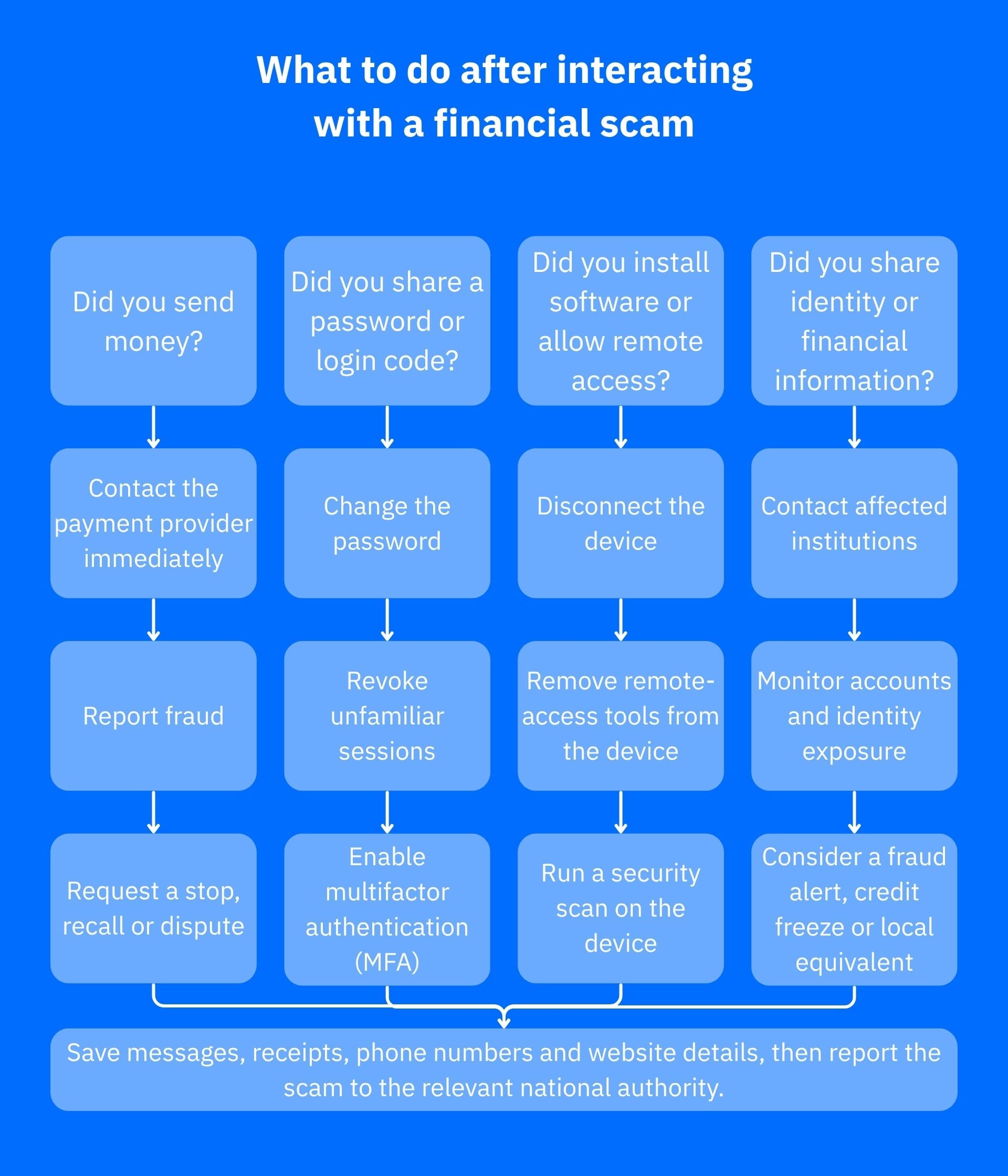
Contact the bank, card issuer, payment app, exchange, gift-card company or transfer service immediately. Report fraud and ask whether the transaction can be stopped, recalled or disputed. Recovery is not guaranteed, but speed preserves more options.
Change exposed passwords from a trusted device, revoke unfamiliar sessions and scan any device on which you installed software. Preserve messages, receipts and website details, then report the incident to your national fraud or cybercrime authority. If identity data was exposed, consider a fraud alert, credit freeze or local equivalent.
How Bitdefender can help
- Bitdefender Scamio can analyze suspicious texts, emails, social messages, links and QR codes before you engage
- Bitdefender SecurePass generates and stores unique passwords
- Bitdefender Ultimate Security combines device, scam, email, privacy, password-management and digital-identity protections; features vary by plan and market
- Bitdefender Digital Identity Protection monitors personal-data exposure on the public and dark web and provides breach alerts and remediation guidance
- Creators who depend on social accounts may find Bitdefender Security for Creators relevant for account monitoring, anti-scam email protection, device security and recovery assistance
No security product guarantees recovery of money already sent.
Conclusion
The strongest defense against financial scams is a repeatable pause-and-verify habit. Stop the conversation, confirm the story independently and contact the payment provider immediately when money or account access may be at risk.
Frequently asked questions (FAQ)
What are the common financial scams?
Common financial scams include investment and cryptocurrency fraud, bank or government impersonation, romance scams, fake jobs, online-shopping and non-delivery schemes, loan or debt-relief fraud, prize scams and account takeover. Many scams overlap, such as a stolen social account promoting fake investments.
What is a financial scammer?
A financial scammer is a person or criminal group that uses deception to obtain money, financial information, identity data or account access. They may impersonate trusted organizations, cultivate a relationship, fabricate an emergency or promise unrealistic gains.
What are 7 common types of financial crime?
Seven common categories are fraud and scams, money laundering, identity theft, bribery and corruption, embezzlement, tax evasion, and market abuse such as insider trading. Legal classifications vary, and not every financial crime targets consumers directly.
tags
Author

Vlad's love for technology and writing created rich soil for his interest in cybersecurity to sprout into a full-on passion. Before becoming a Security Analyst, he covered tech and security topics.
View all postsYou might also like
Bookmarks
