Instagram crypto scams are getting smarter and more expensive

March 24, 2026
Instagram crypto scams exploit trust, hijack social proof, and pressure users to send funds they may never recover. They can take many forms, from fake trading gurus to fictitious withdrawal fees and cloned influencer accounts. However, they’re all designed to look credible, personal – and urgent. This unholy trifecta makes them incredibly dangerous. Our guide aims to help you learn more about what they are, how they work and how to avoid them with minimal effort.
Key takeaways
- Instagram crypto scams often begin with trust-building, using polished profiles, fake testimonials, hacked accounts or direct messages specially crafted to seem personal.
- Many scams rely on fake trading dashboards, fabricated profits and repeated fee requests to keep victims paying long after the initial transfer.
- These scams are especially dangerous because they may combine financial fraud with phishing, identity theft, account compromise and wallet theft.
- The safest rule is simple: if someone contacts you on Instagram with an investment opportunity, guaranteed returns or a crypto “secret,” treat it as a scam unless proven otherwise.
Why Instagram investment and crypto scams are so dangerous
Instagram scams exist within a larger ecosystem of impersonation, phishing, financial fraud and account takeover. But Instagram crypto and investment scams deserve a spotlight because they can inflict some of the most devastating losses through:
- Credential theft
- Wallet compromise
- Phishing
- Impersonation
- Identity fraud
- Compromised Instagram accounts used to target new victims
Unlike giveaway scams or fake support messages, these schemes are often designed to extract repeated payments over time. A victim may send an initial deposit, then a verification fee, then a tax payment, then an account upgrade charge, all while believing they are getting closer to unlocking high returns. By the time the fraud becomes obvious, the financial damage may already be severe.
The danger is real— regulators and police have repeatedly warned that social media has become a major gateway to investment fraud, especially crypto scams. Instagram is increasingly attractive to scammers because it is built around trust signals that can be faked or stolen. Polished accounts, luxury aesthetics, high follower counts and a few convincing stories are usually enough to make a fraudulent operation seem legitimate.
The damage may outlast the original scam. Fraudsters can reuse exposed information for impersonation, phishing or account fraud later on, which is why identity monitoring can be relevant after an incident. Bitdefender Digital Identity Protection is designed to monitor exposed personal data across the surface web and dark web. It alerts users to breaches and helps them keep track of identity-related risks, including possible impersonation on social platforms.
Why Instagram is so attractive to scammers
Investment scams have always relied on credibility. Instagram gives scammers a convenient platform to simulate credibility with minimal effort.
A scammer doesn’t need to look like a criminal; on Instagram they can look like a trader, an entrepreneur, a crypto educator, a luxury brand ambassador or even a friend. They can borrow branding, steal photos, repost finance content and build a profile that spells trust. In some cases, they don’t even need to build credibility from scratch—they may be using a hacked account that belongs to a real person.
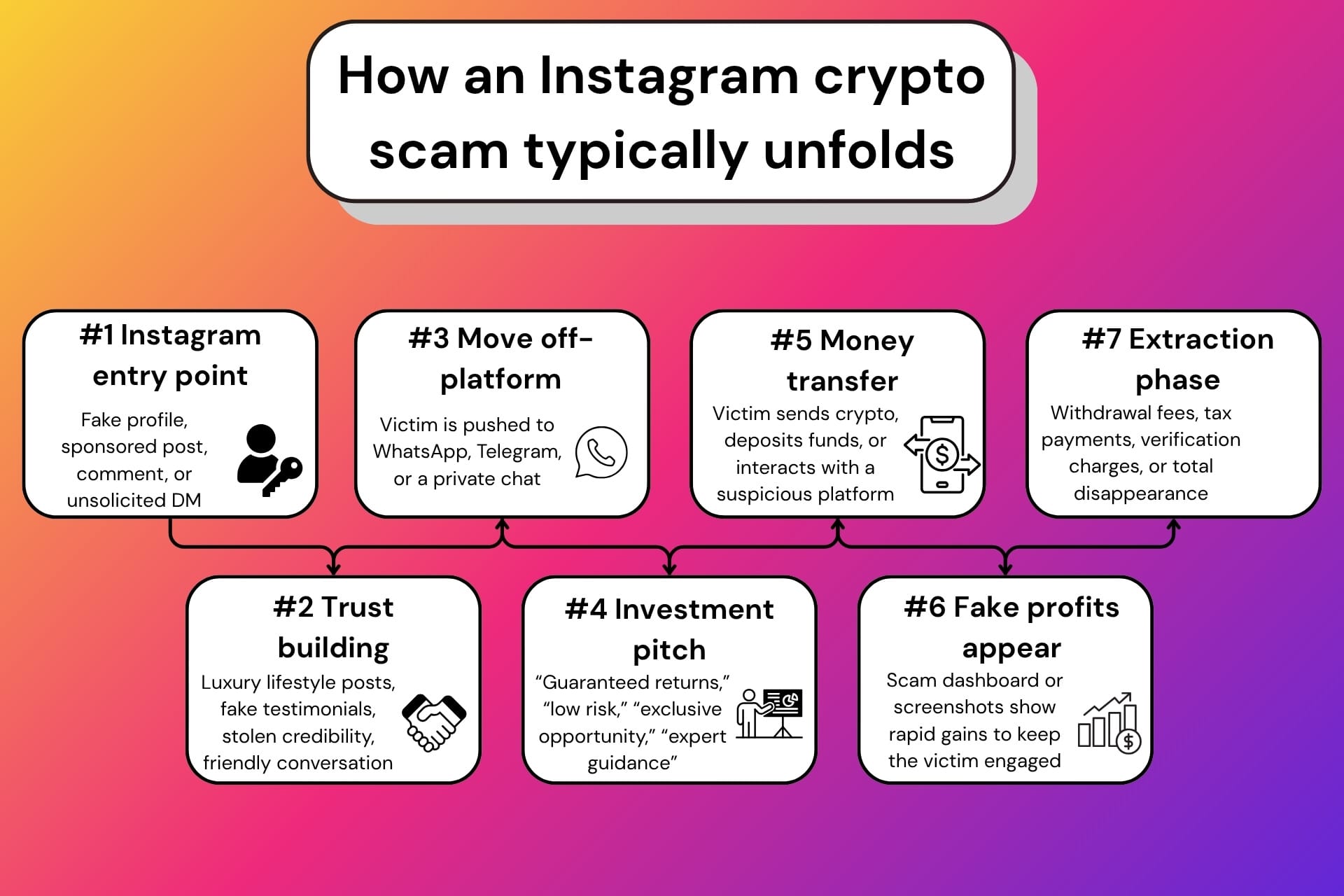
Instagram also helps scammers compress the trust-building process. In a short amount of time, a victim may see:
- Screenshots of supposed profits
- Comments from fake followers praising the service
- Video clips of “successful withdrawals”
- Story highlights with testimonials
- Lifestyle imagery meant to imply wealth and legitimacy
- Direct messages that feel friendly rather than overtly sales-driven
That combination can make an otherwise absurd pitch seem believable. It also helps explain why these scams often do not begin with a direct demand for money. Instead, they begin with familiarity, curiosity or aspiration. The sales pitch comes later.
Another factor is off-platform migration. Instagram may be the entry point, but scammers often move the real fraud to private channels such as WhatsApp, Telegram or a fraudulent trading website they control. That shift gives them more room to manipulate the victim, create a sense of urgency, and present fake investment dashboards without scrutiny.
The most common types of Instagram investment and crypto scams
There is no universal Instagram crypto scam template. Tactics vary, but the core objective is usually the same: persuade the victim to transfer funds, reveal sensitive details or interact with infrastructure controlled by the scammer.
Fake crypto mentors and trading gurus
This is one of the most recognizable Instagram crypto scams. The scammer poses as a trader, investor, mining specialist or market expert who claims they can help followers generate fast returns with little effort.
The pitch often includes claims such as:
- “Turn $500 into $5,000 in days”
- “Guaranteed daily profit”
- “No experience needed”
- “Limited slots available”
- “I’ll trade for you”
- “DM me to start earning passively”
Sometimes the fraudster poses as an independent expert. Other times, they impersonate a real investor, creator or business account. In all cases, the point is to present investing as easy, exclusive and low risk.
Relationship-driven investment grooming
Some of the most harmful scams are slower and more personal. Instead of leading with an investment pitch, the scammer first builds rapport. They may act like a new friend, an admirer or even a romantic interest. Only after establishing trust do they introduce crypto trading, a special platform or an “opportunity” they insist changed their life.
This tactic is especially manipulative because it exploits emotional trust rather than just greed. The victim may feel they are receiving advice from someone who genuinely cares about them.
Typical signs include:
- Frequent friendly conversation before money is mentioned
- Encouragement framed as concern or support
- Repeated claims that “I want to help you succeed too”
- Pressure to join a trading platform the scammer recommends
- Emotional manipulation when the victim hesitates
This type of scam can be particularly difficult for the victims to recognize because it doesn’t always feel like a fraud until much later.
Fake investment groups and chat-based ‘communities’
In this variation, Instagram acts as the top of the funnel. A profile, ad or DM invites the victim to a WhatsApp or Telegram group presented as an investment club, trading room or insider community.
Once inside, the victim sees what appears to be a thriving network of successful investors. Members share profit screenshots, celebrate wins and praise the organizer’s market predictions. But much of that activity is staged by bots or accomplices.
These groups are persuasive because they manufacture consensus. Instead of one stranger making claims, it looks like an entire community is validating the opportunity.
Common pressure tactics include:
- “Everyone else is already making money”
- “This call is only open for a short time”
- “You missed the last one, don’t miss this one”
- “Start with a small amount and scale up”
- “The admin’s signals are always accurate”
The group dynamic lowers the guard of many victims and makes it feel less like a sales pitch and more like social proof.
Pump-and-dump style token hype
Some scammers exploit Instagram’s viral mechanics to promote low-quality or obscure tokens, often suggesting that followers are getting in early on the next big opportunity. The language usually centers around urgency, insider knowledge and explosive growth potential.
This may not always look like the classic fake mentor scam. Sometimes it looks more like hype culture through:
- Countdown posts
- Aggressive reels
- Influencer-style endorsements
- “Early access” messaging
- Repeated instructions to buy before a supposed surge
In reality, the asset may be manipulated, illiquid or outright fraudulent. By the time users buy in, the people promoting it may already be preparing to sell and disappear.
Fake profits followed by withdrawal-fee fraud
This is one of the most destructive scam phases because it targets victims who believe they have already made money.
After the victim deposits funds, the scammer directs them to a fake platform or dashboard that shows rapid gains. The account balance grows, trades appear successful and everything seems to confirm that the opportunity was real.
The mask drops when the victim tries to withdraw. Suddenly, a new payment is required. The platform claims the account needs:
- A tax fee
- A withdrawal processing charge
- A compliance deposit
- An anti-money-laundering verification payment
- An account upgrade
- A minimum balance top-up
Each fee is presented as temporary and necessary to release the larger balance. But the balance is fictional, as the victim is not unlocking profits; they are simply being milked for additional payments.
Why Instagram crypto scams are so dangerous
The most obvious danger of Instagram crypto and investment scams is financial loss, but that is only the beginning. These scams are especially harmful because cryptocurrency transfers are typically difficult to reverse. Once funds are sent to a scammer-controlled wallet, recovery may be unlikely. That irreversibility makes crypto an ideal payment rail for fraudsters.
However, Instagram investment scams often create additional layers of risk:
- Victims may submit identity documents for fake KYC (know-your-customer) verification
- They may reveal passwords or one-time codes through phishing pages
- They may connect wallets to malicious services, which can be used to drain them
- They may expose personal data that can be reused in future fraud
- They may lose control of their Instagram accounts, which are then used to scam others
A compromised account adds a dangerous twist. While scammers use real accounts to post success stories, followers are more likely to trust what they see. Suddenly, the scam no longer looks like spam. It looks like a recommendation from someone familiar.
For creators and public-facing accounts, that risk is even more serious because a hijacked Instagram profile can become a scam delivery channel overnight. A solution such as Bitdefender Security for Creators can prevent this scenario by protecting social media channels, emails and devices, while monitoring creator accounts for takeover attempts and suspicious activity.
Red flags you should never ignore
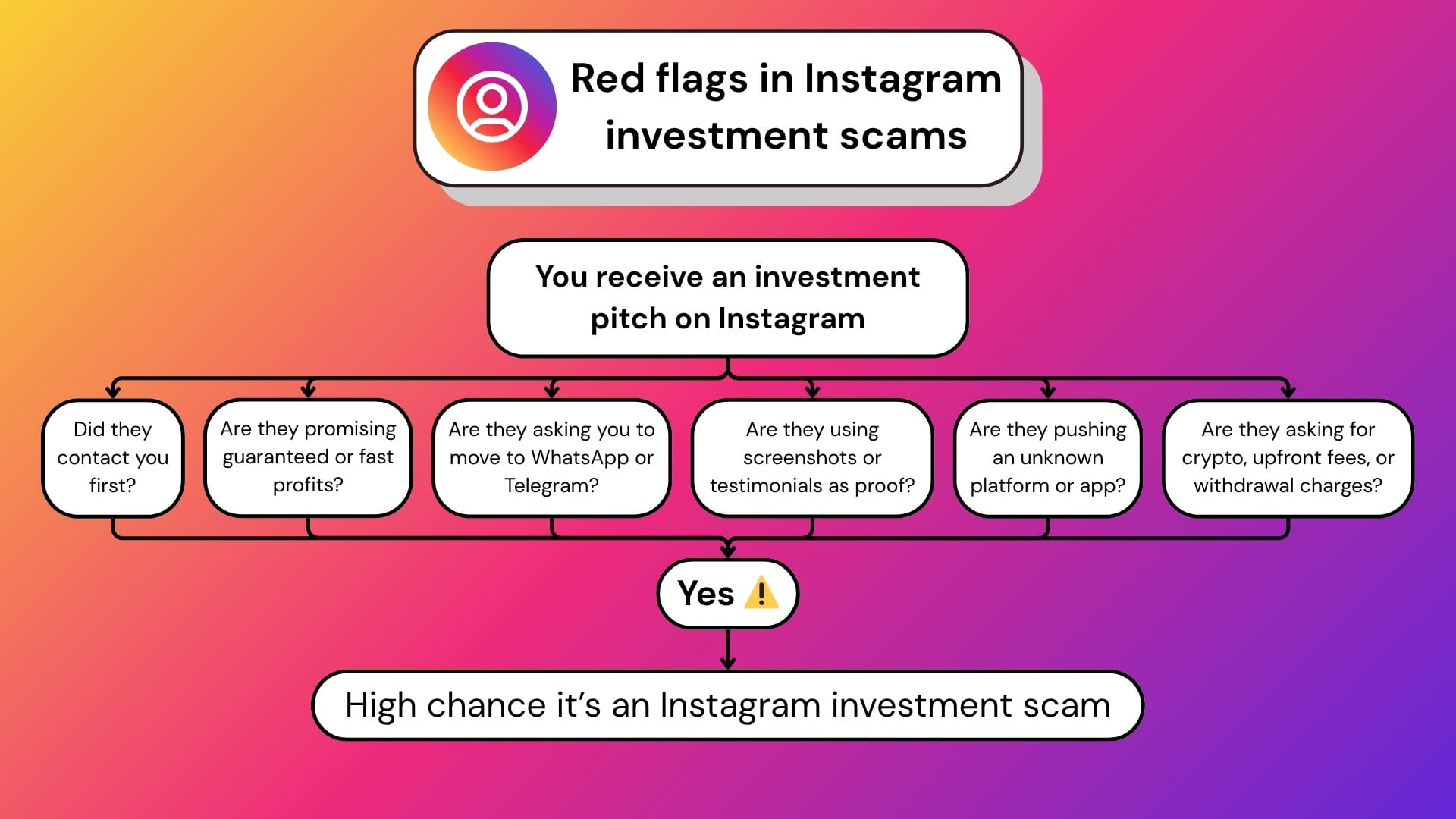
No single warning sign guarantees fraud, but certain patterns appear so consistently that they should always trigger caution.
Here’s what to watch out for:
- Unsolicited investment advice in DMs or comments
- Promises of guaranteed or unusually high returns
- Claims of low risk or “can’t lose” strategies
- Pressure to act quickly or keep the opportunity secret
- Requests to move the conversation to external platforms like WhatsApp or Telegram
- Screenshots offered as proof of earnings
- Suspicious testimonials or overly enthusiastic comment sections
- Unknown platforms, apps or wallet tools with no credible reputation
- Requests for crypto payments rather than standard regulated channels
- Demands for fees before withdrawals are allowed
- Requests for login credentials, wallet recovery phrases or verification codes
One of the clearest rules in this entire category is also the simplest: legitimate investment professionals do not need to cold-message people on Instagram promising fast profit.
What to do if you come across an Instagram crypto scam
The best response is immediate disengagement. If you’re unsure whether a crypto pitch, DM, link or screenshot is part of a scam, consulting a scam detection tool for a second opinion can help before you click or reply. Tools such as Bitdefender Scamio are designed to analyze suspicious messages, links, images, emails and QR codes, which makes them relevant in the exact moment many Instagram investment scams begin: the initial approach.
Do not argue, negotiate or keep testing the scammer to see how far it goes. The longer the interaction continues, the more material they have to manipulate you.
Take these steps instead:
- Stop replying
- Do not send money or cryptocurrency
- Do not click links or connect wallets
- Take screenshots of the profile, messages and any payment instructions
- Report the account through Instagram
- Block the account
- Warn any friend whose compromised account appears to be promoting the scam
If you have already sent money or shared sensitive information, the response should be broader. You should do the following:
- Document wallet addresses, transaction IDs, usernames and timestamps
- Contact any relevant financial institution or exchange immediately
- Change passwords associated with exposed accounts
- Enable multifactor authentication (MFA) if it is not already active
- Review active Instagram sessions and security settings
- Monitor for follow-up phishing attempts
- Report the incident to the appropriate consumer protection and cybercrime channels in your region
Victims should not be shamed for falling for these scams. Many of the scames are highly engineered, visually convincing and psychologically sophisticated to succeed. Shame only helps the scam ecosystem by discouraging reporting.
Conclusion
Instagram crypto scams thrive because they blend the language of investing with the mechanics of social engineering. They look personal, visual and aspirational, a combination that makes them harder to dismiss than a crude spam email. But underneath the luxury imagery, fake dashboards and success stories, the pattern is remarkably consistent: create trust, urgency, and fake profit, then extract as much money and data as possible.
Frequently asked questions (FAQ)
How can you tell if someone is a crypto scammer?
Watch for unsolicited DMs, guaranteed profits, pressure to act fast, requests to move to WhatsApp or Telegram and demands for crypto or upfront fees. If they ask you for your wallet phrase, login or verification code, it’s a scam.
What is the most common crypto scam?
The most common Instagram crypto scam is the classic investment fraud: fake trading or investment opportunities that show fake profits and then ask for more money. This often starts on social media and ends with withdrawal fees or vanished funds.
Can I get my money back if I get scammed on Instagram?
Sometimes, but often not fully, especially if you paid in cryptocurrency. Contact your bank, card issuer, payment app or crypto platform immediately and beware of “recovery services” asking for more money.
tags
Author

Vlad's love for technology and writing created rich soil for his interest in cybersecurity to sprout into a full-on passion. Before becoming a Security Analyst, he covered tech and security topics.
View all postsYou might also like
Bookmarks
