The Deepfake Boss Scam: How to Verify Requests Before It's Too Late

June 04, 2026

Imagine receiving an urgent video call from your CEO. The face looks familiar. The voice sounds exactly right. You’re told a confidential deal is underway and you’re asked to transfer funds immediately.
Would you question it?
As artificial intelligence advances, criminals increasingly use deepfakes and synthetic media to impersonate executives, managers, and business leaders – typically to get funds transferred to an account they control. What once required sophisticated technical expertise can now be created with readily available AI tools, making "boss impersonation" scams a growing threat for organizations of all sizes.
Key takeaways
- Deepfakes can convincingly imitate a manager's face and voice during calls, meetings, or voice messages
- Several organizations have already lost millions of dollars due to AI-powered fraud
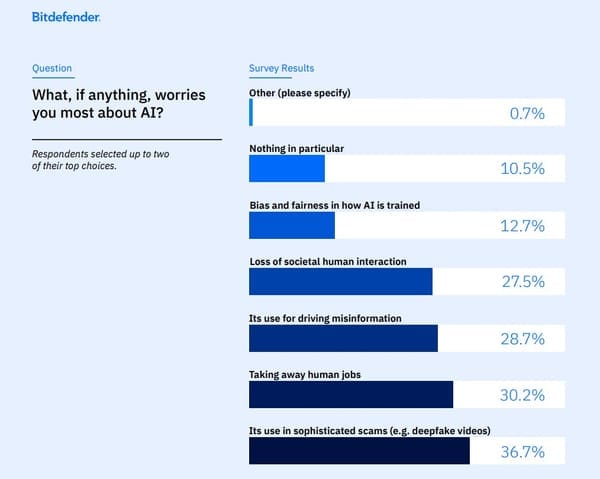
- A Bitdefender survey reveals that people are increasingly concerned about AI being weaponized to commit fraud and deception
- Verification procedures remain among the most effective defenses against deepfake-enabled attacks
What is a boss impersonation deepfake?
A boss impersonation deepfake uses artificial intelligence to mimic the appearance, voice, or mannerisms of a company executive.
Criminals may combine publicly available photos, videos, interviews, conference appearances, podcasts, and social media content to build a convincing digital clone. Once created, these synthetic identities can be used to:
- Request urgent wire transfers
- Approve fraudulent invoices
- Obtain sensitive company information
- Steal credentials
- Manipulate employees into bypassing security procedures
Unlike traditional phishing emails, deepfake scams exploit something even more powerful: trust in familiar people.
Real-world cases of executive impersonation
The threat is no longer theoretical.
The CEO-to-CEO voice clone fraud ($255,000)
In 2019, years before sophisticated video deepfakes became mainstream, criminals used AI-generated voice technology to impersonate a CEO and trick a senior employee into transferring €220,000 to a fraudulent account.
As the story went, the CEO of a UK energy firm believed he was on the phone with his boss, the chief executive of the parent company in Germany. He followed the order to immediately transfer €220,000 (approx. $255,000) to the bank account of a Hungarian supplier. According to reports, the voice matched the executive's accent and speaking style closely enough to bypass suspicion. He explained at the time that he’d recognized the subtle German accent in his boss’s voice – including the man’s “melody.”
According to Forbes, this was the first noted instance of an artificial intelligence-generated voice deepfake used in a scam.
The Singapore deepfake CFO scam ($500,000)
In 2024, a finance executive at a multinational company received a WhatsApp message from someone claiming to be the firm's CFO. The employee was invited to join a confidential video meeting about a purported business restructuring. The call appeared to include multiple senior company figures, but they were actually AI-generated impersonations. Convinced the meeting was legitimate, the executive transferred approximately 670,000 SGD (about 500,000 USD) to a local bank account controlled by the fraudsters.
The attackers even introduced a fake lawyer to the call to boost credibility. The combination of authority, urgency, and apparent consensus helped overcome the victim's skepticism.
Luckily, the funds were successfully clawed back by the Singapore Police and Hong Kong authorities.
The Hong Kong deepfake video conference scam ($25 million)
In one of the most alarming examples so far, an employee at a multinational company was tricked into transferring HK$200 million (around $25 million) after participating in a video conference populated entirely by AI-generated versions of senior executives and colleagues.
According to reports, the employee initially suspected a phishing attempt. However, those concerns disappeared after joining the meeting and seeing what appeared to be multiple trusted coworkers and company leaders. The participants were actually deepfake recreations.
Why people fall for these scams
Many people assume they would immediately recognize a fake. In reality, deepfake-enabled fraud often succeeds because attackers carefully engineer situations that discourage scrutiny.
Common tactics include:
Creating urgency
Attackers frequently claim that a transaction, acquisition, legal matter, or customer issue requires immediate action.
When employees feel pressured, they are less likely to verify requests through normal channels.
Leveraging authority
People naturally trust instructions from senior leadership.
When an apparent CEO or manager asks for help, employees may hesitate to challenge the request.
Exploiting remote work
Remote and hybrid work environments have increased reliance on video calls, messaging platforms, and virtual communication.
This creates more opportunities for criminals to insert synthetic content into everyday business interactions.
Gathering public information
Executives often maintain a strong online presence through interviews, keynote speeches, webinars, podcasts, and social media.
Ironically, the very content that helps leaders connect with audiences can also provide criminals with material to train AI models.
The challenge of AI-generated deception
Modern AI tools can now produce videos, voice clones, and synthetic images that are increasingly difficult for viewers to spot. While many creators use these technologies for editing, visual effects, or creative storytelling, the same tools can also be used to create deepfakes, impersonations, and misleading content.
In the 2025 Bitdefender Consumer Cybersecurity Survey, consumers in seven countries stated loud and clear that they are concerned about AI being weaponized to commit fraud and deception.
While AI promises incredible advances, 37% of respondents rates its use in sophisticated scams (e.g., deepfake videos) as their top concern — above job loss and misinformation.
Warning signs of a deepfake boss scam
While deepfakes continue to improve, they still often leave clues.
Watch for:
- Unexpected requests involving money or sensitive information
- Pressure to bypass normal approval processes
- Demands for secrecy
- Slightly unnatural speech patterns or unusual phrasing
- Delays between lip movements and speech
- Unusual video artifacts or distorted facial expressions
- Requests that contradict established company procedures
Most importantly, treat unusual requests as suspicious regardless of who appears to be making them.
How organizations can protect themselves
Establish verification procedures
Organizations should require secondary verification for high-risk actions such as:
- Wire transfers
- Vendor payment changes
- Payroll updates
- Sensitive data access requests
Verification should occur through an independent communication channel.
For example, if a request arrives during a video call, employees should confirm it through a separate phone call, messaging platform, or established approval workflow.
Train employees about deepfakes
Many workers remain unaware of how realistic AI-generated content has become.
Regular awareness training can help employees recognize manipulation techniques and respond appropriately.
Limit public exposure where appropriate
Executives should remain visible and accessible, but organizations should understand that threat actors might use publicly available videos and audio recordings.
Security teams should assess the risks associated with publicly shared content and develop appropriate guidance.
Strengthen approval workflows
No single individual should be able to authorize large financial transactions without additional oversight.
Multi-person approval processes create friction that can stop fraud before money leaves the organization.
Encourage employees to challenge unusual requests
Employees should never fear they could be berated for taking the time to verify instructions, even when they appear to come from senior leadership.
A culture that prioritizes verification over blind obedience can significantly reduce risk.
Bottom line
If you receive an urgent request from a manager, executive, or colleague involving money, sensitive data, or account access:
- Pause before taking action.
- Verify the request through a separate communication channel.
- Follow established company procedures.
- Report suspicious communications to your security team.
- Never bypass approval processes, even under pressure.
In everyday scenarios, deepfake detection technology is becoming increasingly important as synthetic media becomes more realistic and harder to spot with the naked eye. But don’t rely on a single signal. Human judgment, context, behavioral clues, and technical detection all work better when they’re matched up with each other.
You may also want to read:
Common Deepfake Red Flags Everyone Should Know About
FBI Warns Fans About FIFA Scams Ahead of 2026 World Cup
Instagram Impersonation Scams: Fake Brands, Businesses and Support Accounts
tags
Author

Filip has 17 years of experience in technology journalism. In recent years, he has focused on cybersecurity in his role as a Security Analyst at Bitdefender.
View all postsYou might also like
Bookmarks
