Common deepfake red flags everyone should know about

June 03, 2026
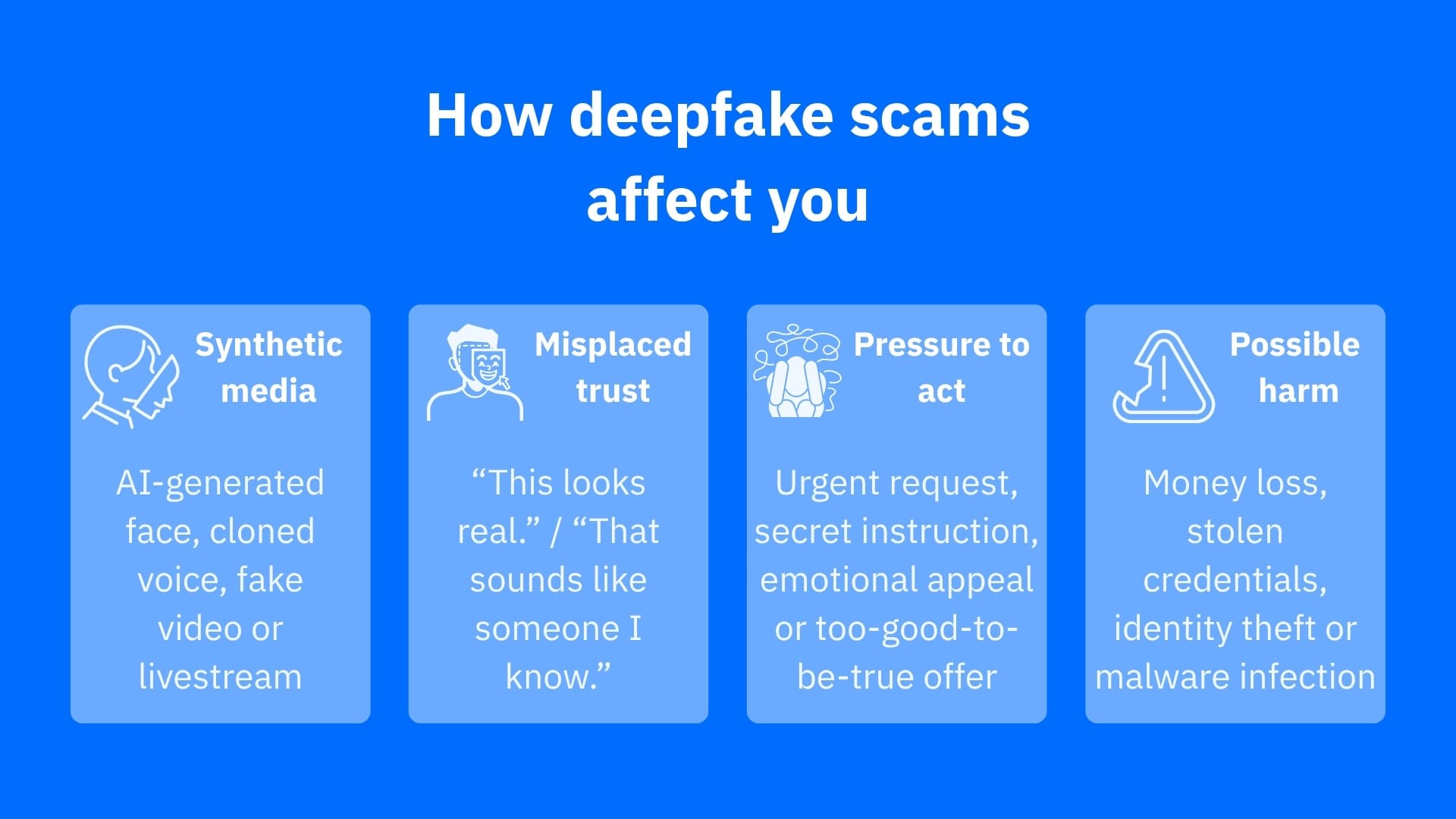
Gone are the days when deepfakes were just strange celebrity videos or internet curiosities. Scammers now use AI-generated faces, cloned voices, fake livestreams and synthetic endorsements to trick people with their disturbingly real feel.
Key takeaways
- Deepfake red flags are often visual, audio and behavioral, from strange lip-syncing to urgent requests for money or personal information.
- AI-generated video and voice scams are becoming more convincing, making it harder for consumers to rely only on what they see or hear.
- The best way to spot a deepfake is to examine context, not just appearance, because high-quality synthetic media may not show obvious glitches.
- If a video, voice note or livestream pressures you to act fast, verify the person or claim through another trusted channel before interacting.
Why deepfake awareness is important
For years, deepfakes were treated as a futuristic threat and not something people expected to encounter in everyday life. That has changed. AI tools now generate realistic faces, imitate voices, alter videos and create convincing synthetic content with far less effort than before.
For regular internet users, the risk is not limited to fake celebrity clips or political misinformation. Deepfakes can appear in scams involving fake investment opportunities, romance fraud, account takeovers, bogus customer support, job scams, family emergency scams, fake product endorsements or impersonation attempts.
This is why deepfake awareness needs to become part of everyday cybersecurity hygiene. Just as people learned to question suspicious links and phishing emails, they now need to question suspicious media. A video, livestream, audio recording or even a voice call can look or sound convincing and still be part of a scam.
Visual deepfake red flags
Visual flaws are the warning signs most people think of first. They can still help, especially when the video is low quality or generated with cheaper tools.
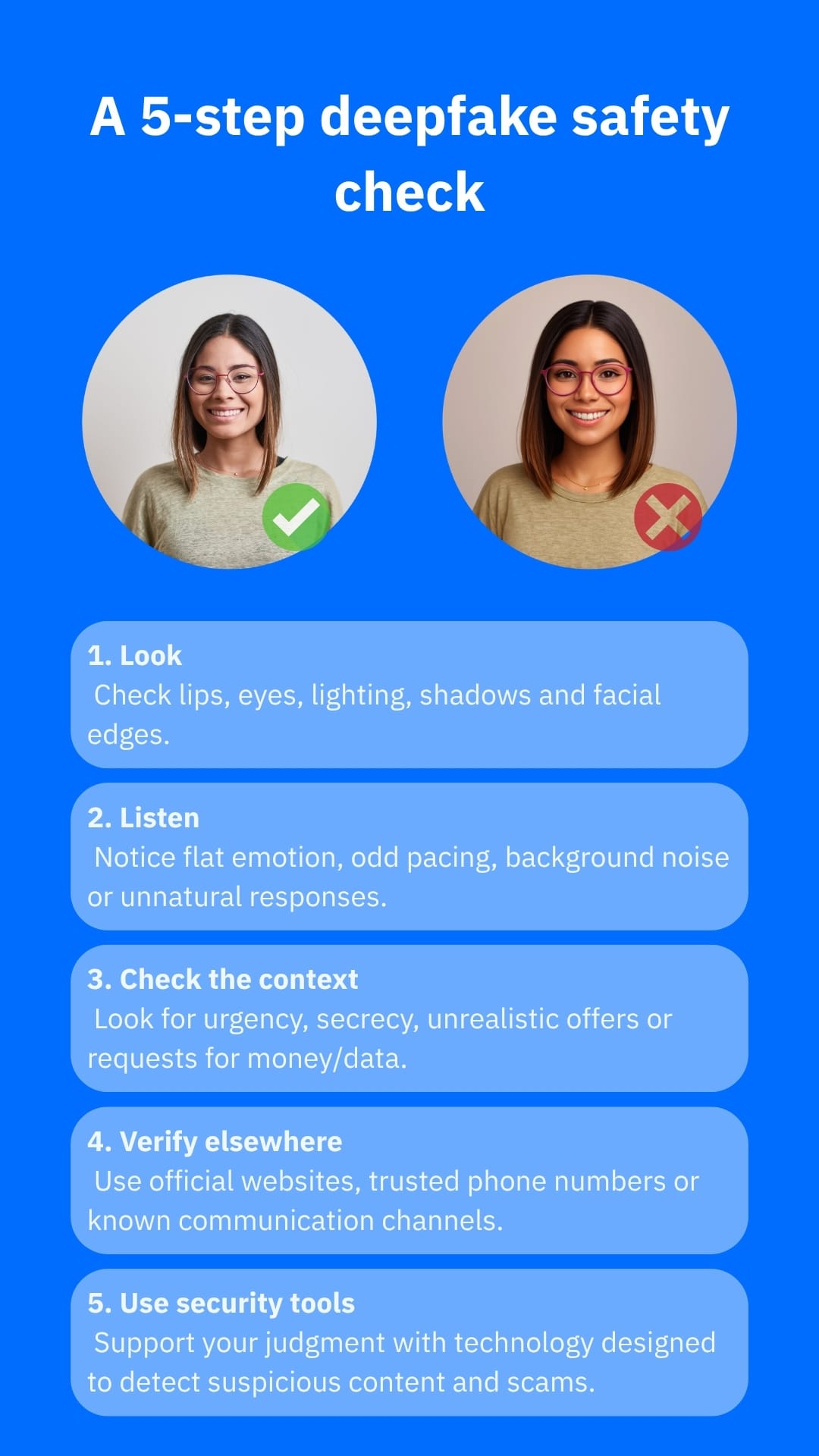
Look closely at the face. The mouth may not fully match the words, teeth may be blurred, and facial expressions may feel slightly delayed or unnatural. The eyes can also look wrong: strange blinking, an unfocused gaze, odd reflections in the pupils or a lack of natural micro-expressions. A common indicator is that a deepfake character’s eyes may feel dead or have that “uncanny valley” feeling.
Lighting is another useful clue. A person’s face may be lit differently from their surroundings. Shadows may fall in the wrong direction, glasses may reflect light strangely, or the edges of the face may shimmer when the person turns their head.
Common visual deepfake red flags include:
- Lip movement that doesn’t match the audio naturally
- Blurry teeth, hairlines, ears, hands or jewelry
- Skin that looks too smooth, waxy or inconsistent
- Face edges that flicker during movement
- Odd blinking, gaze or facial expressions
- Lighting or shadows that do not match the background
These clues are useful, but not foolproof. High-quality deepfakes may avoid many obvious mistakes. That is why consumers should treat visual analysis as only one part of the verification process.
Audio deepfake warning signs
Voice cloning is one of the most concerning deepfake risks because it can give scams a feeling of urgency. A victim may receive a call from someone who sounds like a child, parent, friend, colleague, manager, or romantic partner asking for help.
Audio deepfake warning signs can include a voice that sounds slightly flat, robotic, breathless or emotionally mismatched. The speaker may avoid spontaneous conversation, repeat certain phrases, interrupt awkwardly or refuse to answer personal questions. Some scammers add background noise to hide imperfections.
Still, cloned voices can be convincing. A familiar voice can bypass skepticism because it feels trustworthy, which is why the safest response is not to listen harder, but to verify separately. Hang up and call the person back using a number you already trust. Families can also choose a private safe phrase for emergencies.
Behavioral red flags more relevant than visual artifacts
Visual flaws may not give away deepfake scams, but the story built around them can. Scammers use urgency, authority, fear, greed or emotional pressure to push people into fast decisions.
A video or voice message should raise suspicion if it asks you to:
- Send money, cryptocurrency or gift cards
- Click a shortened or unfamiliar link
- Download an app, file or remote-access tool
- Share login codes, banking details or ID documents
- Keep the conversation secret
- Act immediately before an opportunity disappears
These are classic social engineering tactics—now backed by synthetic media. The deepfake is not always the entire scam. Often, it’s the trust-building layer that makes the scam more believable. Some examples of deepfake scams include:
- A fake executive video making a payment request
- A cloned relative’s voice in emergency scams
- A synthetic celebrity endorsement in fraudulent investment scams
A common misconception is that red flags are those that make the media look fake, but in reality, they indicate whether the media is being used to make you do something risky.
Deepfake red flags in accounts, messages and claims
Deepfakes often appear inside a broader fake identity or manipulated narrative. The media environment, including the originating account, message, or claim, may reveal the fraud before the media itself does.
Check the profile or sender for questionable behavior, such as limited history, inconsistent details, copied images, recent name changes, poor grammar, suspicious links or unusually aggressive messaging. Be cautious when a person or brand suddenly contacts you from a new account, especially if they claim there is an emergency, special offer, account problem, job opportunity, financial opportunity, or anything else that may make you act hastily.
Also pay attention to where the conversation is going. Scammers often try to move people away from public platforms and into private channels where there is less visibility and fewer protections. They may also discourage you from speaking to others, comparing sources or taking time to think.
How to verify suspicious video or audio
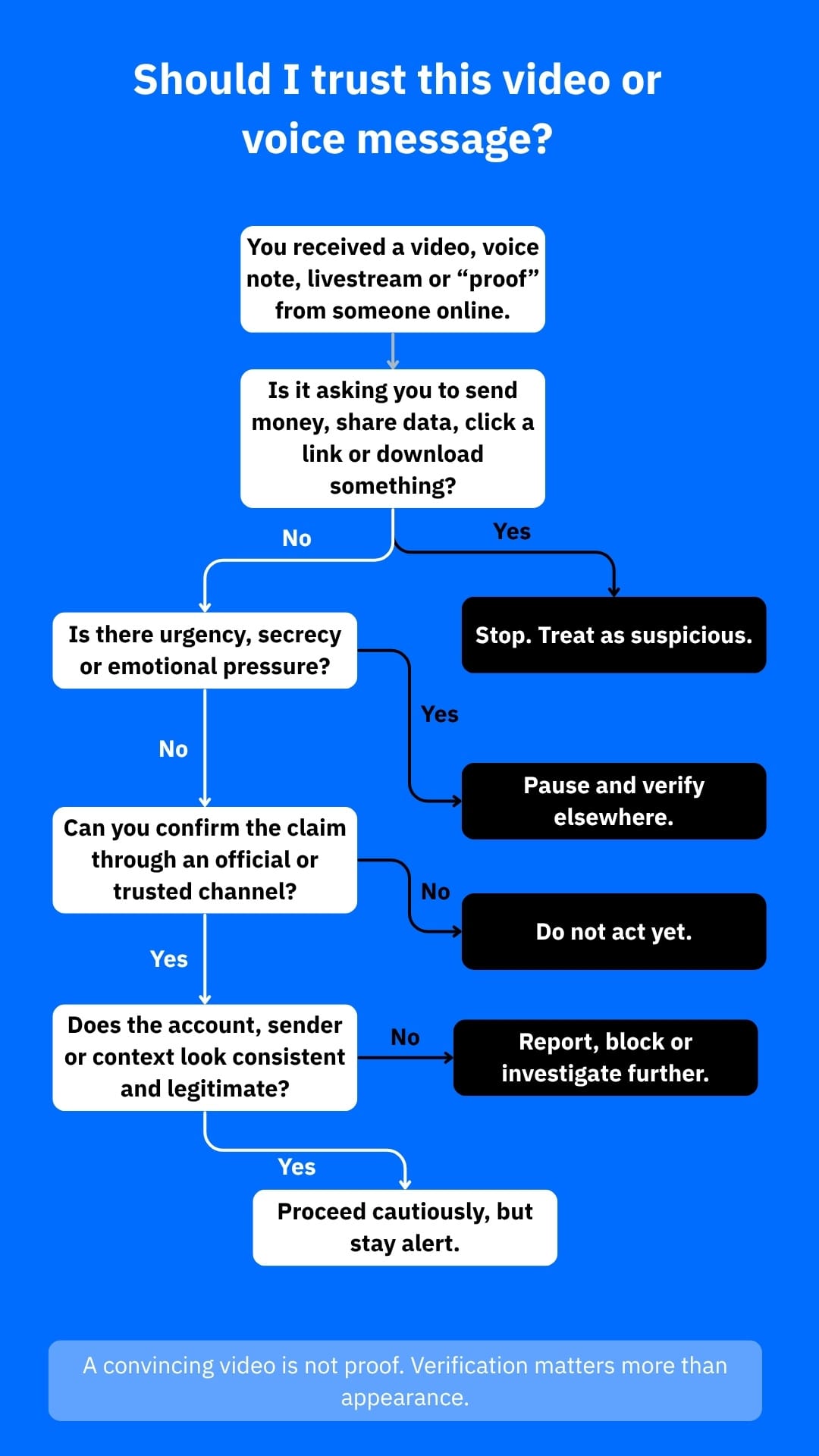
When something feels off, slow the interaction down. Scammers rely on speed because careful verification often shatters the illusion.
Search for the same claim on official websites, verified accounts and reputable sources. Do not use contact details provided in the suspicious message. Go directly to the person, company or organization through a trusted channel.
For personal requests, use a known phone number, a previously established communication channel or a private verification question. For business-related requests, confirm through internal procedures, especially when money transfers, account access or sensitive documents are involved.
You can also look for signs that the media has been recycled or manipulated. Search for screenshots, unusual phrases or the main claim. If a celebrity, executive or public figure appears to endorse something surprising, check whether the same endorsement appears on their official channels.
The rule is simple: if a video or voice message changes what you are about to do with your money, accounts or personal information, step back and verify it outside that conversation.
A keen eye is often not enough
Deepfake detection technology is increasingly important, especially as synthetic media becomes more realistic and harder to judge with the naked eye. But consumers should not rely on singular signals. Human judgment, account context, behavioral clues and technical detection all work better when they’re matched up with each other.
That’s why deepfake education is crucial nowadays. People need to understand the warning signs before they are pressured into a risky decision. Knowing what to look for helps consumers pause and verify before trusting what appears on screen.
Conclusion
Deepfake red flags are no longer limited to strange faces and awkward blinking. The most important warning signs now include the context around the media: urgency, secrecy, emotional pressure, suspicious links, fake endorsements and requests for money or sensitive data.
As AI-generated scams become more convincing, consumers need a stronger verification reflex. Pause before trusting a video. Question the account sharing it. Confirm the claim through another channel. In a world where seeing and hearing are no longer enough, skepticism morphs into basic digital self-defense.
Frequently asked questions (FAQ)
What are the red flags for deepfakes?
The main red flags for deepfakes include unnatural lip movement, strange blinking, blurry facial edges, inconsistent lighting, robotic or emotionally flat audio, and a message that pressures you to act quickly. However, the biggest warning sign is often contextual: any media, whether video or audio, that asks for money or personal data should always be verified separately.
Which is a red flag for deepfake documentation?
A red flag for deepfake documentation is inconsistency between the document, image, video or profile presenting it. Watch for mismatched names, odd fonts, distorted faces, unnatural shadows, blurred ID details, suspicious screenshots, or “proof” that only appears inside a private chat. If documentation is used to pressure you into trusting something, verify it through an official source.
How to tell if someone is using deepfakes?
You can tell that someone may be using deepfakes if they avoid live, spontaneous interaction, send only short video clips or voice notes, refuse to answer personal verification questions, or use media to support an urgent request. The safest method is to verify their identity through another trusted channel, such as calling a known number, checking an official account, or asking for a real-time confirmation that cannot be easily scripted.
tags
Author

Vlad's love for technology and writing created rich soil for his interest in cybersecurity to sprout into a full-on passion. Before becoming a Security Analyst, he covered tech and security topics.
View all postsYou might also like
Bookmarks
