Virtual knife, real lawsuit: Counter-Strike skin dispute ends in court

May 29, 2026
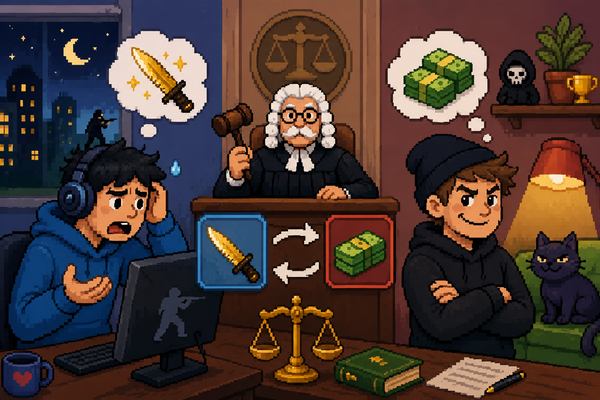
A dispute over a virtual knife skin in Counter-Strike has resulted in a court ruling in Sweden, highlighting how digital items can trigger real-world legal consequences.
The Sundsvall District Court ordered a seller to repay approximately $2,300 after failing to honor an agreement to buy back a valuable in-game knife skin. The case, centered on a transaction involving a Counter-Strike cosmetic item, raises questions about the legal status of virtual assets worth thousands of dollars.
Key takeaways
· A Swedish court ruled in favor of a Counter-Strike player seeking reimbursement for a virtual knife skin.
· The skin was originally sold for about $2,300.
· The seller later agreed to repurchase the item but allegedly failed to return the money.
· Court evidence included Messenger conversations and transaction records.
· The ruling demonstrates that agreements involving digital game items can be legally enforceable.
What happened in the Counter-Strike knife dispute?
It all started in December 2024 when one player purchased a Counter-Strike knife skin for 25,000 SEK from another.
After completing the transaction, the buyer reportedly discovered that the knife was a less desirable variant than expected. While the item remained genuine, its specific attributes made it harder to sell on the secondary market.
According to court documents cited by SVT Nyheter, the seller later agreed to buy the skin back at the original purchase price. The buyer transferred the virtual knife back to the seller, expecting a full refund but the money never arrived.
Instead, the buyer claimed that the seller blocked communication and failed to return the agreed amount, triggering a legal dispute.
Why did the case end up in court?
The disagreement centered on whether a binding buyback agreement existed. The buyer argued that both parties had agreed to reverse the transaction and that he had fulfilled his part of the arrangement by returning the digital item. The seller disputed the claim.
As the disagreement escalated, the matter moved to the Sundsvall District Court, where judges reviewed evidence, including social media messages and payment records.
The court’s task was not to determine whether the skin had value. Instead, judges focused on whether the parties had entered into a valid agreement and whether either side failed to fulfill its obligations.
How did the court reach its decision?
The court examined Messenger conversations and transaction data presented by both parties. Judges concluded that enough evidence existed to show that the seller had agreed to repurchase the knife skin.
Because the buyer returned the virtual item while the seller failed to make the promised payment, the court ruled that the seller breached the agreement.
The decision effectively treated the transaction like any other contractual agreement involving valuable property.
Why virtual items have real-world value
Counter-Strike skins have evolved far beyond cosmetic game accessories. Rare knives, gloves, weapon finishes, and stickers often sell for hundreds, thousands, or even tens of thousands of dollars on third-party marketplaces.
Some rare Counter-Strike skins have sold for six-figure sums, transforming digital cosmetics into highly valuable virtual assets. These items are also prime targets for criminals, who use the perceived values of digital items in massive scamming campaigns.
Often, such scams follow similar paths like in this suit, especially since there’s a massive skin industry focused on tricking people.
FAQ
Can a virtual game item be the subject of a lawsuit?
Answer: Yes. Courts can enforce agreements involving virtual items when parties enter valid contracts and enough evidence exists to prove the agreement.
How much was the Counter-Strike knife worth?
Answer: The knife skin sold for 25,000 Swedish kronor, equivalent to roughly $2,300 at the time of the dispute.
Why are Counter-Strike skins so expensive?
Answer: Prices depend on rarity, demand, visual appearance, pattern variations, and collector interest. Some skins trade for tens of thousands of dollars.
Did the court recognize ownership of the skin?
Answer: The court primarily focused on the buyback agreement between the parties rather than broader questions of digital ownership.
Are skin trading scams common?
Answer: Yes. Fraud involving account theft, fake marketplaces, impersonation, and payment disputes remains a significant risk within virtual item trading communities.
tags
Author

Silviu is a seasoned writer who followed the technology world for almost two decades, covering topics ranging from software to hardware and everything in between.
View all postsYou might also like
Bookmarks
