Instagram romance scams and red flags you should never ignore

April 21, 2026
Instagram was built for connection, discovery and polished self-presentation, making it a lucrative environment for romance scammers. A romance scam that starts on Instagram rarely looks like a traditional cyberthreat. It often starts with a follow, a reaction to a Story or a flattering direct message (DM) from someone who seems attractive, attentive or simply interested. Behind the charm, though, often lies a playbook designed to build trust fast enough to isolate the target and turn their affection into money or personal data. Romance scammers regularly use social platforms such as Instagram then steer victims into private conversations on different platforms, where manipulation becomes harder to detect.
Key takeaways
- Instagram romance scams often start innocently, with a follow, a Story reply or a flattering DM, before escalating into emotional manipulation and financial fraud
- Scammers exploit trust and urgency, often prompting victims to move conversations off Instagram and inventing excuses to ask for money, crypto or personal information
- Romance scams are especially dangerous because they blend emotion with deception, making victims more likely to ignore red flags and continue engaging even after warning signs appear
- The biggest red flags are quick emotional escalation, refusal to meet, secrecy and any request involving money or investments
Why Instagram turned into a launchpad for romance scams
Instagram romance scammers need three things to succeed: access, appearance and context.
Access is easy because Instagram has a plethora of tools scammers can use to reach their targets, including DMs, follows, comments, replies and Story interactions.
Appearance also matters because scammers can exploit it to build highly curated fake personas, most of the time using stolen or AI-generated photos. Criminals now use generative AI to create believable social media profiles and supporting images for romance and confidence schemes.
For context, public posts, captions and Stories can reveal emotional vulnerabilities, lifestyle aspirations, relationship status, travel plans or recent life changes that scammers can mirror back in conversations.
These three elements combine into a scam that feels personal from the very start. Instead of a crude pitch, the victim experiences what looks like chemistry.
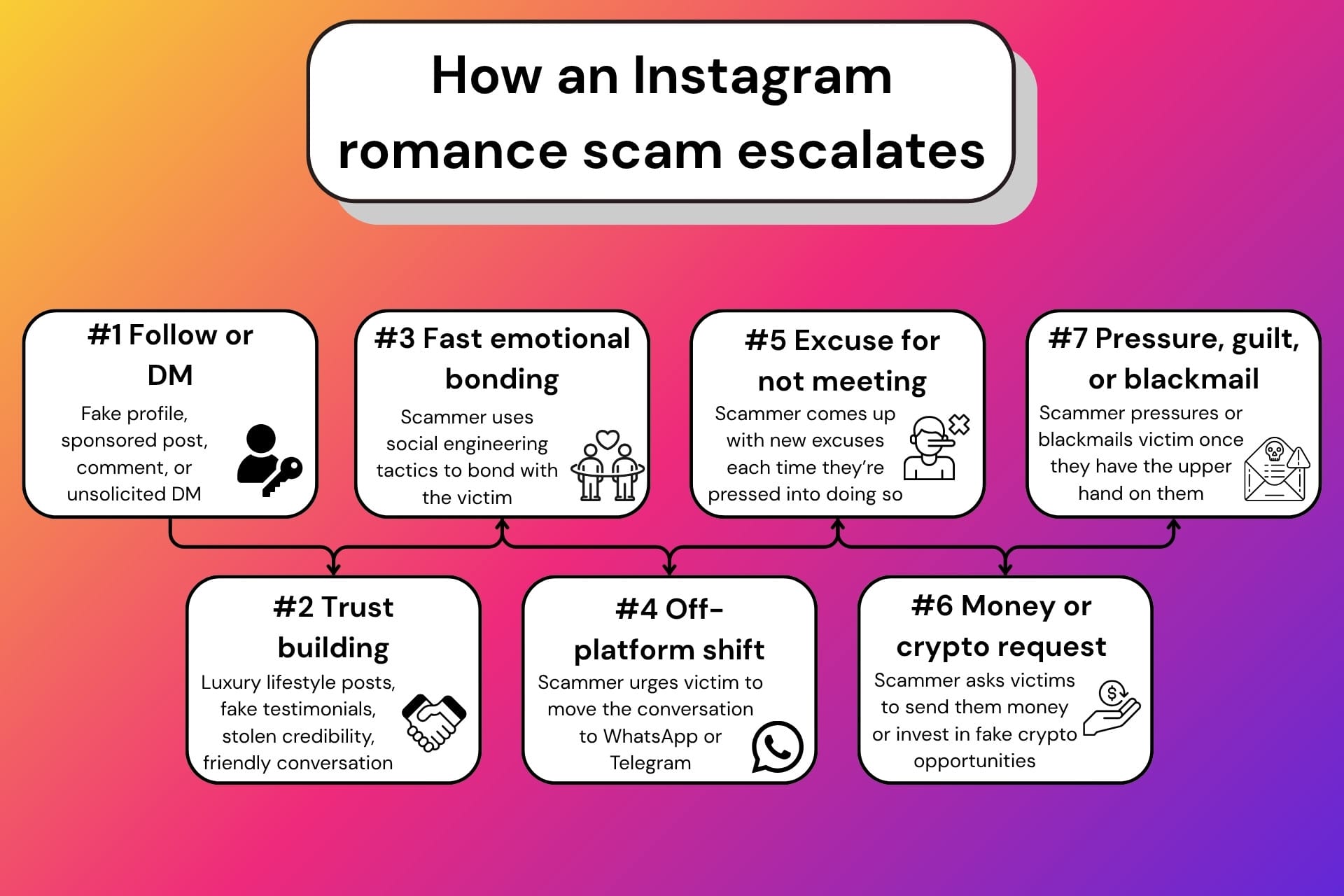
Common Instagram romance scam patterns
It’s worth mentioning that not every Instagram romance scam looks the same. Some stick to the classic emotional-fraud script, while others merge romance with impersonation or fake investing.
Love bombing
One of the most common patterns in Instagram romance scams is the love-bombing stranger. The scammer sends an unsolicited message, quickly becomes attentive and pushes emotional intimacy early. The FTC notes that romance scammers often communicate several times a day to build trust before introducing a money problem.
‘Can’t meet in person’ trope
Another major pattern is the “can’t-meet-in-person” persona. The FBI and FTC both describe recurring cover stories, where the scammer claims to be overseas, in the military, on a work assignment or otherwise unable to meet.
These stories are useful because they explain distance while setting up later requests for money tied to travel, illness, legal trouble or emergencies.
Romance-turned investment opportunity
A newer and especially dangerous variant is the romance-to-investment crossover. In this scenario, attackers say they want to help the victim build wealth instead of asking for rent money or airfare. The proposition often comes through crypto.
The FTC has explicitly warned that some romance scammers pivot to cryptocurrency “investment” pitches after establishing trust.
Military, celebrity and fake matchmaking agencies
Meta’s own 2025 scam write-up highlights patterns involving military impersonation, celebrity impersonation and fake matchmaking agencies operation across Instagram and other platforms.
In those cases, victims may be steered toward WhatsApp, Telegram, Signal or similar apps and then asked for gift cards, wire transfers, crypto or fees for access, travel or supposed relationship logistics.
Why Instagram romance scams are so dangerous
You may think financial damage is the only part of the story; you’d be wrong. Romance scams are among the costliest fraud categories on a per-person basis, which reflects how effective emotional grooming can be. Aside from making transactions, victims are responding to what they believe is a relationship. That emotional dependency can cause them to ignore contradictions, defend the scammer to friends (or keep them a secret), or even keep paying after the first loss.
These scams can also expand into other forms of harm. If an online contact asks to use your bank account, you may be getting pulled into money laundering or related fraud. Romance scams can also lead to sextortion and blackmail, especially when intimacy, secrecy and compromising content are involved.
According to the FTC, romance scams account for the second-highest amount of losses on social media, after investment scams. And in the first half of 2023, half of people who reported losing money to an online romance scam said it began on Facebook, Instagram or Snapchat.
Red flags you should never ignore
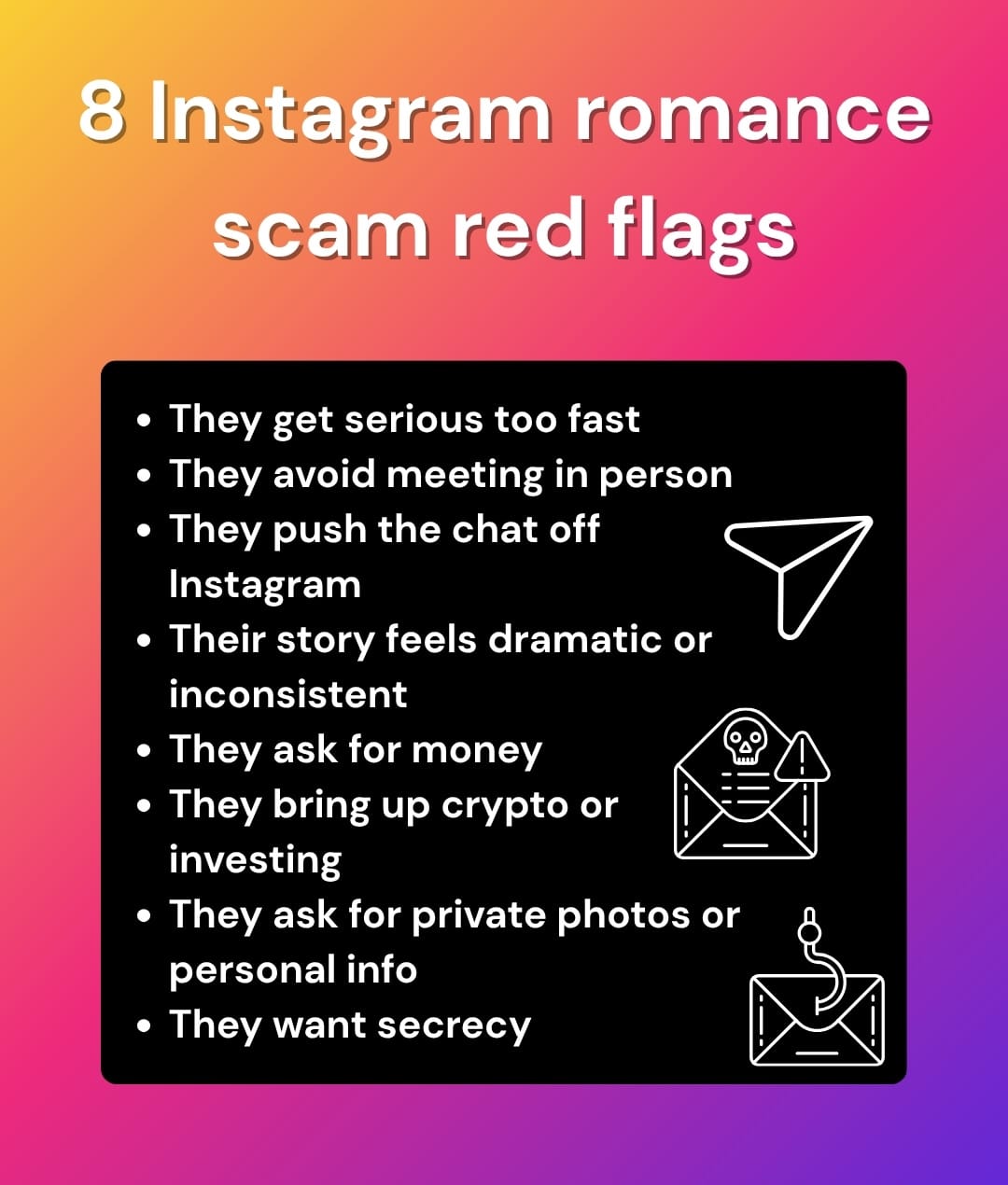
Although scammers have a comprehensive toolbelt of malicious tactics, you don’t need to memorize every scam script. Recognizing recurring signals is far more effective. These include:
- The relationship escalates unusually fast
- The person avoids meeting in real life or always has a reason to cancel
- They want to move the conversation off Instagram quickly
- Their life story sounds glamorous, dramatic or strangely optimized for sympathy
- They ask for money, crypto, gift cards or “help” with payments
- They claim they can teach you to invest or help you make easy returns
- They ask for bank details, identity documents or intimate images
- They pressure you to keep the relationship secret
How to protect yourself from Instagram romance scams
Although a zero-trust approach would be the most effective, the goal is not to lean into paranoia and distrust everyone online by default. When they want speed, slow down instead—it’s a far more sensible approach.
Keep early conversations on-platform for longer instead of rushing to encrypted or secondary apps. Be skeptical of profiles that look very polished but feel thin on authentic interaction. It can still help to reverse-image search profile photos, although AI-generated images make visual checks less reliable than before. Most importantly, treat any request involving money, crypto, banking or secrecy as a hard stop. Never send money to someone you have not met in person.
Instagram users should also review privacy settings and limit how much personal information is visible to strangers. Tightening social media visibility and being cautious when someone rushes a friendship or romance is also a good idea.
Meta implemented warnings and restrictions on suspicious accounts and took down romance-scam-linked accounts and pages in the past few years. While those protections come in handy, they are not enough on their own, as users must be able to recognize patterns of manipulation to steer clear of scams.
What to do if you have fallen for an Instagram romance scam
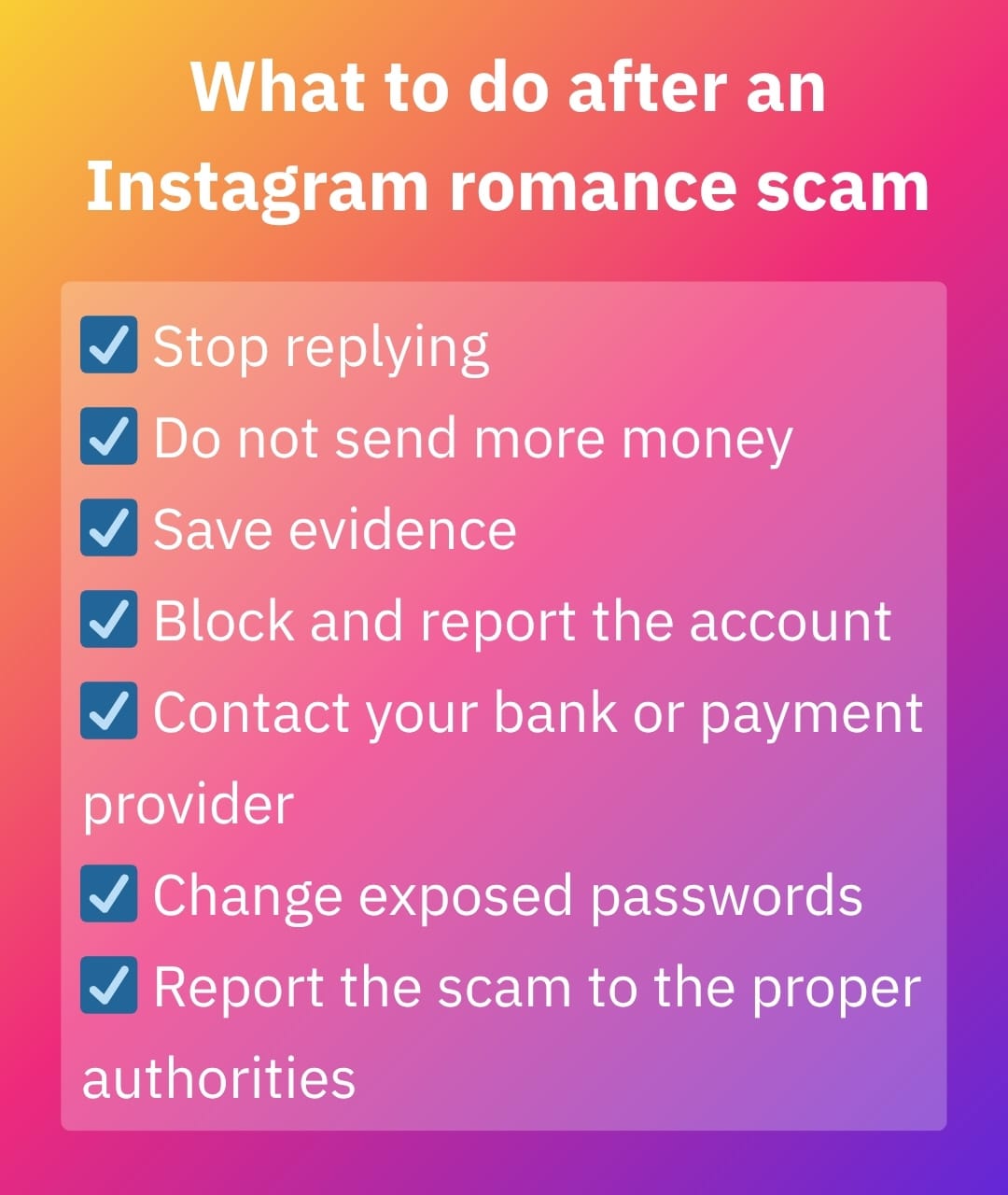
Stop sending money immediately. If you have already made transactions to the scammer, check it you can reverse payments. Do not send “one last payment’ to recover prior losses or give in to blackmail. Save the messages, usernames, payment details and any linked phone numbers or wallet addresses. Block and report the account on Instagram.
If any money was sent, contact your bank, payment service or crypto exchange right away. They might not be able to recover your funds, but they could block or identify the scammer’s accounts. Report the incident to relevant authorities (e.g., the FTC, FBI’s IC3). If intimate images or blackmail are involved, preserve evidence and seek help quickly rather than negotiating with the scammer.
Tools that can reduce your risk
Good judgment is still your first line of defense, but dedicated security tools can add useful layers of protection when an Instagram interaction starts to feel off.
- Bitdefender Scamio can be a practical first stop when you’re unsure whether a message, link, screenshot or supposed romantic approach is legitimate. Our free, AI-powered scam detector can help you check suspicious content without having to install anything.
- Bitdefender Digital Identity Protection can also come in handy, as scammers rarely stop at emotional manipulation. They may also exploit exposed personal data, impersonate victims or use breach-linked information to make fake personas sound more convincing. Bitdefender Digital Identity Protection monitors your digital footprint, checks whether personal information has been exposed and alerts you in real time if your data appears in a breach.
- Bitdefender Security for Creators is the most natural fit for users who rely heavily on Instagram as part of their public-facing work. It includes 24/7 monitoring for Instagram, Facebook and YouTube accounts, account recovery assistance, phishing protection and a unified dashboard for managing security across channels.
Conclusion
Instagram romance scams work because they don’t feel like scams at first. They feel flattering, exciting, intimate and emotionally specific. This combination is the very trap you’re designed to fall in.
The safest mindset is simple: when an Instagram connection starts pushing intensity, secrecy, distance or money, stop perceiving it as romance and start seeing it for what it is: a major risk.
Frequently asked questions (FAQ)
How to spot a romance scammer on Instagram?
Watch for fast emotional intensity, excuses for not meeting face-to-face, pressure to move the conversation to WhatsApp or Telegram, and any request for money, crypto or personal information.
What are the most common romance scams?
The most common romance scams include fake long-distance relationships, military or celebrity impersonation scams, emergency-money scams and romance scams that turn into fake crypto or investment pitches.
How to outsmart a romance scammer?
Slow the conversation down, verify who they are and never send money, crypto or personal information. If they keep pressing you, stop replying and report them.
tags
Author

Vlad's love for technology and writing created rich soil for his interest in cybersecurity to sprout into a full-on passion. Before becoming a Security Analyst, he covered tech and security topics.
View all postsYou might also like
Bookmarks
