Instagram paid follower scams can cost you more than your money

May 12, 2026
Instagram paid follower scams promise quick popularity, instant credibility and effortless growth. However, many “cheap followers” and “real engagement” promises lie fake accounts, phishing pages, stolen credentials and payment traps that exploit Instagram users.
Key takeaways
- Instagram paid follower scams often deliver fake followers, bot likes, recycled engagement or nothing at all after payment
- Buying fake Instagram followers can damage your account’s credibility and engagement rate
- Some Instagram engagement scams are phishing schemes that steal passwords, recovery codes or two-factor authentication details
- Safer Instagram growth comes from patience, authentic content, verified partnerships, secure account settings and avoiding “guaranteed growth” offers
Why Instagram paid follower scams work
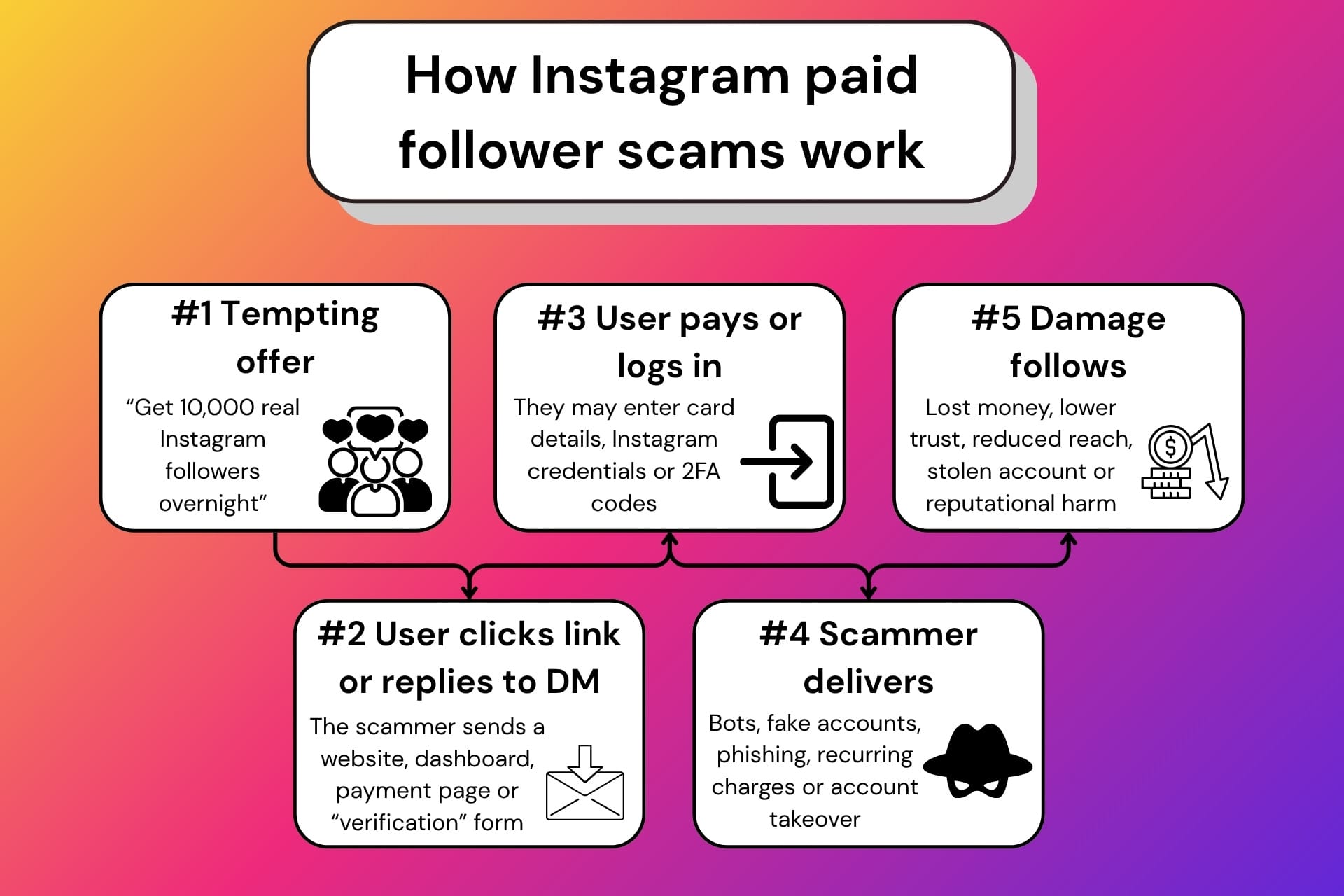
Instagram is built around visibility and reach. Follower counts, likes, comments and views can influence how users judge creators, small businesses, influencers, and even ordinary accounts. That pressure makes paid follower offers tempting, especially when they promise thousands of followers overnight for a few dollars.
Scammers understand this perfectly. They target people who want social proof fast, such as new creators, side-hustlers, small shops, musicians, coaches, students and anyone else trying to look more established online. The pitch usually sounds harmless and may include the following keywords:
- “real followers”
- “organic growth”
- “safe promotion”
- “no password needed”
- “guaranteed engagement”
In reality, many of these services are not growth services at all. They either sell low-quality bot traffic, run phishing campaigns, abuse stolen accounts or collect payments for results they’ll never deliver.
Meta has said that Instagram prohibits misrepresentation, fake accounts and artificially inflating the popularity content under its integrity and authenticity efforts. Instagram has also used automated systems to flag spam across comments, tags, story views and followers, with tools designed to help users remove suspicious activity.
Common Instagram paid follower scams
Fake follower package
The simplest version is also the most common: the fake follower package. A website or account offers thousands of followers for a low price. Some followers may appear briefly, but many are bots, inactive accounts or suspicious profiles that disappear when Instagram performs its periodical sweep to remove suspicious activity.
‘Growth manager’ scam
Another version is the “growth manager” scam. In this scenario, someone contacts you by DM and claims they can grow your account through influencer networks, secret algorithms tricks or paid promotion. They may ask for an upfront fee, access to your account or a login through a fake analytics dashboard.
Fake engagement platform
A more dangerous variation is the fake engagement platform. These sites ask you to connect your Instagram account to “track growth,” “activate delivery” or “verify your profile.” The login page might even look convincing enough to prompt you to lower your guard, but its real purpose is credential theft. Once scammers have your password and 2FA codes, they can lock you out of your account, change your recovery details and use your account to target your friends or followers. Phishing scams on Instagram commonly impersonate trusted systems or services to steal login details and take over accounts.
Fake collaborations
Some scammers also use fake collaboration opportunities as bait. For example, they may send you a page that offers paid shoutouts, guaranteed engagement from a “creator network” or promotion through a large account. After payment, the promised exposure never arrives, or the engagement comes from bots that drown your account in a sea of spammy comments, making it look less trustworthy.
Why fake Instagram followers are dangerous
The obvious risk is losing money. However, much like with other Instagram scams, paid follower scams can cause more serious harm than a wasted payment.
Fake followers hurt your organic engagement
Fake followers do not care about your posts, products or content. That can distort your engagement rate because your audience grows on paper while real interaction stays flat. For creators and small businesses, this can make the account look suspicious to brands, customers and potential collaborators.
You can lose your account
The cybersecurity risk is even more serious. If you enter your Instagram credentials into a fake growth website, scammers may gain access to your account. From there, they can impersonate you, message your contacts, promote crypto scams, post malicious links or demand payment to return the account.
For creators, influencers and small businesses, Instagram accounts can be a revenue channel, a portfolio and a reputation-building asset. That’s why account takeover risk deserves more attention than follower count. Bitdefender Security for Creators is built around this problem, offering protection for creators’ channels, emails and devices, including 24/7 monitoring for social channel takeover attempts and suspicious account changes.
Reputation damage
There is also reputational risk. Fake followers are often easy to spot. An account with 50,000 followers but only 20 likes per post raises questions. So does a comment section filled with generic praise, emoji spam or irrelevant replies. For influencers, coaches, sellers and creators, fake engagement can undermine the very credibility they thrive on and seek to build.
Legal issues
The legal and compliance angle is also important, more so for people using Instagram commercially. The FTC’s rule on consumer reviews and testimonials addresses fake indicators of social media influence, including fabricated followers, views or engagement when used deceptively in commercial contexts.
How to spot an Instagram engagement scam
Paid follower scams on Instagram rely on unrealistic promises, unlike scammers on most of its counterparts, which exploit urgency and secrecy. Be careful if a service guarantees a specific follower number in a very short time, claims to know “algorithm loopholes” or says it can deliver real engagement without explaining how.
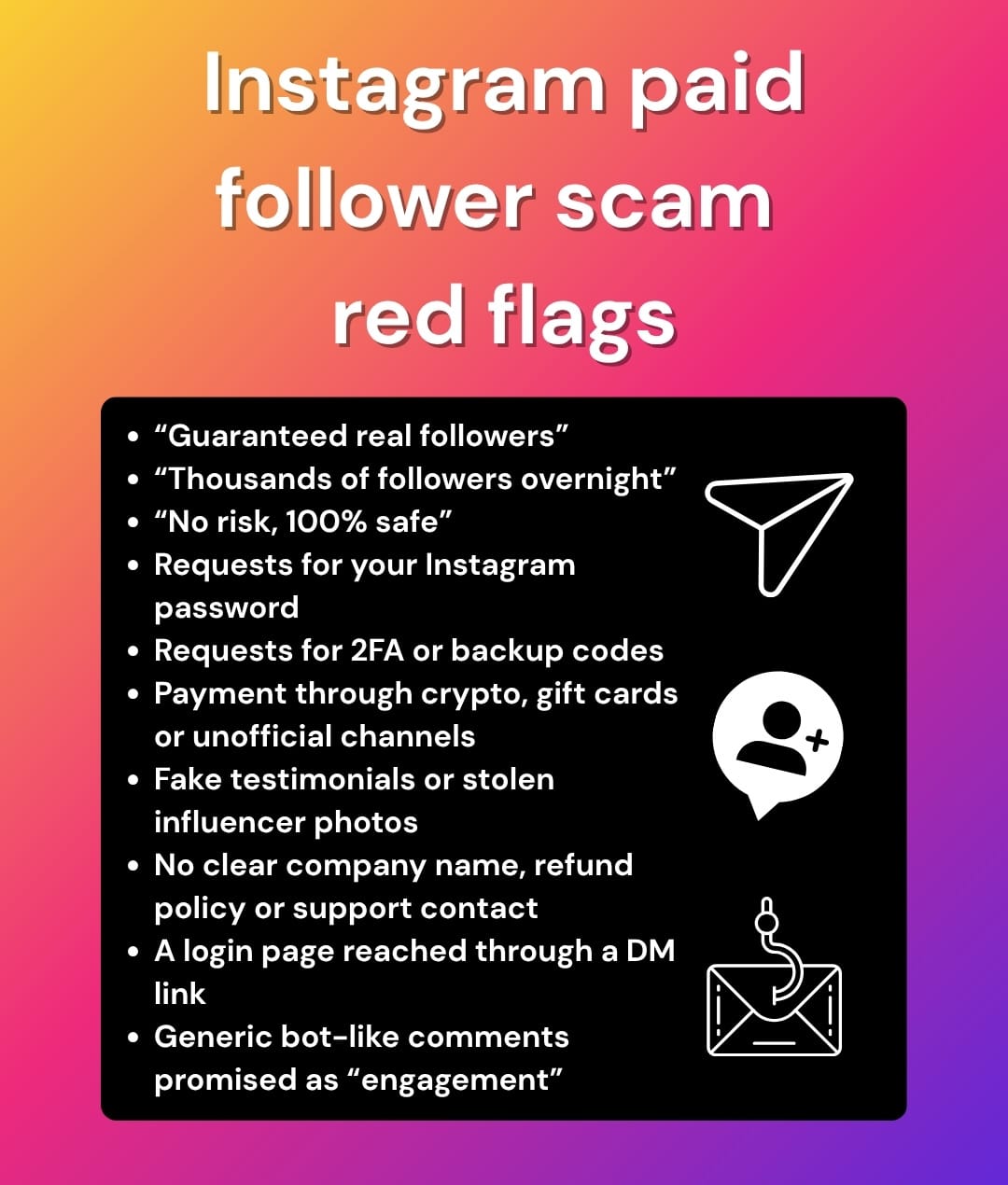
Here are common red flags you should watch for:
- Prices far below legitimate advertising or creator promotion costs
- Requests for your Instagram password, backup codes or 2FA code
- Payment requests through crypto, gift cards, wire transfer or unofficial channels
- Vague claims such as “100% real users” with no transparent methodology
- Generic testimonials, fake review screenshots or stolen influencer photos
- No company details, refund policy, privacy policy or support channel
A legitimate marketing service should never need your password to run ads or advise on content strategy. If a service asks you to disable 2FA, share a recovery code or log in through a link sent by DM, treat it as an account takeover attempt.
When in doubt, do not rely on instinct alone. A suspicious DM, “limited time” follower package, QR code or login link can be checked with a scam detection tool before you click, pay or share information. Bitdefender Scamio, for example, is designed to analyze potentially fraudulent messages, links, images, QR codes and described scenarios, giving you a practical way to pause before a scam can turn in to a payment loss or account takeover.
What to do instead of buying followers
The safer alternative is slower, but it builds something scammers can’t sell: trust. Focus on content that attracts the right audience rather than inflating the wrong number.
Use Instagram’s native tools, review your account insights, test posting formats and, if you have a budget, promote content through legitimate ad channels. Collaborate with real creators, disclose paid partnerships properly and avoid any service that promises guaranteed followers without real audience targeting.
For personal safety, secure your account before you need to recover it. Use a strong unique password (Bitdefender SecurePass can help you avoid password fatigue), enable 2FA, review connected apps and be skeptical of links in DMs that ask you to log in again.
If you have already paid for followers, avoid giving the seller more information. If you shared your password, change it immediately, enable 2FA, remove suspicious connected apps and check your email and phone number in Instagram settings. If you have lost access, use Instagram’s official account recovery process.
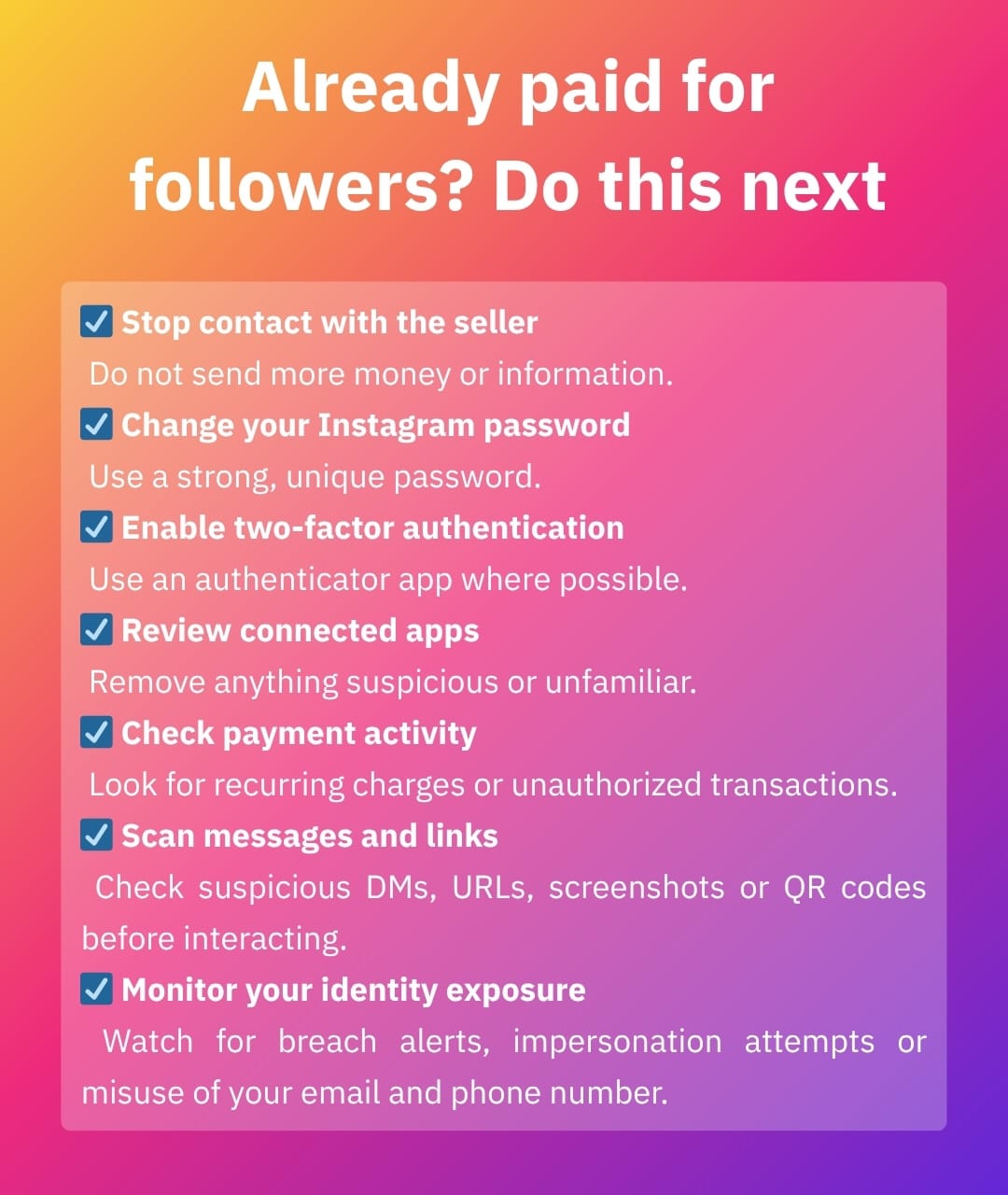
After dealing with a suspicious seller, you don’t stop at checking just the Instagram account. Check whether the email address, phone number or other personal details you used have been exposed in breaches or are appearing in places they should not. Digital identity monitoring tools, like Bitdefender Digital Identity Protection, can help users track data exposure, receive breach alerts and spot signs of impersonation that may follow after personal information is mishandled.
Conclusion
Instagram paid follower scams exploit the desire to look popular, credible or successful online. But fake followers do not create real influence. They can drain your money, weaken your engagement, expose your account to criminals and damage the trust you were trying to build.
The safest way to grow on Instagram is to treat follower count as an outcome, not a shortcut. Real engagement comes from real people. Anything that promises instant credibility for a small fee should be treated as a potential scam.
Frequently asked questions (FAQ)
Do people really pay for Instagram followers?
Yes. Some people pay for Instagram followers because they want to look more popular, attract brand deals, boost a business page or create the appearance of credibility. Scammers exploit this demand by selling fake followers, bot engagement, fake promotion packages or phishing links disguised as growth tools.
How to tell if IG followers are fake?
Fake Instagram followers often have incomplete profiles, no profile photo, strange usernames, little original content, low activity, private profiles or generic comments. A major warning sign is a mismatch between follower count and engagement, such as an account with thousands of followers but very few likes, comments or meaningful interactions.
Is it illegal to pay for followers on Instagram?
Paying for followers is generally a platform policy and trust issue, but it can create legal trouble when fake followers or fake engagement are used deceptively in a commercial context. Even when it does not cross into outright illegality, buying followers or engagement can still violate Instagram’s rules and damage your account performance. Instagram may remove fake followers, likes or comments, restrict suspicious activity, reduce the visibility of content that appears artificially boosted or otherwise limit organic reach. In the end, a shortcut can make the account less visible.
tags
Author

Vlad's love for technology and writing created rich soil for his interest in cybersecurity to sprout into a full-on passion. Before becoming a Security Analyst, he covered tech and security topics.
View all postsYou might also like
Bookmarks
