How a fake investment dashboard invents profits that never existed

October 20, 2026
A fake investment dashboard can make a nonexistent investment look spectacular: as your balances grow and your trades show gains, you might feel a false sense of confidence that the platform is legitimate. However, those numbers can be fabricated. This guide will help you better understand the scam, how to check it, and what to do if you land in this situation.
Key takeaways
- A fake investment dashboard displays invented balances, trades or returns; a screen is not proof that assets were purchased
- Fraudsters may stage rapid profits or allow a small withdrawal before pushing for larger deposits
- Guaranteed returns, unverifiable operators and extra payments to release money are major warning signs
- Check the firm independently; if you've paid, stop sending money, preserve evidence and contact your payment provider
What is a fake investment dashboard?
A fake investment dashboard is a website or app displaying fictitious holdings, balances and trades. It’s one tactic within broader financial scams. The US Securities and Exchange Commission (SEC) warns that criminals manipulate account information to simulate investment gains that never existed.
The FBI's Internet Crime Complaint Center logged $8.65 billion in reported investment-fraud losses in 2025, its highest-loss cyber-enabled fraud category. That US reporting figure covers investment fraud overall, not just fake dashboards.
How do scammers manufacture convincing profits?
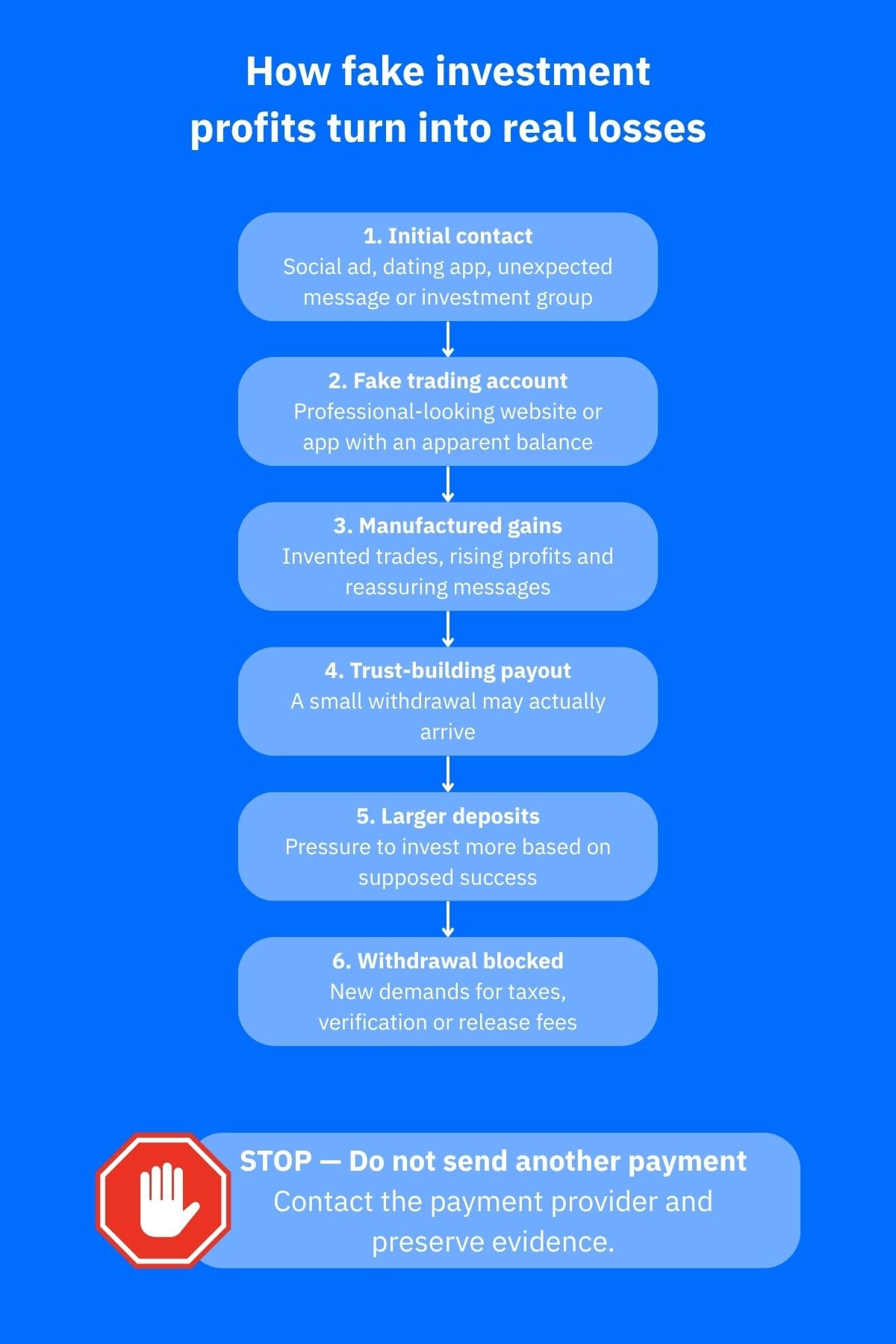
The setup may start with a social ad, unexpected message, dating app or investment group chat. A supposed expert or new friend steers you to a polished trading site, perhaps promising AI-selected trades. A familiar logo or app-store listing proves little.
After a deposit, the dashboard may show a growing balance, profitable trades and testimonials from other members. Those gains could be invented, even if you bought genuine cryptocurrency before sending it to a stranger's wallet.
Some scammers allow the mark to make a small withdrawal to gain trust. A real payout does not validate the claimed profits. Once larger sums arrive, a withdrawal may trigger demands for separate "tax," "verification" or "release" payments. The SEC and UK financial regulator warn about this progression.
These demands can develop into fake trading platform withdrawal fee scams, where each supposed requirement leads to another payment.
How to tell whether a fake investment dashboard is hiding behind a legitimate-looking site
Before investing, always:
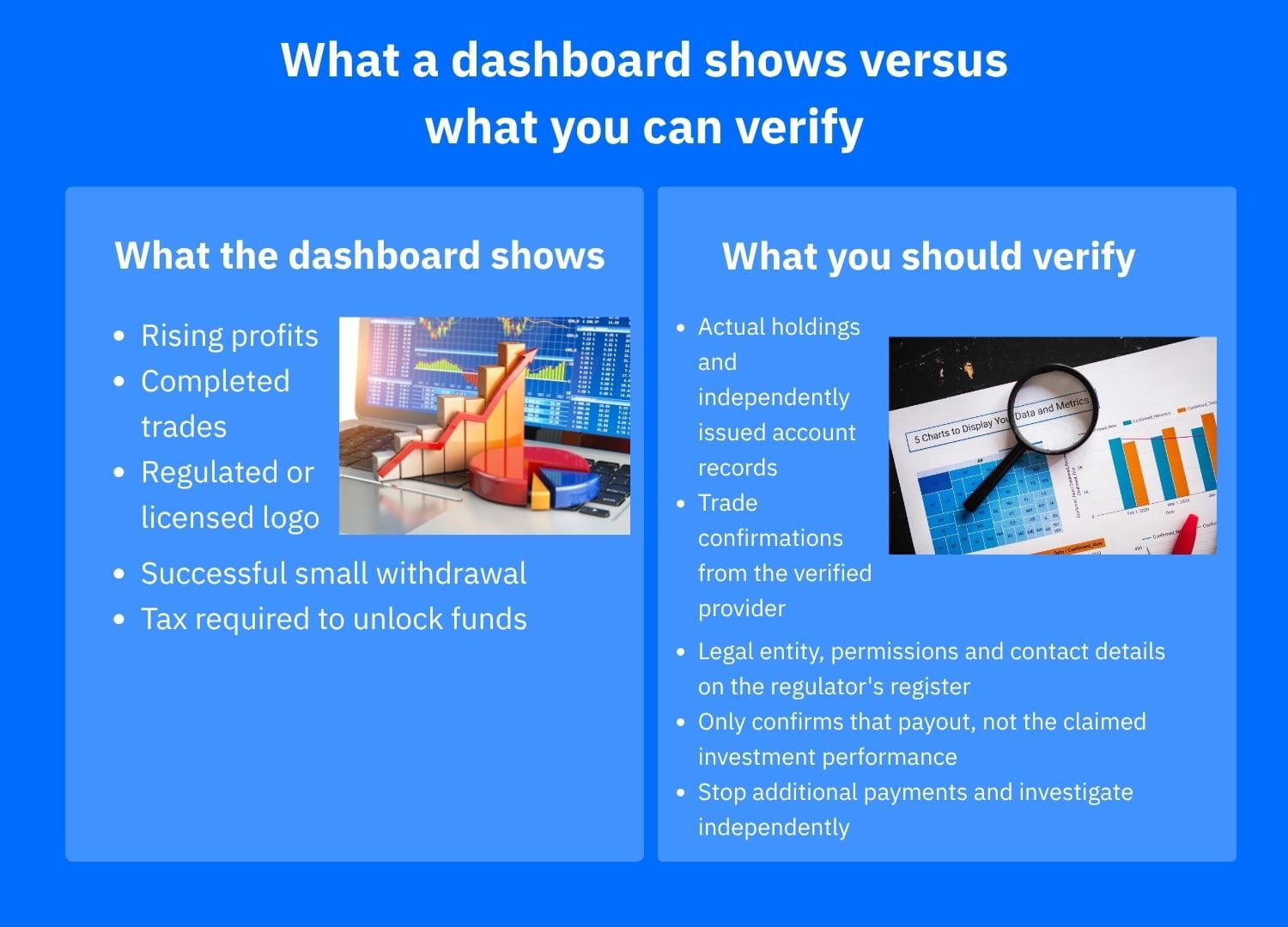
- Verify the operator. Check the legal name, regulatory permissions and contact details through US Investor.gov, the UK's FCA Firm Checker or EU national registers via ESMA. Scammers clone genuine firms.
- Check the recipient. Payments to individuals, unrelated businesses or unfamiliar crypto wallets are warning signs.
- Request independent records. Ask for trade confirmations and custody information from the actual provider, contacted independently. Screenshots and transaction references shown only on the platform are not proof.
- Examine withdrawal demands. Guaranteed gains or fresh payments to "unlock" an account are a sign of fraud; absence from a regulator's warning list does not establish legitimacy.
Note that you shouldn’t treat payouts as a substitute for these checks, even if they’re early.
What to do if you've already paid
Stop making deposits, including for supposed withdrawal taxes. Preserve the site URL, dashboard screenshots, chats, account details, bank receipts and crypto transaction IDs. Use our scam evidence checklist to organize the evidence.
Contact your bank, card issuer or crypto exchange through official channels immediately. Ask about recalls or disputes; recovery depends on the payment method and circumstances. For transfers, follow our first-24-hours bank-transfer guide. Change exposed passwords, enable multifactor authentication and flag shared identity documents. If you installed software at the scammer's request, remove it and scan your device.
In the US, report to IC3 and the SEC; in England, Wales and Northern Ireland, contact the FCA and Report Fraud (Police Scotland in Scotland). EU readers can report to their national financial regulator and police. Ignore fee-charging "recovery agents."
How Bitdefender can help
Bitdefender Scamio can assess suspicious investment messages, links, QR codes and screenshots. Bitdefender Ultimate Security provides scam and malware protection if a purported broker sends dangerous links or software. Neither can authenticate an investment balance.
If you have shared credentials, Bitdefender SecurePass helps generate unique replacement passwords, while Bitdefender Digital Identity Protection monitors exposed personal data and breaches. Bitdefender Security for Creators is relevant when someone's YouTube, Facebook or Instagram account faces compromise linked to scam promotion; it offers connected-account monitoring and security guidance. Keep in mind that these tools cannot recover transferred money.
Conclusion
A scam investment dashboard takes advantage of human nature to instill a fake sense of confidence through fabricated figures. Verify the provider and its records independently before investing. If a withdrawal requires another payment, stop, save the evidence and contact your payment provider.
Frequently asked questions (FAQs)
What are examples of fake investment schemes?
Examples include fraudulent cryptocurrency exchanges, sham forex or CFD trading platforms, fake AI investment clubs and romance or friendship pitches leading to nonexistent brokerage accounts. Some impersonate genuine firms. The common feature is a promised investment or account balance that the promoter cannot substantiate independently.
What will a bank never ask you?
A bank will not ask you to share your full PIN or online-banking password, give a one-time authentication code to an unexpected caller, or transfer money to a "safe account." If someone makes these requests while claiming to represent your bank, end the conversation and call the number on your card or official banking app.
How do scams work when they send you money?
Investment scammers sometimes pay a small withdrawal to make fictitious profits seem real. The payment does not prove genuine trading. In other schemes, criminals send fraudulent or stolen money and ask you to forward it, potentially making you a money mule. Never transfer unexpected funds on a stranger's instructions; ask your bank to investigate.
tags
Author

Vlad's love for technology and writing created rich soil for his interest in cybersecurity to sprout into a full-on passion. Before becoming a Security Analyst, he covered tech and security topics.
View all postsYou might also like
Bookmarks
