Fake trading platform withdrawal fee scams: why the charges never end

September 04, 2026
A fake trading platform withdrawal fee is often the next payment in a financial scam, and not a normal hurdle to accessing profits. Fraudsters may call it a tax or liquidity charge, then invent another condition after you pay. Here is how to recognize the pattern and staunch the losses.
Key takeaways
- A fake trading platform withdrawal fee is often an advance-fee fraud: you are asked to send more money before receiving money supposedly already in your account
- Scammers may allow a small withdrawal or display profits, then block larger withdrawals behind taxes, verification, liquidity or other invented charges
- Unsolicited pitches, guaranteed returns, unverifiable regulation claims and payments to unrelated accounts or crypto wallets are major warning signs
- Stop paying, contact the payment provider, preserve evidence, secure exposed accounts and report the platform
What is a fake trading platform withdrawal fee?
A fake trading platform withdrawal fee is an unexpected charge imposed when someone tries to withdraw money from a fraudulent investment website or app. In this type of scheme, victims are told to pay a fee, tax, commission, validation charge or other expense before receiving supposed proceeds.
Why do tax, liquidity and verification payments keep appearing?
Often, paying the first charge does not unlock a genuine account. It merely shows the scammer that another demand may work. California’s Department of Financial Protection and Innovation (DFPI) has logged consumer reports involving identity-verification fees, liquidity requirements, taxes and service fees, and it cautions that sudden or unexplained withdrawal charges are characteristic of fraudulent trading schemes.
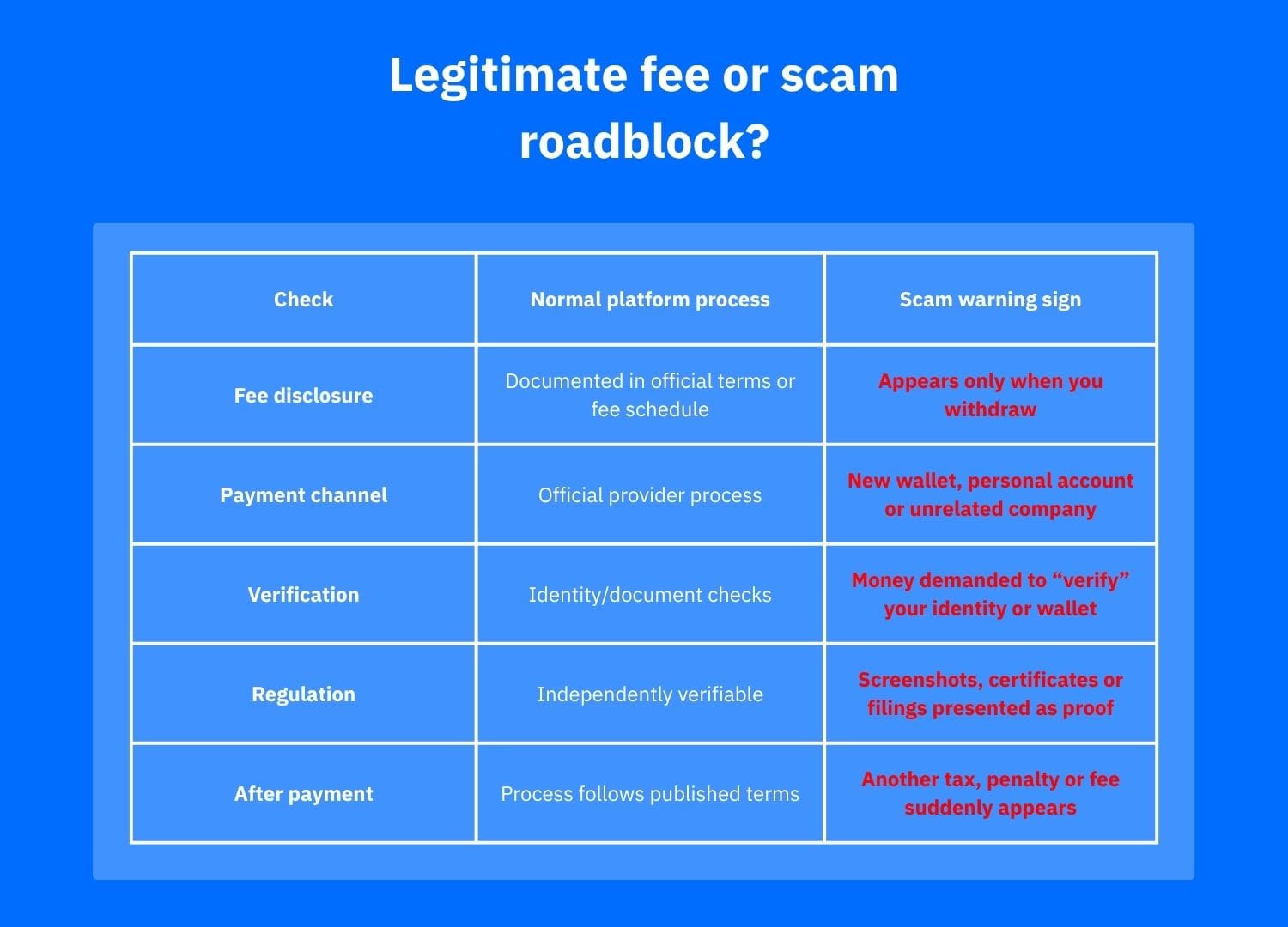
Legitimate platforms can levy fees as well, although they are disclosed, and tax rules vary by country. The red flag is an unexpected demand for fresh money, especially to a new account, individual or crypto wallet, as a condition for releasing funds. US regulators also warn that scammers may show fictitious returns or permit an early withdrawal before introducing fees or taxes when the victim tries to cash out.
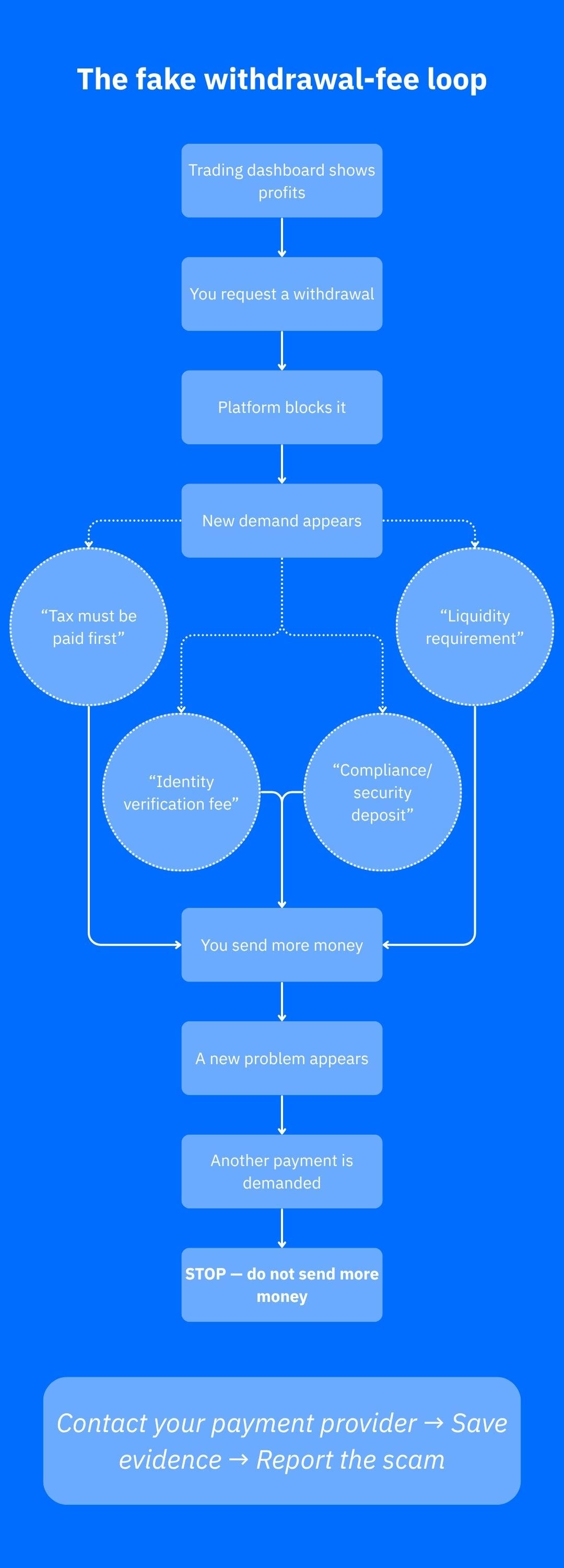
The typical scam sequence
- An ad, wrong-number text, social-media contact, dating conversation or investment group introduces a trading opportunity
- A professional-looking site or app shows apparent profits; a small withdrawal may even work
- The victim is encouraged to deposit larger amounts
- A bigger withdrawal triggers a tax, verification, liquidity, security-deposit or “compliance” payment
- Paying it leads to another fee, a frozen account, penalties or silence
The SEC warned that investment-related group chats can steer people toward websites or apps that display fake profits, then demand fees, taxes or deposits. On Aug. 27, 2026, the agency issued another advisory to warn that scammers were using Exempt Reporting Adviser filings to create a false impression that an investment business is registered or legitimate.
How to spot a fake trading platform
Verify the firm independently, not through links supplied by its promoter. UK readers can use the Financial Conduct Authority’s (FCA) Firm Checker; EU investors can check the European Securities and Markets Authority’s Investor Corner. Polished dashboards and regulatory logos are not proof: ESMA recommends checking whether a trading platform is registered and scrutinizing suspicious or lookalike URLs.
Be especially cautious when an online-only acquaintance recommends the platform, or if returns are guaranteed, payments go to unrelated recipients, or withdrawals require a new payment first. Never lie to your bank about the purpose of a transfer; SEC and CFTC investor guidance identifies unusual payment instructions and requests to disguise the real purpose of a transaction as warning signs.
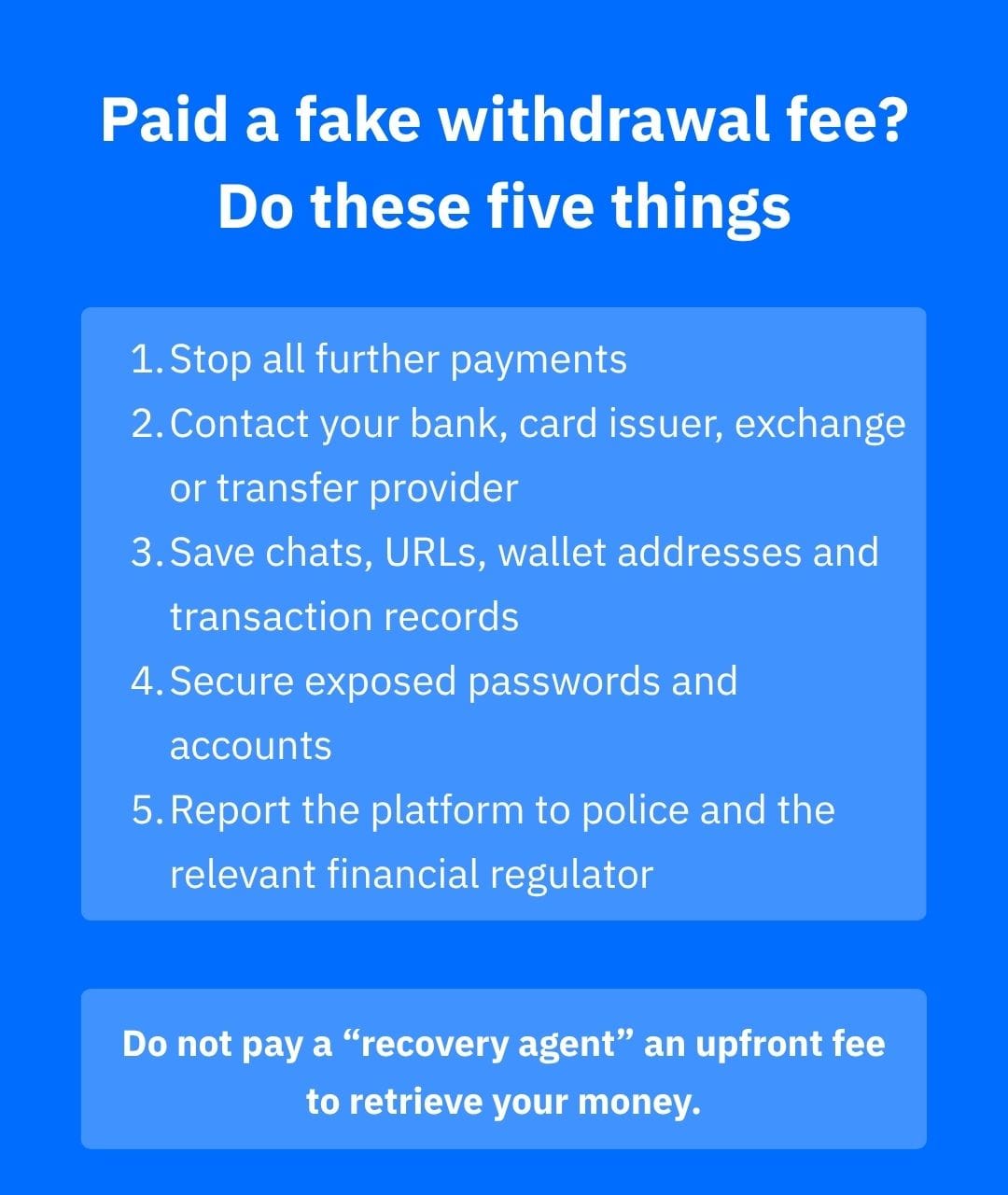
What to do if you have already paid
Do not pay the next fee. Contact your bank, card issuer, crypto exchange or transfer service immediately and ask about recall, freeze or fraud-reporting options. If you have sent money to a scammer by bank transfer, act quickly. Preserve chats, URLs, wallet addresses, transaction IDs and payment records with our scam evidence checklist, then follow the scam recovery timeline.
Change passwords for exposed accounts and enable multifactor authentication. Report the fraud to police and the regulator; in the US, the FBI directs victims to IC3, while UK victims can use the FCA and Report Fraud. If your bank refuses a scam refund, preserve its decision and your evidence before escalating.
Ignore anyone who offers to recover the money for another upfront payment. People who have already lost money to investment fraud may be approached again by scammers posing as recovery firms, officials or other intermediaries asking for another fee, regulators warn.
How Bitdefender can help
Bitdefender Scamio can analyze suspicious texts, emails, social-media messages, links, screenshots and QR codes. Bitdefender Ultimate Security adds device security and Scam Protection features, but no security product can validate an investment return or recover money already sent.
If credentials were exposed, Bitdefender SecurePass can help replace reused passwords with strong, unique ones. Bitdefender Digital Identity Protection monitors for exposed personal information and compromised accounts. For creators, Bitdefender Security for Creators is relevant when a scam arrives through social accounts or scam emails, with account monitoring and anti-scam email protection.
Conclusion
A fake trading platform withdrawal fee is your first sign to pause and check more thoroughly. If every tax, liquidity or verification payment creates a new requirement, stop sending money, preserve evidence and contact your payment provider and regulator through independently verified channels.
Frequently asked questions (FAQs)
Are there fake trading apps?
Yes. Fraudsters operate fake trading apps and websites, and appearing in a well-known app store does not prove legitimacy. Verify the provider with the appropriate regulator, check the exact domain and company details, and avoid platforms introduced through unsolicited messages or private investment groups.
How do I spot a fake trading platform?
Look for guaranteed returns, pressure to deposit quickly, unverifiable licensing claims, payments to unrelated people or wallets, mismatched domains, and withdrawals blocked by unexpected taxes or fees. Check the firm independently with the regulator rather than using contact details supplied by the promoter.
How do I identify a crypto scammer?
A crypto scammer often takes time to build trust, then directs you to a specific wallet or trading platform and shows apparently profitable results. Red flags include unsolicited advice, guaranteed profits, pressure to add money, requests for identity data and demands for extra payments before withdrawals.
tags
Author

Vlad's love for technology and writing created rich soil for his interest in cybersecurity to sprout into a full-on passion. Before becoming a Security Analyst, he covered tech and security topics.
View all postsYou might also like
Bookmarks
