What Scares People Most About Hackers? We Asked Netizens

January 06, 2026

Most people don’t worry much about hackers stealing their photos or reading their emails. What keeps them up at night is far more fundamental, and far more human: fear for their money, identity, and control.
A single smartphone can unlock bank accounts, investment platforms, crypto wallets, tax records, medical portals, and years of personal history. Despite knowing how much is on the line, many consumers still treat cybersecurity as optional — something to think about after it becomes a problem.
The 2025 Bitdefender Consumer Cybersecurity Survey reveals a contradiction. People clearly understand what they stand to lose, but their day-to-day behavior tells a different story — one marked by weak passwords, minimal protection on mobile devices, and a growing reliance on “it-won’t-happen-to-me” thinking.
Hackers don’t just notice this gap. They plan around it. As cybercriminals refine AI-powered scams and automate fraud, consumer complacency is becoming one of their most valuable assets.
What people fear most: financial loss, identity theft, scams
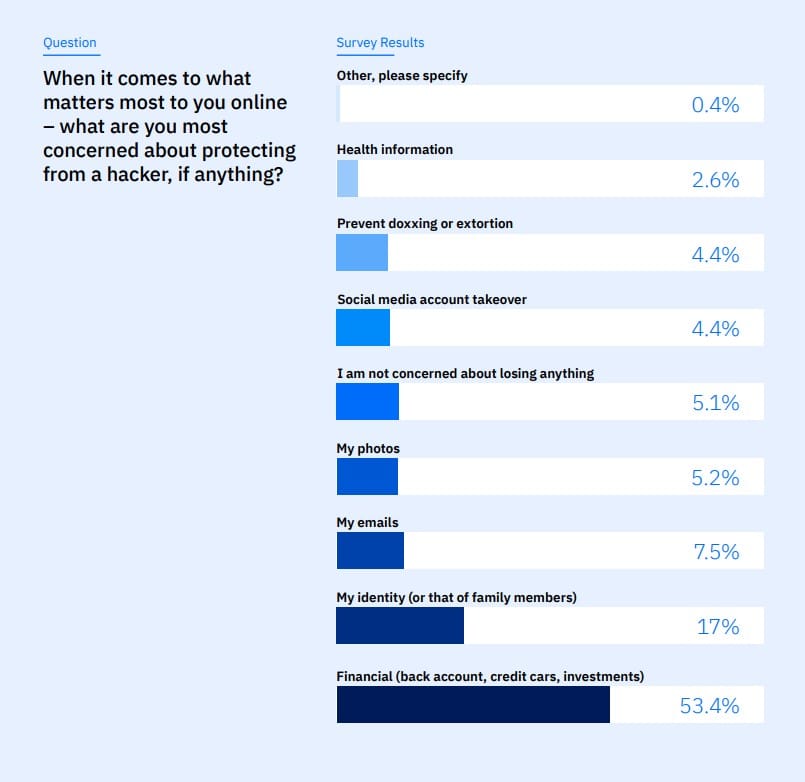
According to our survey, consumers’ top fears center on their wallets and personal identity. Among the concerns cited, AI-powered scams — such as deepfakes and voice cloning — ranked at the top of people’s worries in the digital space.
Asked plainly, “What are you most concerned about protecting from a hacker?,” 53% selected financial loss as their top fear, far outpacing identity theft, at 17%, or the compromise of email (7%) and personal photos (5%). Interestingly, 5% of respondents said they were not afraid of losing anything at all.
Source: Bitdefender 2025 Consumer Cybersecurity Survey
Yet even as awareness grows, the habits that leave users exposed remain common — weak password practices, blind acceptance of cookies, and reluctance to deploy an independent security solution. This paradox — fearful yet complacent — gives hackers exactly what they want: high reward with low resistance.
Convenience vs security: the cost of complacency
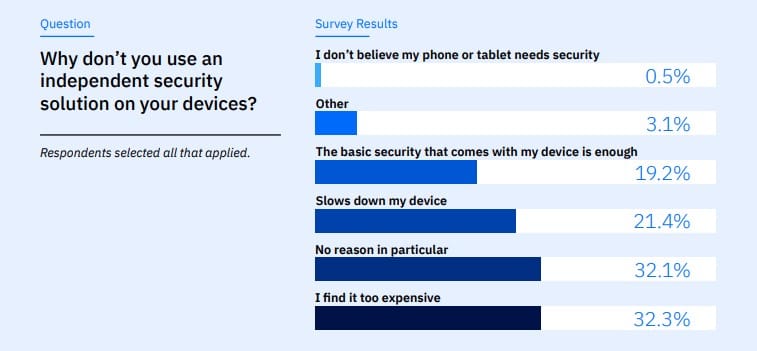
Consumers prioritize convenience, often at the expense of protection. Half of users conduct banking, shopping, and other sensitive activities on their phones, yet nearly half admit they don’t use any dedicated security solution on those devices.
Reasons range from believing built-in device defenses are “good enough,” to thinking security apps would slow performance or cost too much.
Source: Bitdefender 2025 Consumer Cybersecurity Survey
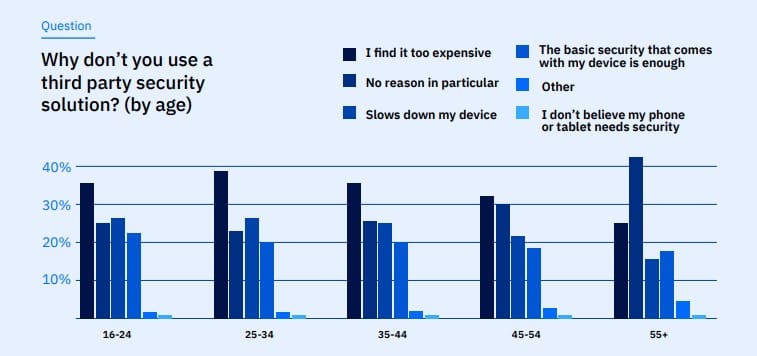
Older users are especially likely to forgo protection, with nearly half saying they see no reason to add independent security software to their devices.
Source: Bitdefender 2025 Consumer Cybersecurity Survey
Cybercriminals know this complacency is profitable, and are already exploiting it.
They prey on emotion, trust, and everyday routines. Whether it’s fear of legal trouble, the lure of quick returns, or a believable message from a “friend,” scammers know exactly how to make ordinary people hand over extraordinary amounts of money.
Read: Scammers Are Posing as Your Bank – Here’s How to Protect Your Account
Read: Florida Woman Loses $15K to AI Voice Scam Mimicking Daughter in Distress
Data from the Federal Trade Commission (FTC) shows that consumers in the US lost more than $12.5 billion to fraud and scams in 2024, with investment scams alone accounting for roughly $5.7 billion. Older adults are especially targeted; impersonation scams have caused reported losses of hundreds of millions as scammers pose as government or trusted entities to extract money from victims.
Actionable advice for consumers
Our survey makes one thing abundantly clear: knowing the risks isn’t enough if behavior doesn’t change. Scams aren’t fringe anymore — 7 in 10 consumers encountered one in the past year, and 1 in 7 fell victim.
And because social media has eclipsed email as the top delivery method for malicious messages, users are encountering more targeted scams than ever.
Even simple behaviors — like blindly accepting all cookies or neglecting mobile security — signal complacency that hackers will exploit. Here’s what you can do to close that gap:
1. Use layered defense
Security isn’t just one product — it’s a strategy. Combine:
- A password manager
- Two-factor authentication (2FA)
- Trusted cybersecurity software for all your devices
This multi-layered setup drastically reduces the likelihood of a breach.
2. Treat your phone like a safe
If, like most people, you bank or shop on your smartphone, treat it like a personal safe. Install dedicated mobile security. Don’t rely solely on built-in protections — especially on Android phones.
3. Never reuse passwords
Writing passwords on sticky notes or repeating them across accounts is a hacker’s dream. Use a password manager to generate unique, strong credentials.
4. Think before you click
Phishing isn’t going away — it’s evolving with AI. Slow down, verify links before clicking, and remember: legitimate entities never ask for passwords or codes over the phone, SMS, email or social media.
5. Use a scam detector
Consider using Scamio if you’re suspicious of a certain phone call, email, or text message. Our clever chatbot is designed specifically to combat socially engineered fraud attacks.
6. Stay educated
Cyberthreats change fast. Read the cybernews bulletin from time to time! Keep up with how attackers are using new technologies — and how defenses evolve too.
In 2026, protecting what matters most means moving beyond fear and into preparedness. With the right habits and tools, you can turn the tables on hackers — and keep what’s yours, safe.
You may also want to read:
What Scares You Most About AI? We Ask Netizens
How Do You Manage Your Passwords? We Ask Netizens
1 in 7 Consumers Got Scammed in the Past Year – Bitdefender Consumer Cybersecurity Survey 2025
tags
Author

Filip has 17 years of experience in technology journalism. In recent years, he has focused on cybersecurity in his role as a Security Analyst at Bitdefender.
View all postsYou might also like
Bookmarks
