UK plans social media ban for under 16s in 2027: What parents need to know

June 15, 2026
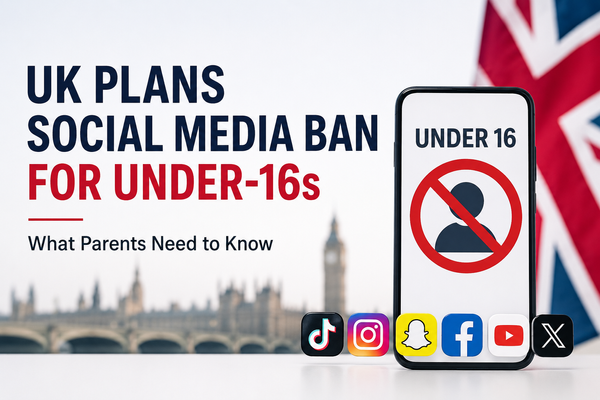
The UK government has announced plans to ban children under the age of 16 from social media platforms, in what officials are calling a landmark move to “give kids their childhood back.”
The proposal follows Australia’s lead on restricting social media access for youth. But the UK government says it will go further than a blanket social media ban by also targeting harmful online features across a wider range of services, including gaming sites.
Key takeaways
- The UK plans to ban social media platforms from offering services to under-16s.
- Platforms likely affected include Snapchat, TikTok, YouTube, Instagram, Facebook and X.
- Messaging services such as WhatsApp and Signal are not expected to be included in the social media ban.
- The government also wants restrictions on harmful features such as livestreaming and strangers communicating with children.
- These additional protections would apply across a wider range of online services, including gaming sites.
- AI “romantic companion” chatbots designed to simulate intimate relationships or roleplay with users would have to enforce a minimum age of 18.
- The first set of regulations could come into force in Spring 2027.
Why is the UK taking action?
The UK is following the lead of Australia, which became the first country to pass legislation restricting social media access for younger users. However, the UK's proposal goes even further. The government says parents are struggling to protect children from risks that come from online platforms.
According to the announcement, the aim is to give parents more support, create clearer rules around what is age-appropriate, and put children’s wellbeing ahead of platform engagement.
The government also said the proposal follows a major national conversation with parents, children and experts. It says more than 116,000 responses were submitted, with 9 in 10 parents backing a social media ban for children under 16.
“Parents want to keep their kids safe and happy, but the online world has made that harder than ever,” Prime Minister Keir Starmer said. “I’ve heard first hand from families crying out for change and we will do right by them.
“That’s why we’re going further than any country in the world by banning social media for under-16s and putting wider protections in place to give kids their childhood back.
“This is a line in the sand. Tech giants had their chance and failed, but we’re stepping in to protect children, back parents and set a new normal for future generations.”
You may also want to read: How to handle teen social media bans, according to therapist
What should parents expect
The UK government says it plans to use a model similar to Australia’s social media ban.
That means the restrictions would target platforms meant to enable social interaction, allow users to post content, and use algorithmic feeds. The government named platforms such as Snapchat, TikTok, YouTube, Instagram, Facebook and X.
Messaging services such as WhatsApp and Signal are not expected to be included in the social media ban, according to the latest press release.
But this is where the UK proposal becomes broader.
The government says it will also introduce restrictions on harmful features such as livestreaming and communication of strangers with children. These restrictions, together with the ban, would go further than any other country and apply to a wider range of online services, including gaming sites.
This detail is important because children’s online lives do not begin and end with traditional social media. Many young people spend time in multiplayer games, livestreaming environments, online communities, messaging apps and platforms where they can interact with people they do not know.
What about 16- and 17-year-olds?
The government says restrictions on certain harmful features will also be switched on by default for under-16s and 17-year-olds.
This is meant to prevent a sudden cliff-edge at 16, where young users go from stronger protections to much looser rules overnight.
Officials are also looking more closely at overnight curfews and breaks in infinite scrolling for under-18s. More details on these measures are expected in July this year.
AI companion chatbots are also under scrutiny
The announcement also addresses AI chatbots designed to simulate intimate or sexual relationships. So-called AI “romantic companion” chatbots would have to enforce a minimum age of 18. Similar intimate functions would also be restricted for under-18s on AI chatbots more widely.
This is a notable part of the proposal because children are no longer exposed only to risks from human users. They may also interact with AI systems designed to be emotionally persuasive, intimate or addictive.
You may also want to read:
- Are AI companion apps safe for kids? New report raises concerns
- How kids bypass age verification online and what families can do about it
- Age verification for teens: Privacy risks parents should know
- Is your child addicted to screens? What parents should watch for, according to a therapist
How will the rules be enforced?
The government says it will learn from Australia’s experience by introducing more effective age assurance measures to make it harder for children to bypass safeguards.
Ofcom will carry out a rapid study on effective age assurance for verifying whether someone is over 16. The government has also asked Ofcom to produce a clear enforcement strategy.
The first set of regulations could be brought before Parliament before Christmas and may come into force in Spring 2027.
Why parents still need layered protection for househ
Government action can help create safer online spaces, but it can’t replace active parental involvement or security tools designed to protect families across devices.
Children use phones, tablets, laptops, gaming platforms, and apps throughout the day. That means protection needs to follow them wherever they go online, not just on social media.
A layered approach combines open conversations, healthy boundaries and technology that helps parents manage risk.
Dedicated Bitdefender Family plans help protect multiple household devices against online threats including malware and scams, while Bitdefender Parental Control gives parents tools to manage screen time, filter inappropriate content, monitor online activity, and encourage safer digital habits.
tags
Author

Alina is a history buff passionate about cybersecurity and anything sci-fi, advocating Bitdefender technologies and solutions. She spends most of her time between her two feline friends and traveling.
View all postsYou might also like
Bookmarks
