Press Center

July 2010

BitDefender Malware and Spam Report Finds E-Threats Exploiting Web 2.0 Platforms

PayPal, eBay, HSBC Top-Phished Institutions; China and Russia Hosting Majority of Malware - Predictions for Malware Activity Over The Second Half of the Year

Today BitDefender, an award-winning provider of innovative internet security solutions, released a report that found the first half of 2010 saw a rise of worms exploiting various Web 2.0 platforms. The report examined data from January through June 2010 and found social networks and Web 2.0 services have become one of the most valuable channels of malware dissemination during the last six months, while phishers focused on impersonating PayPal and eBay, and pharmacy spam volume now makes up two-thirds of all spam.

Spam and Phishing Trends in First Half of 2010

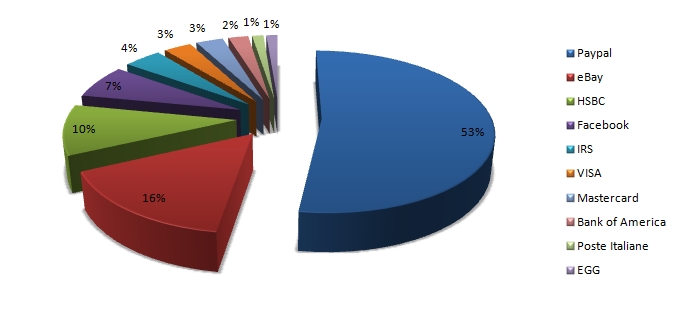
Financial institutions were cyber-criminals▓ preferred targets, constituting more than 70 percent of global phishing messages. Social networks also came under heavy fire, as user profiles are a rich source of personal information and compromised accounts may be effectively used in spear phishing attacks. For the first half of 2010, phishers focused on impersonating PayPal and eBay. The HSBC Bank ranks third, while Poste Italiane and EGG conclude the list of the most abused online identities.

World▓s Top 10 Phishing Targets January √ June 2010


The FIFA World Cup≥ and the massive floods in Guatemala were two of the many events used for Black-Hat SEO optimization to improve the ranking of various malware-serving websites in the first half of 2010. The period also saw spam messages grow to 86 percent of the total email, driven by pharmacy spam, which reached new heights - jumping from 51 to 66 percent of all spam.

The spam breakdown by type for the first half of 2010 is:


  • Medicine Spam √ 66%
  • Replica products √ 7%
  • Loans and insurance √ 5%
  • Bundled malware √ 3.5%
  • Casino and gambling √ 3.5%


Malware Threats in Review

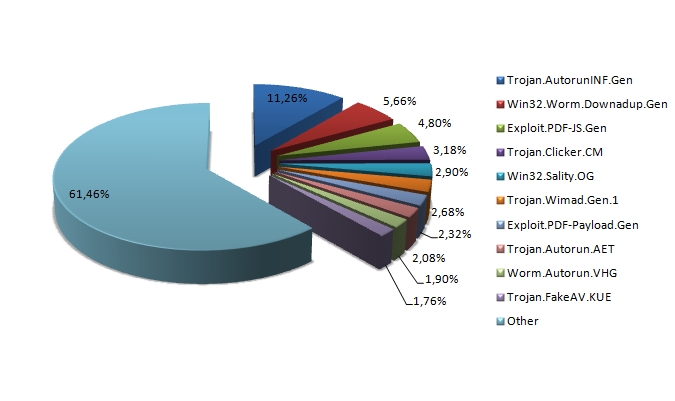
Exploiting Windows▓ Autorun feature - Trojan.AutorunINF.Gen ranked first in the study, with more than 11 percent of the total number of infections, while MBR worms have made a comeback with upgraded viral mechanisms. Late January saw the emergence of Win32.Worm.Zimuse.A, a deadly combination of virus, rootkit and worm. Upon infection, the worm would start counting down the days. 40 days from the infection, it would overwrite the hard disk drive▓s Master Boot Record, thus rendering the OS unable to boot. China and the Russian Federation led the world in malware hosting, with 31 and 22 percent respectively.

World▓s Top 10 Malware January √ June 2010


Vulnerabilities, Exploits and Breeches

Critical zero-day exploits on popular software such as the Internet Explorer browser from Microsoft╝ or Adobe╝ Reader╝, Adobe╝ Flash Player╝ and even Adobe╝ Photoshop╝ CS 4 have also played a key role in the malware landscape for the first half of 2010. Some of the Internet Explorer exploits have even been used to attack major companies such as Google, Adobe╝ and Rackspace╝.

E-Threat Predictions

BitDefender experts warn, while the first six months of 2010 have been dominated by conventional e-threats such as Trojans and worms, various exploits pointing at third-party applications have rapidly gained ground, both in count and in terms of impact. As seen in the case of Exploit.Comele.A, zero-day vulnerabilities may be used for purposes that are beyond identity theft or compromising banking accounts, but instead act as fully-fledged weapons used in cyber-warfare and top-level industrial espionage.

⌠With Facebook╝ surpassing 400 million users, most of the malware authors will focus on the social networking platform to deliver their newest payloads. Some of these attacks will focus on social engineering tricks (such as launching various malware offensives from compromised computers), while others will try to exploit different vulnerabilities or features already implemented across the platform,■ said Catalin Cosoi, Head of the BitDefender Online Threats Lab.

BitDefender experts also believe personal information leaks will also dramatically contribute to the success of various attacks, especially when data harvested from social networks is corroborated with personal blogs, career history and other relevant data. Third-party applications are also expected to play an important role in social networking abuses.

⌠The introduction of HTML5, the upcoming major revision of the HTML standard, will add extra levels of interaction between the user and the webpage and will probably change the face of the Web as we know it. The new technology is highly likely to be exploited by malware authors to compromise the browser security,■ added Cosoi.

For more information and to see the full report, please click here.


* * *

About Bitdefender®
Bitdefender is the creator of one of the world's fastest and most effective lines of internationally certified internet security software. The company is an industry pioneer, introducing and developing award-winning protection since 2001. Today, Bitdefender technology secures the digital experience of around 400 million home and corporate users across the globe.

Recently, Bitdefender won a series of important awards and accolades in the global security industry, including "Product of the Year" by AV-Comparatives, "Best Repair 2012" by AV-Test, "Editor's Choice" and "The Best Antivirus for 2013" by PC Mag, that confirmed the antivirus software’s leadership status among security products.

More information about Bitdefender's products is available from the company's security press room. Additionally, Bitdefender publishes the HOTforSecurity blog, where readers can find stories from the underworld of internet fraud, scams, malicious software - and gossip.


Bitdefender E-Threats Landscape Reports

The purpose of this report is to provide a comprehensive investigation of the threats’ landscape. Bitdefender’s security experts thoroughly analyze and examine the menaces of the each semester, focusing on software vulnerabilities and exploits, different types of malware, as well as countermeasures, cyber crime prevention and law enforcement. The E-Threats Landscape Report concentrates mainly on the latest trends, but it also contains facts and data and concerning the previously investigated periods, as well as several predictions related to the upcoming semesters. This document is primarily intended for IT&C System’s Security Managers, System and Network Administrators, Security Technology Developers, Analysts, and Researchers, but it also addresses issues pertaining to a broader audience, like small organizations or individual users concerned about the safety and integrity of their networks and systems.

H2 2012 E-Threat Landscape Report - Overview

For the first half of the year, zero-day vulnerabilities played an essential role in disseminating malware with exploit packs as a favorite vector of infection. The dangerous zero-day exploit in the Java Runtime Environment (CVE-2012-4681) was documented and proof of concept was added to Metasploit, which became public knowledge before a fix was made available.

As a direct result, three billion devices running Java were vulnerable to remote code exploitation for roughly 48 hours. A second exploit hit in September and targeted Internet Explorer 9. Successful exploitation would allow remote compromise of the system with the installation of the Poison Ivy backdoor. Both zero-day exploits were used in advanced persistent attacks.

2012 saw fluctuations in the amount of junk e-mail as a proportion of e-mail traffic. The year began with a slight decrease in spam e-mails, but spam constantly gained ground towards the middle of the year. According to data gathered from the Bitdefender Antispam lab, the second half saw growth again, with small variations towards the end of 2012. The increase in the number of junk e-mails was nonetheless minor, by only 5%, leading to a rough value of 73% of the total number of e-mails sent worldwide.

Download now the full H2 2012 E Threat Landscape Report (pdf)

Download now the overview H2 2012 E Threat Landscape Executive Summary (pdf)


Archive

2012
Download now H1 2012 E Threat Landscape Report (pdf)

2011
Download now H1 2011 E-Threats Landscape Report - Executive Summary (pdf)
Download now H2 2011 E-Threat Landscape Report (pdf)
Download now H2 2011 E-Threat Landscape Report - Executive Summary (pdf)

2010
Download now H2 2010 E-Threats Landscape Report - Executive Summary (pdf)
Download now H2 2010 E-Threats Landscape Report (pdf)
Download now H1 2010 E-Threats Landscape Report - Executive Summary (pdf)
Download now H1 2010 E-Threats Landscape Report (pdf)

2009
Download now H1 2009 Malware and Spam Review Executive Summary (pdf)
Download now H1 2009 E-Threats Landscape Report (pdf)
Download now H2 2009 Malware and Spam Review (pdf)
Download now H2 2009 E-Threats Landscape Report - Executive Summary (pdf)

2008
Download now H1 2008 E-Threats Landscape Report (pdf)
Download now H2 2008 E-Threats Landscape Report (pdf)

White Papers

Bitdefender e-Guides Series

The Bitdefender e-Guides series is a learning initiative aiming to provide the Bitdefender reader and user community with valuable information about e-threats and the security issues of the IT&C realm, while also offering practical advice and feasible solutions to their on-line defense needs. The Bitdefender security analysts share their knowledge in malware prevention, identification and annihilation, with an emphasis on on-line privacy and different technologies, countermeasures and cybercrime prevention methods.

Covering topics that range from kids and family's on-line protection, safe social networking and preventing data safety breaches to securing enterprise environments, the e-Guides series is intended for a broad audience of small organizations and individual users concerned about the safety and integrity of their networks and systems. The e-Guides also address issues pertaining to the daily activity of IT&C Systems Security Managers, System and Network Administrators, Security Technology Developers, Analysts, and Researchers.

Safe Blogging Guide

Tips and tricks on how to keep your blog and your identity safe

Safe Blogging Guide

Blogging is one of the most popular forms of written expression on the web, with more than 150 million indexed blogs worldwide. While regular readers are looking for pieces of information and articles, cyber-crooks take a different interest in them. Finding private information and getting cheap storage space for their malware campaigns are only two of the multitude of users they may subject your blog to.

This material covers the basic guidelines for safe blogging and is especially focused on individual blogs that are either self-hosted or provided as a service by major blog providers.


Securing Wireless Networks Guide

Tips and tricks on how to shield your home network from intruders

Securing Wireless Networks Guide

This document is intended for computer users who have deployed or plan to deploy a home wireless network. At a time when wireless communication has become a significant part of our lives, cyber-criminals try to exploit every security breach in the wireless configuration in order to intercept traffic or use the internet connection for illegal purposes.

The following guide will teach you the best practices when using unsecured wireless networks, as well as how to properly configure your home router or access point to prevent others from abusing your network.


Protecting Children On-line Guide

How to secure and defend the digital experience of your kids


This document is intended for family, parents and teachers and its purpose is to help secure the digital activities of kids and teens. In an age when the mass production and accessibility of computers have turned these devices into regular family or household commodities, children get familiar with PCs and Internet from a very fresh age. Despite its obvious communication-related benefits, the WWW can also be a hazardous place for kids, with e-threats directly targeting their age group and their home or school computers.

This e-Guide covers the main risks and dangers for kids on-line, such as cyber-bulling, exposure to inappropriate content, on-line addiction and other harmful online actions, while also focusing on topics such as malware, phishing, ID theft and spam, to which teenagers, just as any other Internet users, are exposed nowadays. A Safety Tips section helps parents and teachers better understand and deal with these issues in relation to the kids.


Silver Surfers On-line Safety Guide

How to protect valuable ideas and assets from cyber-hacking


This document is intended for families and senior citizens and its purpose is to help them browse the web safely and enjoy their on-line activities.

At a first glance, it would appear that senior citizens are exposed to cybercrime just as much as any other inexperienced Internet user, irrespective of their age. However, as this e-Guide shows through several case studies, there are several risks and dangers targeting directly silver surfers, such as pension delivery and fallacious tax paying methods or income-related scams. Examples, tips and advice complement the case studies and provide readers with useful guidelines in their daily on-line routine.


Preventing Data Breaches Guide

How to protect valuable ideas and assets from cyber-hacking


The e-guide was designed to cover the various potential sore points of business data safety, from the matter of the network's physical integrity to the complicated mechanisms of business targeted cybercrime (e.g. banker Trojans, phishing). This material is also intended to match, though not in as much detail as a full-fledged technical description, the features of the various consumer and business oriented Bitdefender solutions to the situations in which they might come in handy to IT administrators.

Consulting this document would be useful in the process of deciding what's best for small to medium-sized networks security and a solid basis for further comparative research on this subject.

Welcome to the Bitdefender Photo Gallery

Bitdefender is the creator of award-winning, internationally certified Internet Security and Antivirus software.

Since its inception in 2001, Bitdefender has continued to raise the bar to set new standards in proactive threat prevention and virus removal, in many cases leading the way in the best Internet security detection techniques to prevent the spread of malicious threats.

Thanks to its first-class products and state of the art technologies, the company rapidly expanded into a worldwide leader. Bitdefender made its entrance on the international market when opening offices in the UK, USA, Germany, France and Spain, as well as establishing strategic partnerships and a local presence in over 100 countries globally.

By the end of 2009, Bitdefender was protecting millions of users globally and had established trusted use of our technology with household names like IBM and Virgin Media through strategic partnerships.

2011 brought a pivotal change in Bitdefender’s company philosophy, as the organization embraced a new corporate identity. It was also a year of success, as the company’s consumer products were the first in years to be voted the #1 choice (in terms of internet security) by three of the most important independent testing organizations in the world.

The new image acts as a binder between the company’s roots and its future. One thing has remained unchanged: Bitdefender’s capacity of delivering top antivirus products. Bitdefender provides the best antivirus solutions using the same award-winning technology for consumers and for corporate networks, from the small business right through to the global enterprise, protecting all endpoints.

The Bitdefender proprietary technologies, based on innovative ideas and leading trends in the information security industry, continue to be internationally recognized as the best Internet security software. The independent organizations which reward our outstanding results through numerous prizes and certifications are: Av-Test.org, Virus Bulletin, ICSA Lab, Checkmark, PC World Top 100, just to name but a few.

Bitdefender strives to constantly develop technology to stay one step ahead in offering our customers the best antivirus detection, combined with flexible usability and performance.

BRAND STORY

Who we are – under the sign of the Wolf

Who are we? We’re a sublime alloy of intelligence, strength and willpower. We have the sharp mind of the wolf and the sleekness of the dragon, the vigilance of the alpha-male and the indestructibility of the snake’s body. We are a unique combination of symbols that fight on Good’s side.

Half wolf. Half dragon. The Dacian Wolf was carried into battle by soldiers defending their territories in ancient times. It created fear in the opposition, and built confidence in those who carried it.

We are now the bearers of this symbol that transcends time. While the battlefield has changed, its spirit lives on. We are the defenders of the new digital world. We are AWAKE, always on guard—protecting more than 400 million users across the globe with our award-winning technologies.

Judging by its looks, the Bitdefender brand avatar borrows the spirit of our fearless ancestors. It also adds a modern layer to our historical heritage, by bringing the Bitdefender quintessence into the equation.
Bitdefender is perfectly adapted to today's combat requirements. It possesses the necessary skills to win the digital warfare that is going on inside computer networks all over the world.

The logo is a sleek, simplified representation of the brand avatar, while "AWAKE" means we’re always on guard, always ready to step in for the safety of the user.

Our purpose

We are here to defend the welfare of all users, no matter the platform, the nature of the user nor the magnitude of the challenge.
We will do whatever it takes to keep computer users safe from harm and help the Good prevail.
Always.

Catalin Cosoi

Catalin Cosoi

Chief Security Strategist

Alexandru Catalin Cosoi is Bitdefender's Chief Security Strategist, tasked with energizing and publicizing the company's technological progress.

Catalin specializes in pattern extraction and recognition technologies, with an accent on neural networks and clustering algorithms. His technical achievements have so far materialized in four granted patents and a series of classification technologies being implemented mostly in Bitdefender software. As a consequence of his interests, he is also pursuing a PhD in natural language processing.

He lists his professional goals as "gaining a Nobel prize and achieving clinical immortality", is married and lives in Bucharest, Romania at the rare times when his job isn't sending him around the globe.

Bogdan Botezatu

Bogdan Botezatu

Sr. e-Threat Analyst

Bogdan Botezatu (born 1983 in Romania) is a computer security expert and editor of HOTforSecurity.com. He has a strong background in computer networking and antimalware research .

Bogdan Botezatu is Senior e-threat analyst for Bitdefender. He has worked for the Romanian provider of innovative antivirus solutions since 2007. His areas of expertise are cyberwarfare , mobile and social networks malware.

As Senior e-threat analyst, he was part of the teams that developed the Bitdefender USB Immunizer and Bitdefender Removal Tools . More than that, he was the author of Malware History , an overview of the most notable developments in the malware landscape, Securing Wireless Networks , that provides tips and tricks on how to shield your home network from intruders, and Safe Blogging Guide , that highlights key recommendations on how to keep your blog and identity safe.

Bogdan Botezatu has spoken at various computer security conferences around the world, including IPEXPO , DefCAMP and international seminars, such as “Current Methods for Combating Cybercrime”, organized by IMPACT Alliance.

Before joining Bitdefender he has activated as system administrator at the Alexandru Ioan Cuza University of Iasi, where he supervised the implementation of IT functions in the educational sector for non-IT-related specialties.

Who to ask? Below you have a list of all of our media representatives who are ready to answer any question you might have.


Marius Buterchi
PR Manager
US
+40 212 063 470
publicrelations[at]bitdefender[dot]com


Catalin Cosoi
Chief Security Strategist
Head of Communications
+40 212 063 470
publicrelations[at]bitdefender[dot]com


Andrei Taflan
Global PR Manager
+40 212 063 470
publicrelations[at]bitdefender[dot]com