Bitdefender wins Best Scam Protection in H1 2026 from Artifact Security

October 27, 2026

Bitdefender earns the highest result in Artifact Security’s first-half evaluation, with a 98% overall score and perfect on-device results in the tested scenarios.
A suspicious email. A QR code that leads to the unexpected. A convincing webpage that asks you to run a command to fix a problem. Online scams give people plenty of such pathways to a costly mistake.
Bitdefender’s recognition for Best Scam Protection in H1 2026 by independent testing firm Artifact Security reflects the company’s ability to protect consumers at multiple stages of these encounters.
Key points
- Bitdefender scored 1,545 out of 1,575 points across 315 scored test cases, achieving 98% overall and the best result in the H1 2026 cycle
- On-device protection earned a perfect score across all 125 scored scenarios, including legitimate-content checks
- All 150 scored phishing cases were handled correctly across device protection and Scamio
- Scamio offered clear, correct advice in 185 of 190 assistant cases
- All 30 legitimate pages were allowed by on-device protection without blocking or warnings
- The evaluation covered Premium Security on Windows and Scamio, representing part of Bitdefender’s broader scam-protection capabilities
Protection tested against the way scams unfold
Artifact Security’s January–June 2026 evaluation followed online threats through everyday interactions: receiving an email, opening a page, following instructions, or asking an AI assistant for a second opinion.
The lab tested Bitdefender Premium Security on Windows 11, using Google Chrome, alongside Scamio, Bitdefender’s AI assistant that helps consumers assess suspicious online interactions.
Testing included 30 phishing campaigns impersonating European brands, 30 corresponding legitimate pages, and 20 scam scenarios. Threats ranged from investment, recruitment, and romance scams to impersonation, videos featuring AI-generated content or real actors, and techniques such as ClickFix, FileFix, and fake CAPTCHAs.
These techniques can persuade people to compromise their own computers by following seemingly helpful instructions, such as copying and running a malicious command.
The lab used established mailbox and browser profiles with genuine history. Products ran in their default consumer configuration without special tuning, and Scamio was accessed through its public interface. Vendors received no advance notice of the test cases.
Testing produced 380 observations, including 315 scored cases: 125 for on-device protection and 190 for Scamio.
A 98% overall result and a Platinum award
Bitdefender’s performance earned the highest overall result in the H1 2026 cycle and a Platinum award in Artifact Security’s scam and phishing evaluation.
The report’s main results were:
| Area evaluated | Result |
|---|---|
| Overall score | 1,545/1,575 points — 98% |
| On-device protection | 625/625 points — 100% |
| Scamio assistant | 920/950 points — approximately 97% |
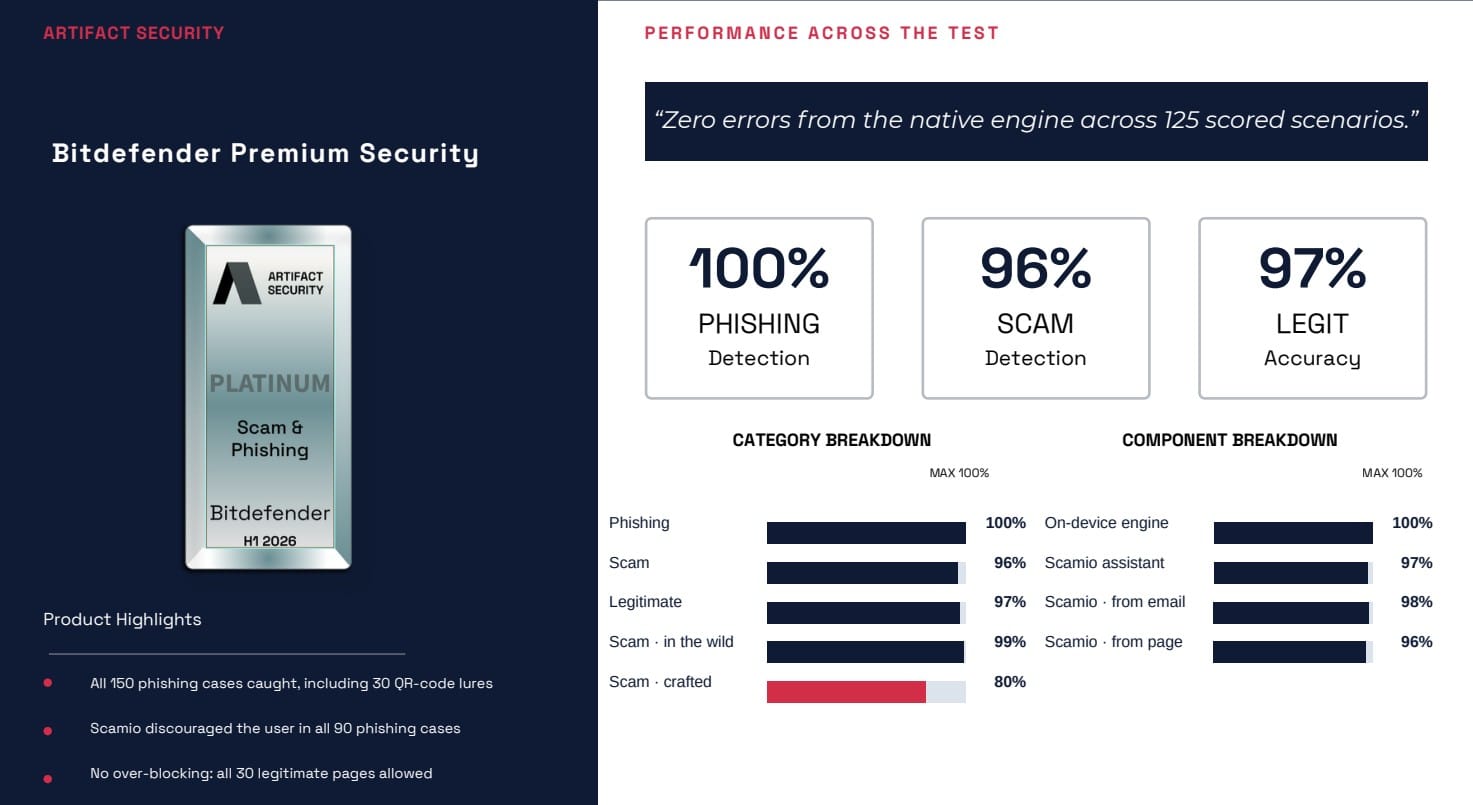
| Phishing category | 100% |
| Scam category | 96% |
| Legitimate-content category, combining device and assistant results | 97% |
On-device protection earned points for stopping malicious scenarios before compromise and correctly allowing legitimate content. Scamio earned points for giving the user the right recommendation.
A verdict the user cannot act on has no protective value, so the assistant is scored on the steer it gives, not the verdict alone. Bitdefender gave a clear, correct instruction in 185 of 190 assistant cases.
— Stefan Dumitrascu, CEO, Artifact Security
A perfect on-device score, without blocking legitimate pages
Bitdefender’s on-device protection earned full marks across all 125 scored scenarios.
The lab assessed whether protection stopped an attack before compromise through email filtering, URL filtering, or scanning a malicious payload when it was written or executed.
Protection also correctly allowed all 30 legitimate pages, without browser-level blocking, warnings, or degradation. Legitimate downloads were allowed too.
Phishing protection held up against links and QR codes
Bitdefender achieved 750 out of 750 points across 150 scored phishing cases, combining device and assistant results.
The lab ran brand-impersonation campaigns using conventional links and QR-code lures embedded in emails. Neither variant produced a failure in the scored phishing tests.
Scamio advised users against proceeding in all 90 phishing-related assistant cases. Even when it expressed uncertainty about its verdict, its recommendation remained protective.
Scamio offered practical guidance, with room to improve
Scamio provided clear, correct advice in 185 of 190 assistant cases, earning approximately 97% of available points. The report recorded scores of 98% for assessments submitted from email and 96% for those submitted from a page.
Five cases account for all the points lost. Two scam pages and two legitimate pages received uncertain verdicts with no usable advice. In one additional case, Scamio incorrectly rated a scam email as safe and encouraged the user to proceed. On-device protection retained its perfect score.
Across the scam category, Bitdefender earned 96%. Results differed between scenarios drawn from live campaigns, which scored 99%, and those crafted by the lab, which scored 80%.
Recognition for protection that helps people act
The evaluation assessed a defined part of Bitdefender’s scam-protection capabilities. Within that scope, the results demonstrate the value of combining protection that can interrupt attacks with an assistant that helps people decide what to do.
Bitdefender's result was close to the best this scam and phishing evaluation can measure. The on-device protection was effective in all 125 attempts, and the assistant gave a clear, correct recommendation in 185 of 190 cases. That is the strongest combined result we recorded in the first half of 2026.
— Ana Maria Pricop, Chief Business Officer, Artifact Security
For consumers, the benefit is straightforward: more opportunities to stop a scam before it causes harm, and practical guidance when an online interaction feels suspicious.
Explore Bitdefender Premium Security for protection against online threats, and turn to Scamio for help assessing suspicious messages, links, and other potential scams before taking the next step.
Download the Artifact Security Bitdefender Scam & Phishing H1 2026 report (PDF) for the full findings.
tags
Author

Filip has 17 years of experience in technology journalism. In recent years, he has focused on cybersecurity in his role as a Security Analyst at Bitdefender.
View all postsYou might also like
Bookmarks
