Binance breach news is already being used in crypto phishing emails, Bitdefender Labs warns

November 03, 2026
Just days after reports of a security incident at Binance involving an estimated $6.3 billion in crypto assets, phishing emails are already exploiting the news to pressure crypto holders into sending Bitcoin or “verifying” their wallets.
It’s unfortunately a familiar pattern. When a major breach, outage, or financial incident makes headlines, scammers quickly piggyback on the news with fake messages of support, offers of compensation, and urgent account warnings. These campaigns show just how quickly they adapt an existing phishing template to a real-world event.
Bitdefender Antispam Lab has identified two related campaigns: one posing as a Binance “reconciliation desk,” and another impersonating Trust Wallet.
Key takeaways
- Bitdefender Antispam Lab has uncovered two scam campaigns exploiting news of the Binance breach just days after it made headlines.
- The first is an advance-fee scam posing as a Binance “reconciliation” process. It promises recipients a Bitcoin payout, but demands a supposed wallet-verification fee first.
- The second impersonates Trust Wallet and uses warnings about account suspension to lure recipients to a fake wallet-verification page, where their wallet access or recovery details may be at risk.
- The campaigns show how quickly phishing templates can be updated to exploit a major breach, using real news, invented procedures and urgent deadlines to make the message feel credible.
- Neither Trust Wallet nor Binance is associated with these scam messages.
Last week, on Oct. 29, Binance disclosed a security incident involving an estimated $6.3 billion in crypto assets, which the FBI has publicly attributed to North Korea-linked actors tracked as TraderTraitor. While Binance said it would cover customer losses through its Secure Asset Fund for Users and company reserves, cybercriminals quickly jumped on the opportunity, exploiting the news and confusion around recovering stolen funds.
Just days later, on Nov. 1, Bitdefender Antispam Lab researcher Viorel Zavoiu identified scam emails already exploiting the news. The campaigns use the Binance breach as a ready-made pretext for fake compensation claims and urgent wallet-verification requests, showing how quickly threat actors can adapt phishing templates around a major incident.
Below is a closer look at the two campaigns and the warning signs to watch for.
‘Your Bitcoin address has been returned as UNCLAIMED’
The first campaign, observed targeting recipients in Ireland, Japan, the US, Germany and Finland, presents itself as a formal compensation process called the “SAFU Reconciliation Desk.”
The email claims the recipient’s Bitcoin address appears in a “reconciliation index” built after the Binance breach:
“Your Bitcoin address has been returned as UNCLAIMED in the reconciliation index built from the 29 October breach at Binance.”
It then uses detailed claims about the breach, including the value stolen, the FBI attribution, assets allegedly frozen, and supposed compensation arrangements. This is what makes the email dangerous: it blends real news with made-up administrative language and invented recovery terms.
The message claims that Binance has already replaced “90% of the stolen book,” that the remaining portion is being bought back, and that the recipient qualifies for a fixed Bitcoin allocation. It even includes fabricated tiers such as:
“0.50 – 1.99 BTC held → 1.10 BTC reissued”
The goal appears later in the message. To receive the invented allocation, the recipient is told to pay a “wallet-verification fee” of 0.0042 BTC, worth roughly $327 at the time the email was sent.
“Confirm the address is live and controlled by sending the wallet-verification fee to the settlement address below.”
The email claims the fee will be returned with the release. Based on our analysis, there is no indication that it would be. Once cryptocurrency is sent to a wallet controlled by someone trying to deceive you, there is usually no practical way to reverse the transaction.
The sender also adds a tight deadline, a case number, a queue of “11,400 cases,” settlement batches and a supposed independent auditor. These details are meant to make the process sound official while pushing recipients to act before they think to verify it.
What this scam is after
This version is straightforward: it wants recipients to send Bitcoin directly to the supplied wallet.
It does not need a password, seed phrase or exchange login if it can persuade someone to voluntarily authorize a transfer. That is why the message reassuringly says:
“No seed phrase. No exchange login. No KYC documents.”
Those statements are not evidence that the email is safe. They are part of the pitch. The “verification fee” is simply an advance-fee scam dressed up as a crypto recovery process.
A real compensation or security notice should never require you to send cryptocurrency first to prove ownership, activate a claim or release funds.
Trust Wallet phishing campaign adds Binance angle
A separate email phishing campaign using the subject line “Binance Hack Also Impacts Trust Wallet Users” impersonates Trust Wallet and has targeted recipients in the US, UK, Australia, Ireland and South Africa.
Its central message is much simpler:
“Due to the ongoing situation involving Binance, all users are required to complete a verification process.”
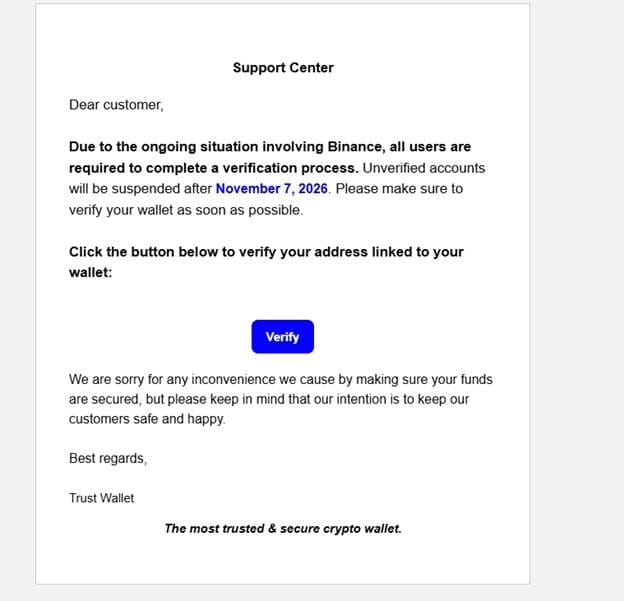
Sample of a phishing email impersonating Trust Wallet after the Binance security incident (recipient details redacted).
It warns that unverified accounts will be suspended after Nov. 7, 2026, then urges users to click a button to “verify your address linked to your wallet.”
The email uses the Trust Wallet name and familiar support language to make the request feel routine. But any link in an unsolicited wallet-verification email can lead to a phishing site designed to steal login details, recovery phrases, private keys or authorization for a malicious transaction.
A clear example of how fast phishing templates change
What makes the Trust Wallet campaign particularly revealing is how quickly it was adapted.
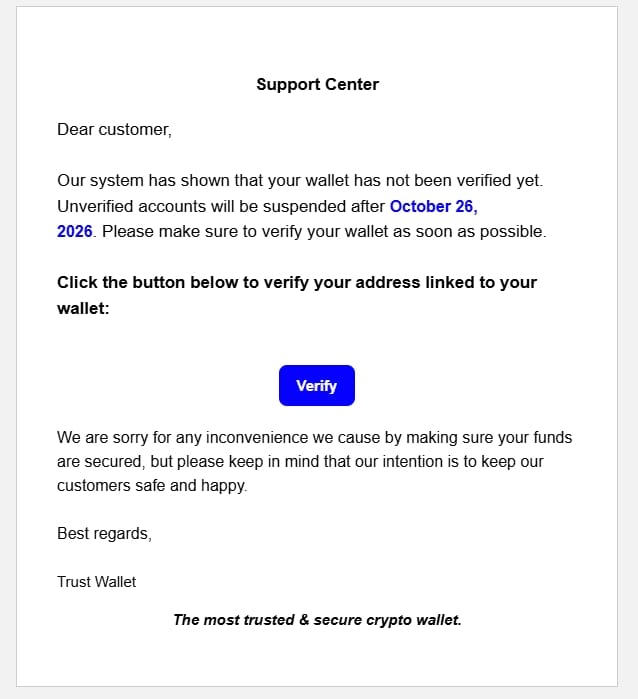
Just before this version appeared, a nearly identical email used the subject line:
“Please verify your Trust Wallet.”
That earlier message did not mention Binance. It simply claimed that the recipient’s wallet was not verified and would be suspended after Oct. 26, 2026.
The newer version keeps the same structure, urgency and “verify your address” button, but swaps in the Binance breach and a new deadline. In other words, the people behind the campaign did not need to build a completely new phishing operation. They only had to update a few lines to exploit a headline that crypto holders were already watching.
This is an important reminder: after any major breach, outage or security announcement, expect fake support emails, recovery offers and verification requests to follow quickly.
How to stay safe after a crypto breach
- Do not send crypto to receive crypto, unlock compensation or verify a wallet
- Do not click verification buttons in unexpected emails, even if they mention a real incident
- Open Binance, Trust Wallet or another service through the official app or by typing the known web address yourself
- Treat fixed compensation amounts, “allocation bands,” queues and countdowns with caution
- Never share a seed phrase, private key, recovery phrase or one-time authentication code
- Review wallet activity and connected applications directly from your account
- Use app-based two-factor authentication or passkeys where available
Add another layer of protection
Scam emails can look polished, especially when they borrow details from a real breach in the headlines. If you receive a message claiming to come from Binance, Trust Wallet or another crypto service, use Scamio to get a second opinion before replying, clicking a link or sending funds. You can also use Bitdefender’s Link Checker to check a suspicious URL without opening it.
A security solution with Scam Protection can provide another important layer by helping identify phishing links and deceptive messages before you reach a fake verification page or authorize a transfer. Bitdefender security solutions help block known malicious websites and flag suspicious links, emails and scam attempts, helping you pause before a convincing-looking message turns into a financial loss. No security tool can detect every scam, so staying alert remains essential.
Disclaimer: This report is published for informational and educational purposes only. The findings presented are based on independent research conducted by Bitdefender Labs using publicly available information and proprietary threat intelligence. The mention of specific domains, entities, brands, or trademarks does not imply any endorsement, affiliation, or official relationship. All trademarks referenced herein are the property of their respective owners. Bitdefender makes no representations or warranties regarding the accuracy or completeness of third-party information. Readers are encouraged to verify any information independently before taking action.
tags
Author

Alina is a history buff passionate about cybersecurity and anything sci-fi, advocating Bitdefender technologies and solutions. She spends most of her time between her two feline friends and traveling.
View all postsYou might also like
Bookmarks
