AI Faces Look ‘More Human’ Than Human Faces, Researchers Find

February 23, 2026
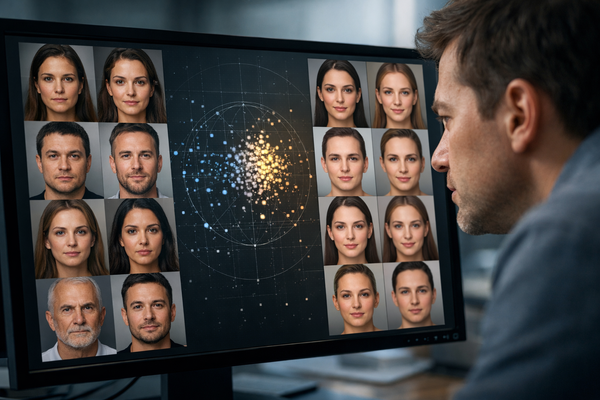
Researchers from the University of New South Wales have discovered that some people have exceptional face-recognition abilities and are much better at spotting AI-generated faces.
Only a few years ago, people were making fun of how bad Will Smith looks when he eats spaghetti. But we knew, even back then, that technology would reach a point where AI-generated people would be almost impossible to distinguish from real people.
From what researchers have explained, it turns out that technology not only reached that point, but it surpassed it for many of us. The only thing that now protects us is that AI systems tend to be “calculated,” which means synthetic images look “too average” to be real.
Why the need for this research?
As AI-generated profile photos and content flood social media, dating apps and every other corner of the Internet, it’s important to understand why some faces look suspicious, as this could help prevent fraud, identity scams and misinformation.
Researchers led by James D. Dunn at the University of New South Wales tested whether people with exceptional face-recognition skills could be better at separating AI-generated faces from real ones.
The team compared 36 super-recognizers to 89 motivated control participants using 200 facial images. Half of the images were real and the other half were AI-generated using StyleGAN2.
Their findings revealed a clear pattern:
· Super-recognizers were significantly better
· Face recognition ability positively correlated with AI detection accuracy.
· AI faces are clustered at the statistical “center” of face-space
It turns out that people’s ability to recognize faces is also very good at spotting that real faces are also asymmetrical. AI tools are more prone to creating faces that are too symmetrical.
In short, AI faces are too proportional and too typical. Researchers described this as “hyper-averageness.”
The bad news is that while the super-recognizers were 15% better than the typical samples, they were only slightly better than guessing. They identified AI faces correctly just 57% of the time – only 7 percentage points above chance.
In practical terms, they would misidentify about 4 out of every 10 faces.
How Bitdefender Helps Protect Against AI-Driven Identity Fraud
Bitdefender launched They Wear Our Faces, a national awareness campaign exposing how scammers exploit trust and relationships by using AI to deceive and impersonate.
Bitdefender’s security solutions combine:
· Advanced anti-phishing detection
· Behavioral anomaly monitoring
· AI-powered fraud prevention
· Identity protection tools
· Scam detection technology
Preventing these types of identity attacks requires more than spotting a suspicious profile photo; it requires identifying the behavior behind it.
tags
Author

Silviu is a seasoned writer who followed the technology world for almost two decades, covering topics ranging from software to hardware and everything in between.
View all postsYou might also like
Bookmarks
