Thread 1.4 Security Guide: How To Guard Your Mesh While Thread 1.4 Trickles In

December 03, 2025

Your smart home is evolving, but your security can’t afford to wait for Thread 1.4 to fully arrive.
A smart home standard in transition
If your smart home feels more like a science experiment than a finished project, you’re not alone. Thread 1.4 promises to finally unify all those little islands of smart bulbs, sensors and plugs into one cohesive mesh. However, as we previously discussed, the rollout is slow, staggered and messy.
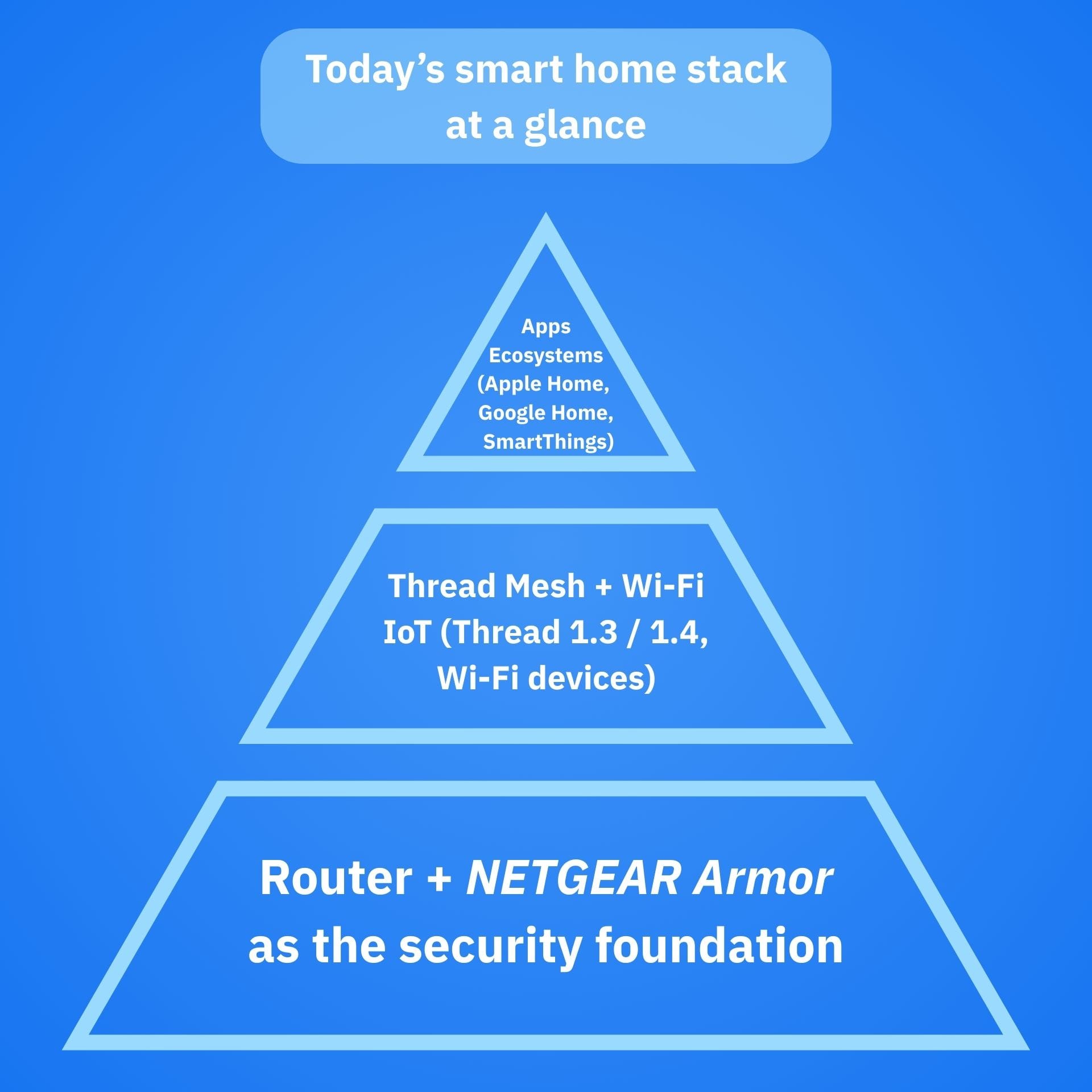
In the meantime, you still need to secure that half-finished mesh. Let’s unpack what Thread 1.4 actually changes, why many homes are stuck in limbo, and how you can harden your setup today, including with solutions like NETGEAR Armor that protect every IoT device on your network.
Thread 1.4 in plain language
Thread is a low-power mesh networking protocol for smart homes. It connects things like sensors, locks, thermostats and plugs in a resilient, self-healing mesh that’s designed to be fast, efficient and secure. It also serves as the backbone of many Matter devices.
Thread 1.4 is the latest major update to that protocol. In practice, it aims to fix three big pain points:
- Too many separate meshes: Older Thread 1.3 devices often spin up proprietary Thread networks, so your home ends up with multiple overlapping meshes from different brands. Thread 1.4 lets Thread Border Routers – such as hubs, routers and smart speakers – join an existing network instead of always creating new ones.
- Credential chaos: Thread 1.4 defines standardized Thread Credential Sharing, so different ecosystems (Apple, Google, Samsung, etc.) can share secure Thread keys instead of relying on proprietary workarounds.
- Better large-scale management: It introduces more robust commissioning tools and diagnostics, like TCAT and Thread-over-infrastructure, so big deployments, and eventually advanced home setups as well, are easier to manage and troubleshoot.
However, there’s a catch. While the specification landed back in late 2024, full support from all major vendors is expected to stabilize closer to 2026.
The security problem: a fragmented mesh is noisy
From a security standpoint, a “half-migrated” smart home is far surpasses a mere annoyance. It’s downright confusing, and this confusion can lead to grave mistakes. Today, many households have multiple Thread meshes that run synchronously (or better yet, asynchronously). The problem is that each ecosystem maintains its own Thread credentials.
Another issue is that legacy Wi-Fi IoT devices that are not exactly Thread-friendly still hang off the main SSID with weak passwords or outdated firmware. Last but not least, there’s severe overlap in control apps, whether vendor or ecosystem apps. This, in turn, makes it harder to see what’s actually on your network and whether it’s secured.
Weak spots in your smart home ecosystem
Threat actors don’t need to “hack Thread 1.4” directly to cause trouble. They often use more facile access points to breach vulnerable systems, including:
- Weak links on local area networks (LANs) such as old cameras, forgotten smart plugs or discount hubs that either reached the end of their life cycle or with poor patching
- Insecure remote access such as weak router passwords, exposed admin panels or cloud dashboards
- Phishing and malicious websites that trick you into visiting rogue websites or installing malware on phones and laptops which share the home network with your mesh
Thread’s crypto technology is solid – more often than not, poor overall smart home posture is the problem. That’s precisely why it’s important to fix it now, while Thread 1.4 is still trickling into your devices through firmware updates.
How to secure your mesh today (practical steps)
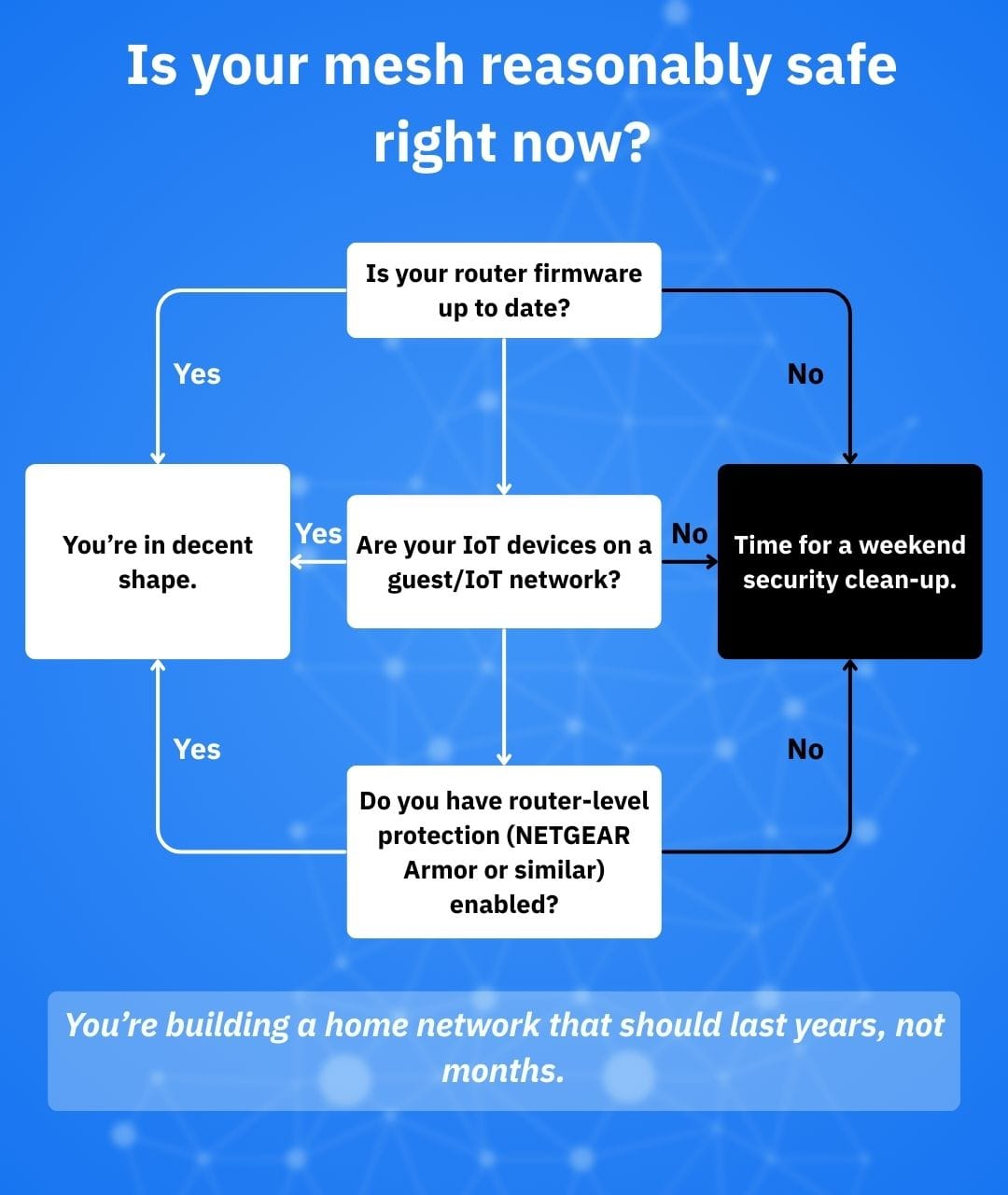
1. Secure your router and Wi-Fi
Even though your mesh may be Thread, it still relies on your router and Wi-Fi for internet access, mobile control and cloud integration. Lock down these first:
- Use strong, unique passwords for router administrator accounts and Wi-Fi SSIDs. No more “admin/password” combinations and no more reused passwords to avoid credential stuffing attacks.
- Turn off remote admin. If you really need it, make sure to enforce strong authentication, and, ideally, use a VPN.
- Keep firmware updated on your router, mesh system and smart hubs. Many vendors quietly add security fixes and Thread 1.4 support in these updates.
2. Segment your smart home traffic
While Thread is its own mesh, most homes still rely on Wi-Fi-only IoT devices. Give them their own lane by putting IoT gadgets on a guest network or dedicated IoT SSID, segregating them from your laptop and phones.
Furthermore, if your router supports it, enable VLANs or device isolation so that IoT devices can talk to the internet, but not to each other unnecessarily.
Although this alone won’t fix Thread fragmentation, it will limit what an attack can do if they compromise a single smart plug or camera.
3. Prioritize buying devices with clear update paths
As Thread 1.4 adoption ramps up, it’s worth being slightly pickier when buying a new device. With that in mind:
- Check whether your hubs, border routers and related devices have announced or shipped Thread 1.4 support.
- Look for vendors who commit to long-term updates. Flashy features can be nice, but a cheap device with no security udpates will age badly in a constantly evolving mesh.
Take a step further in securing your smart home
Even with careful configuration, it’s hard to manually secure every device, protocol and cloud integration in your smart home. This is where router-level security services like NETGEAR Armor (powered by Bitdefender) can make a real difference.
On compatible Orbi mesh systems and Nighthawk routers, NETGEAR Armor sits at the edge of your network and:
- Identifies and protects every connected device, including obscure IoT gadgets that never see a traditional antivirus.
- Blocks malicious websites and phishing attempts before they reach your phone, tablet or smart display.
- Runs vulnerability assessments on your home network, flagging weak passwords, open ports and outdated firmware.
- Extends protection to devices on the go, not just while they’re on your home Wi-Fi.
That means whether your Thread mesh is still fragmented or just transitioning to 1.4, you’ve got a security watchdog inspecting traffic at the gateway instead of trying to harden each device manually.
If you’re already investing in a high-end mesh system to get the best out of Thread and Matter, pairing it with NETGEAR Armor effectively gives your smart home a built-in SOC (Security Operations Center) that never sleeps.

Frequently Asked Questions (FAQ)
What is Thread mesh?
Thread mesh is a low-power, self-healing network that connects smart home devices so they can communicate seamlessly without relying solely on Wi-Fi. Each device can relay signals to others, strengthening both coverage and resilience.
What is 802.15.4 Thread?
802.15.4 Thread refers to the Thread protocol built on the IEEE 802.15.4 radio standard, which is designed for low-power, short-range communication. This foundation allows Thread devices to form efficient mesh networks ideal for smart home environments.
What is an IoT Thread?
An IoT Thread is simply a Thread network used by IoT devices like sensors, locks and switches. It provides secure, low-latency communication tailored for small, battery-powered devices that benefit from mesh connectivity.
What is Thread vs Wi-Fi?
Thread is a low-power mesh network for device-to-device communication, while Wi-Fi is a high-bandwidth network designed for internet access and data-heavy tasks. Thread handles sensors and smart home automation efficiently, while Wi-Fi supports streaming, browsing and cloud connectivity.
Conclusion
You don’t need to wait for every vendor to flip the Thread 1.4 switch before you treat your own smart home like critical infrastructure.
Secure your router, segment your network for IoT, choose updateable gear and turn to a platform like NETGEAR Armor to patrol the edge perimeter while mesh standard slowly catches up.
tags
Author

Vlad's love for technology and writing created rich soil for his interest in cybersecurity to sprout into a full-on passion. Before becoming a Security Analyst, he covered tech and security topics.
View all postsYou might also like
Bookmarks
