Instagram scams in 2026 - How to spot, stop & protect against every major threat

January 28, 2026
Instagram scams combine social engineering, impersonation and financial fraud – this guide explains how they work and how to avoid them.
Key takeaways
- Instagram scams in 2026 blend social engineering, impersonation and financial fraud, using DMs, comments, fake profiles, bio links and hijacked accounts to reach victims.
- The most common Instagram scams include phishing via fake login pages, “vote for me” links, malicious comment prompts, fake giveaways, brand impersonation, fake support accounts, marketplace fraud, crypto scams and romance scams.
- Scammers exploit urgency and misplaced trust, often pretending to be brands, influencers, recruiters, charities, romantic partners or even account recovery specialists.
- Protecting yourself means avoiding unsolicited links, verifying accounts before sharing money or data, enabling MFA, reviewing active sessions and using tools such as Bitdefender Scamio, Bitdefender Security for Creators and Bitdefender Digital Identity Protection where relevant.
Instagram scams are on the rise
Instagram has become much more than a photo-sharing app. Like many other social media platforms, Instagram now serves as a marketplace, a messaging platform, a creator economy hub, and, inevitably, a fertile soil for scams.
Criminals exploit the platform’s informal communication style and frictionless private messaging to run fraud campaigns that range anywhere from quick phishing schemes to long-running financial and romance scams.
This comprehensive guide breaks down a broad spectrum of Instagram scams, explaining how each works, why it succeeds and where deeper coverage is available or planned. The goal is not to alarm you, but to raise awareness. After all, understanding scams is the first step towards avoiding them.
Why Instagram is so attractive to scammers
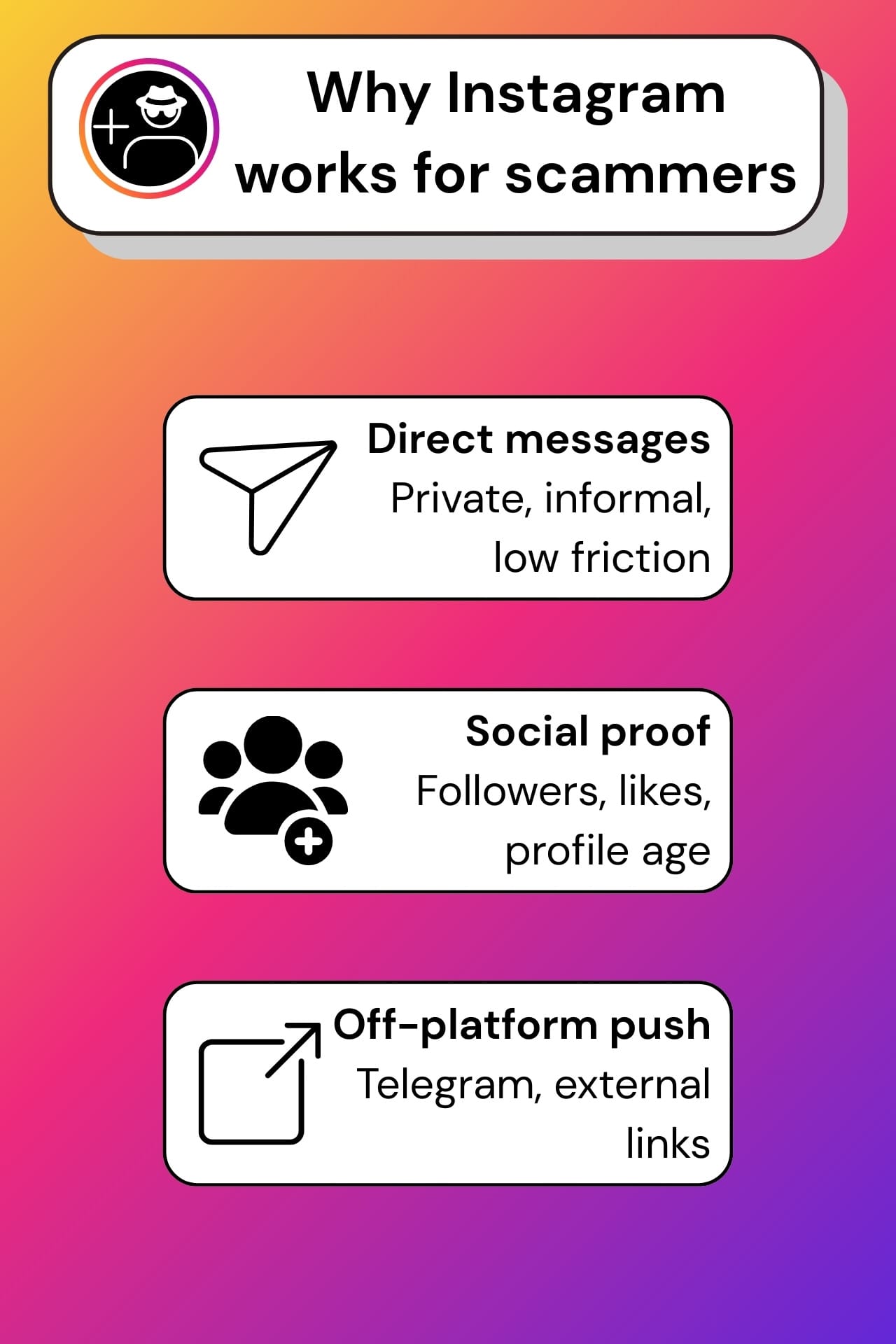
Instagram offers three elements scammers thrive on: scale, trust and plausible deniability. Threat actors can create or hijack accounts in volume. Once they do, they can start luring victims with direct messages (DMs) that feel personal, often succeeding in pushing them off platform before they realize something’s wrong.
These traits help create an ecosystem where con artists can automate, personalize and monetize scams quickly.
Account takeover and credential theft scams
Phishing via fake login pages
One of the most common Instagram scams begins with a simple message. Some examples include copyright complaints, suspicious activity or account verification requests. Notice how all these examples revolve around a central theme: urgency.
Once contact is established, scammers direct their victims to convincing fake login pages designed to steal credentials. If the takeover succeeds, the perpetrator quickly repurposes the stolen account for further scams.
Engagement-bait scams (‘Vote for me’)
These scams rely on social engineering rather than technical deception. A message from a familiar contact asks the victim for a simple favor, such as “vote for me,” or “can you fill out this online survey real quick?” The scammer also provides a link.
If the victim accesses the malicious link, they are redirected to a rogue website where their credentials or funds could be stolen.
Malicious links in comments
Scammers also try to lure victims by posting links in comments, often under viral posts. On Facebook, this type of comment used to be accompanied by a vague prompt that would entice users to check out the link, such as “Is this you?” or “I can’t believe this.”
Fortunately, Instagram restricts clickable links in comments, so they appear as regular text, making it difficult for users to click them by accident. Even if a scammer pasted a malicious link in a comment, users would need to manually copy the link and paste it into a browser to access it.
However, scammers have found a workaround and began placing malicious links in their bios, using enticing prompts in the comments to lure unsuspecting users. Whether in bio sections or comments, these links may lead to phishing pages, malware or adult content giveaways.
Impersonation and trust-abuse scams
Influencer and brand impersonation
Fake accounts copy the branding, usernames and tone of influencers or businesses to promote fake giveaways, counterfeit products or fraudulent services.
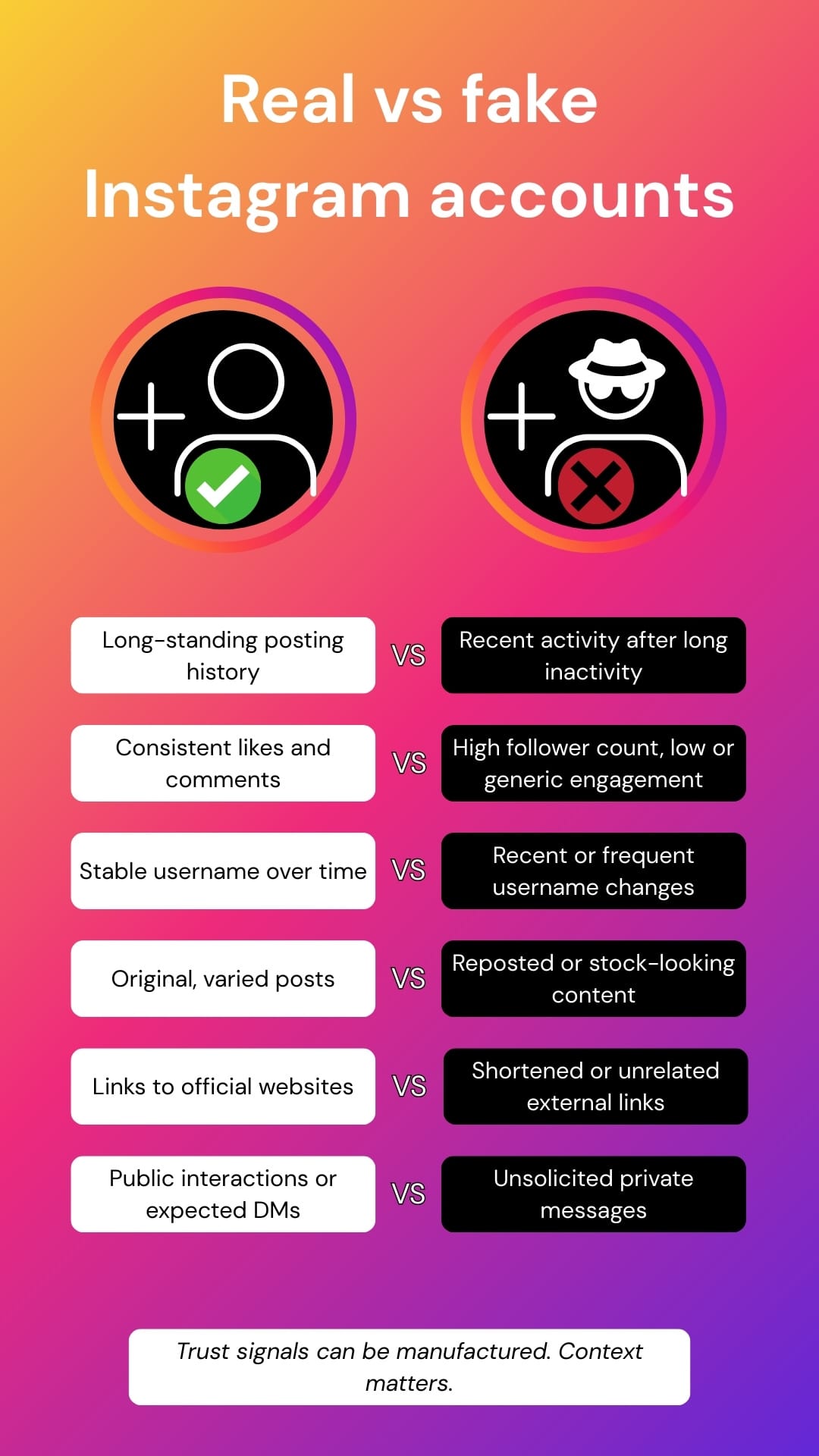
One sure way to spot these cheap attempts is to perform cross-checks and look for mismatches (missing or extra characters in the username, low-resolution profile picture, different links). Note that bad grammar is no longer a reliable indicator of scams; AI advancements have contributed to the rise of scams with pitch-perfect written hooks.
Fake Instagram support accounts
Like the title suggests, in this scenario scammers pose as “official support” agents, contacting people who publicly complain about various account issues.
Once they establish rapport, these fake helpers request credentials or payments to fix the problem. Users who refuse to do so are often persuaded with claims of further damage (account compromise, identity theft).
Aged and hijacked account abuse
Aged Instagram accounts, whether bought or hijacked, are especially dangerous. Their follower count, posting patterns, history and their very age often lend credibility, making scams harder to detect.
Remember, even if an account seems to be in good standing, with a solid follower count and normal posting patterns, you can never assume it’s safe to interact with it.
Financial and transactional scams
Fake giveaways and contest scams
In this scenario, threat actors tell their targets that they’ve won a prize. However, they also ask them to pay for shipping fees or taxes, or require their personal details to claim it.
Regardless of the alleged prize, one effective way to prevent this type of scam is to step back and think it through – legitimate giveaways do not require payment.
Marketplace and fake product scams
Fraudulent Instagram shops and DM-based sellers take payment for products that either never arrive or are counterfeit.
These scams often rely on disappearing accounts and off-platform payment methods. Threat actors typically use aged Instagram accounts for this type of scam, as they lend the scam a massive boost in credibility.
Paid follower and growth scams
Services promising rapid follower growth or engagement could be fronts for credential-stealing campaigns.
More often, though, after payment, these services flood accounts with massive amounts of bot traffic (likes, comments, follows) that gets accounts penalized. Instagram keeps a close eye on accounts that get huge follower counts overnight and either shadow-bans or deactivates them if it detects bot traffic.
Sometimes, the service claiming to help you grow your follower base simply vanishes after payment.
Career and creator scams
Fake job scams
Scammers pose as recruiters or companies offering remote roles at reputable companies or high-paying roles at startups.
Victims are asked for personal data, copies of their ID or even upfront equipment fees. Aside from the equipment fees, handing over personal data is expected when signing up for a job, which makes the scam harder to detect, especially by people who are actively seeking a job.
Brand collaboration scams
Scammers target creators with collaboration offers that lead to malicious contracts, fake onboarding portals or banking information requests. It all starts with a message stating something like: “Hey, I’ve checked out your profile and you’d be perfect for our …”
These scams are particularly effective against freelancers, small business owners, and creators who rely on Instagram for income.
Investment, crypto and romance scams
Investment and crypto scams
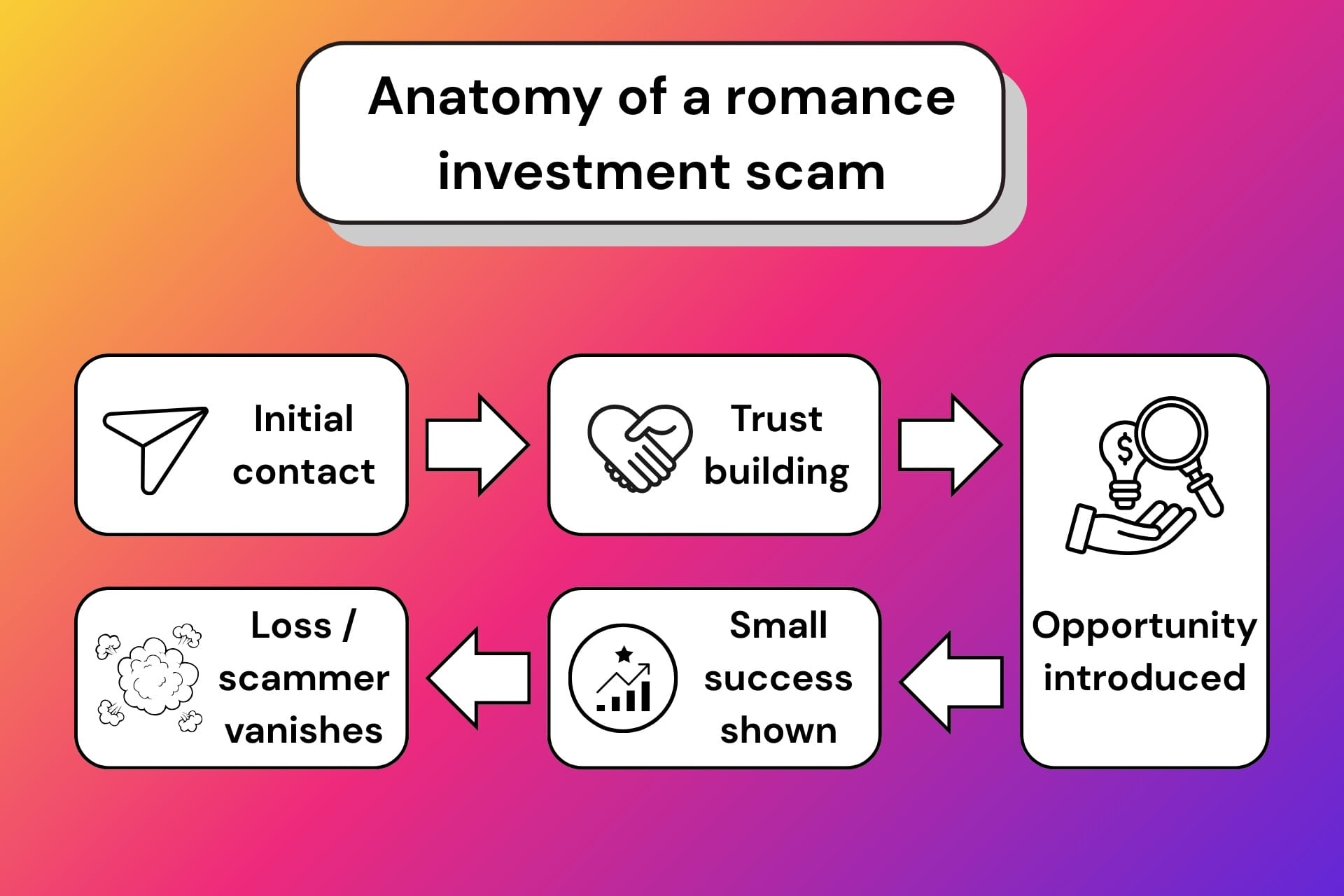
In this scenario, perpetrators often start with casual conversation. If the target seems interested, scammers gradually introduce “investment opportunities,” complete with fake dashboards and fabricated profits.
Sometimes the victim actually sees a return on their investment, but it’s all part of a bigger plot. Once hooked, victims are encouraged to invest increasing amounts before the scammer does a so-called “rug pull,” vanishing with the victim’s investments.
Instagram romance scams
Some scams focus entirely on the social part of Instagram. One such example is the romance scam. This type of scam relies entirely on emotional manipulation; after weeks or months of building trust, threat actors fabricate emergencies or financial opportunities to extract money.
Victims who fall for this trap often end up with drained bank accounts and little to no way to recover their losses.
These two categories frequently overlap, forming so-called romance-investment hybrid scams.
Charity and emotional manipulation scams
Scammers exploit empathy by saying they represent charities, disaster relief efforts or animal rescue organizations. Perpetrators use emotional imagery and urgent appeals to pressure victims into donating quickly, often without verification.
Although you can stumble upon this type of scam at any given time, its incidence spikes during or immediately after national tragedies, cataclysms, military conflicts, earthquakes, and other disastrous scenarios.
Account recovery scams (the second hit)
After an account is compromised, victims are often targeted again – this time by fake “recovery services” that promise to restore access to the lost account, for a fee.
These services are almost always fraudulent and capitalize on a sense of panic and urgency. They typically work in sync with the scammers who initially compromised the account.
Scam automation and bot campaigns
Automated systems such as bot-driven DM campaigns, mass-produced fake profiles and AI-generated conversations hide behind many Instagram scams.
Automation is a scammer’s best friend, as it helps them scale quickly and with minimal effort. That’s precisely why you often see waves of identical messages or comments on Instagram (and other social platforms).
How to keep your Instagram account safe
While no single step guarantees safety, solid knowledge of how scams operate, combined with a layered defense, can significantly reduce exposure. Here’s how to keep your Instagram account safe from scams:
- Be skeptical of unsolicited DMs, especially those containing links
- Avoid logging in via links sent through messages or comments (bio links are not guaranteed to be safe either)
- Enable multi-factor authentication (MFA) and review active sessions periodically
- Verify accounts carefully before sending money or data (or avoid doing so at all, if possible)
- Use platform-native checkout and reporting tools where possible
Beyond basic account hygiene, specialized security tools can also help you detect scams early, limit the impact of compromised credentials and protect high-value Instagram accounts.
- Bitdefender Scamio: an AI-powered scam detection tool that helps assess suspicious Instagram messages or scenarios before you interact with them; useful for spotting phishing and social engineering attempts in DMs
- Bitdefender Security for Creators: a dedicated security solution designed to protect creators’ social media accounts, including on Instagram, by monitoring for account takeover risks, phishing attempts and unauthorized activity across linked devices and platforms
- Bitdefender Digital Identity Protection: a monitoring service that alerts users if their email addresses, credentials or personal data appear in breaches or on the dark web, helping reduce the risk of Instagram compromise caused by exposed or reused credentials
Final thoughts
Instagram scams are part of a broader, ever-evolving fraud ecosystem that blends social engineering and psychological manipulation. The way they seamlessly blend into everyday interactions on the platform makes them very dangerous.
Understanding how these scams fit together makes it easier to spot them early and avoid becoming the next link in the chain. Whether the threat involves phishing links, fake giveaways, hijacked aged accounts or romance fraud, the underlying tactics are consistent – they all exploit a sense of urgency and misplaced trust.
Frequently asked questions (FAQ)
How can you tell a scammer on Instagram?
Scammers often use unsolicited DMs, urgent language, suspicious links, impersonated profiles and requests to move the conversation off Instagram. If one or more of these red flags match your situation, you’re probably in a scammer’s crosshairs.
Can someone steal your info through Instagram?
Yes. Scammers can steal personal data or account credentials on Instagram through phishing links, fake login portals or deceptive messages designed to trick users into sharing sensitive information.
Can a scammer hack you if you reply to them?
Replying alone is not enough to get hacked. Clicking links, downloading files or typing credentials where you shouldn’t, however, can lead to account compromise.
tags
Author

Vlad's love for technology and writing created rich soil for his interest in cybersecurity to sprout into a full-on passion. Before becoming a Security Analyst, he covered tech and security topics.
View all postsYou might also like
Bookmarks
