Why Don’t You Use a Mobile Security App? We Ask Netizens

January 16, 2026

In the modern world, your phone is your wallet, your ID, and increasingly, the gateway to your life online. Despite that, millions of people still don’t take one simple step that could dramatically reduce their risk of scams, malware and identity theft: installing a mobile security app.
Some 53% of respondents in the 2025 Bitdefender Consumer Cybersecurity Survey say they bank, shop and interact online from their phone.
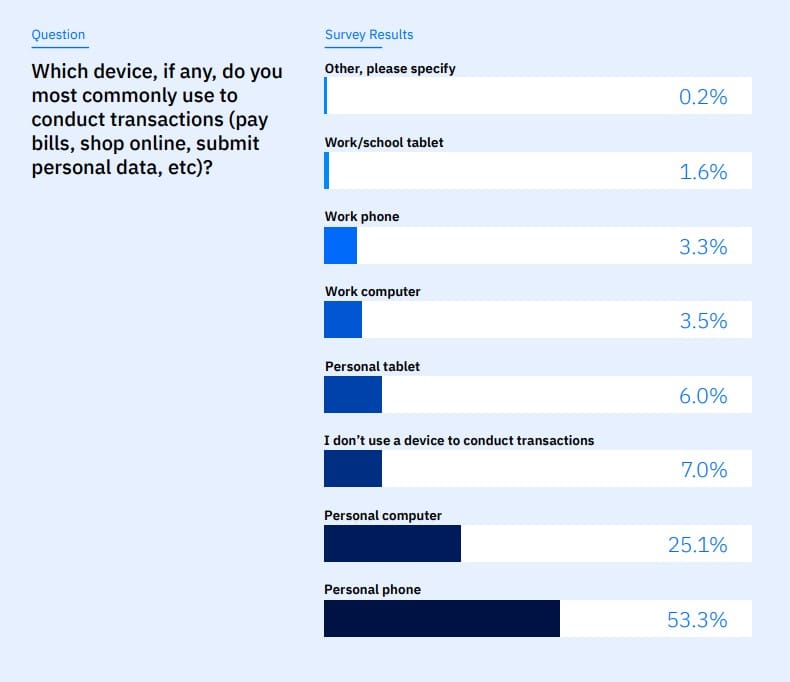
Which device, if any, do you most commonly use to conduct transactions (pay bills, shop online, submit personal data, etc)?
Source: Bitdefender 2025 Consumer Cybersecurity Survey
Yet nearly as many (48%) refuse to run an independent mobile security solution.
Almost a third (32%) find security apps too expensive, and around a fifth believe a security tool will slow down their device.
19% believe their device’s built in security is enough, while as many as 32% said they have no reason whatsoever to eschew security apps.
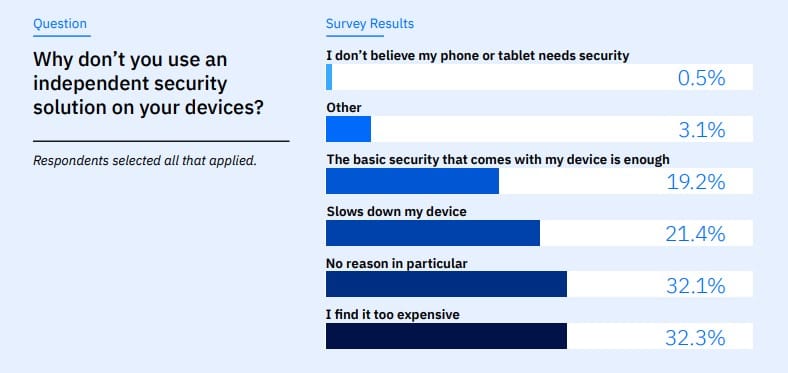
Why don’t you use an independent security solution on your devices? (select all that apply)
Source: Bitdefender 2025 Consumer Cybersecurity Survey
Older consumers are particularly complacent — almost half of those aged 55 and older say they have “no reason” to add protection.
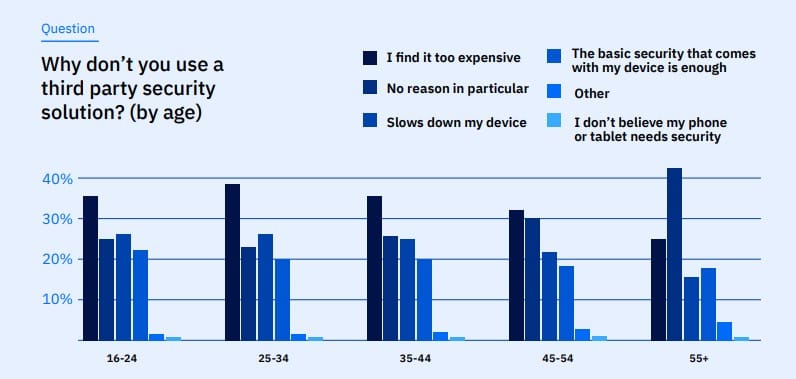
Why don’t you use a third-party security solution? (by age)
Source: Bitdefender 2025 Consumer Cybersecurity Survey
Misconceptions fuel the problem: some think a monthly factory reset is “good enough,” or that Apple devices are immune. The respondents who selected a reason outside the stated survey options gave a range of answers, including:
Security is included with internet
I can’t afford it
I factory reset every month or two. It’s the only sure-fire way to delete all viruses anyway.
Different devices have different levels of security
I have never thought about it as an option
Windows Defender and Apple combined with my own awareness of legitimate software/sites/links etc.
My security is built in and is reliable
Let’s break down some of the reasons netizens gave — and why most of them don’t hold up, given the risks.
1. ‘It’s too expensive’ — but you’re already paying a higher price
The most cited reason consumers avoid mobile security apps is cost. Some 32.3% of respondents said security software was too expensive.
At first glance, that’s understandable — we’re all budgeting, and subscriptions add up. But when set against the reality of daily scam encounters and financial loss, that calculus gets shaky.
According to the survey, scams are widespread: more than 7 in 10 respondents reported encountering scams in the past year, and one in seven admitted to falling victim. The average estimated scam loss among survey participants — over $500 — quickly dwarfs the annual cost of a trusted security suite.
When you consider mobile banking and payments are now standard — a habit that exposes people to credential theft, phishing apps, and malware — paying a few banknotes a month for protection is more an investment than an expense.
2. ‘I have no reason’ — the danger of complacency
Shockingly, about a third of people who don’t use mobile security apps said they simply had no reason to.
This isn’t just a shrug — it’s a mindset that lingers even as scams evolve. Many people trust their phone manufacturers or app stores to shield them from threats — a belief that’s dangerously incomplete. Built-in protections handle some risks, but they aren’t designed to catch the full spectrum of threats before it’s too late.
For example,websites preying on unpatched zero-day bugs, malicious ad networks and deepfake scams can slip past platform defenses. Modern mobile security apps like Bitdefender Mobile Security add layers like real-time web filtering and malware scanning, and can even recognize a scam unfolding — features basic system security doesn’t offer. Operators of mobile threat defense tools invest heavily in updates and threat intelligence, precisely because the threat landscape never sleeps.
3. ‘It will slow my phone’ — a myth worth debunking
One in five respondents cited performance concerns — they worried a security app would slow their device.
This is one of the oldest tech fears, and it largely reflects outdated past experiences. Modern security apps are designed to run efficiently in the background. They leverage optimized scanning schedules, cloud-powered detection and smart notifications so your phone’s performance stays intact for what matters most.
In most cases, the perceived slowdown comes from poorly written or bloated apps. Premium mobile security products prioritize performance because users simply won’t tolerate sluggish devices. And compared to the alternative — your phone infected with spyware or ransomware — a light background process is a tiny trade-off for peace of mind.
4. ‘Built-in security is enough’ — only until it’s not
Almost a fifth of respondents believe the security that comes with their device is enough.
This is a nuanced misconception. Phones from Apple and Android vendors do include security features — sandboxing, permissions control, app store screening, encryption, and secure boot processes. But these are baseline defenses. They’re not designed to protect against the breadth of threats people face today:
- Malicious websites and phishing links delivered through messaging apps and social feeds
- Zero-day malware that slips past even Apple’s walled garden
- Network-level attacks on public Wi-Fi
- Scams using AI-generated content to impersonate trusted contacts
Think of built-in security as the locks on your front door — necessary, but not enough against advanced threats. Independent security apps add the equivalent of alarms, motion sensors and monitoring for potential attacks.
5. Age and awareness — a generational risk gap
Older respondents were disproportionately likely to say they had “no reason” to install protection, even though they’re often targeted by sophisticated AI-voice scams and phishing attacks.
Data from the Federal Trade Commission (FTC) shows that consumers in the US lost more than $12.5 billion to fraud and scams in 2024, with investment scams alone accounting for roughly $5.7 billion. Older adults were especially targeted – impersonation scams have caused reported losses of hundreds of millions as scammers pose as government or trusted entities to extract money from victims.
This highlights how awareness (or the lack of it) plays into adoption. Those who grew up with technology may be more savvy about risks; others see it as “just another app” they don’t need. But fraud doesn’t discriminate — attackers use AI tools to clone voices, mimic texts and exploit trust. If a simple security app on your phone can help you fend of scammers, it’s probably worth considering.
Bottom line
Misconceptions about mobile security often create the perfect storm for attackers: the device people rely on most is often the least defended.
Your phone is your most intimate and most exploited device. As our survey shows, people fear financial loss, identity theft and scams — yet many skip simple defenses precisely because they feel safe. That misalignment between perception and reality makes room for scammers.
Modern mobile security apps don’t just add malware scanning — they provide real-time protection against phishing links, risky networks, malicious apps, scam sites and emerging AI-powered threats. In a world where 48% of consumers install no independent mobile protection at all, that gap makes for a big playground for cybercrime.
So if you ever find yourself wondering “Why would I need a mobile security app?”, remember that your phone is now your financial hub, your identity vault and your connection to the world. It deserves more than just the basics. Try Bitdefender Mobile Security today!
Download Bitdefender Mobile Security for iOS
Download Bitdefender Mobile Security for Android
You may also want to read:
1 in 7 Consumers Got Scammed in the Past Year – Bitdefender Consumer Cybersecurity Survey 2025
tags
Author

Filip has 17 years of experience in technology journalism. In recent years, he has focused on cybersecurity in his role as a Security Analyst at Bitdefender.
View all postsYou might also like
Bookmarks
