IP spoofing: What it is, how it works & how to prevent it

June 05, 2026
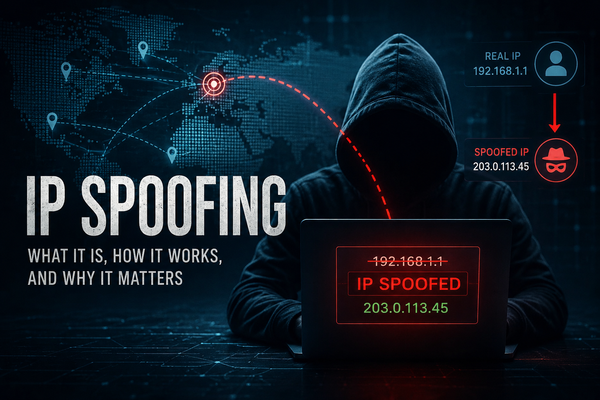
Your IP address helps devices communicate online, but it can also be manipulated to make internet traffic appear as if it came from somewhere else.
This technique is called IP spoofing.
IP spoofing is used in cyberattacks to hide identities, overwhelm websites, bypass filters, or make malicious traffic appear trustworthy. Unlike changing your IP for privacy using a VPN, IP spoofing usually involves pretending to be someone else’s device.
Here’s what IP spoofing is, how it works, and what you can do to reduce the risk.
Key takeaways:
- IP spoofing happens when someone falsifies the source IP address of internet traffic
- Attackers use it to hide identity, impersonate trusted devices, or support larger attacks
- IP spoofing alone does not automatically let someone steal your data
- DDoS attacks and some forms of impersonation commonly rely on spoofed IP addresses
- Firewalls, VPNs, monitoring, and secure network practices help reduce risk
What is IP spoofing?
IP spoofing is a technique where someone changes the source IP address attached to internet traffic so it appears to come from another device. Think of it like writing a fake return address on a letter: the message still reaches its destination, but the recipient believes it came from someone else.
Online, attackers may use this to disguise where traffic really comes from, make requests appear more trustworthy, bypass certain security measures, or make attacks harder to trace back to the original source.
IP spoofing does not automatically mean someone has hacked your device. In many cases, it’s used to hide identity or support larger attacks rather than directly access personal data.
Related: What is an IP address and why does it matter for your privacy?
How does IP spoofing work?
Every time you browse the internet, send a message, open a website, or stream content, information travels back and forth in small units called data packets. These packets contain instructions that help devices communicate, including where the information should go and where it appears to come from.
With IP spoofing, someone deliberately changes the part that identifies the sender before the traffic is sent. As a result, the receiving system sees a different IP address instead of the real source.
This can make traffic appear more trustworthy, harder to trace, or as if it originated from another device or location.
IP spoofing is possible because the internet was originally built to prioritize moving information efficiently, not verifying identity at every step. Today, websites, networks, and security tools are much better at spotting suspicious traffic, but IP spoofing still appears in certain types of attacks.
Related: How to change your IP address: Manual methods vs VPN.
What is IP spoofing used for?
DDoS attacks
Attackers send huge amounts of traffic using fake addresses to overwhelm websites and make them unavailable. Because the traffic appears to come from many different places, blocking the attack becomes more difficult.
Hiding the attacker’s identity
Spoofed IPs make investigations more difficult. Instead of revealing the real source, the traffic appears to come from another device or location.
Man-in-the-middle attacks
Attackers may try to insert themselves into communication between devices. In some scenarios, spoofed traffic can help create trust or redirect information without users realizing.
Bypassing IP restrictions
Some systems trust internal or approved IP ranges. Attackers may try to exploit this trust to make requests appear legitimate.
Reflection and amplification attacks
Attackers trick servers into sending large responses toward victims. This allows them to generate far more traffic than they originally send and overwhelm systems more efficiently.
Related: What can someone do with your IP address? Privacy risks explained
Is IP spoofing illegal?
IP spoofing itself is not always illegal. Some legitimate technologies and organizations use forms of IP manipulation for activities such as network testing, managing traffic between servers (load balancing), privacy and security research, or operating cloud infrastructure.
What matters is how the technique is used.
Using spoofed IP addresses to carry out fraud, cyberattacks, impersonation, bypass security controls, or gain unauthorized access is illegal in many jurisdictions and may lead to civil or criminal penalties.
IP spoofing vs VPN: What’s the difference?
People sometimes confuse IP spoofing with using a VPN because both can make online traffic appear to come from a different location. But they work very differently and serve different purposes.
|
IP spoofing |
VPN |
|
Makes
traffic appear to come from another source |
Changes your
visible IP address |
|
Does not
encrypt internet traffic |
Encrypts
internet traffic |
|
Commonly
used to disguise identity or support attacks |
Used to
improve privacy and security |
|
Can make
traffic harder to trace |
Routes
traffic through secure servers |
|
Not designed
to protect users |
Designed to
help protect online activity |
In a nutshell, IP spoofing is about making traffic look like it came from somewhere else, while a VPN is about protecting your connection and improving privacy online.
How to protect yourself from IP spoofing
Use firewalls and packet filtering
Modern firewalls can identify suspicious traffic patterns and block traffic that does not match expected behavior. This helps reduce the chances of malicious or spoofed requests reaching your systems.
Keep routers and devices updated
Security updates often improve traffic validation and close vulnerabilities attackers may try to exploit. Updating routers matters just as much as updating computers and phones.
Enable multi-factor authentication
Even if attackers imitate a connection, MFA adds another layer of protection. It makes it harder for someone to gain access using stolen credentials alone.
Use encrypted connections
HTTPS and VPNs make interception harder and help protect data while it travels across networks. Encryption does not stop IP spoofing directly, but it reduces related risks.
Monitor unusual traffic
Unexpected spikes, repeated login attempts, or activity from unusual locations can be warning signs. The sooner unusual behavior is noticed, the easier it is to investigate and respond.
Does a VPN stop IP spoofing?
A VPN does not stop attackers from spoofing traffic elsewhere on the internet, and it cannot prevent all forms of IP spoofing.
However, a VPN can help protect your own connection and reduce how much information others can see about your online activity. By routing internet traffic through encrypted servers, a VPN helps hide your public IP address from websites and makes certain types of tracking more difficult.
Using a VPN can also add an extra layer of protection when connecting through public Wi-Fi networks, where exposure to suspicious traffic and interception risks may be higher.
In other words, a VPN is best seen as a privacy and security tool that helps reduce exposure online, not as a solution that prevents IP spoofing itself.
If you want an additional layer of privacy, Bitdefender Premium VPN encrypts internet traffic, follows a strict no-traffic-logging policy, and offers access to server locations worldwide to help users browse more privately and securely across devices.
Learn more about Bitdefender Premium VPN and add an extra layer of privacy while browsing, streaming, and working online.
FAQs
What is the difference between IP spoofing and changing your IP?
Changing your IP usually means obtaining a different legitimate IP address, either automatically through your internet provider or by using tools such as a VPN. IP spoofing means deliberately falsifying the source IP information so traffic appears to come from another device or location.
Can IP spoofing be used to hide your location?
Yes, IP spoofing can make traffic appear to come from another location. However, spoofing is not designed for privacy and does not work like a VPN, which changes your visible IP while encrypting internet traffic.
Is IP spoofing the same as using a VPN?
No. A VPN changes the visible IP address while encrypting your internet traffic to improve privacy and security. IP spoofing disguises where traffic appears to come from and is commonly associated with cyberattacks or network impersonation.
Can IP spoofing steal my information?
Not by itself. IP spoofing is mainly used to disguise traffic or hide identity rather than directly steal files or access accounts. However, it can sometimes be combined with other attack methods to support more complex cyberattacks.
How do I know if my IP is being spoofed?
Possible signs may include unusual network traffic, unexpected login alerts, blocked access to online services, strange account activity, or alerts from your security tools.
Can websites detect IP spoofing?
Many modern websites, cloud platforms, and security systems can identify suspicious traffic patterns that may suggest IP spoofing. However, detection is not always immediate, especially during larger or more sophisticated attacks.
Can someone spoof your IP address?
Yes, someone can make internet traffic appear as if it came from your IP address. However, this does not automatically mean they have access to your device, accounts, or personal information.
In many cases, IP spoofing is used to disguise the origin of traffic rather than take over devices. If you notice unusual activity, review account security, change passwords if needed, update devices, and check for unexpected login attempts.
tags
Author

Cristina Popov is a Denmark-based content creator and small business owner who has been writing for Bitdefender since 2017, making cybersecurity feel more human and less overwhelming.
View all postsYou might also like
Bookmarks
