Frontier AI and the Changing Dynamics of Cybersecurity

August 19, 2026

Cybersecurity has always been shaped by the pace at which attackers and defenders evolve. Today, artificial intelligence (AI) is redefining that pace. In Singapore, the Cyber Security Agency (CSA) recently highlighted the emerging risk by issuing an advisory on frontier AI models.
The advisory notes that AI frontier models can significantly accelerate vulnerability discovery and exploit development, compressing timelines that previously took months and completing them in just hours. Cybersecurity is entering a new phase no longer defined only by the presence of vulnerabilities, but increasingly by how quickly they can be discovered, exploited, and defended against.
How Are Frontier AI Models Changing Vulnerability Discovery?
Traditionally, vulnerability discovery was constrained by time, expertise, and effort, relying heavily on skilled analysts and manual workflows. However, this constraint is rapidly diminishing as frontier AI models enable large-scale analysis and faster detection of weaknesses. During the well-documented Hugging Face intrusion, for example, AI agents conducted more than 17,000 actions in less than five days, discovering at least one zero-day and additional vulnerabilities they could, and did, exploit.
Findings from Project Glasswing also highlight this shift, with more than 10,000 high and critical vulnerabilities identified across widely used software within a short period of time using frontier AI systems. Frontier AI models represent a new class of systems capable of analyzing complex codebases, identifying subtle security weaknesses, and supporting vulnerability workflows from discovery through to remediation.
Frontier AI and the Shift in Cyber Defense
The speed of vulnerability discovery continues to define this new phase, and defenders are struggling to validate, prioritize, and remediate findings at this faster-than-ever scale. Addressing this challenge will require a shift in operational focus, with organizations leveraging AI-enabled approaches that go beyond detection and response and increasingly focus on prevention.
How is Frontier AI Changing the Attack Surface?
Frontier AI is expanding the attack surface. As systems can be analyzed more thoroughly and efficiently, vulnerabilities previously overlooked may now surface more easily. This could include misconfigured cloud storage, exposed development or staging environments, insecure API endpoints, or legacy components within large codebases that have not been extensively reviewed. Individually, these issues may appear low risk, but at scale, they provide multiple entry points that can be identified much more quickly by AI-driven analysis.
At the same time, the way attacks unfold is evolving. Rather than relying on a single vulnerability, attackers can now combine multiple smaller weaknesses into a viable path to compromise. For example, an exposed API key, combined with excessive access permissions and a misconfigured cloud resource, may together enable access to sensitive systems. Once initial access is achieved, attackers can progress through environments more strategically, reducing the likelihood of detection while accelerating movement toward high-value assets.
For organizations, this suggests that traditional assumptions around response timelines may no longer hold, as attackers increasingly operate at speeds that compress detection and response windows into minutes rather than hours. Attacks are accelerated, and the attack surface is expanding.
How Can Organizations Respond to AI-Enabled Cyberattacks?
In response, organizations should consider strengthening their cybersecurity posture across several key areas.
1. Reducing the Attack Surface
Limiting exposure is becoming more critical. This includes maintaining accurate asset inventories, removing unnecessary internet-facing services, and securing development and test environments. Organizations should also consider risks from third-party integrations and external dependencies, as these may introduce additional exposure beyond internal systems. As discovery becomes increasingly automated, organizations should implement tools that dynamically reduce accessible entry points to shrink the attack surface and limit opportunities for AI-enabled exploitation.
2. Testing Resilience Through Simulation
Regular red team exercises and simulations help organizations understand how attacks may unfold in practice. If testing identifies an attack path, it is reasonable to assume AI-enabled adversaries may find similar paths more quickly.
Related Post: Your Last Red Team Tested the Wrong Attack
3. Accelerating Vulnerability Management
As exploit timelines compress, vulnerability management should evolve from periodic assessments to continuous processes. Prioritizing critical vulnerabilities, automating patch deployment where feasible, and streamlining approvals can help reduce exposure windows.
4. Consider Leveraging an MDR Service
The increasing pace of AI-enabled attacks means more alerts; the volume can overwhelm any team, especially lean teams. Many organizations are turning to Managed Detection and Response (MDR) to help. Responding effectively now requires contextual visibility, integrated threat intelligence, machine-speed analysis, and experienced analysts who can make complex decisions under pressure.
5. Strengthening Identity and Access Controls
As attackers increasingly operate through valid credentials, enforcing multi-factor authentication and applying least privilege principles becomes more important. Effective control of privileged access can help limit the impact of breaches even when initial access is obtained.
A Transitional Phase in Cybersecurity
AI-enabled attack methodologies are the top concern among IT and Cybersecurity professionals worldwide, including Singapore, according to the Bitdefender 2026 Cybersecurity Assessment.
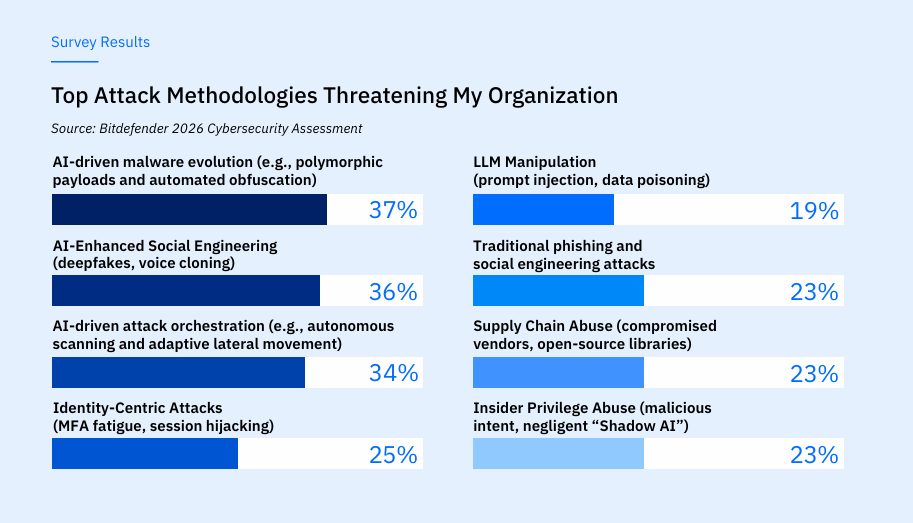
These capabilities are advancing rapidly, and although there is currently limited evidence of widespread misuse at scale, the trajectory is clear.
Frontier AI models are becoming more widely available, and their capabilities continuously improve. Today is a transitional window where organizations can strengthen their defenses before threat actors adopt these tools more broadly.
Ultimately, modern cybersecurity requires a shift from detection and response alone to a focus that also includes prevention tools and strategies to limit attacker pathways in the AI-enabled era.
tags
Author
Rizki Bayuaji is an Associate Cybersecurity Consultant at Bitdefender. He has a degree in Computer Science and also holds a diploma in Information Security and Forensics.
View all postsYou might also like
Bookmarks
