The TikTok bathroom swearing trend: Why kids swear and how parents should respond

October 07, 2026
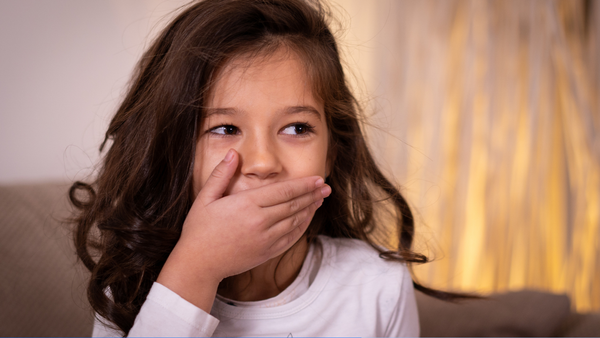
There’s another TikTok trend making the rounds called the bathroom swearing trend, where parents send their children into the bathroom, give them permission to swear freely and film their reactions.
Rather than deciding whether parents should or shouldn’t do it, we wanted to look at what these videos bring to the surface: Why are kids so fascinated by swear words in the first place, and what should you actually do when your child starts using them?
We asked clinical psychologist and CBT psychotherapist Anca Ivu to help us understand why children swear, what their choice of words can tell us, and how parents can respond.
Key takeaways:
- Children may experiment with swear words out of curiosity, imitation, frustration or simply to see how adults react.
- Strong reactions can sometimes give swear words even more power, so a calm, proportionate response is usually more helpful.
- Context matters: swearing after losing a game is different from using insults or threats to hurt another person.
- Parents can help children understand not only which words are inappropriate, but when language becomes hurtful and why.
What is the TikTok bathroom swearing trend?
A parent gives their child permission to go into the bathroom and say all the swear words or bad words they know, usually for a limited amount of time, while filming their reaction to share on TikTok.
For a child who has been told that certain words are off-limits, suddenly being allowed to say them can feel wonderfully rebellious. And for parents, the trend can come with a few surprises too—starting with discovering just how many bad words their child actually knows.
Why do children swear or use bad words?
“Swearing or experimenting with so-called ‘bad words’ isn’t, in itself, a reason for concern. For children, it can occur naturally as they explore language and learn the social rules around it,” says clinical psychologist and CBT psychotherapist Anca Ivu.
In “A Child’s Garden of Curses”, researchers Kristin Jay and Timothy Jay studied taboo language in children between 1 and 12 years old and found that, by the time they enter school, children already have the foundations of a taboo-word vocabulary similar to that of adults. The researchers also found that adults and children don’t always judge how inappropriate certain words are in the same way. In other words, the fact that a child knows, repeats or experiments with a taboo word doesn’t automatically mean there is a behavioral problem.
Children are actually learning two things at the same time: the words themselves and the social rules that come with them. They quickly discover that certain words have a particular “power” and get a reaction. They can make people laugh, cause surprise, embarrassment or anger, or get an immediate response from an adult.
For younger children, using these words may simply start with imitation or curiosity. They hear a word at school, from other children, at home or online and repeat it, sometimes without fully understanding what it means.
“As they get older, testing boundaries becomes more obvious: ‘Let’s see what happens if I say this,’ ‘Where am I allowed to say this?’ or ‘How will Mom or Dad react?’ So, alongside vocabulary, children are also learning the social rules of language: what they can say, in what context, in front of whom and with what consequences,” says Anca.
For preteens and teenagers, the social side becomes even more important. Language can be used to signal that they belong to a group, for humor or to appear more mature. That’s why it can be more useful to ask what purpose a word serves in a particular situation rather than treating its use alone as evidence of a problem.
For parents, a few questions can help: How often does it happen? In what situations? Is your child saying it for fun, copying someone else or using it when they’re very frustrated? Is it directed at someone with the intention of insulting, intimidating or humiliating them? Can your child adjust their language depending on the context?
What should you do when your child swears?
When a swear word suddenly comes out of your child’s mouth, your first reaction matters. Shouting, shaming, threatening or handing out a disproportionate punishment can make the word even more interesting, especially if your child has just discovered that saying it gets an instant reaction.
“Try not to react with the first thing that comes to mind,” Anca says. “Attention can reinforce the swearing. As a general rule, avoid an overly strong reaction and keep your response clear and proportionate.”
Before deciding how to respond, look at what is happening around the word. Is your child repeating something they heard somewhere? Trying to be funny? Testing a boundary? Are they angry or frustrated? Or are they using the word to insult or humiliate someone?
“The same swear word can serve very different purposes, so our response as parents needs to depend on the context,” Anca explains.
With younger children, sometimes a short, neutral response is enough: “That word can hurt people, and we don’t use it to talk to someone like that.” There’s no need for a long lecture. If your child doesn’t actually know what the word means, you can simply explain, in an age-appropriate way, why it isn’t appropriate.
Separate the emotion from the behavior
When swearing comes from anger or frustration, Anca recommends making an important distinction between what your child is feeling and how they express it.
Your child is allowed to be angry. The boundary is around what they do with that anger.
“You can say, ‘I understand that you’re really angry. You can tell me you’re angry, but it’s not OK to insult me,’” Anca says. “We’re not invalidating the emotion, but we’re not giving up the boundary either.”
Children gradually develop the ability to control impulses and choose responses that fit the situation. These executive-function skills continue to mature throughout childhood and adolescence. Part of learning to handle strong emotions, then, is learning that I’m angry and I can say whatever I want because I’m angry are two different things.
Remember that children learn language from us, too
Children learn behaviors by observing other people, particularly the adults who matter to them. So it can be difficult to insist that a child should never use certain words if those same words are a regular part of the adults’ vocabulary at home.
The bigger goal, Anca says, is to help children learn to adjust their language to the context. What they say around friends may be different from what they say to a teacher, at school or at home. And there is an even more important distinction between a word that slips out in frustration and one deliberately used to attack another person.
Swearing deserves a closer look when it becomes very frequent, escalates, comes with aggression or threats, is repeatedly used to humiliate others, or appears alongside broader difficulties managing anger and behavior. “In those situations, the swearing may be the visible symptom of a broader difficulty the child is dealing with,” Anca says.
When should you worry about your child swearing?
“There’s an important difference between using an inappropriate word and using language as a weapon against someone”, Anca says.
If a swear word slips out when your child hurts themselves, loses a game or gets frustrated, you can usually respond briefly and proportionately. Remind them of your family rules, explain when that language isn’t appropriate and, if needed, help them find another way to express what they’re feeling.
The situation changes when those words are directed at another person with the intention of humiliating, frightening, dominating or hurting them.
“Here, the boundary needs to be firmer and very clear: ‘You can be angry with them, but it’s not OK to humiliate or threaten them,’” Anca says.
At that point, the conversation needs to go beyond “Don’t say that word.”
The child needs to understand the impact their behavior had on the other person and how they can repair the relationship. And repairing the harm doesn’t mean simply forcing them to say “I’m sorry.” It means gradually helping them take responsibility for how their words and behavior affect other people.
This is why context matters so much when children swear. Instead of focusing only on the word, Anca recommends looking at the intention, the context, who the words are directed at and their consequences.
Children don’t learn language and social rules only from parents, teachers and friends. They’re also picking them up online, from videos, social media, games, group chats and the creators they follow.
If you want a better understanding of how your child spends their time online, consider Bitdefender Family Plans, which include parental control tools to help you guide their digital habits and keep them safer online.
Growing up online isn’t about avoiding everything inappropriate. It’s also about learning how to handle what comes their way.
Find out more about your family safety plan, here.
You may also want to read:
- Should Parents Follow Their Teenagers on TikTok?
- Would banning TikTok make kids safer? Half of parents think so, according to survey
- Emoji Meanings in Teen Culture: From Jokes to Cyberbullying - What Parents Should Know, According to a Therapist
FAQs
Is it normal for children to swear?
Yes. Children may experiment with swear words out of curiosity, imitation, frustration or to test boundaries. Knowing or occasionally using bad words doesn’t automatically mean there is a behavioral problem. What matters more is how often it happens, the context and how the language is being used.
Why does my child keep saying bad words?
Children may repeat bad words they hear from friends, family, school, social media, videos or games. They may also use them to get a reaction, express strong emotions, make friends laugh or test what is and isn’t allowed.
How should I react when my child swears?
Try to stay calm and keep your response proportionate. Rather than reacting strongly to the word itself, consider why your child used it. You can explain your family rules around language and help them understand when certain words are inappropriate or hurtful.
Should I punish my child for swearing?
Punishment isn’t always necessary when a child swears, especially if they’re experimenting with language, copying something they heard or reacting out of frustration. A calm reminder of your family rules may be enough. If the language is being used to insult, threaten or humiliate someone, set a firmer boundary and help your child understand the impact their words had on the other person.
When should I worry about my child swearing?
Pay closer attention if swearing becomes very frequent, escalates, includes threats or aggressive language, is repeatedly used to hurt or humiliate others, or appears alongside broader difficulties managing anger or behavior.
tags
Author

Cristina Popov is a Denmark-based content creator and small business owner who has been writing for Bitdefender since 2017, making cybersecurity feel more human and less overwhelming.
View all postsYou might also like
Bookmarks
