Signal blocks AI assistants from snooping on your encrypted messages

November 24, 2026
Signal, the privacy-focused encrypted messaging app, has started blocking Apple and Google's AI assistants from snooping on users' private conversations.
Some may consider it very convenient for their mobile operating system's agentic AI features to use their ability to look at their screen to do something like add an event to their calendar. They may be happy for Onscreen Awareness for Apple's Siri and Google's Gemini Intelligence to answer questions and do tasks for them.
But it's far from welcome when the screen shows an encrypted conversation that was supposed to be private.
Once a message has been captured, it could end up in a locally-stored database or uploaded to a remote server - potentially putting everyone in the chat at risk.
Signal's president, Meredith Whittaker, said in a blog post that unless proper safeguards were in place, putting AI agents into operating systems was "an existential threat to privacy at the application layer."
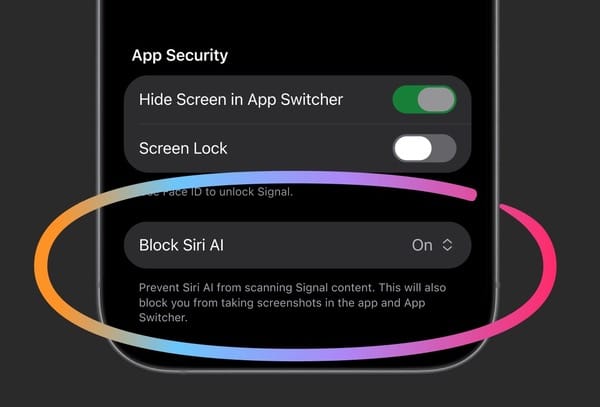
If you are running iOS 27 on your iPhone, Signal now blocks screenshots inside the app - which means Siri cannot read message content from the screen. A new setting called "Block Siri AI" allows users to toggle the feature on or off.
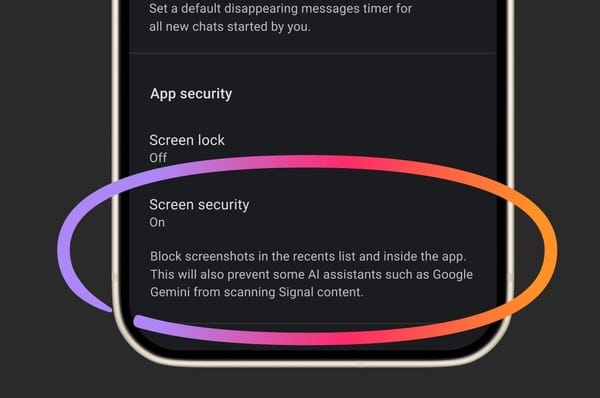
Meanwhile, on Android, Signal attempts to look where it can for an AI assistant trying to read the screen and when it spots one, automatically turns on its existing "Screen security" setting.
There are repercussions, of course, for anyone on iOS who wants to sometimes take screenshots of their own conversations, perhaps for innocent reasons. You can switch the protection off, but - as Signal warns - doing that might expose your chats to AI agents.
Furthermore, Signal admits that its efforts do not prevent every method an AI agent might use to try to read messages being sent via the app.
There is also no protection yet for Mac users, because Signal says it cannot reliably block the taking of screenshots on macOS. For that reason, the best advice if you are using the Signal desktop app on your Mac is to add it to the Excluded Apps list under System Settings > Siri.
And, of course, you need to bear in mind that there are also third-party AI agents, such as Meta's Muse, which can access sensitive data through accessibility permissions that users are encouraged to grant during setup.
Signal has called on Microsoft, Apple, and Google to to give developers an easy, well-documented way to opt their apps out of sharing data with AI agents, and to publish better technical details of how their AI features access and process data.
It is worth bearing in mind that this issue is not unique to Signal - any app that handles sensitive information faces the same problem. The difference is that Signal is publicly trying to do something about it.
As Whittaker says, "Signal is the canary in the coal mine."
tags
Author

Graham Cluley is an award-winning security blogger, researcher and public speaker. He has been working in the computer security industry since the early 1990s.
View all postsYou might also like
Bookmarks
