Which Big Tech companies do you trust? We asked netizens

February 18, 2026

Consumers may depend on Big Tech every day, but trust in the companies behind the world’s most-used platforms is far from uniform. Bitdefender’s latest survey shows a widening gap between the services people rely on and the brands they actually trust with their personal data.
Key Takeaways
- Bitdefender’s consumer survey, covering more than 7,000 internet users across seven countries, found that trust in Big Tech is sharply divided by company type and platform category.
- Google, Microsoft, and Apple ranked among the most trusted tech companies, while X, TikTok, and OpenAI drew significantly more skepticism from respondents.
- Many consumers are especially reluctant to share financial data, photos, and location information with major tech platforms, reflecting broader privacy concerns.
- The findings suggest that convenience still drives platform use, but growing concern over data handling, transparency, and regulation is reshaping how people think about trust online.
Our latest Consumer Cybersecurity Survey, polling over 7,000 internet users in seven countries, sheds light on how netizens feel about Big Tech — and what their habits reveal about trust online.
When asked who they trust, survey respondents showed a split between legacy tech giants and newer platforms.
Divided trust
Tech incumbents like Google, Microsoft and Apple score relatively high in trust. Nearly nine in 10 say they trust Google (88%) or Microsoft (85%) to some extent, and over three-quarters trust Apple (77%).
Social platforms and emerging AI-driven services like X/Twitter, TikTok, and OpenAI rank among the least trusted. As our report notes:
Skepticism runs high toward newer or more controversial platforms. More than half of respondents say they don’t trust X/Twitter (52%) or TikTok (51%) at all, and almost as many view OpenAI with suspicion (45%).
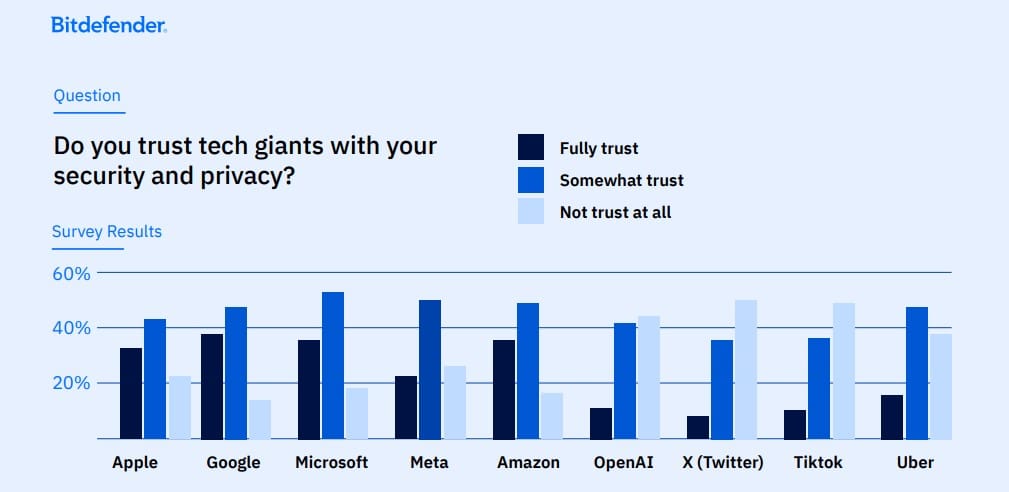
While users still rely on these companies for communication, search, or hardware, confidence erodes when it comes to data collection, or opacity about how information is used.
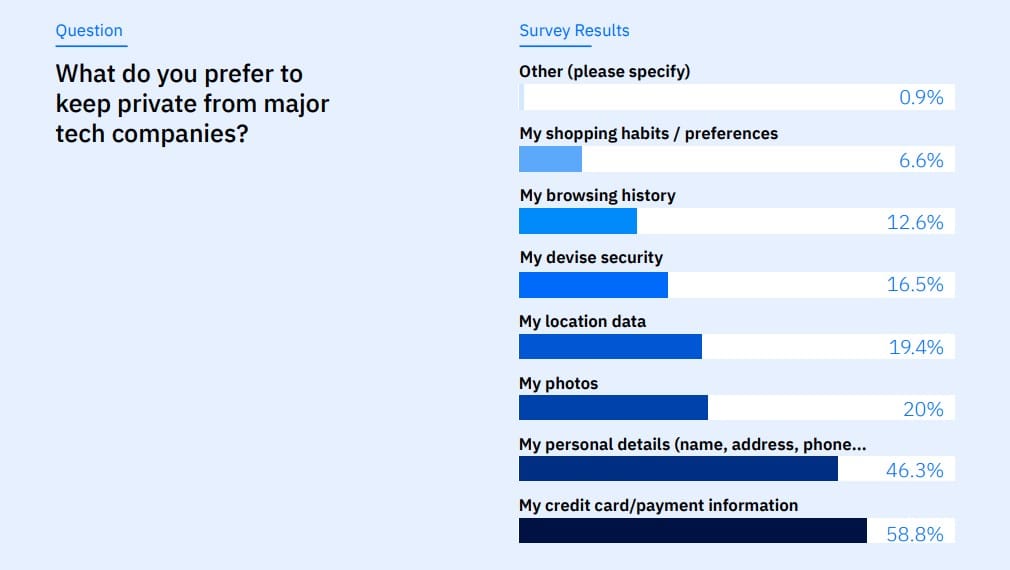
Most consumers draw the line at sharing financial information, with 59% saying they want to keep their credit card and payment data out of tech giants’ reach. Many also want to shield photos (20%) and location data (19%).
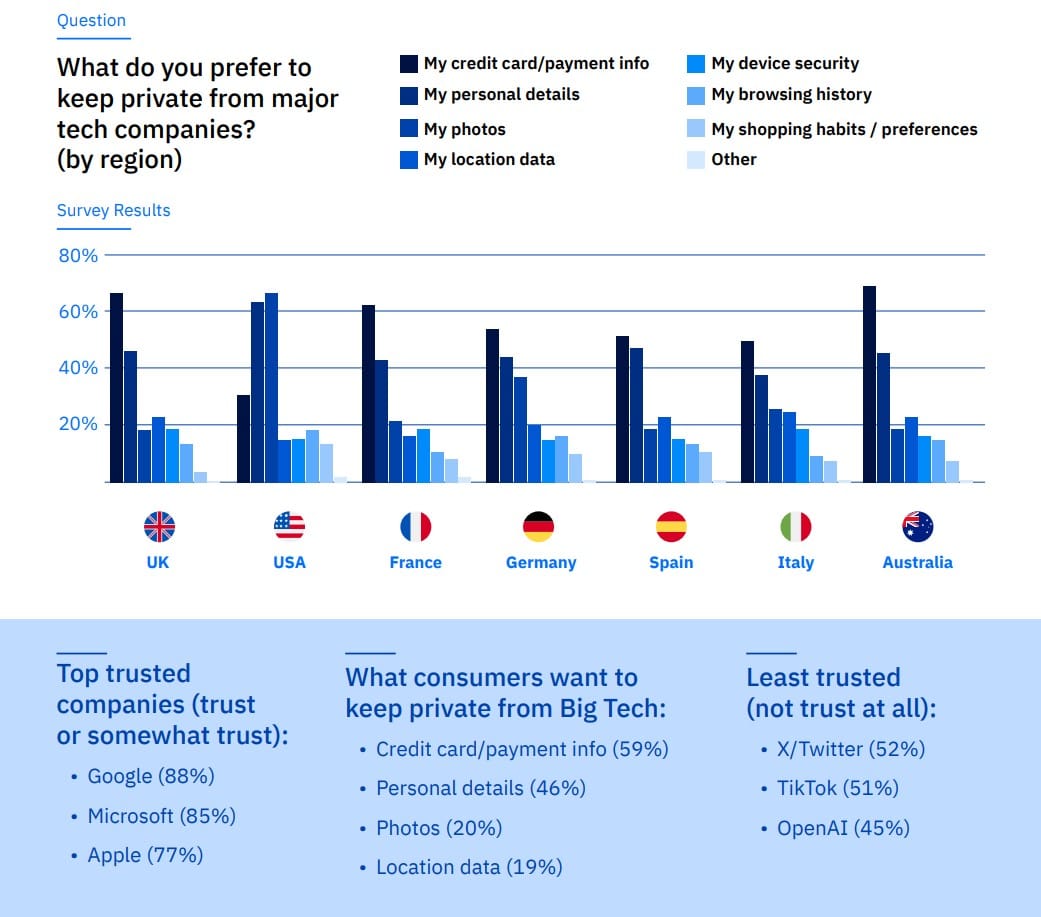
Trust in ‘Big Tech’ looks different in various parts of the world. US consumers are less concerned about sharing certain categories like location data, with only 14% wanting to keep it private, compared to more than one in five in Spain and Italy.
Europeans also tend to be stricter about safeguarding personal details, shaped by years of GDPR-driven awareness. While US consumers focus on convenience, Europeans are more attuned to privacy — though both groups continue to rely on platforms they say they don’t fully trust.
Why the skepticism? A few forces are converging.
Regulatory pressure
Across Europe in 2025, data protection authorities slapped major tech firms with roughly €1.2 billion in GDPR fines, underscoring regulatory concerns about privacy compliance and transparency.
More recently, regulators are probing platforms like X (and its AI assistant Grok) over how AI capabilities could manipulate images or amplify harmful content — tapping into deep-rooted concerns about data use and trust.
These actions are part of broader efforts to restore trust in the digital ecosystem by holding companies accountable for how they handle personal data — precisely the issues that worry many consumers.
Such investigations feed into a broader narrative: consumers want powerful tools, but they also want solid guardrails and assurances that their personal information won’t be misused.
Advice for consumers: how to act on what you don’t trust
Whether you’re cautious about Big Tech or simply want to protect yourself online, here are some practical steps you can take:
1. Manage your permissions
Review what data apps and platforms can access — especially location, contacts and camera — and revoke permissions you don’t need.
2. Know what you share
Cookies aren’t just annoyances. Taking a moment to understand cookie settings can limit how much data tracks you across sites.
3. Use strong, unique passwords
Avoid reusing passwords across accounts. Use a password manager instead. Bitdefender SecurePass can generate and store secure credentials.
4. Enable multi-factor authentication (MFA)
This extra layer of security on your accounts makes unauthorized access much harder.
5. Use independent security tools
Antivirus, anti-phishing filters and identity protection services help catch threats early — especially on mobile devices. Deploy an independent security solution on all your personal devices.
6. Stay informed about your rights
Regulations like GDPR and CCPA give you rights to access, correct, or delete your data — but you have to exercise them.
Trust in Big Tech isn’t just about confidence — it’s about control, transparency and accountability. Consumers expect services to be useful and respectful of their data. Regulators around the world are stepping in, but ultimately, informed users are the strongest defense against misuse. The digital world can be safe — as long as you know where trust ends and caution begins.
Frequently asked questions (FAQ)
What is meant by Big Tech?
Big Tech refers to the handful of massive technology companies that shape how people search, shop, communicate, work, and increasingly use AI. The term usually points to dominant firms such as Google, Apple, Meta, Amazon, and Microsoft because of their outsized influence over digital markets, platforms, and data.
What are the criticisms of Big Tech?
The biggest complaints are familiar: too much market power, too much personal data collection, too little transparency, and not enough accountability when platforms amplify harmful content or make privacy-invasive decisions. Regulators have also warned that some large platforms rely on extensive user surveillance, weak privacy controls, and inadequate protections for children and teens.
What is the biggest problem with technology?
There is no single answer, but the clearest recurring problem is that technology can scale risk as fast as it scales convenience. That risk often shows up as privacy erosion, cybersecurity exposure, manipulation, misinformation, and deeper dependence on systems most users cannot fully see or control.
You may also want to read:
Why Don’t You Use a Mobile Security App? We Asked Netizens
What Scares People Most About Hackers? We Asked Netizens
How Do You Manage Cookies While Browsing the Web? We Asked Netizens
tags
Author

Filip has 17 years of experience in technology journalism. In recent years, he has focused on cybersecurity in his role as a Security Analyst at Bitdefender.
View all postsYou might also like
Bookmarks
