Telecom Executives Plead Guilty to Tech Support Fraud

May 26, 2026

Two former business executives have pleaded guilty in connection with a tech-support fraud operation that allegedly enabled overseas scammers to target victims across the United States and beyond.
The US Department of Justice accuses the defendants of knowingly providing telecommunications services to customers engaged in fraudulent tech-support schemes for years.
Key takeaways
- Two former telecom executives pleaded guilty to accusations they knowingly supported tech-support scam operations for years.
- The scheme allegedly routed fraudulent calls from overseas call centers targeting vulnerable victims in the US.
- Investigators say the operation helped scammers steal millions through fake virus alerts and bogus tech-support services.
- Authorities say the case highlights how cybercriminal ecosystems depend on infrastructure providers — not just scammers themselves.
- International police are mowing through scam centers, making arrests and dismantling fraud networks
- Consumers are advised to exercise caution when faced with urgent pop-up “security” warnings
Executives accused of enabling tech-support scams
The DOJ identified the defendants as Adam Young, former CEO of a telecommunications services company, and Harrison Gevirtz, the company’s former CSO. Both pleaded guilty to “misprision of a felony”—or intentionally ignoring a felony—after admitting they operated a business that provided phone numbers, call routing, call tracking, and forwarding services to customers involved in tech-support fraud.
Federal prosecutors say the company’s services were used by fraud networks operating mainly out of India. Investigators allege the executives were aware of the illegal activity from at least 2017 through 2022 but failed to report it to authorities.
According to court documents, the defendants allegedly received repeated complaints from telecom providers and law enforcement agencies regarding suspicious activity linked to their customers. Prosecutors claim the executives advised some customers on how to avoid account termination and reduce fraud complaints.
How the scam worked
The fraudulent operations reportedly relied on fake pop-up warnings that claimed victims’ computers had been infected with malware or viruses. The alerts urged users to call a phone number supposedly connected to legitimate technical support.
Once victims called, scammers allegedly convinced them to pay hundreds of dollars for unnecessary or fake repair services. In some cases, fraudsters accessed victims’ computers remotely and stole personal or financial information.
Authorities say elderly and vulnerable individuals were disproportionately targeted.
The FBI estimates tech-support scams cost Americans billions annually. In a statement tied to the investigation, FBI Boston Special Agent in Charge Ted E. Docks described the conduct as “downright despicable,” noting that many victims were left “frightened, humiliated, or financially shattered.”
International fraud network dismantled
The investigation began in 2020 and led to multiple convictions involving India-based fraud operators and individuals linked to the telecom infrastructure supporting the schemes.
Investigators say they also uncovered evidence that the defendants operated a Tunisia-based call center where some employees allegedly participated in tech-support fraud activities.
The two executives are scheduled for sentencing in June 2026.
International police are mowing through scam centers
INTERPOL recently announced a “first-of-its-kind cybercrime operation” that has led to 201 arrests linked to a similar operation. The coordinated crackdown targeted online fraud, financial scams, malware distribution, and digital extortion, as global law enforcement agencies step up efforts to disrupt organized cybercrime at scale.
In April, an operation led by the US Department of Justice, the FBI, Dubai Police, and Chinese authorities resulted in at least 276 arrests linked to cryptocurrency investment fraud networks in multiple countries. Authorities dismantled at least nine scam compounds allegedly used to run large-scale online fraud campaigns mainly targeting victims in the United States.
In a separate operation across Asia-Pacific countries, INTERPOL announced the takedown of more than 20,000 malicious IP addresses and domains tied to infostealer malware campaigns. Authorities seized servers and arrested suspects linked to malware operations used to steal credentials, cryptocurrency wallet information, and financial data.
A recent report from Britain highlighted that romance scam victims in the country lost roughly £102 million in 2025 alone, with criminals increasingly using dating platforms and social media to manipulate victims emotionally before requesting money transfers or cryptocurrency payments.
At the same time, data from the U.S. Federal Trade Commission showed Americans lost an estimated $2.1 billion to social media scams in 2025, making social platforms one of the largest sources of fraud-related losses.
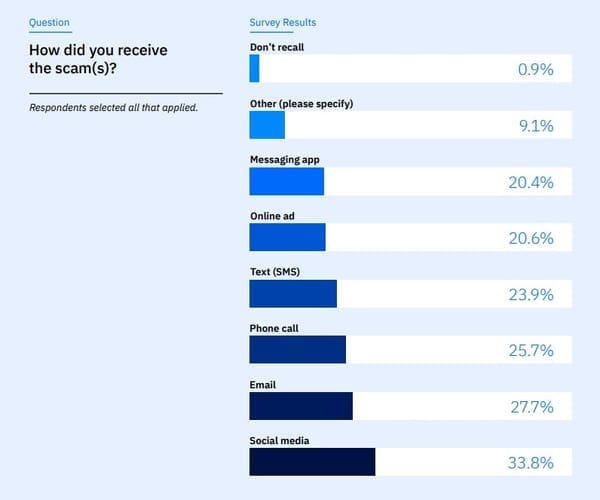
The Bitdefender 2025 Consumer Cybersecurity Survey shows social media is attackers’ preferred scam-delivery system.
How to stay safe from tech-support scams
Fake virus alerts and tech-support scams remain among the most common forms of online fraud. To reduce your risk:
- Remember that legitimate technology companies like Microsoft and Apple do not display browser pop-ups demanding immediate payment or unsolicited phone calls for technical support
- Never call phone numbers displayed in pop-up security warnings
- Be skeptical of urgent claims that your device is infected
- Avoid granting remote access to unknown callers
- Use a reputable security tool capable of blocking malicious websites and scam pages
- Keep your operating system and browser updated
- Educate older family members about common tech-support scam tactics
Use a security tool that detects scams
Security solutions with scam-detection features can help you identify phishing links, fraudulent messages, and suspicious websites.
To help you stay ahead of evolving threats, Bitdefender has introduced Scam Radar, a new feature integrated into Bitdefender Mobile Security for Android and Bitdefender Mobile Security for iOS.
When in doubt about an unsolicited phone call, text or social media interaction, use Scamio, our free scam detector and prevention service. Simply describe your situation and let Scamio guide you to safety.
You may also want to read:
Scam Centers Are Feeling the Heat – INTERPOL Makes 201 Arrests in the MENA Region
Crypto ATM Scams Keep Growing as Americans Lose Millions, FBI Warns
tags
Author

Filip has 17 years of experience in technology journalism. In recent years, he has focused on cybersecurity in his role as a Security Analyst at Bitdefender.
View all postsYou might also like
Bookmarks
